“I will honour Christmas in my heart, and try to keep it all the year.” ~ Charles Dickens
Just a short post from me today, (and my last of the year). I can hear your “phews”! I am ensconced in Christmas preparations and as things stand at the moment, Santa might well break his neck trying to make his way into my daughters’ bedroom…
Even a burglar would have a challenge making that much mess!
As is the case with Christmas crackers, you normally get a bright but flimsy hat, a corny joke and a completely useless plastic gift, (with the odd surprise), but they are quite fun to pull on when you are completely stuffed and happily inebriated!
I’d like to thank everyone who has spent their precious time reading any of my posts, and to wish you all a very Merry Christmas and a Happy New Year!
I know I say this every year, but it feels like 2014 has gone by in a flash. My kids are that bit taller, savvier, and generally more mature. Funnily enough, they haven’t yet grown out of their adoration of Father Christmas!
I, on the other hand, feel older and not much wiser, with a rather depleted bank account! Luckily, monetary measures are not the only way to evaluate a year. It has been a tough one for me, but it hasn’t been without its highlights.
I hope 2015 will bring you abundance in every area of your life!
Some say that ever ‘gainst that season comes
Wherein our Saviour’s birth is celebrated,
This bird of dawning singeth all night long;
And then, they say, no spirit dare stir abroad,
The nights are wholesome, then no planets strike,
No fairy takes, nor witch hath power to charm,
So hallow’d and so gracious is the time.
~ William Shakespeare
Hamlet 1.1.163-9, Marcellus to Horatio
It’s time to give thanks for the light in our lives. Our faith, health, family, friends and for the good fortune that has been bestowed upon us, in whatever form we have been blessed in.
“I have always thought of Christmas time, when it has come round, as a good time; a kind, forgiving, charitable time; the only time I know of, in the long calendar of the year, when men and women seem by one consent to open their shut-up hearts freely, and to think of people below them as if they really were fellow passengers to the grave, and not another race of creatures.” ~ Charles Dickens
I will bid you a festive farewell with a small selection of baroque Christmas music that for me, represents the spirit of love, peace, joy and goodwill to all men:
Ho, ho ho! I better get back to making a path for Santa…
“The piece is a monster. I have never seen anything like it; it may not be music at all.” ~ Wenzel Sukowaty (from the BBC film Eroica).
In honour of Ludwig van Beethoven’s 244th birthday on 17th December 2014, and the composer chat conducted by my esteemed musicians and friends on Twitter (hashtag #LvBchat), I thought I would focus on his most heroic of compositions – the Sinfonia Eroica. It was composed during the summer of 1803 and completed in April 1804.
The 9th of June 1804 was a very important day for our dear Ludwig, but it was also a watershed in the history of classical music, absolutely critical to the future development and evolution of music and for composers and artists in general. Beethoven set the benchmark. However, I doubt that Beethoven realised the profound significance of what he had achieved, he was just doing what he did best – following his heart and his muse.
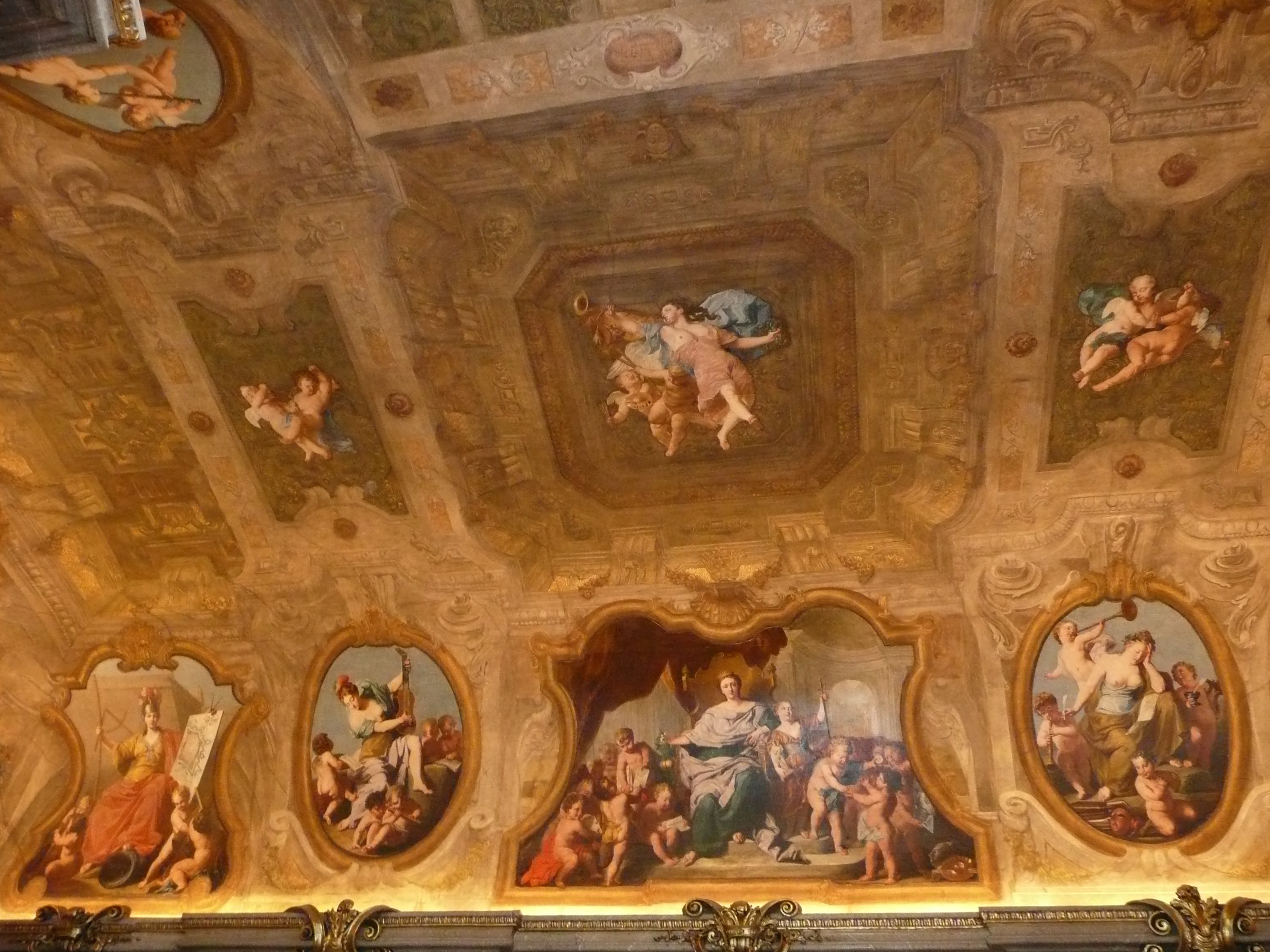
This was the day that his legendary third symphony in E-Flat Major, opus 55 was first privately performed at the Bohemian residence (Castle Eisenberg), of Prince Franz Lobkowitz, to whom the work was dedicated, and one of Beethoven’s most ardent supporters and patrons. Rehearsals prior to the public premier of the symphony (which took place on 7th April 1805 at the Theater an der Wien), were held in the concert hall of the prince’s Palais Lobkowitz in Vienna, (later named the Eroica Saal after this momentous composition), and was to unleash music of the likes the Viennese had never heard before. Now that’s brave!
Ceiling of the Eroica Saal at the Palais Lobkowitz
A temporary respite from the hostilities between Napoleon and Europe was holding. Beethoven embraced this revolutionary turmoil and the ideals of liberty, equality and fraternity, and firmly placed himself as an artist at the centre of his third symphony by writing what he felt, and what he wanted, breaking away from the accepted symphonic structures and norms at the time. It was a beacon of originality. He was a man who had entered into the most creative period of his life.
Eroica: The Day That Changed Music Forever
The BBC dramatised the event of the private premier of the third symphony in the film, Eroica, with the strapline: the day that changed music forever. It was first broadcast in 2003, written by Nick Dear and directed by Simon Cellan Jones. The film follows Ludwig, Ferdinand Ries, the Lobkowitz family, friends, and the musicians as the new music unfolds on an unsuspecting audience, and takes you on Beethoven’s personal journey into the history books.
What I love about this film is the care and accuracy with which it was made, drawing on the recollections of Ferdinand Ries (Beethoven’s pupil and secretary), and from reports about the event.
Ian Hart plays Beethoven just how I imagine him; enthusiastic about his music, bold, dynamic, forthright, (blunt even), brutally honest, brusque, impatient, with frequent outbursts of temper, but underneath that he displays a simmering passion and tenderness for his lover, the widowed Countess Josephine von Deym.
The Orchestre Revolutionnaire et Romantique directed by Sir John Eliot Gardiner perform the music on authentic, period instruments (none of the violins have chin rests, which were yet to be invented), and in the numbers and proportions that Beethoven intended it for.
I love the way it switches from Beethoven walking with Ries to the Lobkowitz residence, to the palace staff going about their business, getting ready for the event, and the musicians, especially the horn player, Otto, who is known to Beethoven.
The camera work is very sensitively done, moving around the sections of the orchestra as they tackle this new, epic work, and capturing their shocked reactions at the nature of the notes and markings presented to them by Beethoven’s copyist Wenzel Sukowaty.
It is longer, more difficult and unlike anything they have ever attempted or played before, and a few re-starts are required until Beethoven is satisfied that they have reproduced the sound he wants.
It’s unthinkable that a modern orchestra would sight read a new symphony at its premiere (private or not), let alone consume beer before doing so. They might start seeing more than one baton!!
There are so many magical touches, one being the introduction of Beethoven to Prince Lobkowitz’s cousin, Count von Dietrichstein; and when asked if he is a land owner, Beethoven proclaims that he is a brain owner! Dietrichstein shows himself to be egotistical, ignorant and rigid in his ideas about music, but strangely his views on Napoleon Bonaparte turn out to be erudite.
We see a scene where the musicians, exhausted from their exertions are having a break and some lunch, and begin to debate the war and Napoleon’s agenda.
Beethoven’s views that an artist is on the same level as the nobility, are borne out by his behaviour and of course Ries’s comment, ‘that he doesn’t accept the inequality,’ to the copyist, who replies, ‘men have been executed for less.’ It could be considered heroic that Beethoven never compromised his artistic integrity for the whims or desires of any of his wealthy and titled patrons.
There is a very endearing moment when Beethoven and Josephine are alone discussing his marriage proposal, and she refers to him as ‘Louis’. However, it does not go well. It’s my personal view that Josephine was his ‘Immortal Beloved’.
In the third movement we glimpse Beethoven’s distress and distracted expression as he deals with his rejection from Josephine, whilst directing the scherzo marked allegro vivace, which personifies his hot-blooded nature.
The elderly Haydn’s entrance just before the start of the fourth and final movement is brilliant, as is the ensuing exchange of comments about students, and what idiots they are. The inference is not lost on Beethoven, who was championed by Haydn and became his student as a young man in 1792.
I’m going to shut up now, and let you watch the film uninterrupted!
Beethoven’s idealism and his abhorrence of tyranny are at the root of the Eroica. The fervour of freedom embodied by the Eroica is just as relevant and ground-breaking today as it was 210 years ago. There is always room for heroism in our lives!
Neither before or since, has music evoked such passion as Beethoven’s. He was in-tune with his creative spirit, and had endured more than his fair share of suffering; so who better than Herr Beethoven to write music that represents the struggle and overcoming of life’s challenges?
When asked by a close friend some fourteen years later, which was was his favourite symphony, Beethoven responded without hesitation: ‘the Eroica.’
We know that with the inevitable onset of his deafness and heart-break, that his heroism would eventually far outshine what he achieved in the summer of 1804. But for me, it’s the starting point of his heroism, it’s the moment we are blessed by his courage and the music that gives us a first insight into the depth of his spirit.
“He gives us a glimpse into his soul. Everything is different from today.” ~ Joseph Haydn (from the BBC film Eroica).
“Every secret of a writer’s soul, every experience of his life, every quality of his mind is written large in his works.” ~ Virginia Woolf
When I was eleven I had a nasty accident at school. It was positively gruesome. I remember the day vividly; my class had just come back from a P.E. lesson and we were making our way into the changing rooms. I wanted to tell my best friend something (I can’t even remember what it was), and in my haste to talk to her I placed my right hand next to the hinge of the door as she was closing it. Only I didn’t quite have my finger out of the way…
The ensuing carnage must have been quite a shock for my head teacher, who was greeted by a very pale screaming girl, with the end of her finger missing and copious amounts of blood flowing everywhere. The trail of blood running from the girls changing room to the classroom must have been redolent of a murder scene. The whole of Bledlow Ridge Primary School knew that something quite grisly had just happened. He duly picked up the top of my finger and wrapped it up (I never asked what in), and I was driven straight to hospital. The car journey was awful, I was clutching my tawdry severed finger, and as the initial shock wore off the pain grew in intensity.
It wasn’t a clean separation, and I was told that they would try and sew it back on. My mum and my family came to see me before the anaesthetic to reassure me. I had never been under before, and I was terrified I would never wake up again, as the anaesthetist counted down from ten. By the time he reached five I was out cold.
When I regained consciousness my finger was throbbing in agony and I felt groggy. The wonderful get well cards made by my classmates helped to cheer me up in the aftermath of my surgery. The only consolation was that I’m left handed, so it could have been worse, and I got to have quite a bit of time off school.
My mum dug those handmade cards out of her loft recently. They still bring a smile to my face. I remember I couldn’t play netball for months, (which I was absolutely gutted about) and when the bandages eventually came off I was shocked to see that the top of my right index finger wasn’t actually recognisable as a finger. The nerve endings gave me hell in the cold. It was like needle points stabbing my flesh until it went numb.
Needless to say, I have a thing about fingers and doors, and my kids have received several lectures about the dangers of getting a digit caught!
In the midst of my trauma little was I to know that the experience would surface many years later from the depth of my psyche, to provide my muse with inspiration for the misfortune of my first heroine and protagonist of my novel, The Virtuoso.
So you could say the idea has been brewing for a good many years! Eleven was also the age when I started learning to play the violin. I can’t help thinking that the foundations of the path to publication were laid in 1981…
Stepping Out Onto the Worldwide Amazon Stage
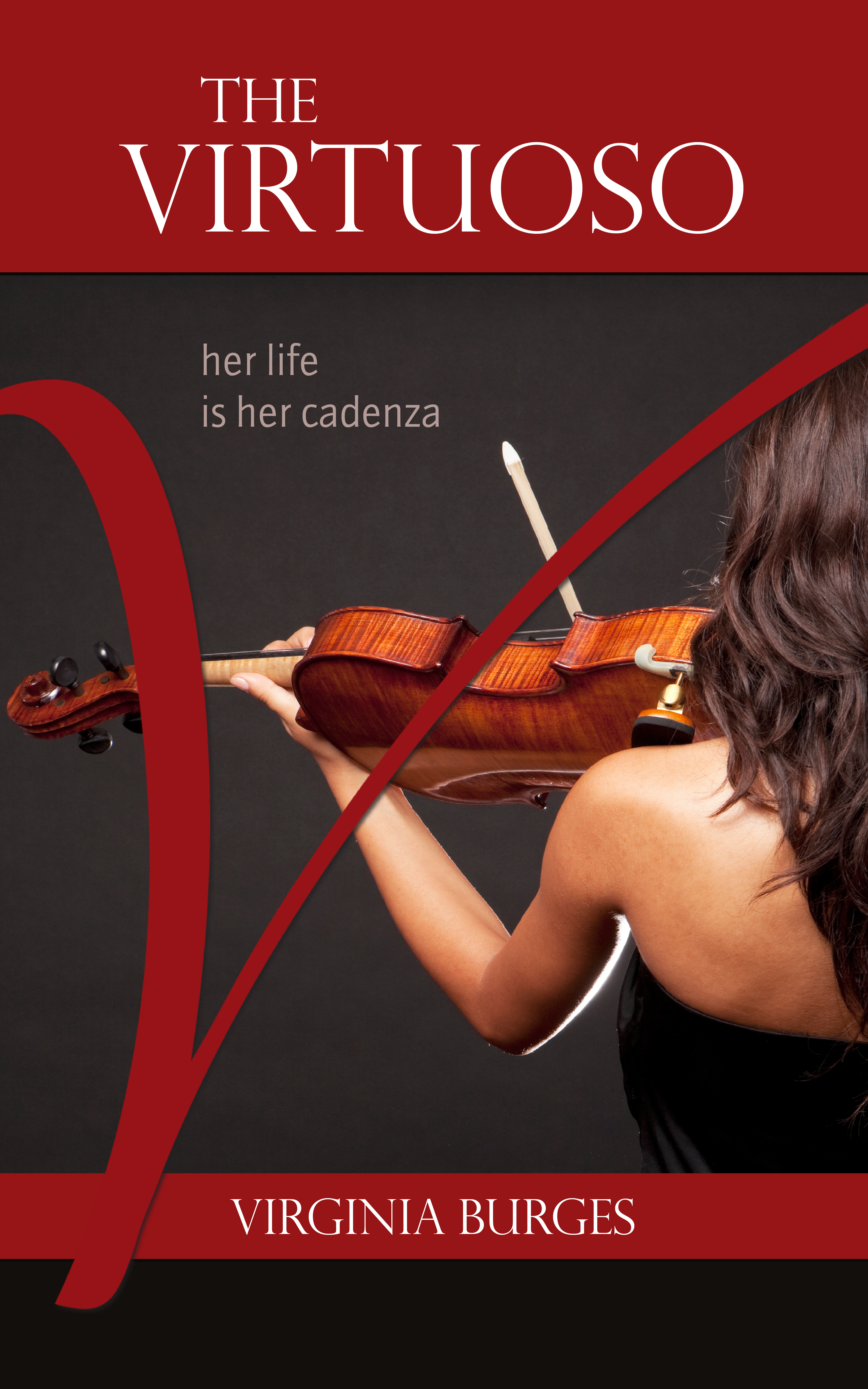
New Kindle Cover
I’m happy to announce that The Virtuoso has now been published on Amazon Kindle today, Monday 15th December 2014 at a launch price of £3.59. There will also be a paperback version available on Amazon next year. (US Link)
I’m sure I’ll feel a certain amount of satisfaction that I made it this far, for persevering over the seven years it’s taken me (on and off) to complete The Virtuoso, so that I can finally say my work in progress is now a work in print!
I’m now at the stage where I’m excited that my work can open the door to other related creative pursuits. I was fortunate to meet and hear the violin virtuoso, Adelia Myslov in the summer. She played a stunning performance of the Mendelssohn Violin Concerto. I asked her if she would be interested in playing a specially composed unique ‘theme’ for The Virtuoso, and to my delight she said yes! The music project is still ongoing and I hope it will be composed and recorded in the not too distant future. Eventually it will be available on iTunes and Amazon.
There is also a book trailer that has been produced for The Virtuoso by 13Media Arts in Daventry. Along with my voice, words and pictures, and Kevin and Darren’s digital jiggery pokery (I mean expertise), I am hoping it will prove to be a successful team effort!
During these years I’ve battled my demons of self-doubt that I could actually be a writer, and a half decent one at that. Well, I’ll leave the judging to my readers (I do hope I have some soon), after all, my daughter Emily is telling everyone she knows: ‘my mum is an author.’
The path to publication hasn’t always been like the yellow brick road! At times I had so many other ‘distractions’ beckoning for my attention; mainly life happening around me. But I found that the more time and effort I put into it, the more I got sucked into my characters’ world of make-believe, and the more I felt as if I was becoming a proper writer.
“Fiction is the truth inside the lie.” ~ Stephen King
“When you play a violin piece, you are a storyteller, and you’re telling a story.” ~ Joshua Bell
To me, the beauty, mystique and resonance of the violin is both beguiling and irrefutable. The instrument’s tone, agility and versatility is unsurpassed in classical music repertoire. Of course, I adore all stringed instruments, with the cello coming a close second.
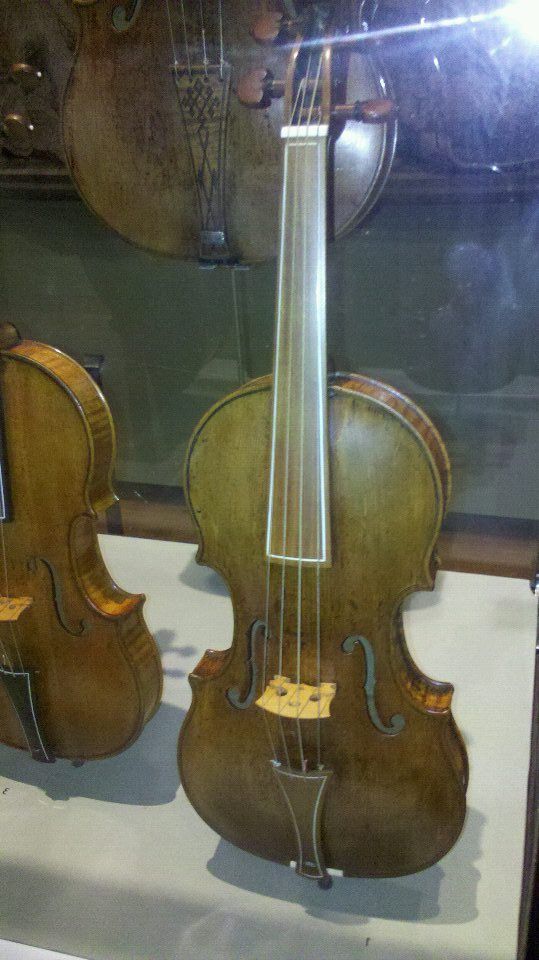
Looking at the design of the violin I love the way the wide curves of the upper and lower bouts contrast with the inverted C-bouts (the waist), to give it that sensual shape, and the elegant f-holes, along with the combination of the long and graceful fingerboard leading to the peg box and the scroll, which can be quite elaborate on older violins. Then you have the sheen and shine of their wood exteriors, usually spruce and maple. It is a thing of beauty!
Ancient liras, violettas and violas were created by the school of Brescia in the late 14th century, and in 1574 the Bertolotti Gasparo da Salò family made what is considered the finest carved and decorated Renaissance violin in the world, which was once owned by Ferdinand II, Archduke of Austria. Its current home is the Vestlandske Kustindustrimuseum in Bergen, Norway.
From Wikipedia:
Early History:
The Persian geographer Ibn Khurradadhbih (d. 911) of the 9th century, was the first to cite the bowed Byzantine lira as a typical instrument of the Byzantines and equivalent to the rabāb used in the Islamic Empires of that time. The Byzantine lira spread through Europe westward and in the 11th and 12th centuries European writers use the terms fiddle and lira interchangeably when referring to bowed instruments (Encyclopædia Britannica. 2009). In the meantime rabāb was introduced to the Western Europe possibly through the Iberian Peninsula and both bowed instruments spread widely throughout Europe giving birth to various European bowed instruments.
Over the centuries that followed, Europe continued to have two distinct types of bowed instruments: one, relatively square-shaped, held in the arms, known with the Italian term lira da braccio (meaning viol for the arm) family; the other, with sloping shoulders and held between the knees, known with the Italian term lira da gamba (or viola da gamba, meaning viol for the leg) group. During the Renaissance the gambas were important and elegant instruments; they eventually lost ground to the louder (and originally viewed as less aristocratic) lira da braccio family of the modern violin.
Between the 16th and 19th centuries, several changes occurred, including:
the fingerboard was made a little longer to be able to play even the highest notes, in the 19th century.
the fingerboard was tilted a little more, to produce even more volume as larger and larger orchestras became popular.
nearly all old instruments were modified, including lengthening of the neck by one centimeter, in response to the raising of pitch that occurred in the 19th century.
the bass bar of nearly all old instruments was made heavier to allow a greater string tension.
the classical luthiers nailed and glued the instrument necks to the upper block of the body before gluing on the soundboard, while later luthiers mortise the neck to the body after completely assembling the body.
the chinrest was invented in the early 19th century by Louis Spohr.
We can thank the French Renaissance for what we know today as the ‘modern’ violin. In Cremona, Andrea Amati created the first batch of violins in 1564 at the behest of King Charles IX, who wanted to create a new musical sound for the kingdom of France. Amati was credited with adding the fourth string to the existing three-stringed ancient violin type instrument. His instruments were beautifully adorned with art work. There is a wonderful display of Amati instruments at the Ashmolean Museum in Oxford.
Andrea passed his violin making skills down to his two sons, Antonio and Girolamo, who in turn inspired the latter’s fourth son, (Andrea’s grandson), Nicolo Amati. Among Nicolo’s aspiring students were Andrea Guarnerius and Antonio Stadivari. Alongside the slightly newer violins of Jacob Stainer of Austria, these instruments are the most sought after and valuable in the world.
Zsolt-Tihamér Visontay (the Leader of the London based Philharmonia orchestra), does a great job of explaining the basics about the violin and his role in the orchestra:
One of my heroes on the violin, Itzhak Perlman, has made some very helpful short videos to assist us amateur violinists with our technique!
For violin lovers here is a fabulous documentary titled: The Art of Violin:
Part 1:
Part 2:
After discussing the ‘ordinary’ Strad (if there is such a thing), played by the late David Oistrakh, and the amazing sound that he achieved with it; Itzhak Perlman concludes that, ‘the sound comes from the individual, not the instrument.’
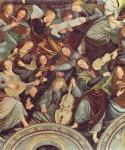
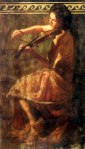
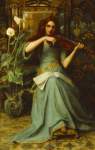
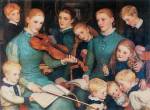
Renaissance artist and sculptor Gaudenzino Ferrari painted the earliest known depiction of the violin. And now to the visual art of violin! I have included a small gallery of some of my favourite paintings and images of the violin in still life and in a living setting:
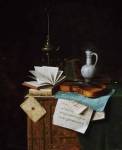
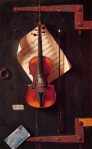
William Hartnett – Violin Still Life
Gaudenzino Ferrari – The Glory of Angels (in Santa Maria dei Miracoli in Saronno
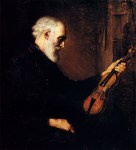
Anders Zorn – The Fiddler
Arthur Hughes – A home Quartet
The Violinist
Jacob Ochtervelt, The Music Lesson (1671)
Pieter Claesz – Vanitas with Violin
Pieter de Hooch
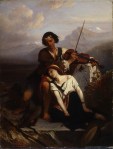
Louis Gallait – The Power of Music
Gustav Igler – The Music Lesson
Frederick Daniel Hardy
Fabritius – View of Delft
Evaristo Baschenis
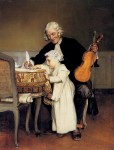
Eduard Charlemont – The Violin Lesson
Edgar Degas – The dance lesson
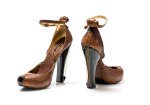
My dream shoes by Kobi Levi
William Hartnett – Violin Still Life
The best swimming pool in the world!
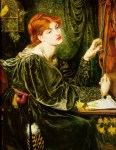
Dante Gabriel Rossetti – Veronica Veronese
Tomasz Rut – Girl Playing the Violin
Arthur Hughes – The Music Lesson
Caravaggio – The Musicians
“You are the music while the music lasts.” ~ T.S. Eliot
 I’d like to thank everyone who has spent their precious time reading any of my posts, and to wish you all a very Merry Christmas and a Happy New Year!














 rhap.so.dy in words