“Every day is a miracle. No matter how bad my circumstances, I have the freedom to choose my attitude to life, even to find joy. Evil is not new. It is up to us how we deal with both good and bad. No one can take this power away from us.”
~ Alice Herz-Sommer
After reading a moving and inspiring book about the life of Alice Herz-Sommer (A Century of Wisdom by Caroline Stoessinger), I’ve come to the conclusion that the word remarkable doesn’t exactly do her justice.
Alice Herz-Sommer was a phenomenon.

So many facets of her life were outstanding, her musical ability, her attitude and resilience, and her extraordinary longevity. Alice Herz-Sommer is known as the world’s oldest Holocaust survivor. She was born on 23rd November 1903 in Prague, which was then part of the mighty Austro-Hungarian Empire. Alice both experienced and witnessed the highs lows of the twentieth century before she passed away on 23rd February 2014 at the impressive age of 110.
What’s even more astounding is that Alice was practicing her piano for at least three hours a day when she was 107! Alice’s musical discipline proves that playing an instrument can keep the mind sharp and fertile right up to the end. There was no sign of atrophy in her grey matter, which included her amazing memory. She must have had a huge hippocampus!
Alice was probably as close to a flesh and blood angel as you can get.
Reading about her life has frequently moved me to tears, and made me reflect and re-evaluate my own attitudes. You can’t help but be drawn in by her warm, radiant smile and the twinkle in her eyes, or fail to be inspired by Alice’s pearls of wisdom when you watch her interviews.
Even though Alice’s mother and husband were murdered in Nazi concentration camps, and she and her son endured the horrors of internment at Theresienstadt (Terezin), for two years, she did not have an ounce of hatred in her.
She never succumbed to self-pity, bitterness or hating; she simply focused on what was beautiful in her life. For Alice that was mainly two things: her love for her son, Rafi, and her passion for the piano and classical music. One of Alice’s sayings was, “My world is music. Music is a dream. It takes you to paradise.”
She was young at heart because of her ‘joie de vivre’, and perhaps her deliberate immersion in beauty played a part in her longevity.
Her childhood friend, Franz Kafka, seems to have summed it up perfectly: “Youth is happy because it has the ability to see beauty. Anyone who keeps the ability to see beauty never grows old.”
Several aspects of Alice’s personality stand out for me: her unquenchable and eternal optimism, her work ethic, her curious mind and love of learning, her early exposure to culture and music which inspired her career path, her gift for teaching as well as performing, and her sweet, sanguine nature. Alice seems to have been friendly to all who came into contact with her. These formidable attributes combined were greater than the sum of their parts, the basis and core of her incredible life.
Alice’s life is an example to all for experiencing a richer, happier existence in the face of the seemingly random vicissitudes that we all face at times. It is surely a gift to humanity.
Malcolm Clarke and Nick Reed’s short documentary film about Alice, The Lady in Number Six won an Oscar in 2014. Filmed shortly before her passing, it is a poignant portrait of a beautiful spirit:
Childhood in Czechoslovakia
Alice grew up in the heart of Bohemia during its cultural zenith. Alice had a twin sister, Marianne (Mitzi), an older sister Irma and two brothers, Georg and Paul.
‘Alice’ in Czech means ‘of the noble kind’, a most fitting name for a truly wonderful lady.
Her Moravian mother, Sofie, was raised in a cultured environment. Her parents ensured that she was highly educated and she became a fine pianist who loved music. She instilled her own cultural education as best she could in her children. Sofie’s parents were friends with Gustav Mahler’s parents, so they played together as children. As an adult, Sofie moved in circles of the great artists, musicians, composers, writers, scientists and thinkers of the day; such as Gustav Mahler, Rainer Maria Rilke, Thomas Mann and Stefan Zweig.
In her wonderful book, Caroline mentions seeing an old photograph of a bearded man in Alice’s London flat, presumed to have been taken by her mother. Alice explained that it was Sigmund Freud.
Also born in Moravia, Freud had met Sofie through mutual family friends in Vienna. Alice recounted the story of a visit to a relative in Vienna with her mother in the late 1920s, who happened to live near Freud’s office on Berggasse. They would often run into him on their walks and Freud would always stop and engage with them in a brief conversation.
As a child Alice knew and spent time with Franz Kafka, whose best friend married her older sister Irma. She shared her treasured memories of him with the writer and pianist Caroline Stoessinger. Kafka would take Alice and her twin sister Mitzi on walks in the countryside outside Prague and regale them with stories. In Alice’s recollections of Kafka to Caroline she would remember him as an ‘eternal child’.
Kafka would often say to Alice, “Writing is a kind of prayer,” and although he did not know anything about music, he understood Alice’s respect for music. Alice mirrored his his sentiment in her view that listening to music, playing concerts, and practicing is a kind of prayer.
Through his friendship with Kafka, the journalist, biographer and music critic Max Brod also became a firm friend of the Herz family.
“Children must study music. It helps with everything in life. This beauty is always in my mind.” ~ Alice Herz-Sommer
Sofie had taken Alice to Vienna with her in November 1907 to attend Mahler’s farewell concert of his Second Symphony, just before her 4th birthday. No doubt this partly inspired Alice to take up the piano. They chatted with Mahler after the performance and stood among the crowd to wave his train off alongside composer Arnold Schoenberg the following morning.
The Israel Philharmonic, the Prague Philharmonic Choir under the baton of Zubin Mehta perform Mahler’s 2nd Symphony ‘Auferstehung’ (Ressurection):
The theme of this symphony appears to be in harmony with Alice’s views on death, which were greatly influenced by Spinoza’s writings that death and life are part of the same infinity of God. Alice believed that the soul lives on without the body, as do I. She listened to Mahler’s epic work again and again, finding solace in the song ‘Urlicht’ (primal light), at the begininning of the 4th movement. The opening words of the song appear to have served as her spiritual theme song: I come from God and I will return to God.
Alice’s father, Freidrich Herz ran a local engineering factory, and was known to be kind and generous in spirit, something he clearly passed on to his daughter.
At some point in her childhood, Sofie had made it clear to Alice that Freidrich hadn’t been her first choice of husband, for she had previously been in love with another man, but had ultimately acquiesced to her parent’s choice of suitor. They made it work, but perhaps there had been some lingering resentment on her mother’s side at having to give up the love of her life. Alice remembered how her mother loved to play the piano, commenting, “It was one of her diversions from melancholy.”
A grand piano took pride of place in their living room, a precious heirloom passed down from Alice’s grandmother.
The Herz’s hosted many musical soirees and concerts in their welcoming salon. Alice and Paul would play Schumann’s ‘Träumerei’ together, Alice on piano and Paul on the violin, as well as sonatas and concertos.
I imagine they slept well if they played it anything like this:
“Music was always all around me. I mean live music, people playing or singing, not recordings. That came years later.” ~ Alice Herz-Sommer (A century of Wisdom by Caroline Stoessinger).
It is heart-warming to hear Alice reminisce about those early chamber sessions with her brother and how they stayed with her over the years. We should never underestimate the power of music in the home for our children.
Life as a piano virtuoso
Alice’s sister Irma, an accomplished pianist herself, began to teach Alice the piano in 1910. In her lessons she imbued in her younger sibling her love of practicing. Their twelve year age gap worked well, as there was no jealousy or rivalry between them.
Alice was dedicated to improving and followed her sister’s instructions and guidance in the early years. As she progressed and showed talent and commitment, Irma took her to play for her former music teacher, the Czech musicologist and pianist Václav Štěpán, widely considered Prague’s finest pedagogue.
Alice performed an early Beethoven sonata at the audition, and Štěpán had been so impressed with her passion that he agreed to see her once a month (even though he did not normally teach younger children), while Irma continued her weekly lessons. A few years later Alice took lessons in earnest with Václav Štěpán, whom she revered as her mentor and friend.
During her time studying the piano at the Prague Conservatory as a young woman, Alice came under the tutelage of Franz Liszt’s former pupil, Conrad Ansorge. Whilst the brilliance of his playing wasn’t in question, it seemed Alice didn’t rate him as a teacher.
A vintage recording of Conrad Ansorge playing Mozart in 1928, only two years before his death:
She was surrounded by brilliant musicians who had been only one generation away from the immortal talents of Brahms, Liszt and Chopin.
Alexander Zemlinsky, (the founder of the German Prague Conservatory) befriended Alice. Himself once a favoured student of Brahms, he had been bequeathed the composer’s grand piano. She also learned from the pianists Wilhelm Backhaus and Moris Rosenthal, both students of Chopin’s pupil Karol Mikuli.
After Alice graduated from the conservatory Václav Štěpán arranged for her first debut as a soloist with the Czech Philharmonic, coaching her performance of Chopin’s E minor piano concerto. He also invited Max Brod to the concert, who was spellbound by her technique and tone. He duly wrote a glowing review, and Alice was launched in her promising career as a concert pianist.
“Stage fright comes mainly from caring more about what others think than about the music itself. The only possible fear that I might have had was of my own inner critic. But once I began to play, even that anxiety disappeared.” ~Alice Herz-Sommer (A Century of Wisdom by Caroline Stoessinger)
Alice took masterclasses with Eduard Steurmann and Artur Schnabel, but rather than inspiring her they impressed upon Alice the need to trust her own judgement, and in the process she learned to teach others.
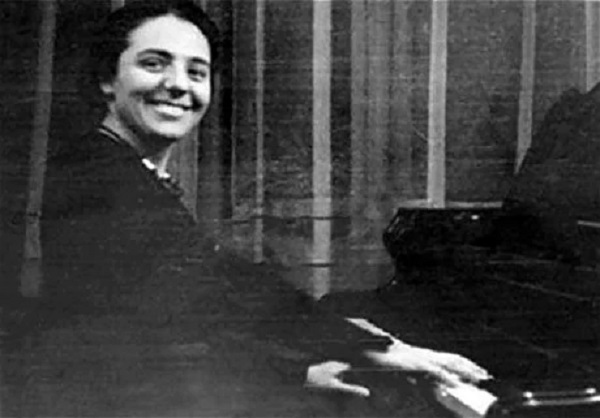
It speaks volumes about Alice’s character that she believed her life as a committed artist in search of excellence came before her performance career. To successfully experience the latter, the former is fundamental.
Alice was a frequent soloist with the Czech Philharmonic and she also undertook commercial recordings prior to the Second World War.
Here she is, playing Chopin’s Waltz in C sharp minor, Op. 64, No. 2 by memory with arthritic hands, just before her 108th birthday!
Alice’s musical inspiration
I share Alice’s admiration and reverence for the genius of Bach, Beethoven, Mozart and Schubert. When asked in a private moment in her apartment by Golda Meir, (who she developed a close friendship with in Israel after the war) about her religion, Alice responded:
“I am Jewish, but Beethoven is my religion.”
Her inspiration came from playing the works of the great baroque, classical and romantic composers, which included her compatriots Bedřich Smetana and Antonín Dvořák, who had achieved international fame and recognition.
“When I play Bach, I am in the sky.” ~ Alice Herz-Sommer
Her early duets with her brother Paul and her evening performances also inspired a deep appreciation for the works of Schumann, Chopin and Strauss.
Alice talking about how music takes us to another world:
Their family entertainment was mainly in the form of the Hauskonzerte (house concerts). It wasn’t just the Herz’s who indulged in this form of enjoyment; many families who had everyday professions were skilled amateur musicians and held house concerts.
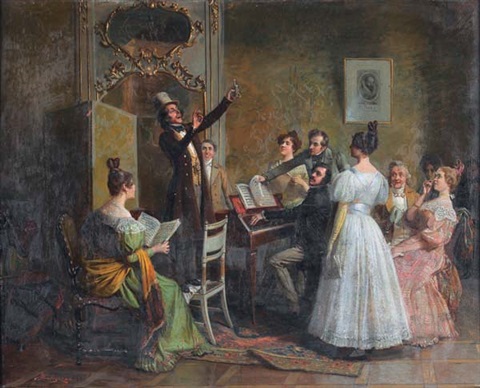
Hauskonzerte by Giacomo Mantegazza
The word amateur is derived from the Latin word amator – lover – and during the Bohemian zeitgeist, music was, for many, their grandest love affair. I don’t think I’ll say I’m only an amateur anymore, because it somehow belittles the fact that music is an amatory activity.
I can’t think of a better pastime for improving memory, keeping your brain, body and spirit healthy, as well as bringing joy…
In her beautiful book, Caroline explained that Alice often talked about Beethoven, saying, “As I grow older, I appreciate Beethoven’s depth more and more.”
Alice would extol how Beethoven created new music dictated by fearless talent, breaking the bonds of established rules when necessary; becoming the first musician to call himself an artist, and about how he searched for meaning in life, keeping a journal and notebook of musical sketches and philosophical quotations.
Alice loved that Beethoven was free from conventional prejudice, standing up to royalty and nobility when he disagreed with them. She told Caroline, “Beethoven would not have been afraid to stand up to Hitler.”
Her love of Beethoven would provide Alice with moral and spiritual courage throughout her imprisonment in Theresienstadt.
“In the camp, I sometimes felt that I was protesting against the inhumanity of the Nazis when I played Beethoven. I could feel the audience breathing, feeling with me as they clung to their memories of a better time.”
Caroline marvelled at seeing Alice throw her head back in hearty laughter when she found a new solution to a difficult passage that she had already been practicing for at least one hundred years!
Alice’s work ethic is unmatched, because apart from her being the oldest Holocaust survivor, she was also the world’s oldest concert pianist.
“I am an artist. Some days I admire myself. Not bad, I think. But the longer I work, the more I learn that I am only a beginner. No matter how well I known a work of Beethoven, for example, I can always go deeper, and then deeper still. One of the rewards of being a musician is that it is possible to practice the same piece of music and discover new meaning without boredom for at least a hundred years. I study the language of music with the same fervour that scholars re-examine the holy scriptures. The artist’s job is never done. It is the same with life. We can only strive towards rightness. As with music, I search for meaning. I practice life.”
~ Alice Herz-Sommer (A Century of Wisdom, by Caroline Stoessinger).
She was most certainly on the same page as Nietzsche in his view that, “Without music life would be a mistake.” Alice had many interests to sustain her throughout her long and rich life; she loved poetry, art, philosophy and architecture, but she agreed with Schopenhauer that music is the highest of all the arts.
This lovely chat with Tony Robbins highlights Alice’s philosophy on life:
Marriage and Motherhood
Alice met Leopold Sommer in the wake of a personal tragedy. Her close friend Daisy had died aged twenty from an infection that could have been cured if she had had access to antibiotics. Alice was devastated, it was one of the few times she stopped playing the piano.
Shortly after Daisy’s funeral Alice’s friend Trude mentioned that her good friend in Hamburg, Leopold Sommer, had written her a comforting letter. She showed Leopold’s thoughtful words to Alice who then resumed her practice regimen. Leopold was himself a fine amateur violinist, also raised in Prague, but he had decided to carve out his professional path in the business world. Alice met Leopold at a Hauskonzerte hosted by their mutual friend Trude.
Their relationship quickly blossomed, and Leopold made many trips from Hamburg (where he was working), to visit her in Prague, and was there for Alice when her father died suddenly from a heart attack. As their relationship deepened Leopold began to seek employment in Prague. They decided to get married during a romantic walk around Prague Castle one evening, with the city lights glimmering beneath them.

Alice and Leopold were married in 1931. Alice’s career as a concert pianist was burgeoning, and for a time life was good. At their wedding breakfast I love that they both performed Beethoven’s Spring Sonata together as a fitting symbol of their union.
“I grew up in friendship. I fell in love with my future husband’s mind and his knowledge. In marriage, friendship is more important than romantic love.” ~ Alice Herz-Sommer
Alice and Leopold lived in an apartment in the same neighbourhood as her mother and sister Irma, and Alice was gifted a Forster grand piano by Leopold’s parents. Alice practiced on her new piano and began giving lessons to young students.
Their son came into the world on June 21st 1937. They named him Štěpán after her beloved piano mentor, but he later changed his name to the Hebrew Raphael, and was always affectionately referred to as ‘Rafi’ by his mother.
Rafi was only six years old when the Sommer family were sent to the Nazi concentration camp at Theresienstadt. He was one of the few children to survive; most likely because of his mother’s musical skill and determination to protect him.
Sadly, in 1944 Leopold was moved to Auschwitz and later Dachau, where he perished just six weeks before the camp was liberated. His last act before being wrenched away from his wife and son was to save their lives.
Alice spoke of how Leopold told her not to volunteer for anything that the Nazi’s offered; no matter how appealing it might sound.
Soon after Leopold and many of the other men had been deported, the wives and children were given the opportunity to be with their husbands. Alice declined as per Leopold’s instructions. None of the mothers and children who took the offer and boarded the special trains ever returned.
Rafi had been taught to play the piano by his mother, but around age 11 he decided that the cello was his first musical love. He studied in earnest at the Rubin Academy in Jerusalem and was fortunate to meet and play for the legendary cellist Paul Tortelier during a Kibbutz. Tortelier became a teacher, friend and mentor to Rafi, who, like his mother, was an outstanding musician and conductor.
Rafi’s sudden death at the age of 65, after performing a concert of Beethoven chamber works with his Salomon Trio in Jerusalem was a devastating blow for Alice. At almost 98 years of age, her closest friends worried that it might be the catalyst for her own passing, but their love and support and her connection to music sustained Alice through the immense sorrow.
Alice’s stoic approach to life and her concern for Rafi’s widow and her two grandsons also kept her going. You could forgive her for indulging in self-pity at such a time, but she told Caroline, “After all, I am not the only mother who has lost her son. Maybe I draw from the strength of Clara Schumann, who one hundred years before me lost two of her children, Felix and Julia. Music kept her going until she closed her eyes for the last time.”
In part two, I will cover Alice’s harrowing time in Theresienstadt, her immediate post war recovery in Prague, her new life in Israel, her formidable contributions as a teacher and mentor to her students, and her final years in London.
I feel it’s right to end part one with a video of her beloved son Raphael Sommer, playing the first movement of Beethoven’s Cello Sonata Op. 5 No. 2 with unbelievable emotional intensity and beauty:
“A sense of humour keeps us balanced in all circumstances, even death.” ~ Alice Herz-Sommer



 rhap.so.dy in words