“Music is the one incorporeal entrance into the higher world of knowledge which comprehends mankind but which mankind cannot comprehend.” ~ Ludwig van Beethoven
Ludwig van Beethoven, a titan of classical music, and to my mind the most pioneering composer and pianist of the romantic era, turned 245 today. At least, the 17th December 1770 was the day of his baptism in Bonn, and most likely his date of birth.
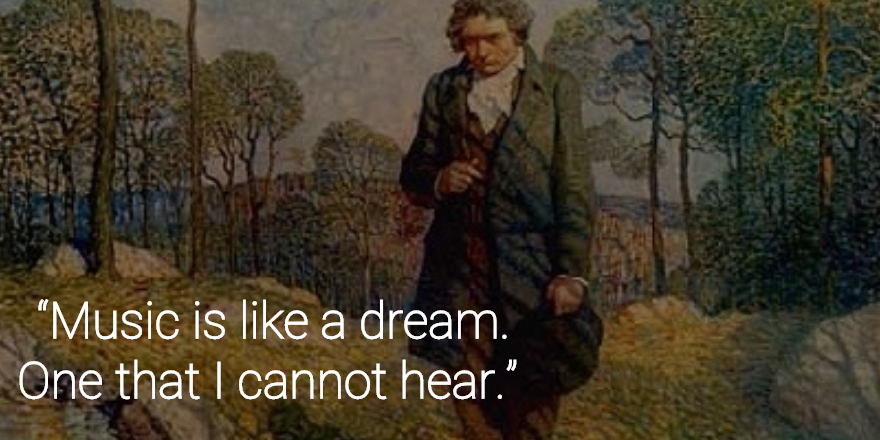
Painting of Beethoven in the Vienna Woods by N.C. Wyeth
The deaf maestro wrote so many unforgettable, transcendental and downright epic tunes and melodies that his position in the lexicon of humanity’s geniuses is eternally guaranteed.
No-one remembers the pompous aristocracy (except for his kind patrons) that thought themselves above a low born musician, because centuries after they popped their noble clogs Beethoven’s music is still making an emotional connection with millions of people around the world.
It’s still relevant. It’s still innovative. It’s still heart-wrenchingly moving and profound… That’s what was so brilliant about Beethoven.
His personal life was complex, passionate, and a catalogue of almost insurmountable challenges. They nearly broke him, but his music moved them into the realm of the divine, into victory with a capital V. His music was his life and his eventful life provided plenty of material for musical inspiration!
He suffered greatly for his art. Who else could have endured such despair and yet still have produced such earth-shattering music? Only dear Ludwig. Suffering really does transpose into the most achingly beautiful and timeless music.
“I do strongly feel that among the greatest pieces of luck for high achievement is ordeal. Certain great artists can make out without it, Titian and others, but mostly you need ordeal. My idea is this: the artist is extremely lucky who is presented with the worst possible ordeal which will not actually kill him. At that point, he’s in business: Beethoven’s deafness, Goya’s deafness, Milton’s blindness, that kind of thing.” ~ John Berryman
I didn’t intend for this to be a lengthy post, (anyone who knows me will be aware that I can get quite carried away when I’m passionate about something). Rather, it’s a short celebration to mark the life and contributions of a person I deeply revere.
These BBC docudramas are superb; they really bring his life to life!
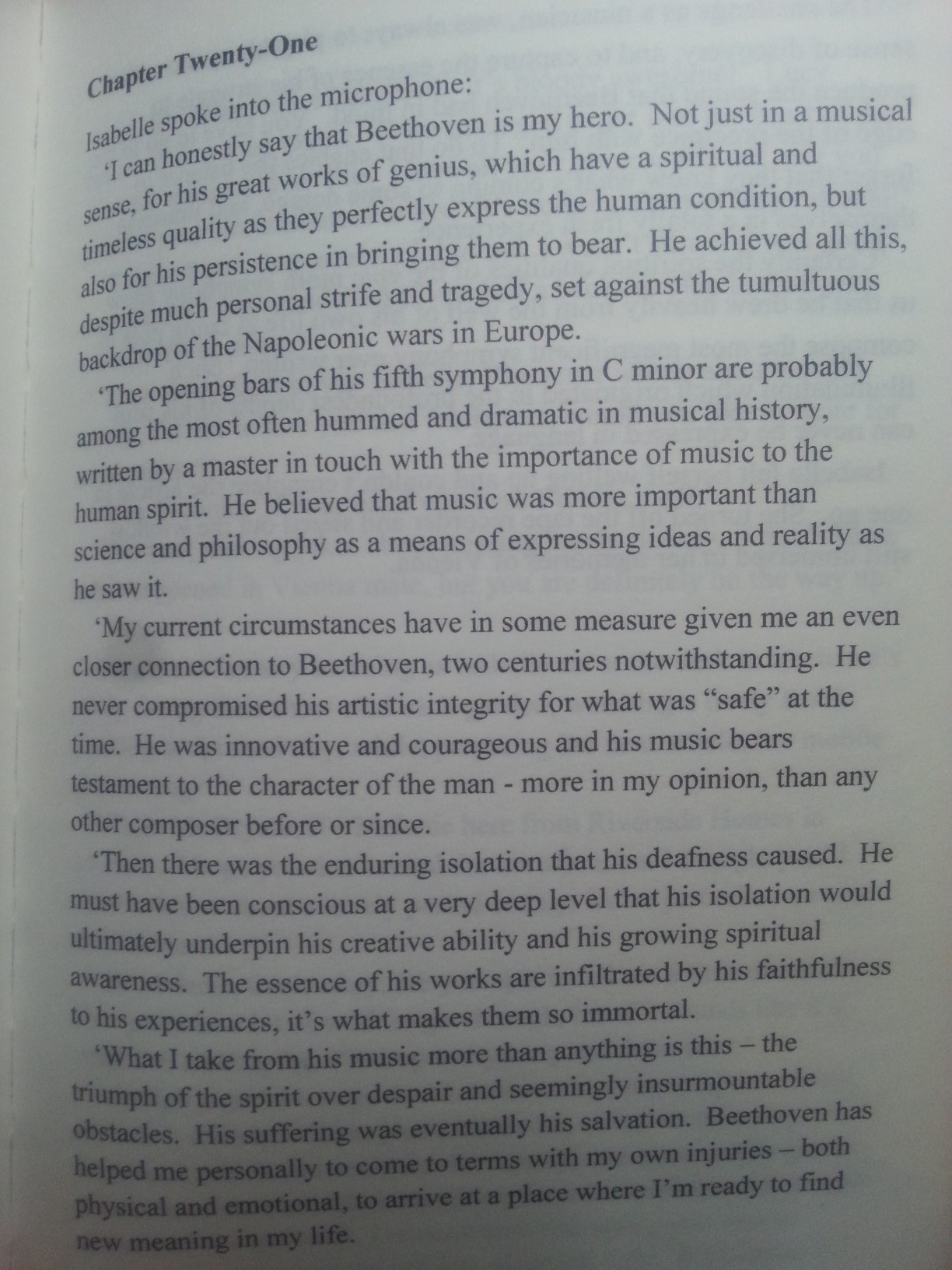
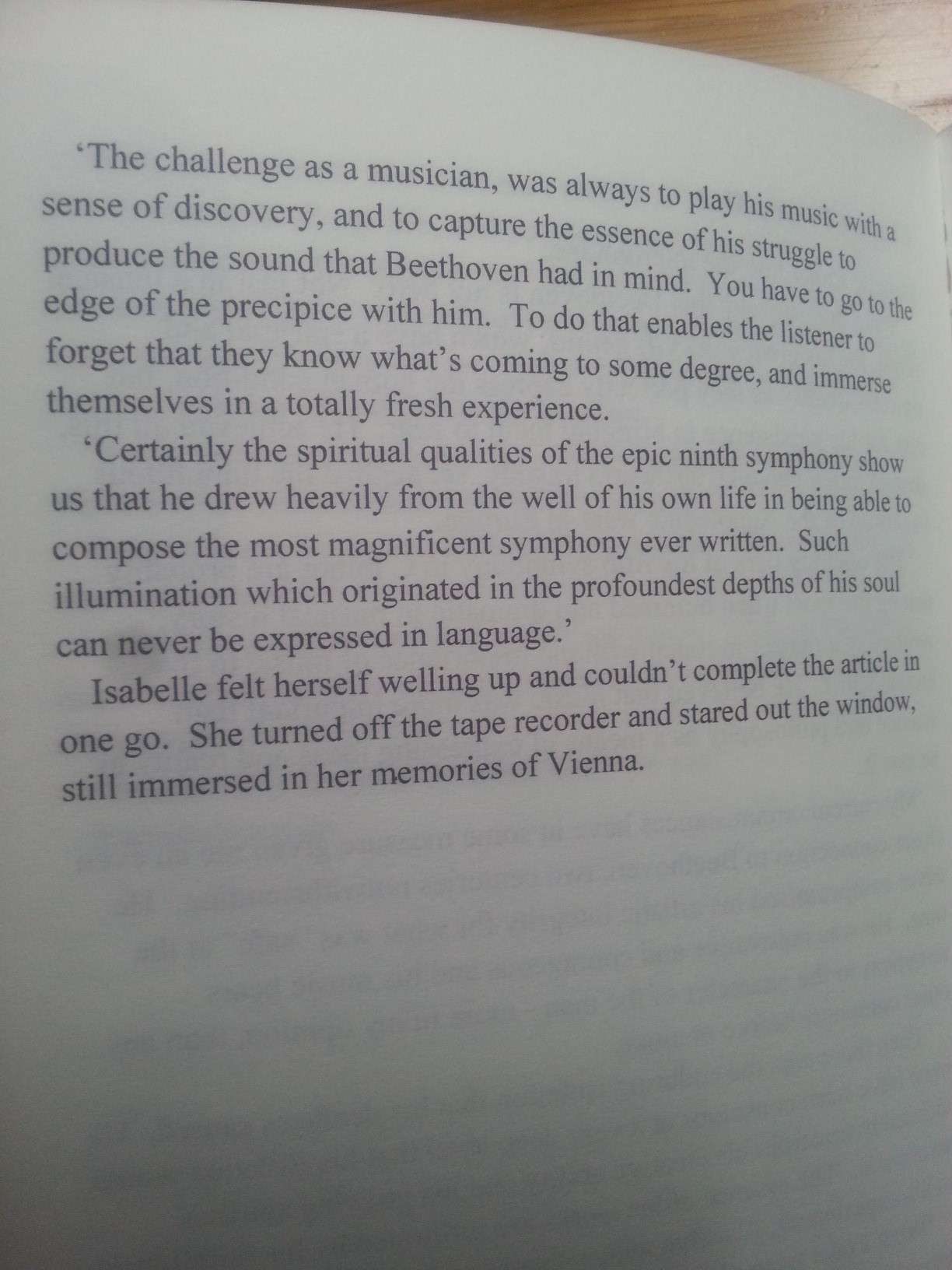
My tribute to Beethoven from chapter 21 of my novel, The Virtuoso:
The Virtuoso – copyrighted material from Chapter 21
Also mentioned in the book is his violin concerto in D Major. Here is my all-time favourite performance that I grew up listening to, of Itzhak Perlman with Carlo Maria Guilini conducting the Philharmonia Orchestra from their 1981 recording:
I also love this transcription for the clarinet performed by the amazing Michael Collins:
It’s great on the piano as well… Daniel Barenboim and the English Chamber Orchestra:
My two favourite recordings of his Romance No. 2 in F Major, Op. 50:
If you hang out on Twitter do join in the birthday celebrations, just use the hashtag #LvBChat.
In an unassuming garden shed that sat in the back garden of a council house on the edge of Bolton, art history was made.
There, over a period of several decades, all kinds of art; paintings, ceramics, bronzes, reliefs and sculptures were produced by the supremely talented (if somewhat deceitful and misguided) Shaun Greenhalgh.
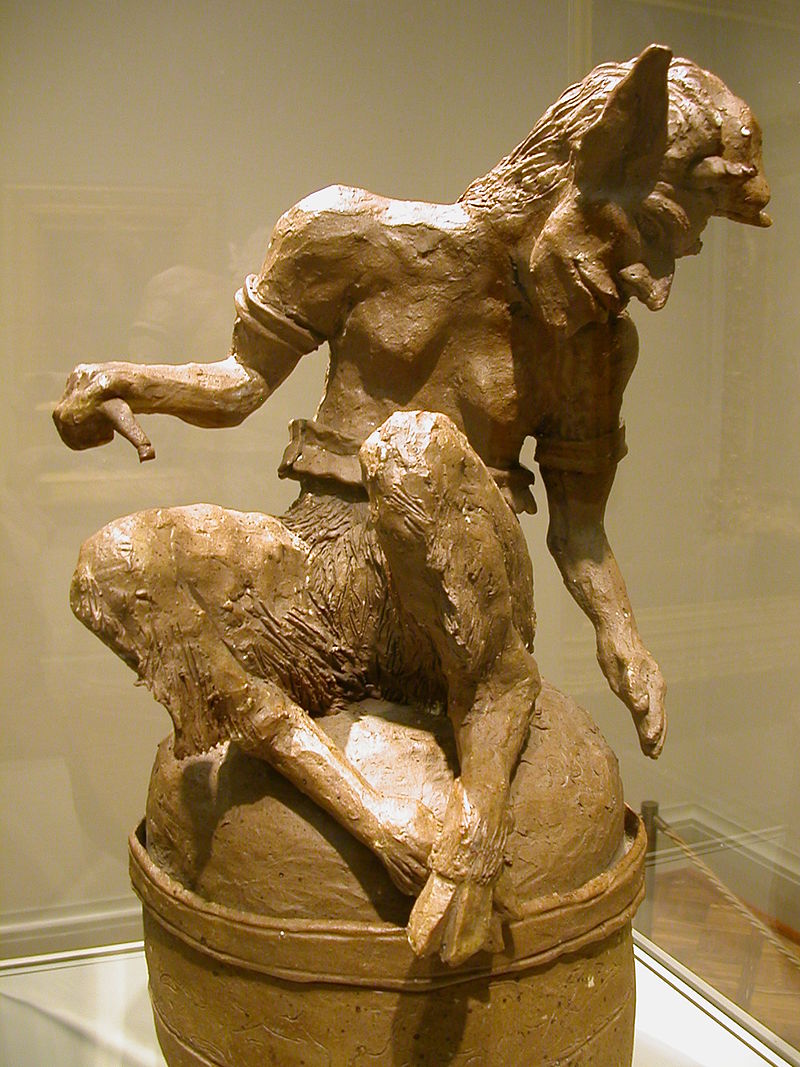
Shaun Greenhalgh’s fake carving of Gauguin’s Faun
Unsurpassed in their variety, quality and sheer inventiveness, these forgeries fooled many art critics and dealers all over the world, being sold to museums, auction houses, private buyers and collectors, all hailed as long-lost masterpieces.
His career as an ‘official forger’ began in 1989 and during the following seventeen years Shaun created and (with the help of his parents), sold a prolific amount of art worth almost a million pounds.
It’s a tale almost too fantastical to be true, but the shunned and frustrated shy young man whose art was scoffed at and who felt discriminated against because of his humble origins (let’s face it, growing up in Bolton in the sixties and seventies wasn’t exactly glamorous or exciting), decided he would prove the experts wrong.
That’s exactly what he did and he achieved it in spectacular style! The fact that his gifted hands were able to produce so many different forgeries for so long shows just how good he was. And he had the nouse to know that he had to create a ‘past’ for each piece.
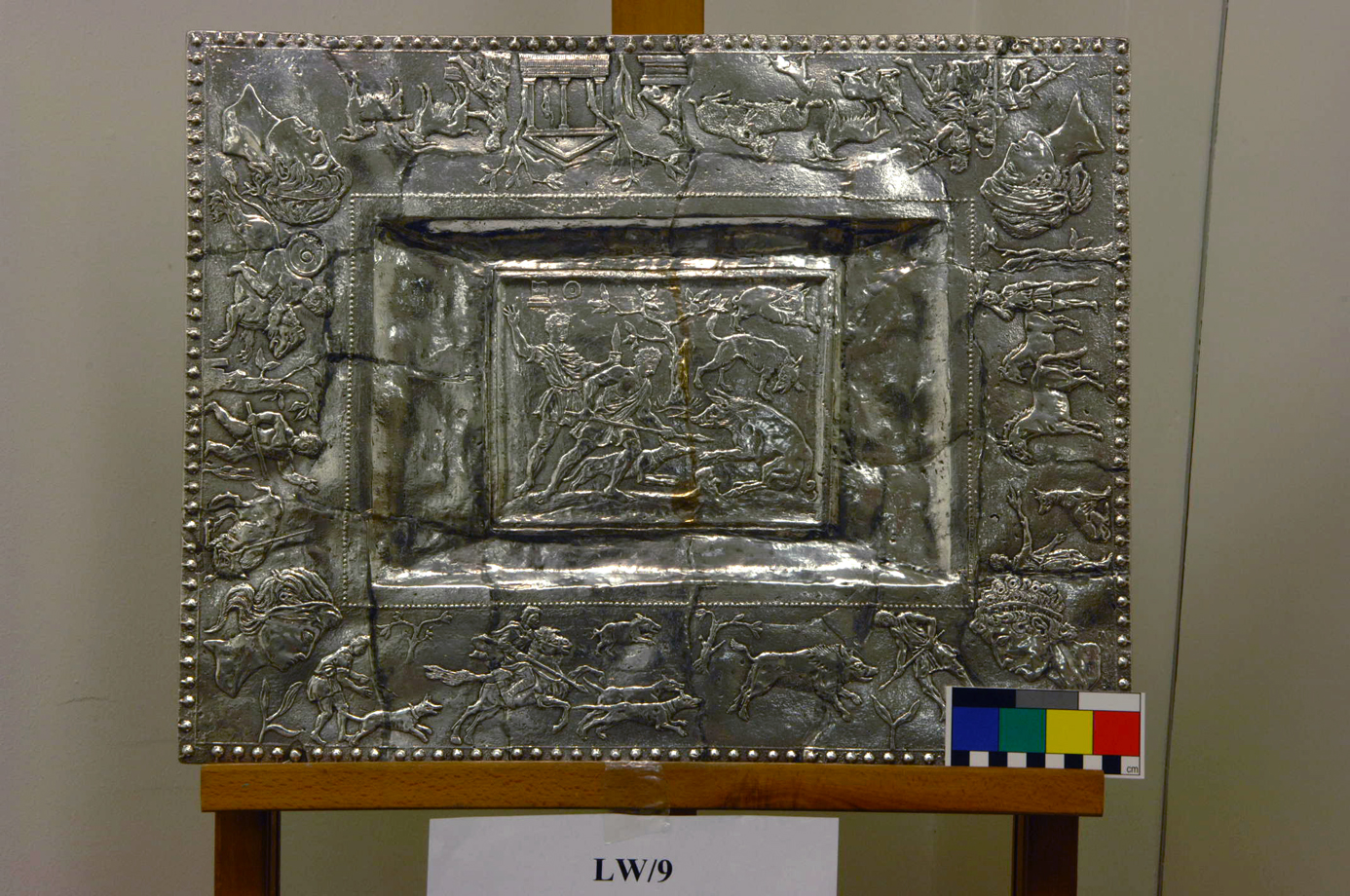
The Risley Park Lanx made by Shaun Greenhalgh from melted Roman coins
The lad from Lancashire took the art world by storm, knocking up masterpiece after masterpiece until one day in 2006, when he got an ominous knock at the door. Goodbye shed, hello Scotland Yard…
The law had finally caught up with Shaun and his elderly parents; the most unlikely ring of master forgers you could ever imagine. Truth really is stranger than fiction!
It turns out a mistake in his Assyrian Relief, which was in the process of being authenticated by Bonhams for The British Museum alerted the authorities to their brazen activities.
Where it all began
Shaun’s penchant for making things began to surface at primary school, where he exhibited early talent in pottery. After a while he gave up art at his Bolton Comprehensive and started to learn on his own terms. The Bolton Museum had also imbued the fledgling forger with a love of all things Egyptian. He taught himself hieroglyphics and stone carving. He studied woodwork and attended pottery classes. As it turned out, there wasn’t anything he couldn’t turn his hand to.
Provenance is everything
Much like musical instruments, the provenance of a piece of art can massively add to its value and desirability. It’s a shame that a certain amount of snobbery comes into play.
Shaun Greenhalgh believes that people should only buy a thing because they like it, rather than for the signature on it, or for an item’s detailed history. Forgeries thrive because of the stories behind the art’s creation. I wonder if, in a few hundred years, collectors will flock to purchase the art of probably the most prolific art forger of all time?
Gauguin’s Faun
Art critic, Gauguin fan and documentary maker Waldemar Januszczak was one of the people that Greenhalgh fooled, and can be seen here waxing lyrical about the discovery of Gaugin’s first sculpture during an exhibition celebrating the centenary of Gaugin’s death at the prestigious van Gogh Museum in Amsterdam in 2003:
To be fair, the faun was displayed underneath bright lights and sheltered behind thick perspex, so it’s unlikely he would have noticed the composite pieces had been made separately and glued together with Araldite Rapid! The naughty “PGo” signature was a touch of genius that added authenticity to Shaun’s fake faun. The half man, half goat ceramic was acquired by the Chicago Art Institue for $125,000 back in 1997.
The Amarna Princess
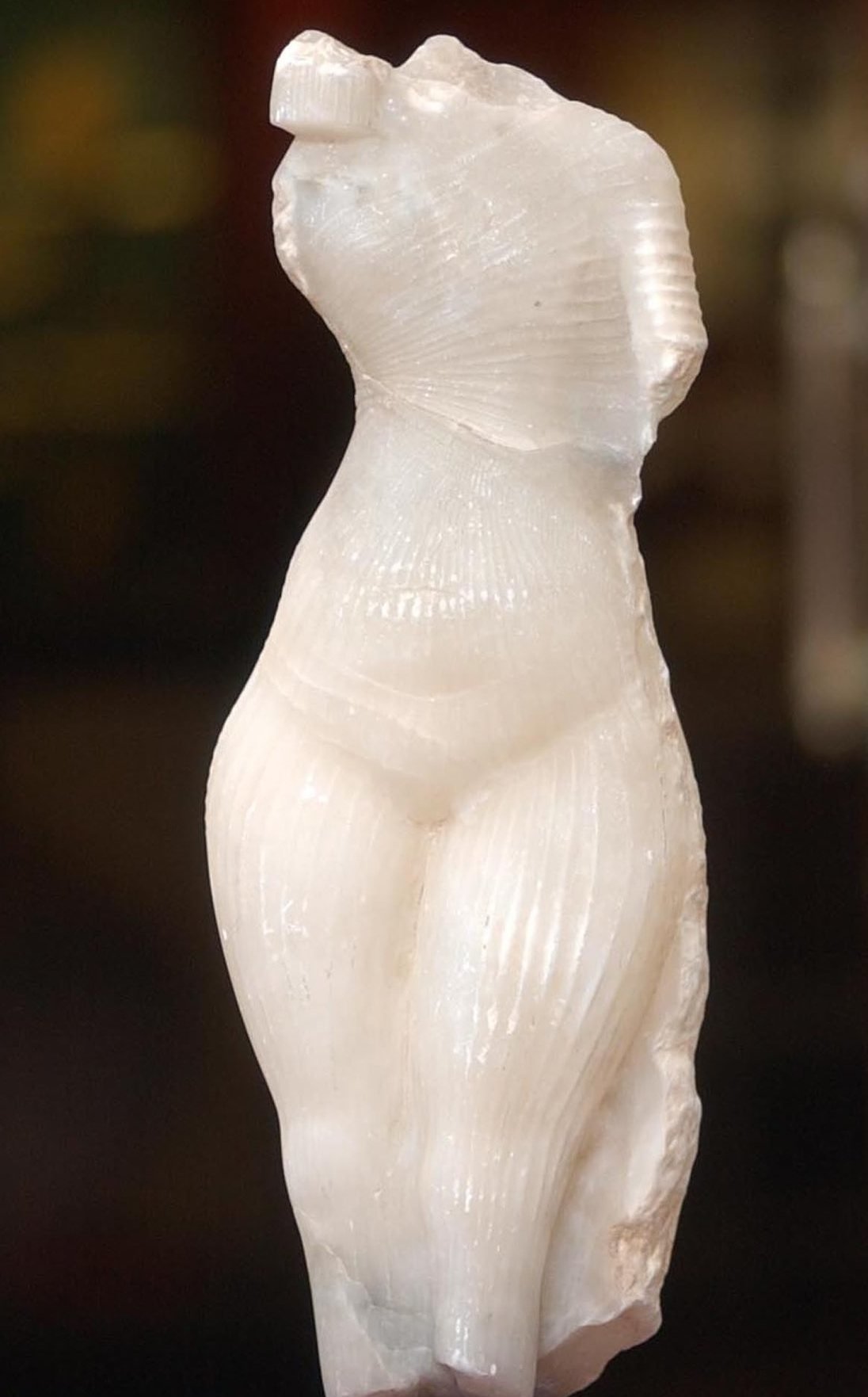
Another stunning creation by Greenhalgh was his alabaster model of an Egyptian princess, carved in his shed in just three weeks from calcite, with tools he purchased from B&Q. He aged it with tea and clay. The statuette depicts the daughter of the Pharoah Akhenanten and Queen Nefertiti, mother of Tutankhamun, said to date to the Amarna period of 1350 B.C.
The Amarna Princess
The idea for the provenance of the piece came after they had purchased an 1892 catalogue that listed valuable antiques that had been auctioned off in Silverton Park, Devon, home of the 4th Earl of Egremont. Among the items sold were eight Egyptian figures, which he drew on as inspiration for the carving.
Unbelievably, Shaun dropped the piece of stone and it cracked in two, but his trusty Araldite Rapid came to the rescue once again! The glued together work was authenticated by both the British Museum and Sotheby’s, and was deemed so important that it was even shown to the Queen. It was sold to the Bolton Museum in 2003 for £439, 676.00!!
La Bella Principessa, aka Alison from the Co-Op
Greenhalgh claims that in 1978 he did a drawing in the style of Leonardo da Vinci, using a check-out girl as his model. Shaun used the lid from a discarded desk that came from Bolton Tech. His dad had worked there and when he realised there were unwanted desks he bought one home for his son. The wood was used as the backing to the vellum of an old land deed that Shaun drew the image onto. It was never meant to be a da Vinci and wouldn’t have fooled any Renaissance specialists, it was more an experiment to see if he could emulate the left-handed genius.
Amazing artefacts
It’s thought that Shaun produced over 120 forgeries, and it’s highly likely that some are still in circulation, yet to be discovered or else kept on the QT by embarrassed owners. Over the years many experts were duped, as were private buyers. One such buyer, William Jefferson Clinton purchased a so called bust of Thomas Jefferson in an auction. Luckily for Shaun, the Tower of London is now only open to tourists, as he sold a medieval crucifix to the royal family on the pretence that it came from the tomb of King John. It actually came from the shed on the outskirts of Bolton.
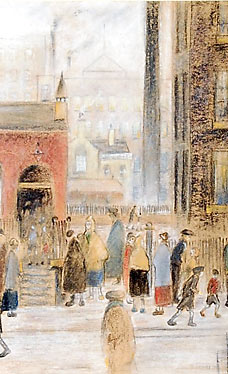
Shaun Greenhalgh’s forgery of LS Lowrys – The Meeting House
His copy of LS Lowry’s painting, The Meeting House sold for £70,000 and his Risley Park Lanx made £100,000 and was displayed in the British Museum for a time. He passed off watercolours claiming they were painted by Archibald Thorburn, as well as beautiful items of lalique glass, Chinese pots, Venetian bronzes and Visigoth eagle brooches.
I think what I found so fascinating about this story is the fact that we tend to underestimate seemingly ordinary people. We judge by appearances and circumstances. Unless you’re already an established name or celebrity it seems that it’s almost impossible to make it in the world of literature, art, music and culture.
But by anyone’s standards, the range and depth of skill of this self-taught artist is staggering, and he should have been able to produce his own art and make a living with the same prestige and recognition as say Rothko, Warhol, Banksy, Gormley or Emin – to my mind he has more talent.
But his talent wasn’t recognised in its own right because the ‘experts’ were blinded by prejudice. It was this prejudice that drove him underground, where, by taking on the personas and works of masters of the past, he could prove he was every bit as good (within a whisker) as Lowry, Gaugin, Da Vinci and ancient Egyptian, Roman and Anglo-Saxon artists.
How the Greenhalgh’s were caught:
According to Shaun’s prison memoir – A Forger’s Tale – many of his creations were sold to unscrupulous dealers who made up the provenance and stories attached to them.
Facts tell but stories sell…
It’s obvious he was no angel, and I liken his father, George, to a British TV character Arthur Daley, a benevolent wheeler dealer, but he certainly became embroiled in the underworld of the art world. Waldemar Januszczak points out that Greenhalgh’s book (written during his four and half years in prison), exposes the massive murky side of an industry that is meant to celebrate enlightened and brilliant individuals at the pinnacle of human expression.
Shaun Greenhalgh features after the Sutton Hoo hoard is shown, about 23 minutes in (demonstrating how Anglo Saxon disc brooches were made) in episode 4 of Januszczak’s documentary, The Dark Ages – An Age of Light (2012):
It’s not as if he lived a flamboyant and expensive lifestyle with his considerable earnings from his forgeries; Shaun never left home. It seems he was content to live in meagre circumstances doing what he did best – making things.
“Beyond doubt, Tartini strove for the truest possible expression in violin playing, he wished to give his epoch the best possible example of style, in the broadest sense of the word.” ~ Leopold Auer.
In this second installment on Tartini I’ll be covering his formative years, Slavonic and folk music influences, career highlights, as well as his musical ethos, developments on bowing, Treatise on Ornaments and his teaching legacy. Plenty to write home about and to listen to!
Tartini’s philosophy
Tartini’s principles in performing and teaching, like his principles in composing, were based on an experience of the humanism of art, its need for context and on his desire to be as close as possible to nature without artificiality.
According to Tartini good musical taste should be displayed in both composing music and performing it, as a product of human nature and should therefore be guided by one’s “sommo giudicio” (highest judgement).
I feel that the undisputed heavy weight champion of classical music, Ludwig van Beethoven, who was also faithful to his life experiences in terms of musical expression shared this musical ideology with Tartini.
Tartini attached great importance to the ‘singing quality’ of the violin. In his ‘Regole per ben suonare il Violino’ (Rules for Playing the Violin Well), he differentiates two ways of playing: cantabile (singing style) and sonabile (resonant). According to Tartini the singing manner of playing cantabile required slurring (same bow for multiple notes) and coherence, as distinct from sonabile.
Tartini’s motto: “Strength without convulsiveness; flexibility without laxity.”
‘Theory of Affects’
In his aesthetic views Tartini belonged to a group of 18th century composers who were the trend setters of his day, namely, Francois Couperin, Johann Mattheson, Francesco Geminiani, CPE Bach, Leopold Mozart and Luigi Boccherini. Their collective views were incorporated into a doctrine known as the ‘theory of affects’, which can be traced back to ancient times.
Their ideology can be summed up by Geminiani, who believed that music was good if it expressed “movements of the soul” and bad if it “expressed nothing”.
My score of the G minor violin sonata ‘Didone Abbandonata’
Tartini certainly was a master of music with a descriptive force that could arouse emotional states in the listener. Truthfulness of expression was everything. According to his contemporaries, Tartini often drew inspiration from the poems of Petrarch and the romantic writings of Metastasio.
The Cipher
Tartini modestly put his verses into cipher, so that his feelings were expressed in the music alone. He wrote his mottoes in a cipher that he invented which remained a mystery to investigators for two hundred years, adding to the mystical aura that surrounded his life and work. Just over thirty years ago the Greek violinist and musicologist Minos Dounias (who cataloged his violin concertos according to tonality), cleverly decoded Tartini’s cipher.
Folk music and Slavonic influences
Tartini had a keen interest in Italian and Slavonic folk songs and dances, hence much of his music reflected their simple, lively tunes and enchanting rhythms.
There is a story that tells of how the impressionable composer once heard some Venetian Gondoliers singing a song with words by the 16th century Italian poet, Torquato Tasso. Tartini put down the song and allegedly used it in a movement of a solo violin sonata and wrote the Tasso text under the notes.
Violinist and scholar Peter Sheppard Skærved performing the so called ‘Aria del Tasso’:
Tartini dedicated considerable attention to folk songs in his Treatise on Music, written in 1750:
“Each nation has its own songs, many of which arose from old tradition, though many are created afresh in harmony with the prevailing spirit. As a rule they are extremely simple; one might even remark that the simpler and more natural they are, the better they are assimilated.”
In his youth Tartini listened to and absorbed the songs of Croats and Slovenes. The final movement of his violin concerto D. 115 is a fine example of his affection for Slavonic folk tunes.
Violin Concerto in A Minor, D.115 ‘A Lunardo Venier’ Presto with Nicola Beneditti and the Scottish Chamber Orchestra in a sweet rendition:
Formative Years
Born the fourth of six children to Florentine merchant, Giovanni Antonio Tartini and a girl from a family in Pirano dating back to the 15th century, Caterina Zangrando; little Giuseppe grew up with his siblings in Pirano, a small, pretty town on the Adriatic coast now part of Slovenia.
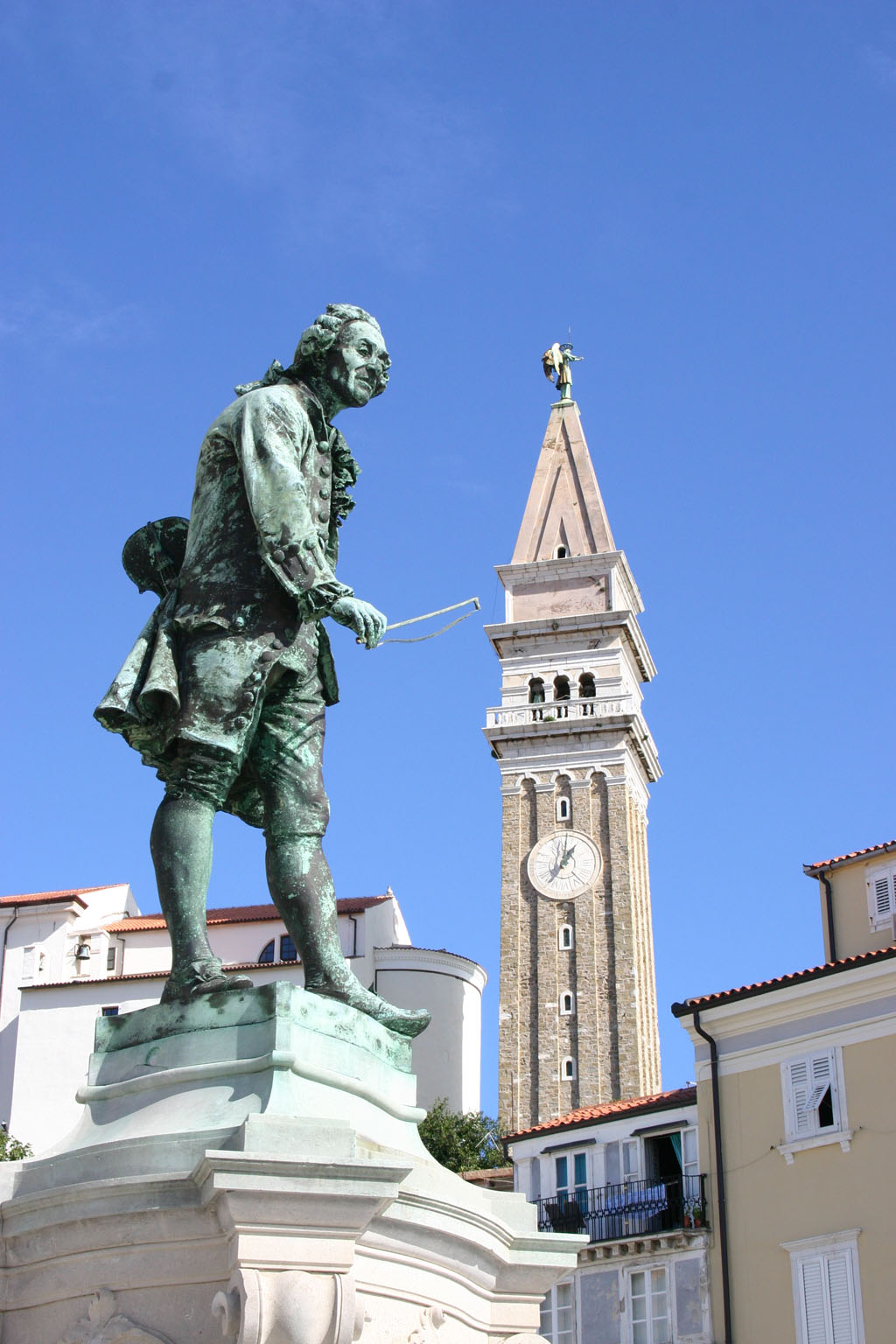
Statue of Tartini in the square of his home town Pirano
He was influenced by both Italian and Slavonic culture of the baroque period. One of his early musical influences may well have been attending the famous ‘Dei Virtuosi’ Academy in Pirano with his father. Giovanni actually intended for Giuseppe to become a priest and prepared him for an ecclesiastical career. However, after his initial education Tartini rebelled against his father and moved to Padua in 1708 (which at that time was part of the Republic of Venice) and a year later he enrolled to study law in Padua’s ancient university, (said to have been founded in 1222).
It seems that Tartini quickly began to out-perform his first music teacher, Julio di Terni, and developed mastery of the violin largely through his own efforts and the study of other prominent violinists of his time. He studied Corelli and listened attentively to the likes of Veracini, and divided his time between law and music studies as well as a penchant for fencing.
Love and marriage
According to some sources Tartini developed a passion for the cardinal’s niece, Elisabetta Premazone, and married her secretly in 1710. This did not go down well with her influential family and Tartini fled to Assisi, having also incurred the wrath of his own family, who cut off all financial support. He spent two years studying assiduously in a monastery and worked on perfecting his musical skills, and where he created his early compositions (and most likely his famous Devil’s Trill Sonata).
There are also claims that whilst in seclusion in Assisi Tartini took musical instruction from Bohuslav Cernohorsky (1684 – 1743 nicknamed Padre Boemo), a noted Czech composer, theorist and head of the 18th century Czech school of composition, who had also tutored Christoph Willibald Gluck.
Prague and Padua
Tartini returned to Padua in 1721 as a mature artist and versatile musician. He spent most of his life there, but also performed and taught in Venice, as well as undertaking visits to Milan, Bologna, Livorno, Palermo and Naples. By this time he was well known throughout Europe and was invited to perform in Prague by an influential member of the Hapsburg dynasty and a big supporter of the arts, Count Kinsky.
The Kinsky family’s coat of arms in Prague
After the coronation of Emperor Charles VI they worked as chamber musicians in Count Kinsky’s chapel until 1726. Tartini also played in Prague’s musical academies.
The success of his countrymen Scarlatti and Geminiani in foreign courts may have hastened his decision to go to Prague, but because of his early exposure to Slavonic folk tunes the trip most likely excited him and represented an opportunity to further study Slavic music.
He travelled with his friend and first cellist at Padua, Antonio Vandini. The role of cello accompaniment was quite important in the absence of a harpsichord or keyboard instrument. Tartini and Vandini were close friends for over fifty years, and Tartini wrote several cello concertos for him.
Here’s my favourite of them, in D major, performed by Russian virtuoso Mstislav Rostropovich:
After he returned to Padua in 1726 he rarely left, and besides his performances in Venice his last major concert tour was a trip to Rome in 1740 after an invitation from the cardinal to play in the presence of Pope Clement XII.
Performer and teacher
Tartini founded the Paduan Violin School a year or so after his return from Prague, which he directed for more than forty years. Violinists from all over the world came to learn from Tartini and perfect their craft, and he earned the nickname “maestro delle nazione” (teacher of nations). Antonio Capri, who was his biographer states that over seventy of his pupils became violinists of note in the history of violin playing.
“One cannot speak of music at Padua without mentioning the famous Giuseppe tartini, who has long been the first violin of Europe. His modesty, moral standards and considerateness evoke as much respect as his talent; in Italy he is referred to as ‘il Maestro delle Nazioni’ both in regard to the violin and to his compositions… No one has impressed me more with his inspiration and the fire of his compositions than Tartini. ~ Jérôme Lalande
Tartini’s methods were also passed on by his students, namely Pietro Nardini, of whom Leopold Mozart said, “I have heard the famous Nardini… It is impossible to hear anything of greater beauty, purity, evenness of tone and melodiousness. And with all of this he has nothing heavy in his playing.” Other students worthy of mention were Maddalena Lombardini, Domenico Ferrari, Pierre Lahoussaye, Filippo Manfredi and Domenico Dall’Oglio.
From reading about his legacy I have assumed that he was equally as good at teaching as he was at performing and composing! His respected writings qualified him as the eminent music scholar of 18th century Italian violin music; so you could say he had many strings to his bow!
Development of bowing techniques
“The bow should be held firmly between the thumb and forefinger and lightly by the other three fingers, in order to produce a strong, sustained tone. To increase the tone, press harder on the bow with the fingers and also press down the strings more firmly with the fingers of the other hand.” ~ Giuseppe Tartini
The authors of Methods of the Paris Conservatoire (Paris 1802), Baillot, Rode and Kreutzer wrote that under Tartini’s bow the violin becomes a “harmonious, sweet instrument, full of grace.”
He attached great importance to the “correct distribution of the bow.” A story from a contemporary relates that sometimes Tartini used two bows while teaching: one of them had its stick divided into four parts, and the other into three.
Tartini also fluted the wood of the bow. It’s also easy to forget that during Tartini’s musical era the bow was held not at the heel as it is today, but gripped at a certain distance from it. Tartini discovered that in order to enrich the tone it was necessary to lengthen the bow which increased its flexibility and enabled a broader range of expression in bowing technique. He developed a broader palette of bow strokes than Corelli (who used mostly detache and legato), by also using both staccato and bouncing strokes.
It’s quite a skill to amplify the sound without compromising the quality of the note, so bowing technique is crucial in applying the dynamics of a piece. Crescendo’s aren’t my Forte!!!
Minos Dounias observed that Tartini’s slurring of strokes coincides with that of musical phrases.
L’Arte del Arco (The Art of Bowing)
To assist his teaching methods Tartini wrote The Art of Bowing which consists of fifty variations on a Gavotte from Corelli’s Violin Sonata in F Major, (Opus 6, No. 10). Despite its title the variations also challenge left hand activity and require perfect coordination of movement from both hands!
It highlights his exhaustive knowledge of the many modes of expression of the violin and serves as a kind of compendium of violin technique in the 18th century. The work isn’t just a manual in technical ability but combines a certain artistry that frees it from the usual monotony of studies and exercises.
The Art of Bowing was adopted by many prominent 18th and 19th century violinists (such as Joseph Szigeti and Fritz Kreisler) who made arrangements for their own performance.
A gorgeous performance by Oscar Shumsky of Kreisler’s shortened arrangement of Tartini’s Variations on a Theme by Corelli:
Treatise on Ornaments
Tartini was against ornamentation/embellishment as a purely decorative device unconnected with the inner nature of the music itself. The choice of ornaments and the way they were played had to be underpinned by an understanding of the music and performed to reflect the feeling, idea or, as was the basis for his philosophy, the affect that it expressed.
Tartini’s writings pertaining to technical and aesthetic performance started out as instruction manuals for his pupils that he refined over the years. His Treatise on Ornaments was thought to have been written between 1735 and 1750 when he was highly active both as a performer and teacher.
It contains his ideas on different kinds of grace notes, trills, tremolos and mordents and various ways of using them. Regarding mastering the trill at different speeds he wrote:
“The same shake will not serve with equal propriety for a slow movement as for a quick one.”
He suggests starting the trill slowly and gradually making it faster.
Tartini’s art was progressive, meaningful, and full of humanity. It’s no surprise then that through generations of violinists many of his principles in methods of teaching are used to this day, and his best compositions still thrive in modern repertoire.
I’ll leave you to listen to a small selection from his massive output of violin concertos, sonatas, trios etc. Happy listening!
Violin Sonata in G minor Op. 1 No. 10 ‘Didone Abbandonata’ David Oistrakh and Frida Bauer:
My favourite violin concerto in D minor ‘Ombra diletta…’ D. 44 Performed by Wolfgang Schneiderhan and the Festival Strings Lucerne conducted by Rudolf Baumgartner:
Violin Concerto D. 22 Concerto Bucolico for violin, strings & b.c. by L’Arte dell’Arco:
Violin Concerto in A Major, D. 96, Accademia Bizantina, on period instruments:
Violin Concerto in G Major, D. 82 Pierre Amoyal, Claudio Scimone & I Solisti Veneti:
Trio Sonata in F Major for 2 Violins and Harpsichord, David and Igor Oistrakh with Hans Pischner:
Sonata ‘Staggion bella’ for Violin & basso continuo in B flat major, Op.Posth (Brainnard Bb.3):
Violin Sonata No. 12 Op. 2 in G Major, vintage recording of Joseph Szigeti:
Trio Sonata in D major, B. D2 (Op.3 No.6) La Magnifica Comunità :
Violin Concerto in E minor, D. 55 by the Drottningholm Baroque Ensemble & Nils-Erik Sparf:
Violin Concerto in G minor, D. 85 by the Drottningholm Baroque Ensemble & Nils-Erik Sparf:
“Giuseppe Tartini is one of the leading figures of the Italian School of violin playing in the 18th century, a school whose art is as meaningful today as it has ever been. Tartini’s music is expressive, sincere, warm and melodious, and it is in these qualities that lies its appeal.” ~ David Oistrakh
The more I learnt about Tartini, the more I became engrossed in his life and musical achievements. As with Vivaldi, there’s just too much to share to do him justice in one post. There’s a lot more to this iconic Italian master than his exceptional ‘Devil’s Trill’ sonata; however that incredible work is the main focus for part 1.
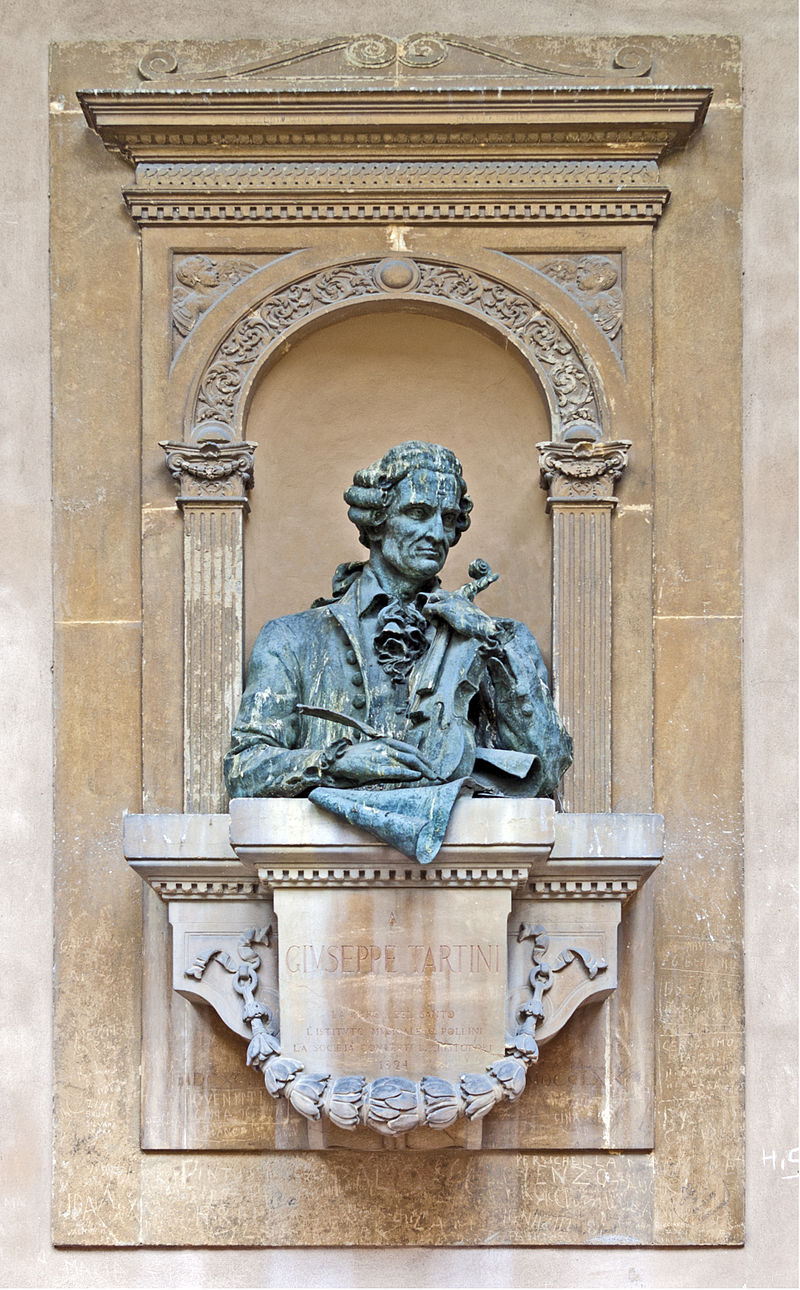
Monument to Tartin at St. Anthony’s Basilica Padua
If the violin is the so called ‘Devil’s Instrument’, then Guiseppe Tartini (8th April 1692 – 26 February 1770) is most definitely his composer of choice!
I think Paganini would have given him a run for his money on the fingerboard, but so far in my investigations into the great virtuoso violinists who were also composers, I feel that Tartini, more than the others, embodied the most evenly balanced skills in both composing and virtuoso performance.
Vivaldi, Viotti and Corelli I think leaned more towards composition, whilst Paganini, although highly talented in both, played with such virtuosity that his reputation as the ‘Devil’s Violinist’ will forever remain the stuff of legend.
Tartini however, would prove to be Lucifer’s student extraordinaire, as his most popular Violin Sonata, aptly named ‘The Devil’s Trill’, proves to this day to be one of the most wickedly sublime sonatas ever written for the instrument.
Legacy
Tartini left the world a vast heritage of music. As a result of his study, hard work, and imagination his quill penned no fewer than 350 works, most of which were written for the violin. Like Corelli and unlike Vivaldi, Tartini composed almost exclusively instrumental music, criticising composers of both vocal and instrumental music.
“These kinds of music are so different that he who is successful in one of them cannot be so in the other; each must remain within the confines of his own talent.” To push his point home he also said, “I have received offers to work for theatres in Venice, but I have never agreed to this, for I know well that the vocal chords are by no means identical with the violin fingerboard. Vivaldi, who wanted to work in both genres, was always booed in the one, whilst in the other he was completely successful.”
Tartini’s influence reached beyond his contemporaries: Vivaldi, Laurenti and Boccherini across nations to what historians have discovered as traces of his style in the works of the young W.A. Mozart. Leopold Mozart recognised his genius by referring to Tartini as “one of the most splendid violinists of our time,” in citations that appeared regularly in the pages of his School for the Violin (1756).
Tartini himself it seems was a creative and sensitive soul with an inquiring mind, who was committed to mastering the technical aspects of the violin as well as finding the peak of his artistic taste and individuality.
He was greatly was influenced by a fellow virtuoso violinist from Florence, Francesco Maria Veracini (1690 – 1768), who had performed in London, Dresden, Poland and what is now the Czech Republic for Count Kinsky. It is thought the two met in 1716 in Venice at the festivities in honour of the Crown Prince of Saxony. Tartini was attracted to the romantic colouring of Veracini’s sonatas and was impressed by his manner of playing, which was bold and vivid, with a smooth-flowing tone and an easy mastery of bow and finger techniques, including the trill.
Tartini assimilated the skill and style of his eminent compatriot over the years that followed as he busied himself in seclusion in Ancona.
Not all of Tartini’s work has been published, but most of his original manuscripts can be found in the music archives of the chapel of St. Anthony in Padua.
Basilica of St. Anthony in Padua
How I wish I’d known that when I visited Padua in my early twenties! There are probably more autographs that have yet to be discovered, as was the case with Vivaldi. His first collection of violin concertos were published in Amsterdam in 1729, followed by his sonatas four years later.
In addition to his violin works, Tartini left a few compositions for viola da gamba, cello and flute.
The Devil’s Trill Sonata
Written in the key of G minor, the sonata is an example of one of the best 18th century violin classics. It begins with a beautiful, melancholy and expressive melody, the ‘Largo Affettuso’. I wonder if this is meant to represent Satan’s sadness at being kicked out of heaven?
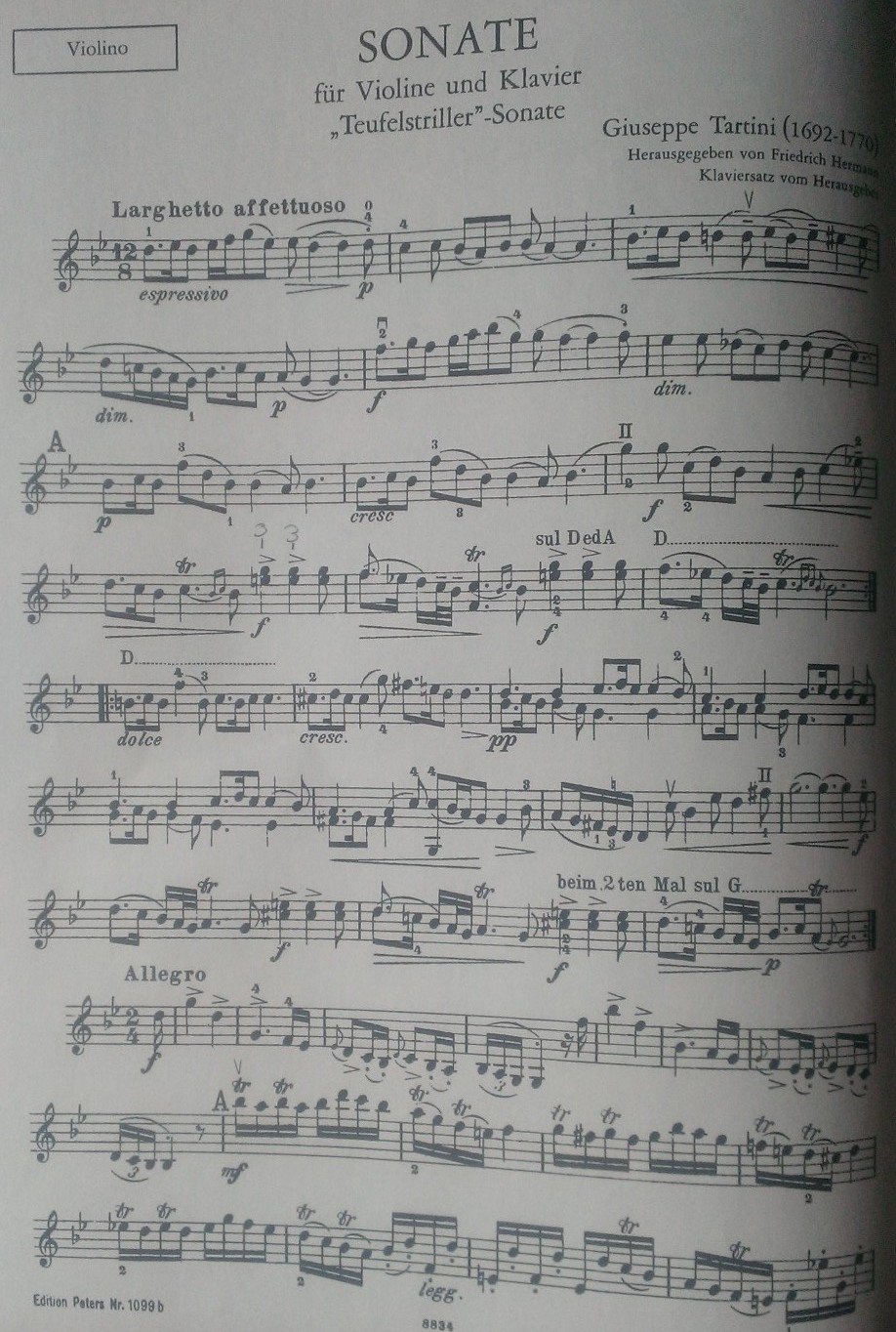
My score!
It is both poetic and soulful, with a mournful lyricism that immediately creates an emotional pathos. It lulls you into a poignant state before the song like tune moves into the ‘Allegro’ where the tempo and temperament change dramatically.
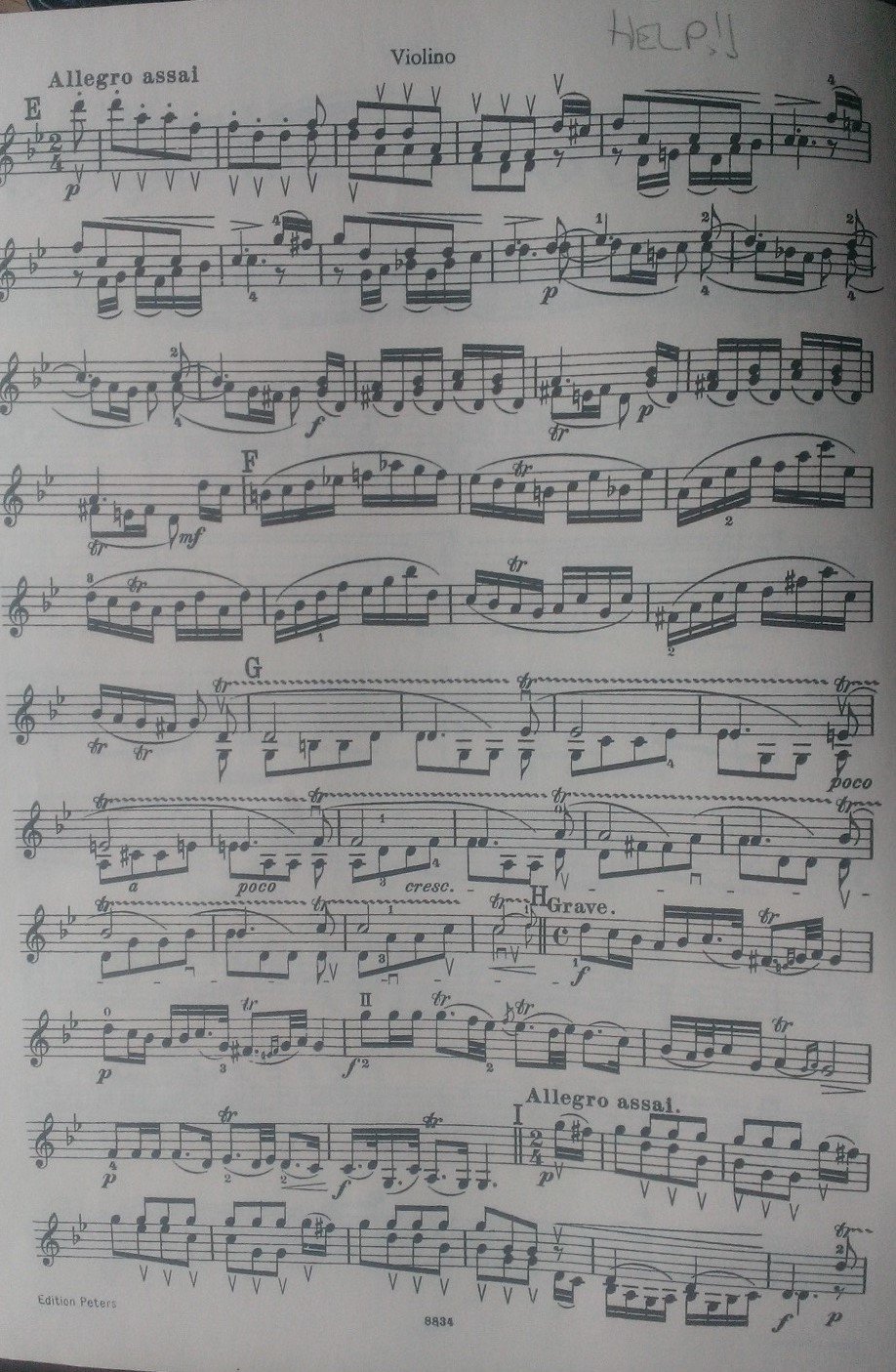
The Andante provides a lyrical interlude before the Allegro assai assaults the senses! Vigorous, determined and virtuosic, it’s positively demoniacal to play; Tartini was most certainly gripped by a violent and turbulent passion…
The Allegro assai, where Tartini uses a continuous background of double-stopping trills. Looks like a lifetime of practice for me!
“Such marvellous compositions of Tartini’s as his sonata in E minor and G minor (The Devil’s Trill) or his Concerto in D minor have been with me since my youth, throughout my life as a musician; these and other works by Tartini are now played by my pupils, but his music never loses its freshness for me, its colour and its emotional impact. I consider his Devil’s Trill sonata to be of such importance that I not infrequently conclude my solo concert (recital) programmes by performing it.” ~ David Oistrakh
His words perfectly complement his amazing performance of The Devil’s Trill in a feat of such jaw dropping virtuosity that I haven’t found a performance to top this one!
The Devil’s Dream
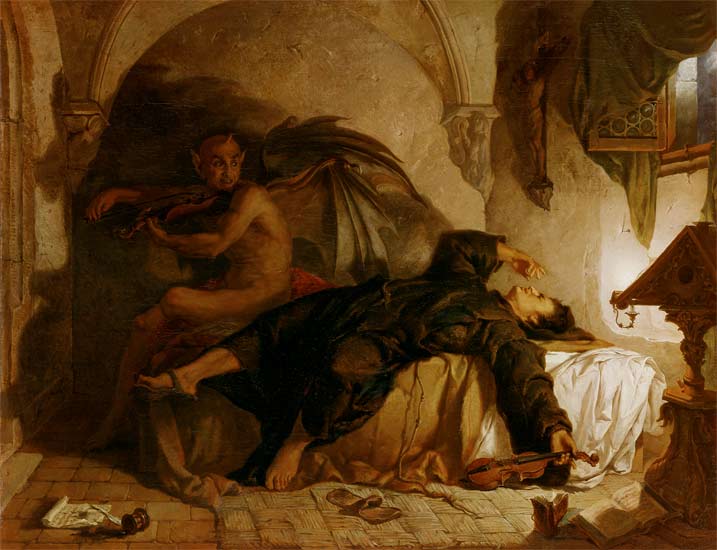
French astronomer and writer, Joseph Jérôme Lefrançois de Lalande, tells the story of how the Devil’s Trill Sonata came about as told to him by Tartini himself:
“One night in 1713 he (Tartini) dreamed that he had made a contract with the devil, who happened to be in his service. Whatever Tartini wanted was granted to him, and all his wishes were anticipated by his new servant, who gave him his violin to see if he could play anything harmonious. But what was Tartini’s surprise when he heard a sonata so original and lovely and performed with such perfection and meaning that he could never have imagined anything like it! He experienced such amazement, admiration and delight that he was breathless; this strong emotion woke him up and he immediately seized his violin in the hope that he would be able to remember at least part of what he had heard, but in vain. The piece that Tartini composed then is indeed the best of all that he has ever done, and he calls The Devil’s Sonata. But the former one that amazed him was so much higher that he would have broken his violin and given up music forever if only he could have.”
The musical idea of the sonata had probably matured in Tartini’s mind long before the dream further ‘elucidated’ his ideas. He’d already worked hard on the trill, conceiving it not only as a technical device but as a means of musical expression.
Although the dream story has an air of the mystical about it the cause of the dream was undoubtedly Tartini’s creative drive at work. He later devoted much attention to the trill in his Treatise on Ornaments.
Debate over the date of composition
The Tartini scholars, Paul Brainard, Andreas Moser and Antonio Capri assert that the artistic content of the sonata, its depth, harmony, originality and technique are more in line with his mature final period, and suggest it wasn’t written before 1730/1740.
However, Johann Quantz heard Tartini perform in Prague in 1723 and made a point of Tartini’s skill in playing double trills. These comments prompted Italian violinist Michelango Abbado, (father of conductor Claudio), to surmise that the sonata had already been written by 1723.
Sadly, the original autograph of the Devil’s Trill sonata no longer exists, and as Tartini was prone not to date his works it may not have shed light on the debate in any case. It’s also logical to assume that if it was composed in Tartini’s youth that over time he would have practiced and perfected the sonata, as well as teaching it to his students. It’s also understandable that Tartini himself didn’t want to shout from the rooftops that he was dreaming of the Devil whilst a violin soloist and director of music at the Chapel of St. Anthony!
Here are some other wonderful performances and interpretations of the brilliant Opus 1 No. 4 composition.
Henryk Szeryng:
Joshua Bell’s interpretation with the harpsichord:
An arrangement for violin and orchestra by Marc-Oliver Dupin, performed by Orchestre d’Auvergne and Jean-Jacques Kantorow:
A lovely performance on authentic instruments from the Palladian Ensemble for violin, viola da Gamba and Harpsichord, archlute & baroque guitar:
A 16 year old Yehudi Menuhin in a fabulous vintage recording:
The inimitable Itzhak Perlman:
Nathan Milstein from 1959:
Publication
Jean Baptiste Cartier first published The Devil’s Trill sonata in his method (L’art du Violon ou Collection Choisie dans les sonatas des Ecoles Italienne, Francaise et Allemande), that came out in Paris in 1798 followed up by a second edition in 1801.
The sonata then had a dormant period of 54 years and reappeared in 1855 with a piano accompaniment by Henri Vieuxtemps and Robert Volkmann. That edition also revived interest in Tartini’s works in general not just The Devil’s Trill.
At the turn of the 19/20th century a large number of arrangements of the sonata were produced by Joseph Joachim, Fritz Kreisler, Leopold Auer and Georgi Doulov which further spread appreciation and performance of this brilliant sonata.
I’d love to hear from you with your favourite versions of The Devil’s Trill as well! Until part 2…
“When we are happy, we are less self-focused, we like others more, and we want to share our good fortune even with strangers. When we are down, though, we become distrustful, turn inward, and focus defensively on our own needs. Looking out for number one is more characteristic of sadness than of wellbeing.” ~ Martin E. P. Seligman ph.D. (Authentic Happiness)
This isn’t particularly easy for me to share, but I feel the lessons I learnt from my recent ‘mensis horribilis’ may be useful to some who are having a nasty time of things. The week leading up to Friday 13th was truly awful and stressful, I really had the kitchen sink thrown at me.
I won’t bore you with all the gory details, but suffice to say, pretty much every day I had a major challenge to deal with. On top of that I was tired, my kids were at each other’s throats and I had a constant ear ache that thankfully hasn’t developed any further. I felt like I had the world on my shoulders. I’d deal with one problem and then another arose more or less straight away, so I began reacting badly to my worsening circumstances.
I wasn’t flowing in and out of my emotions, I had become entrenched in my negative energy field. I certainly didn’t take my own advice from a previous post: Positive Psychology, the Science of Happiness.
Maybe if I’d been more positive I would have coped better with the events that presented themselves to me. I’m usually quite a positive and happy person, but somehow everything got on top of me and I was drowning in a sea of negativity. I was expecting the s**t to hit the fan, and it dutifully did! My pity party rapidly upgraded into a full-on woe-is-me rave…
However, after hearing about the barbaric and tragic murders in Paris something shifted in me. The terror of those affected must have been unimaginable. It has been incredibly distressing to watch the news over the last few days, but it helped put my life into perspective for me. There were many people suffering in much worse circumstances than me.
I said my prayers for the poor souls who were in pain, and thanked God for all that I had. Which, when I tallied it all up was quite considerable, despite the many setbacks of the preceding week. I had allowed myself to become pessimistic and because I was mired in that negative energy it magnified everything.
In a beautiful light bulb moment I started to feel grateful for all the good in my life, in light of the fact that so many just across the channel had needlessly lost their lives in a cowardly, heinous attack. Here one minute, gone the next.
My challenges haven’t disappeared, but the black cloud I borrowed from Eeyore has now left its temporary home above my head!
Everyone has bad events to deal with; it can’t all be plain sailing. It’s not what happens to you that matters, it’s what you do about it that does. It’s how you react to it.
I admit, it’s harder to stay positive when you’re under an onslaught, but thankfully weeks like that are relatively rare.
Mum and I went to Oxford on Friday, I needed to do a bit of research for my next novel, plus it meant we could have some precious mother/daughter time, as mum now lives near the ‘city of dreaming spires’.
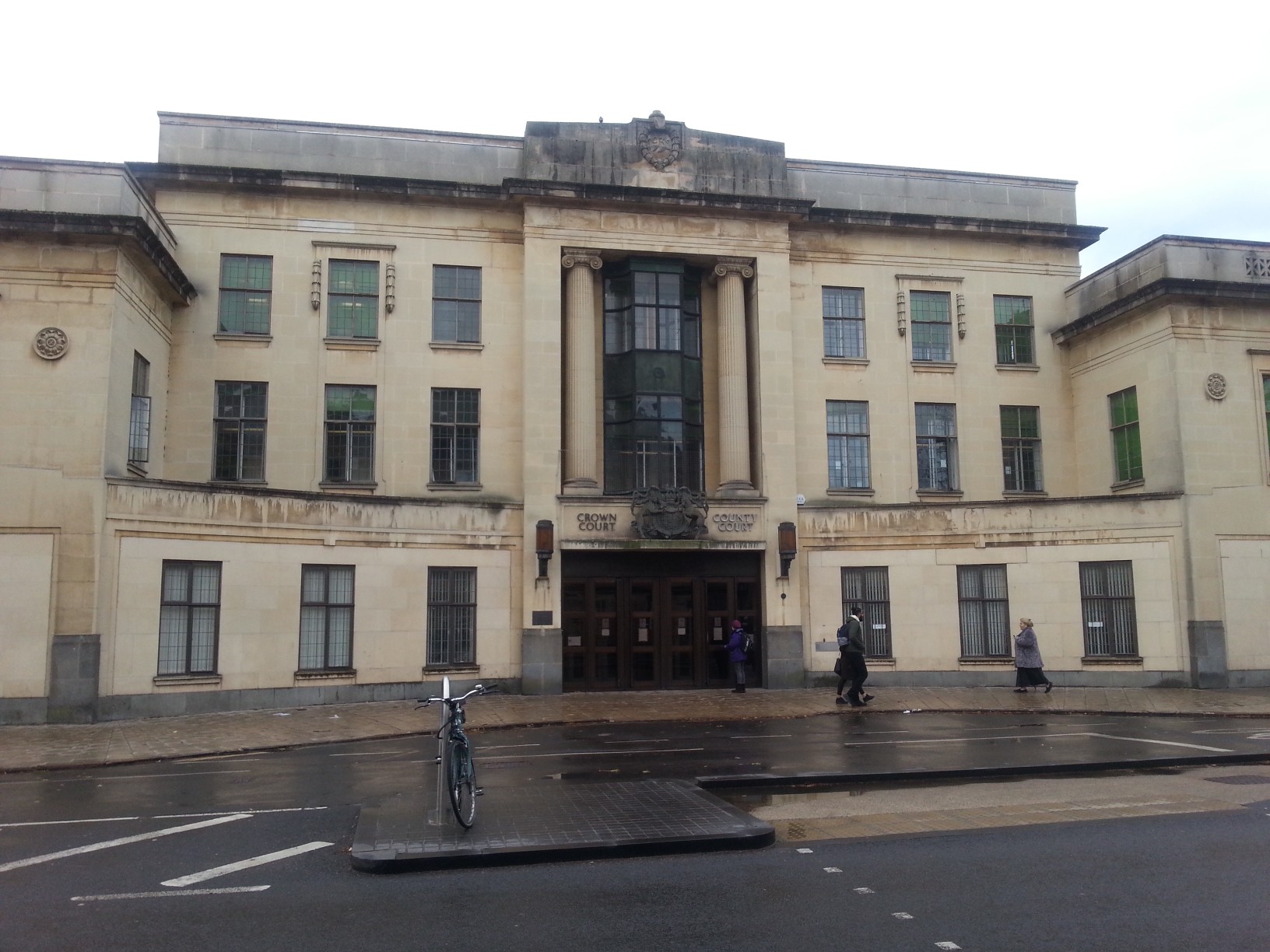
We spent a good hour and a half in Oxford Crown Court, mainly in courtroom two. After seeing a complainant be cross-examined in the witness box by a seemingly kind and softly spoken barrister who mercilessly went in for the kill at the end of her questions, I was grateful not to be in her shoes. I’m not permitted by law to reveal any details about what I heard.
Oxford Crown Court
Whilst I had sympathy for the person in the witness box, I was learning about the workings of a case. That defence barrister certainly operated like an iron fist cloaked in a velvet glove.
After hearing charges against another man for unmentionable crimes, I began to see that there is so much evil and drama going on in other people’s lives, that mine seemed relatively happy in comparison.
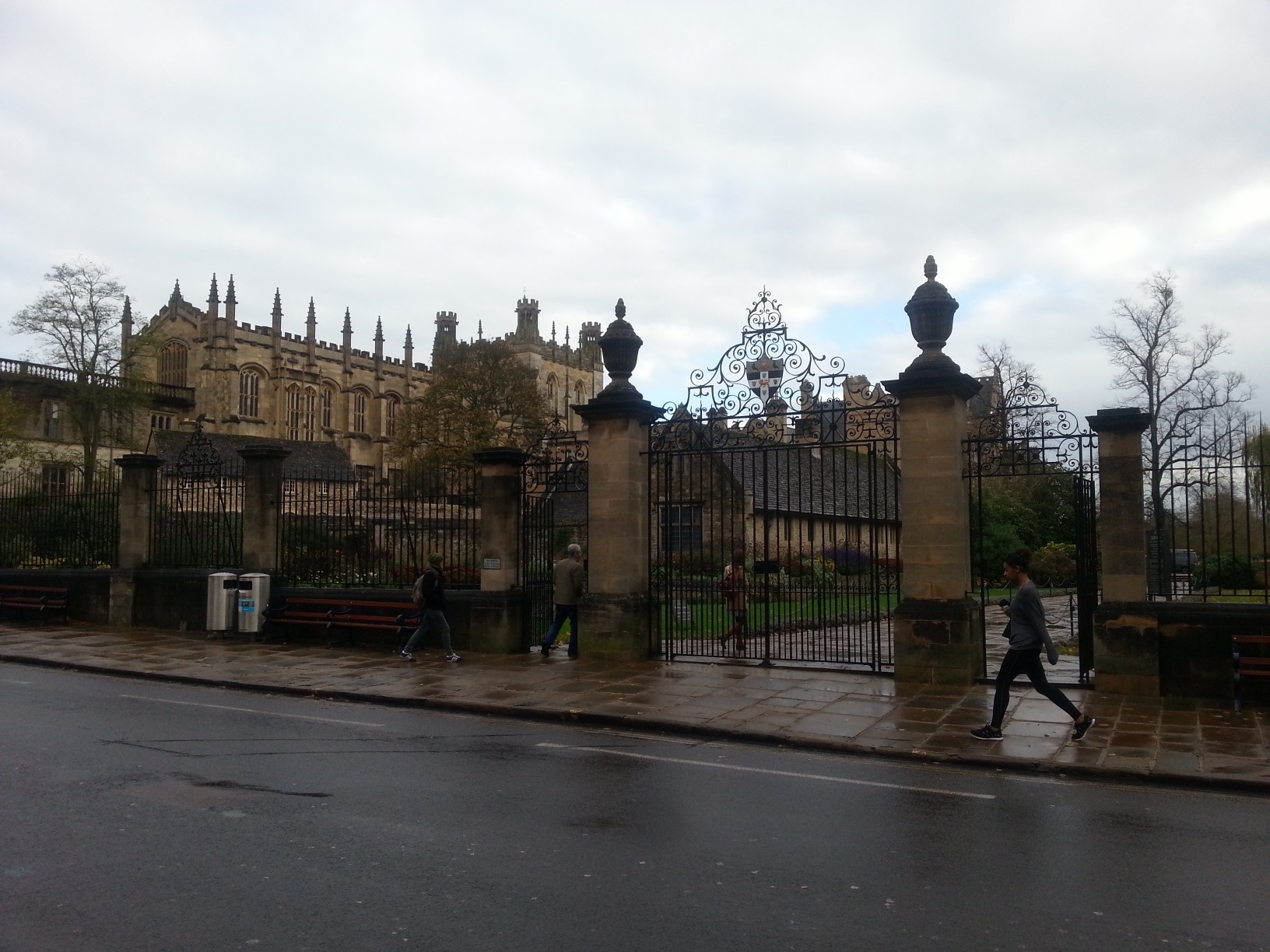
Passing Christ Church Cathedral en-route to the Crown Court
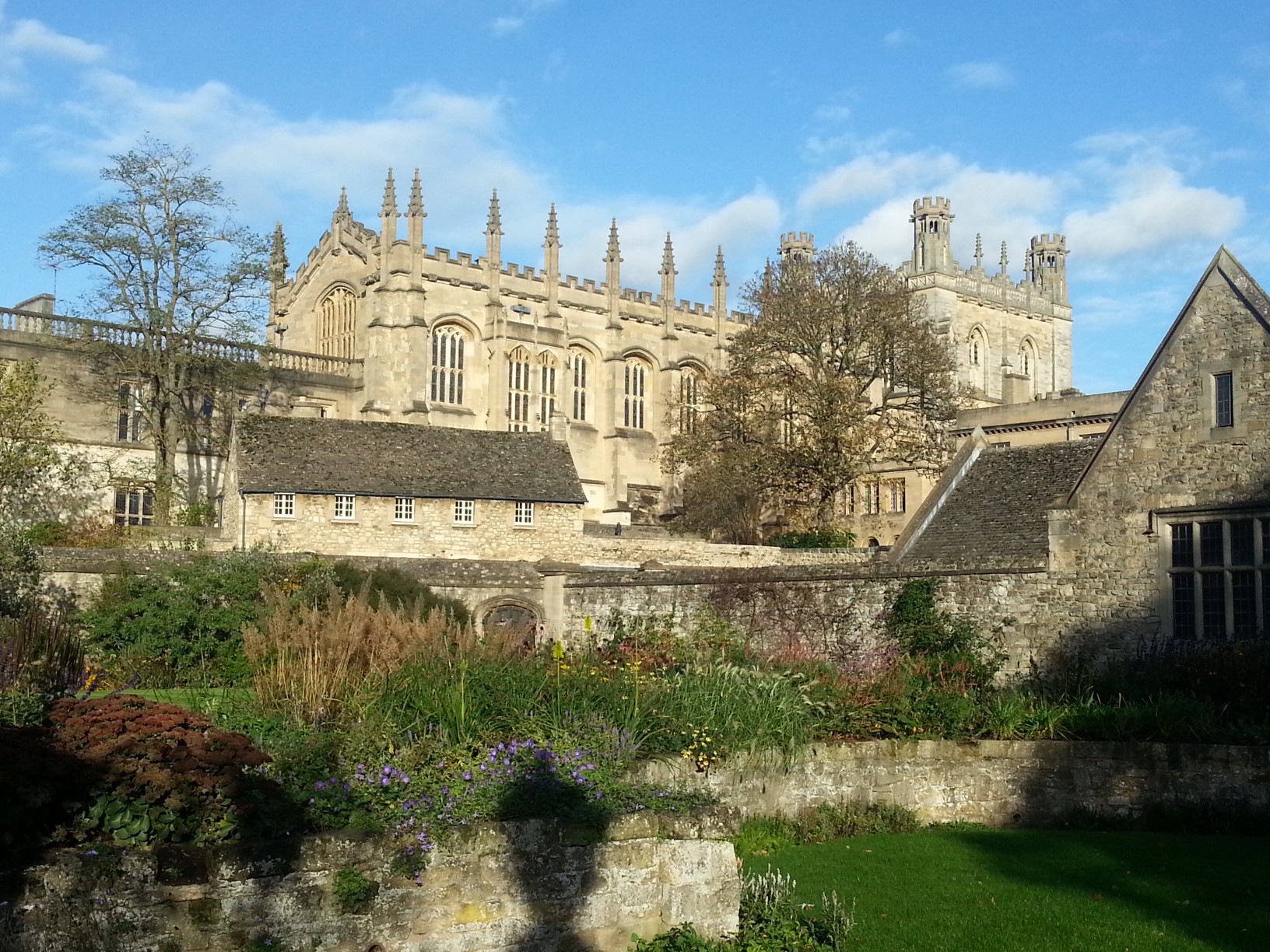
I almost decided not to go as we had a deluge of torrential rain that morning, but by the time we exited the court house at the lower end of St. Aldates the sun had come out and blue sky illuminated the city. The heavy grey clouds that blanketed the sky earlier had completely evaporated. Mum and I had a short stroll around Christ Church before we had to get the bus back to the park and ride. It was a happy and productive day and I felt myself brightening up.
On our way back from Christ Church Meadow
I stopped listening to the chimp on my shoulder and started making the case for all the success and good things I’ve done. This what Martin Seligman refers to as disputation. What I had perceived as a permanent failure was just a temporary setback. Having the setbacks all at once was probably a consequence of a deeper, more pervasive dissatisfaction with myself.
A cherished friend introduced me to Martin Seligman’s ground break book, Authentic Happiness, which is an invaluable companion right now! I took Martin Seligman’s Gratitude Test, and whilst the results weren’t bad, they weren’t particularly great. It’s obviously something I need to work on.
Here’s the link to the Gratitude Survey, I recommend you give it a try!
The Authentic Happiness website has some great resources and further tests that you can complete anonymously to help further research into positive psychology.
Looking back, I can see that even in the midst of challenges there were some beneficial events unfolding and people helping me. I won’t mention them by name, but in my heart I am truly grateful to them!
This is an easy to follow presentation about optimism and gratitude based on the positive psychology work of Martin Seligman:
I’ve seen the video before of Joshua Bell playing his Gibson ex-Huberman Stradivariusin the Washington Subway experiment and feel it’s very relevant to show, (as it’s mentioned in the video above), to demonstrate how sometimes people don’t appreciate the beauty all around them in their lives:
Since my recent epiphany my energy levels are on their way back up, and I feel grateful for so many things: family and friends (both in my physical space and online), having a roof over my head, transport, food in the cupboards, healthy, happy children, a new book to write, my violin and music, a new direction with my health and an opportunity to top up flagging finances, plus many more blessings that I have taken for granted.
My wish for the future (stealing a phrase spoken by Abraham Lincoln in his first inaugural address), is that you, me and humanity can be happy, grateful and content despite the everyday threats and challenges we face, by being true to the better angels of our nature.
I’m going to let my voice do all the talking on this post!
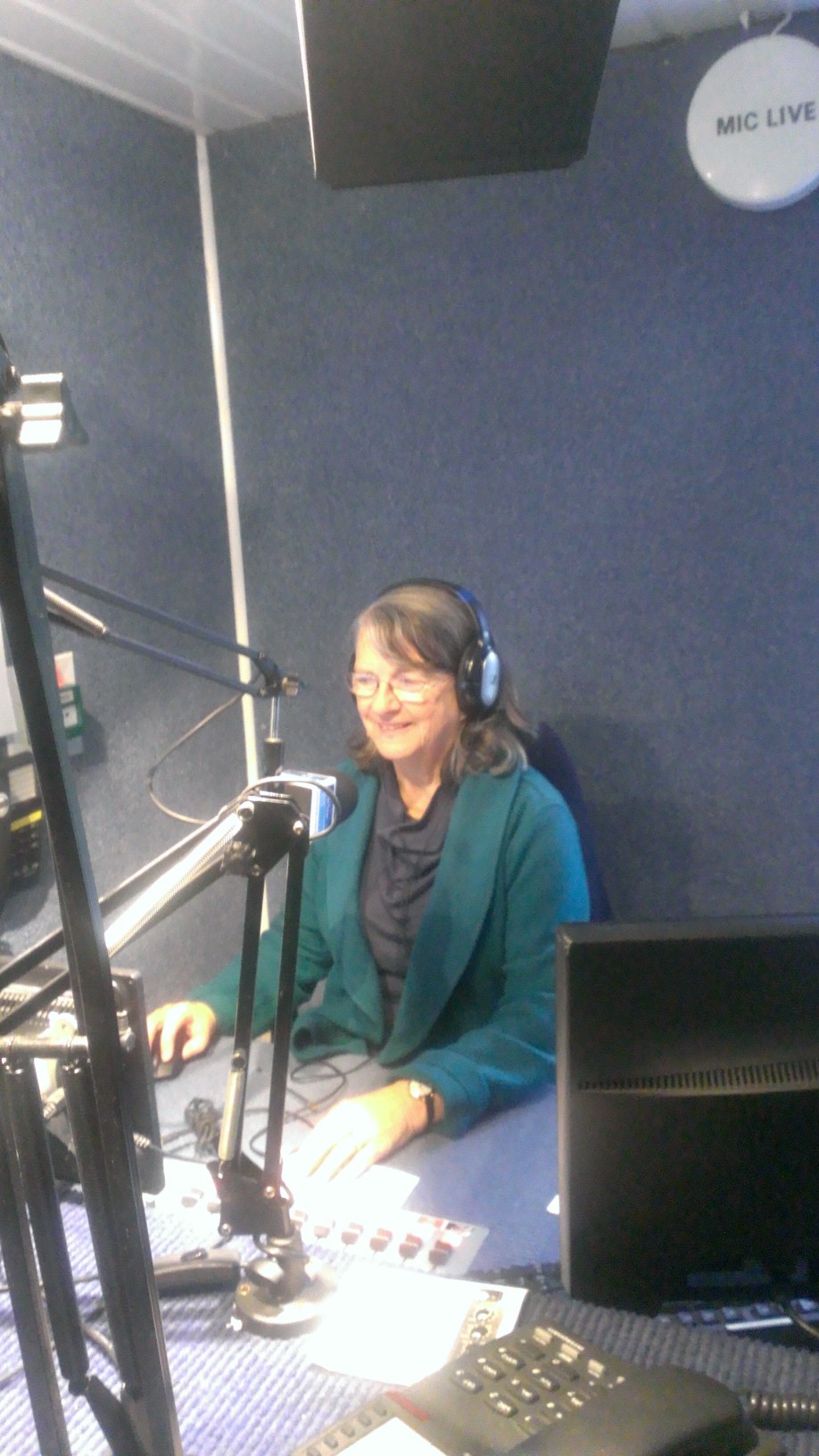
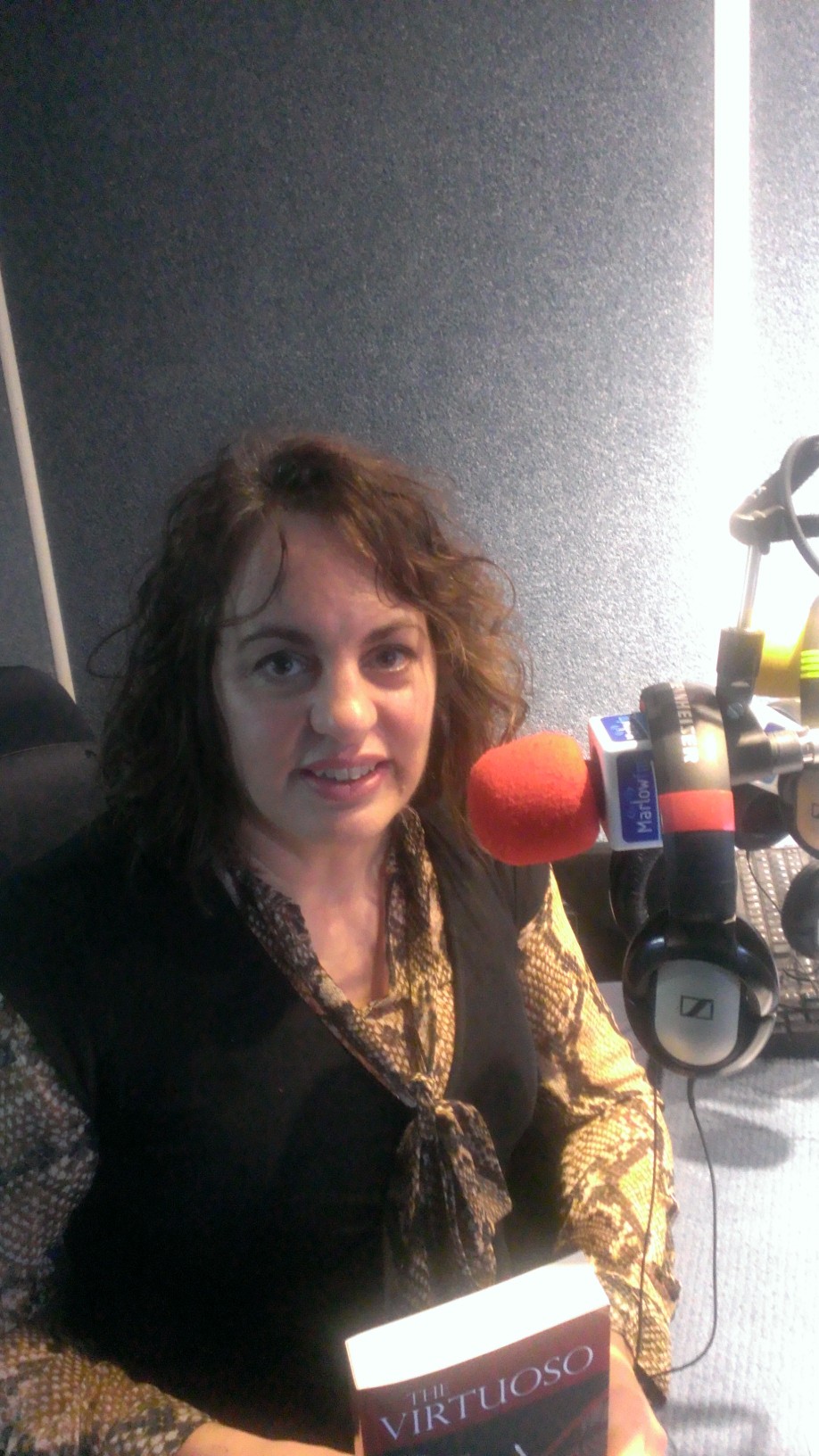
I’d like to say a big thank you to Jean Wolfe (@jeanspark) for having me as her guest on Friday 6th November to talk about writing on her BizBuzz show. Jean broadcasts every Friday afternoon at 2 pm on Marlow FM. She was such a warm, welcoming and knowledgeable host and I really enjoyed our conversation.
The goal of NaNoWriMo is write 50K words in a month! I’m using this month to get my next trilogy of novels off the ground.
I don’t want to repeat everything we discussed on air, so without further ado here is the link to the interview which will be available with all the music interludes for the next three weeks.
I was delighted to be on my local radio station Marlow FM (@MarlowFM), especially as there are a few scenes in The Virtuoso that take place in the town!
And before I forget, here is Schubert’s marvellous String Quartet ‘Death and the Maiden’ (same title as my next trilogy) that we discussed in the interview:
Thanks for listening! I’d appreciate any constructive feedback, I did make an effort not to um and ah too much…
“Venite ad me, qui onerati estis.” (Come to me, all ye who labour and are heavy laden.)
Death lingers in the air at this time of year. Ghastly ghouls, wicked witches and spooky skeletons decorate shops, costumes and cakes, as everything occult fascinates society at Halloween. Perhaps it’s our way of confronting the inevitable, the journey of life towards the grave that no one particularly wants to talk about.
Frans Francken the Younger – Detail of Danse Macabre
Halloween decorates death with a mostly comical slant; ergo it becomes more acceptable, slicing and dicing the edges from the fear and disgust of the decomposed, emaciated body, the dissolution of earthly life. We are reminded in a joking atmosphere that Death has become light hearted, transforming some people into what I would describe as necromaniacs!
Necromancy, dancing spirits and ghostly stories abound at this time of year, but underneath this creepy consumerism and fun there’s a deeper message lurking for anyone who dares to look harder. Could it be modern society’s memento mori minus the seriousness of Christian theology?
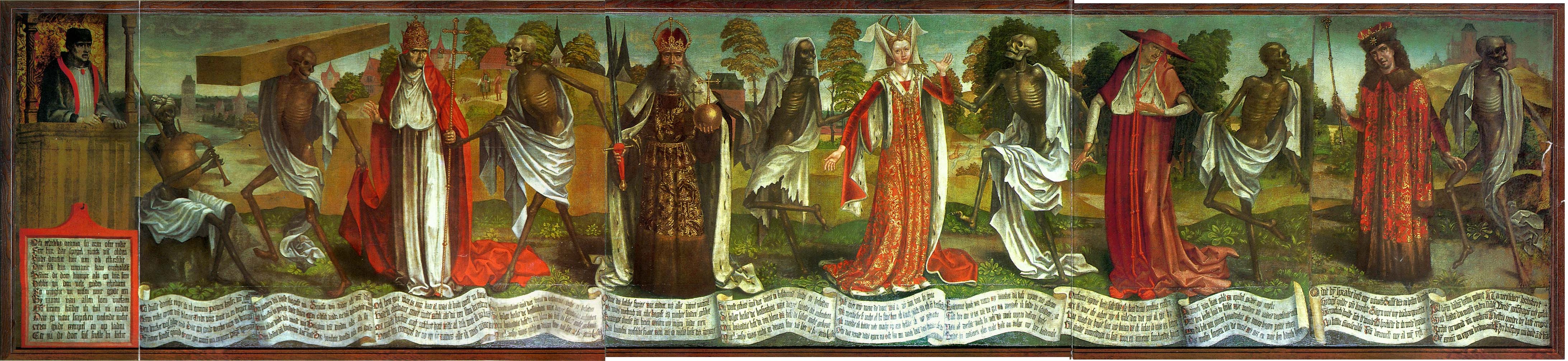
Totentanz – Danse Macabre at St. Nicholas Church Tallin
It’s a subject people are loath to ponder, why would one meditate on one’s own demise? Yet the transience of life, the fragility of physical existence is all around us, we have all been touched by death’s tendrils in one form or another. Our ongoing mortality is grounds for practising gratitude, for no matter how bad things get, we are at least still breathing! It’s a stark reminder not to take our existence for granted.
Origins
Musically, culturally and artistically, the dance of death has its origins in medieval France. Dancing and death went hand in hand – the allegory of the longest sleep.
Hans Holbein – Nuremburg Chronicle c. 1493
The Danse Macabre was designed to show us that no matter our station in life, whether lowly or exalted, death is the harbinger of equality; it eventually comes for us all, and one should consider one’s earthly activities in order to earn a spiritual meritocracy – aka eternal salvation, entrance into heaven/immortality.
Throughout medieval France and Europe the Danse Macabre/Totentanz was a serious message about the inevitability of death, packaged as entertainment (life was pretty grim for the ordinary folks), and was expressed in poetry, church murals, paintings, Hans Holbein’s woodcuttings and in religious hymns.
The Hundred Years War
The poor souls that inhabited Paris throughout the cruel and bitter civil war between the Armagnacs (those loyal to the French Royal Family and the Orléanist Lords) and the Burgundians (those loyal to the English Royal Family and Anglo-allied Burgundian Lords), experienced the intense suffering of a late Middle Ages power struggle, namely: famine, sieges, plagues, disease and extreme weather conditions, thus life expectancy was short. Very short.
The English Regent, John Duke of Bedford, ruled a stricken Paris in the years that followed the deaths of his ambitious brother, King Henry V of England and the mentally unstable Armagnac King Charles VI of France, (only seven weeks apart), when the Anglo-Burgundian alliance sought to rule over all of France.
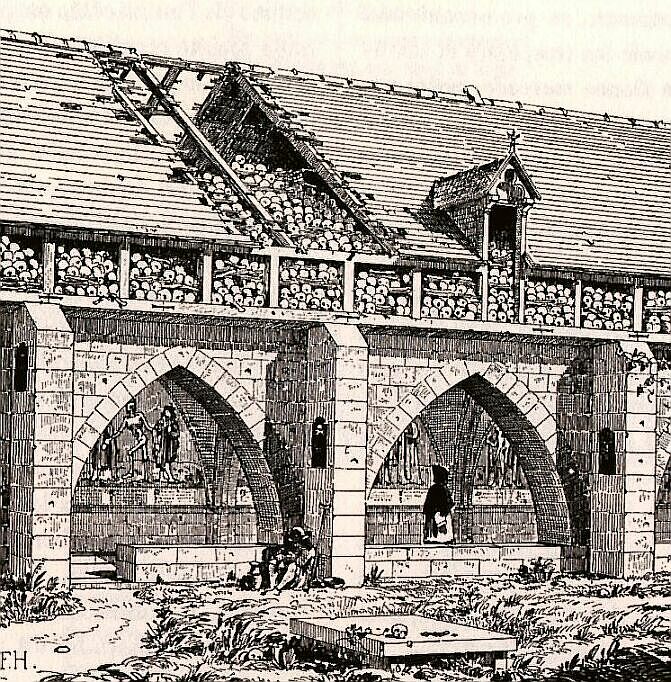
Danse Macabre on the Charnier at Holy Innocent’s Cemetery
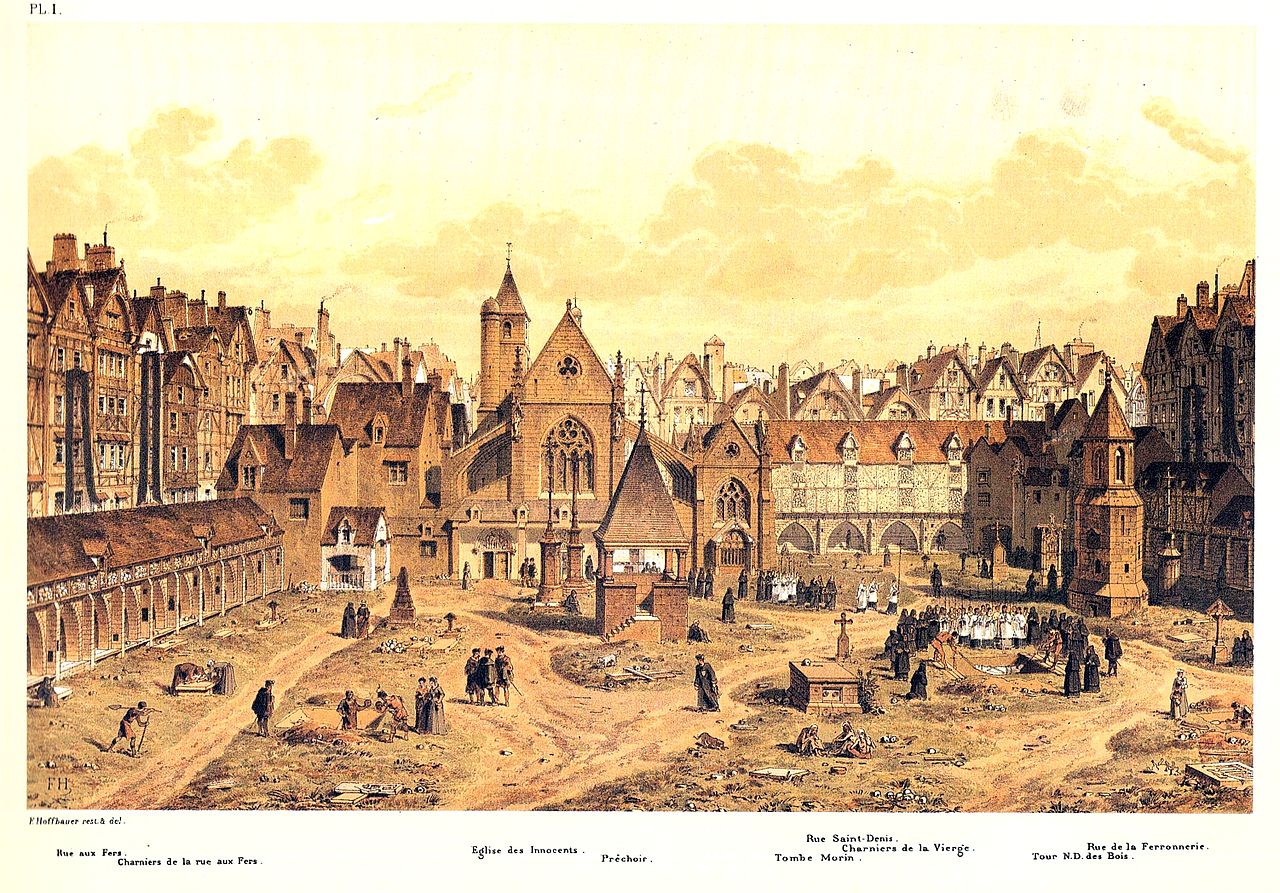
In the spring of 1425 the weary citizens of Paris witnessed the unveiling of a painting of the ‘Danse Macabre’ along the cloister walls of the city’s massive cemetery of the Holy Innocent’s, which depicted the grotesque figure of death leading a carnival of king, beggar, pope and peasant, mocking the pomp and power of earthly life in the face of certain death. It showed the people that the vanity of earthly riches and a sybaritic lifestyle was no protector from death’s grasp. They all marched towards the inevitable one-way door as equals, united in death’s all encompassing dark cloak…
That very first Danse Macabre mural was destroyed in 1669 when the wall was demolished. The copious corpses of medieval Paris were eventually relocated in a mass exhumation to the city’s catacombs due to the unsanitary conditions of the Holy Innocent’s in the late 18th century, and the church was also destroyed around this time.
The Holy Innocent’s in Paris c. 1550 by Hoffbauer
All that remains today is the original Fountain of Innocents, moved and rebuilt in the centre of the new market, now known as the Place Joachim-du-Bellay.
The music of La Danse Macabre
As music is the universal language; transcending time, religion and race, it has power over words alone in conveying a feeling, thought or message, hence ‘La Danse Macabre’ prises its fiendish way into the imagination…
The most famous of all is Camille Saint-Saëns’ richly evocative eponymous tone poem, Opus 40. First performed in 1875, the composition is based on the text of French poet Henri Cazalis:
The opening chords of the solo violin are meant to put you on edge, and so it’s hardly surprising the work wasn’t as popular in the 19th century as it is today. I personally think those first startling, dissonant and jarring notes are pure genius when taken in the context of the subject matter. It also has a surprisingly jaunty and devilishly good melody that makes you want to dance death’s jig… I love to play it at home on my violin.
From Wikipedia:
According to legend, “Death” appears at midnight every year on Halloween. Death calls forth the dead from their graves to dance for him while he plays his fiddle (here represented by a solo violin). His skeletons dance for him until the rooster crows at dawn, when they must return to their graves until the next year. The piece opens with a harp playing a single note, D, twelve times (the twelve strokes of midnight) which is accompanied by soft chords from the string section. The solo violin enters playing the tritone consisting of an A and an E-flat—in an example of scordatura tuning, the violinist’s E string has actually been tuned down to an E-flat to create the dissonant tritone.
The first theme is heard on a solo flute, followed by the second theme, a descending scale on the solo violin which is accompanied by soft chords from the string section. The first and second themes, or fragments of them, are then heard throughout the various sections of the orchestra. The piece becomes more energetic and at its midpoint, right after a contrapuntal section based on the second theme, there is a direct quote played by the woodwinds of the Dies Irae, a Gregorian chant from the Requiem that is melodically related to the work’s second theme. The Dies Irae is presented unusually in a major key. After this section the piece returns to the first and second themes and climaxes with the full orchestra playing very strong dynamics. Then there is an abrupt break in the texture and the coda represents the dawn breaking (a cockerel’s crow, played by the oboe) and the skeletons returning to their graves.
Clara Cernat and Thierry Huillet give a fantastic performance on Violin and Piano:
I also love this orchestral version by Leopold Stokowski and the National Philharmonic Orchestra:
The Gromoglasova sisters do a chilling job on two pianos!
An inventive and lively arrangement for four violas by members of the Taiwan Viola Chamber Orchestra:
The Dance of Death is also portrayed in the 4th movement of Shostakovich’s Piano Trio in E minor, Opus 67. A fine performance from Richter, Kagan and Gutman:
Dance of Death based on Mussorgsky:
Totentanz
Composer and virtuoso pianist Franz Liszt had something of an obsession with death, it featured in quite a few of his compositions, but Totentanz is the most well-known.
Valentina Lisitsa gives a spine tingling rendition of Franz List’s Totentanz for Piano and Orchestra, Paraphrase on Dies irae:
Liszt’s arrangement for two pianos:
Sylvia Plath’s Poem Danse Macabre:
Down among the strict roots and rocks,
Eclipsed beneath blind lid of land
Goes the grass-embroidered box.
Arranged in sheets of ice, the fond
Skeleton still craves to have
Fever from the world behind.
Hands reach back to relics of
Nippled moons, extinct and cold,
Frozen in designs of love.
At twelve each skull is aureoled
With recollection’s tickling thorns
Winding up the ravelled mold.
Needles nag like unicorns,
Assault a sleeping virgin’s shroud
Till her stubborn body burns.
Lured by brigands in the blood,
Shanks of bone now resurrect,
Inveigled to forsake the sod.
Eloping from their slabs, abstract
Couples court by milk of moon:
Sheer silver blurs their phantom act.
Luminous, the town of stone
Anticipates the warning sound
Of cockcrow crying up the dawn.
With kiss of cinders, ghosts descend,
Compelled to deadlock underground.
I’d like to thank you for visiting my blog and wish you a happy Halloween!
Guest Post by Author and Cancer Survivor, Jenny Phillips
Jenny Phillips is a Registered Nutritionist, author and public speaker on all things wellness related. Her book, Eat to OUTSMART Cancer, aims to inspire people to create their own health and reduce their risk of chronic ill health.
As we draw to the end of the 2015 ‘Breast Cancer Awareness’ month – it’s worth reflecting on the fact that breast remains the leading cancer for women, accounting for some 30% of cases. In the latest data (2011) this equates to over 50,000 diagnoses a year.
Back in 2003, I was one of those cases. Diagnosed at the age of 39, a mum to two very young kids, it felt like our world had fallen apart. The medical treatment was slick and effective, chemo and surgery, but the next mountain to climb was staying cancer free. I have spent the last twelve years researching how not to get a recurrence, which has made me something of an expert in diet, lifestyle and health.
I have learnt that cancer takes time to develop, in some instances this can be up to 10 years before it is detectable by conventional means, such as mammogram. But what if there was a way to determine the health of your breasts before it became a cancer diagnosis?
This could then enable you to be more vigilant in your diet and lifestyle. Potentially then you could reverse yourself away from a future disease state.
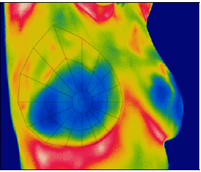
This is what is offered by thermography, or breast thermal imaging. It uses a state of the art thermal imaging camera to produce an image or thermal scan. This is based on the knowledge that breast tumours have abnormal blood vessel patterns that give off more heat than the surrounding tissue. Hence thermography acts as a potential early warning of abnormal physiology, or whether the breast cells have started to behave aberrantly.
Breast thermography has been the subject of extensive research since the 1950s. There are over 1000 peer-reviewed studies in the medical literature, some of which followed patients over twelve years.
In one study of women reported to have false positive thermograms (ie: positive thermogram and negative mammogram), over one third went on to have confirmed breast cancer within five years.[i] This suggests that the thermogram is indeed an early indicator for future disease risk.
Dr. Mercola on the benefits of breast thermography:
Another study confirmed that a positive thermogram is 10 times more significant than a first order family history of the disease.[ii]
What are the benefits of thermography?
Thermography is 100% safe, radiation free, non-contact and painless.
It enables very early detection of cancer risk (up to 10 years earlier than mammography).
It is unique in its capacity to record physiological problems such as increased metabolism, inflammation and abnormal blood vessel patterns.
What is involved?
The thermal scan takes around fifteen minutes to complete. We use a cold challenge, which means the room is cool (18 degrees). Firstly we take a series of infra red images, there is then a ten minute cool down, and the images are repeated.
The cool down increases the accuracy of the scan. We use advanced software which compares right breast to left, and then warm to cool. You receive a detailed report and can opt in for a further consultation to discuss healthy breast strategies.
Where can I get a thermal scan?
Thermography is now available in Buckinghamshire at the Whitethorns Medi-clinic near Stoke Mandeville. Please call 01296 614441 or 07904 438411 to check next dates and availability.
References:
[i]Gautherie M, Gros CM. (1980) Breast thermography and cancer risk prediction. Cancer. Jan 1;45(1):51-6.
[ii] Louis K, Walter J, Gautherie M (1982) Long-term assessment of Breast Cancer risk by thermal imaging. Biomedical Thermology. Alan R Liss Inc p279-301