“The Gods and Goddesses of myth, legend and fairy tale represent archetypes, real potencies and potentialities deep within the psyche, which, when allowed to flower permit us to be more fully human.”
Margot Adler
There’s no denying that for thousands of years we have lived in a male dominated, patriarchal, hierarchical society, where the prevailing attitudes undervalue feminine attributes. Many women are unappreciated and in some parts of the world, utterly suppressed. Our collective psychology is unbalanced, and we can see the results of that in the world.
We each have a masculine principle (Animus) and a feminine principle (Anima), that make up our psyches, and in each person the marriage of the positive aspects of these two energies leads to harmony – the best of both worlds. The yang energy of action, movement, motivation and achieving alongside the yin energy which is receptive, imaginative, intuitive, a state of being. Left brain – right brain.
Several years ago I read an extraordinary book by Jungian Analyst, Jean Shinoda Bolen MD, Goddesses in Everywoman, and she also wrote Gods in Everyman. I found it fascinating how the psychology of Greek mythology plays out in our archetypal personalities and shapes our unconscious behaviour, but that can be harnessed consciously for positive integration.
Just so you guys don’t feel left out!
I delved deep, and discovered my primary archetypes: Artemis, Aphrodite and Demeter. But I’ve also developed and worked with Athena, Hestia and Persephone (the queen). Hera is the goddesses I relate the least to. Nevertheless, I could trace how all their archetypal patterns had influenced me and manifested in my life.
So for all my sisters out there, and for any man who wants to understand his woman better, (and even the feminine principle within himself, just as women can understand the masculine principle and god archetypes within themselves); here are my takeaways from this body of wisdom, recorded in the mythology of the ancient Greeks, and so eruditely encapsulated and elucidated by Jean Shinoda Bolen…
Feminine Psychology through the lens of Greek Mythology
I think it’s fair to say that myths have survived over the centuries because they speak to a primal part of our psyches – somewhere in the mists of time there is a grain of truth, wrapped up in a colourful tale…
All myths hail from the depths of collective human experience, hence they are in a sense, timeless.
The stories of the Greek Gods and Goddesses are particularly dramatic and fascinating, and they were more than stories; they were the deities worshipped by the ancient Greeks. There are remains of temples built thousands of years ago across Greece, built in their honour.

Temple of Aphrodite
The Greeks grappled with complex psychological truths through the telling of vivid stories. These stories are more commonly referred to as Greek Mythology, which filtered into consciousness over millennia and is still very much alive. We come across it in our everyday lives without even realising a word, or a meaning, or a way of thinking, stems from ancient Greece. Mythology is deeply embedded and woven in our culture.
Here are some of their threads:
DEMOCRACY – Ahh, good old democracy. Combining demos (δήμος — “people”) and kratos (κράτος — “power”), the meaning of this quintessential Greek word used in English is simply put: power to the people!
GALAXY – Now that we’re on the subject, many Greek words used in English have mythological origins. Galaxy, a.k.a. the Milky Way, comes from the Greek word for milk, gala (γάλα). According to one myth, the Milky Way was created by Zeus’s baby son, Heracles, after he tried suckling on his step-mother’s milk while she slept. When Hera woke up to discover that she was breastfeeding an infant that was not her own, she pushed the child away, causing her milk to spurt into the universe.
MUSIC – Music literally means art of the Muses, the nine Greek goddesses who presided over the arts and sciences. The concept of a museum was originally intended to be a shrine for the Muses.
NARCISSISM – Narcissism comes from the Ancient Greek mythological figure of Narcissus, a young man who fell in love with himself when he saw his reflection in a lake. One nymph who fell passionately in love with him withered away into nothingness when he ignored her, leaving no trace behind but her voice. Her name was Echo.
EROS – Eros (/ˈɪərɒs/, US: /ˈɛrɒs, irɒs, -oʊs/; from Ancient Greek ἔρως (érōs) ‘love, desire’) is a concept in ancient Greek philosophy referring to sensual or passionate love, from which the term erotic is derived.
LOGOS – Logos (UK: /ˈloʊɡɒs, ˈlɒɡɒs/, US: /ˈloʊɡoʊs/; Ancient Greek: λόγος, romanized: lógos, lit. ’word, discourse, or reason’) is a term used in Western philosophy, psychology and rhetoric and refers to the appeal to reason that relies on logic or reason, inductive and deductive reasoning. Aristotle first systemised the usage of the word, making it one of the three principles of rhetoric.
PATHOS – Pathos Entered English in the 1500s. The Greek word páthos means “experience, misfortune, emotion, condition,” and comes from Greek path-, meaning “experience, undergo, suffer.” In English, pathos usually refers to the element in an experience or in an artistic work that makes us feel compassion, pity, or sympathy.
COSMOS – “Cosmos (kósmos) is a Greek word for the order of the universe. It is, in a way, the opposite of Chaos. It implies the deep interconnectedness of all things. It conveys awe for the intricate and subtle way in which the universe is put together.” ~ Carl Sagan
EUREKA! – Eureka (Ancient Greek: εὕρηκα) is an interjection used to celebrate a discovery or invention. It is a transliteration of an exclamation attributed to Ancient Greek mathematician and inventor Archimedes. “Eureka” comes from the Ancient Greek word εὕρηκα heúrēka, meaning “I have found (it)”, which is the first person singular perfect indicative active of the verb εὑρίσκω heurískō “I find”.
It is human nature to ponder our origins and purpose – and the ancient Greeks provided captivating insights through their unforgettable tales; where every emotion known to man was personified by the Greek Gods and Goddesses.

Mount Olympus
They may have been glorious deities residing on Mount Olympus, but their characters were just as flawed and contrary as us mere mortals. Jealousy, rage, love, passion, infidelity, lust, rape, vengeance, violence, greed, despair, hope, kindness, compassion and redemption featured in many myths. Not to mention incest!!
The Greek myths are certainly entertaining, but they carry far deeper meanings if we delve into the characters or archetypes of the Gods and Goddesses.
What is an archetype?
An archetype is an inner way of being – it is non personal and universal. In Jungian theory, an archetype is a primitive mental image inherited from the earliest human ancestors, and supposed to be present in the collective unconscious.
The archetypal Goddesses are representations of what contemporary women are like, but with more power and diversity of behaviour than cultural norms have hitherto encouraged women to express. So often in a patriarchal society women have had expectations and limitations imposed on them.
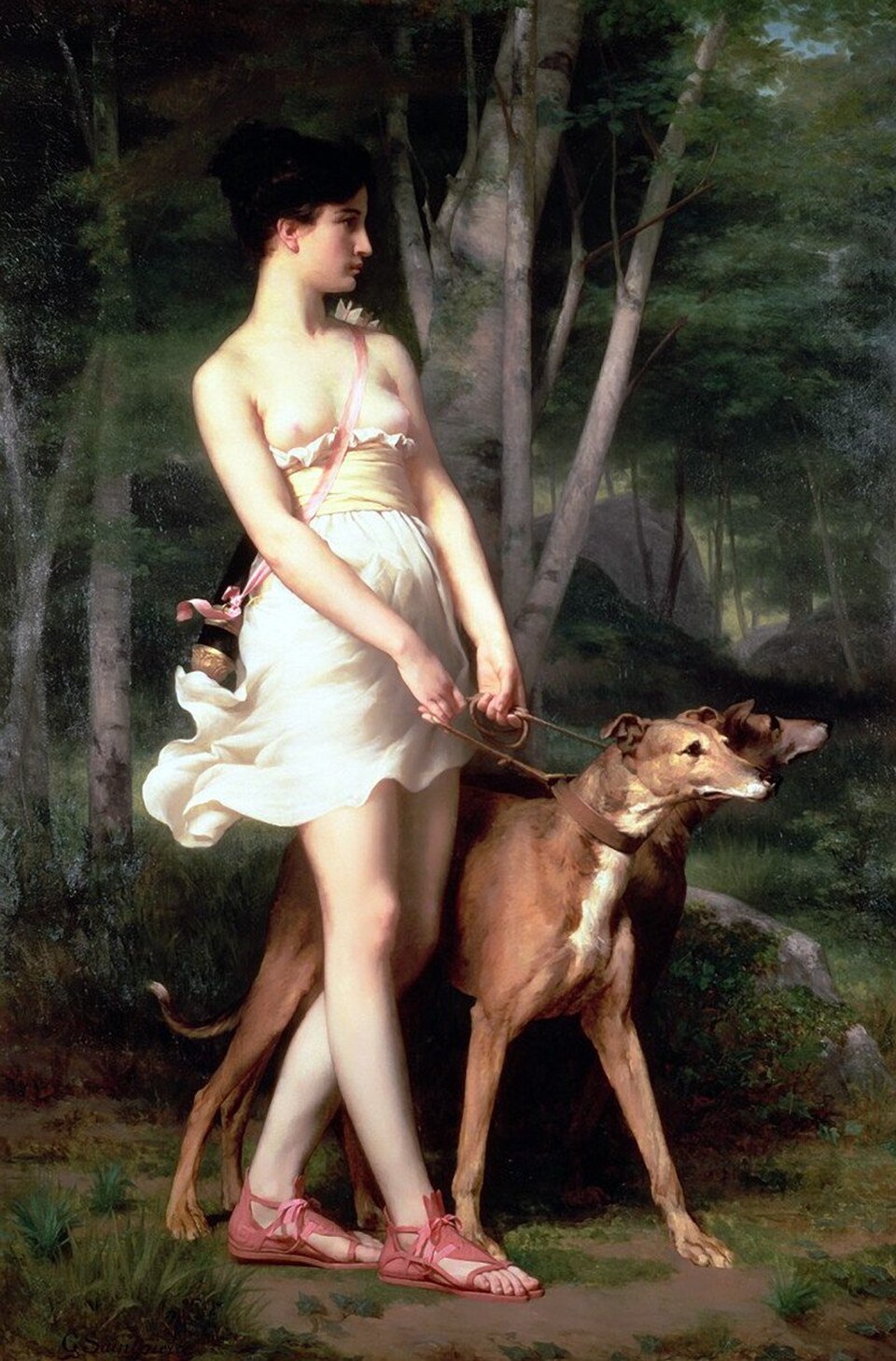
Diana the Huntress by Gaston Casimir Saint Pierre
Sometimes the prevailing culture works with a woman’s predominant archetype, such as during the 70s and 80s where more women were having careers, helpful for Athena and Artemis types, or the 40s to 60s (the baby boomers) for Demeter.
Archetypes are instinctual forces inside a woman’s psyche, and even if we are not aware of them can have a compelling effect on our decisions and actions. Of the seven goddess archetypes, Aphrodite, Demeter and Hera wield the most power in terms of dictating behaviour, as they are more closely related to the Great Goddess than the other four.
Artemis, Athena and Persephone were ‘maiden’ goddesses who were the generation of daughters, influencing character patterns less intensely.
Hestia, the oldest, wisest and most honoured goddess of them all, shunned power. She represents a spiritual component that serves a woman well.
All the goddesses are potentially present in every woman, just as all the gods are potentialities within every man.
Archetypes are not bound by time, and do not take into account a woman’s life situation or needs. Therefore, awareness of these patterns is highly beneficial so that a woman (or her partner and friends) can recognise which goddess is at work in any given moment. Some instances may require the specialty of a particular goddess, and to be able to embody the positive traits of that archetype on demand is the ultimate goal of this knowledge.
The inner turmoil can be overwhelming when two powerful goddess archetypes are competing for dominance. Women’s psyches are complex and many-sided.
It’s important to note that the Greek goddesses lived in a Patriarchal society, as modern women also do. The male gods ruled over the earth, heavens, oceans and underworld – and the goddesses adapted to this reality by either separating from the gods, joining them, or withdrawing inwards. We cannot deny that the goddesses represent patterns that reflect life in a patriarchal culture.
How and when do goddess archetypes become activated?
Jean Shinoda Bolen teaches that all the goddess archetypes are potential patterns in the psyches of all women, yet in each unique, individual woman some of these patterns are activated (energised, constellated or developed) and others are not.
Carl Jung used the analogy of crystals to explain the formation of archetypes – to explain the difference between archetypal patterns (which are universal), and activated archetypes (which are functioning in us).
An archetype is akin to an invisible pattern that determines what shape and structure a crystal will take when it is formed. Once the crystal is fully formed the now recognisable pattern is concomitant with an activated archetype.
“Which goddess or goddesses (several may be present at the same time) become activated in any particular woman at a particular time depends on the combined effect of a variety of interacting elements – the woman’s predisposition, family and culture, hormones, other people, unchosen circumstances, chosen activities, and stages of life.“
Jean Shinoda Bolen (Goddesses in Everywoman).
Creation Story
To comprehend the goddesses more fully it’s best to have some understanding and context about their world; how they came to be and the events of ancient mythology.
Greek mythology was written by great poets, and they were the first civilisation to make coherent narratives, a literature (even if it was quite lurid at times), of their gods, monsters and heroes.
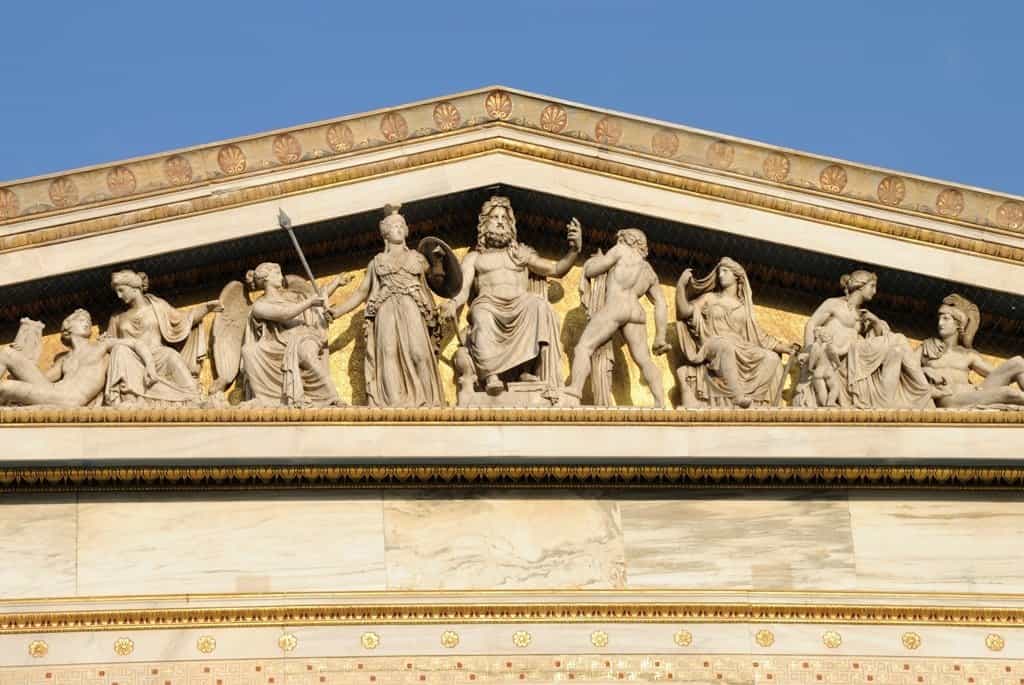
The Twelve Olympians sculpted on the Academy Building in Athens.
The arc of Greek myths follows the rise of mankind, our battle to free ourselves from the interference of the gods – their abuse, their meddling, their tyranny over human life and peoples.
The Greeks created gods that were in their image: warlike but creative, wise but ferocious, loving but jealous, tender but brutal, compassionate but vengeful. Their light and shadow, their dualities, were entirely human. In fact, their dysfunctional family dramas seem to have set the stage for human dramas as well…
My aim is to help you ponder the deep truths that myths embody, a rich and elaborate world with many psychological insights that lie behind them.
The Greek Family Tree
The ancient Greeks postulated that the universe began not with a big bang, but with CHAOS. Stephen Fry in his brilliant book Mythos describes Chaos “as a kind of grand cosmic yawn”. As in yawning chasm or yawning void. And in this chaos, all the bits that make us were there. The Greek word for ‘everything that is the case’, what we would call the universe, is COSMOS.
The First Order
From formless Chaos sprang two creations; EREBUS and NYX. Erebus (male) was the darkness and Nyx (female) was the night. The fruits of their union were HEMERA (day) and AETHER (light).
Chaos also bought forth two more entities; GAIA, the earth, and TARTARUS, the depths and caves beneath the earth. These were the primordial deities, the First Order of divine beings from whom all the gods, heroes and monsters of Greek myth emanated.
The silence end emptiness of the world was filled when Gaia bore two sons of her own, PONTUS, the sea, and OURANOS, the sky, better known to us as Uranus.
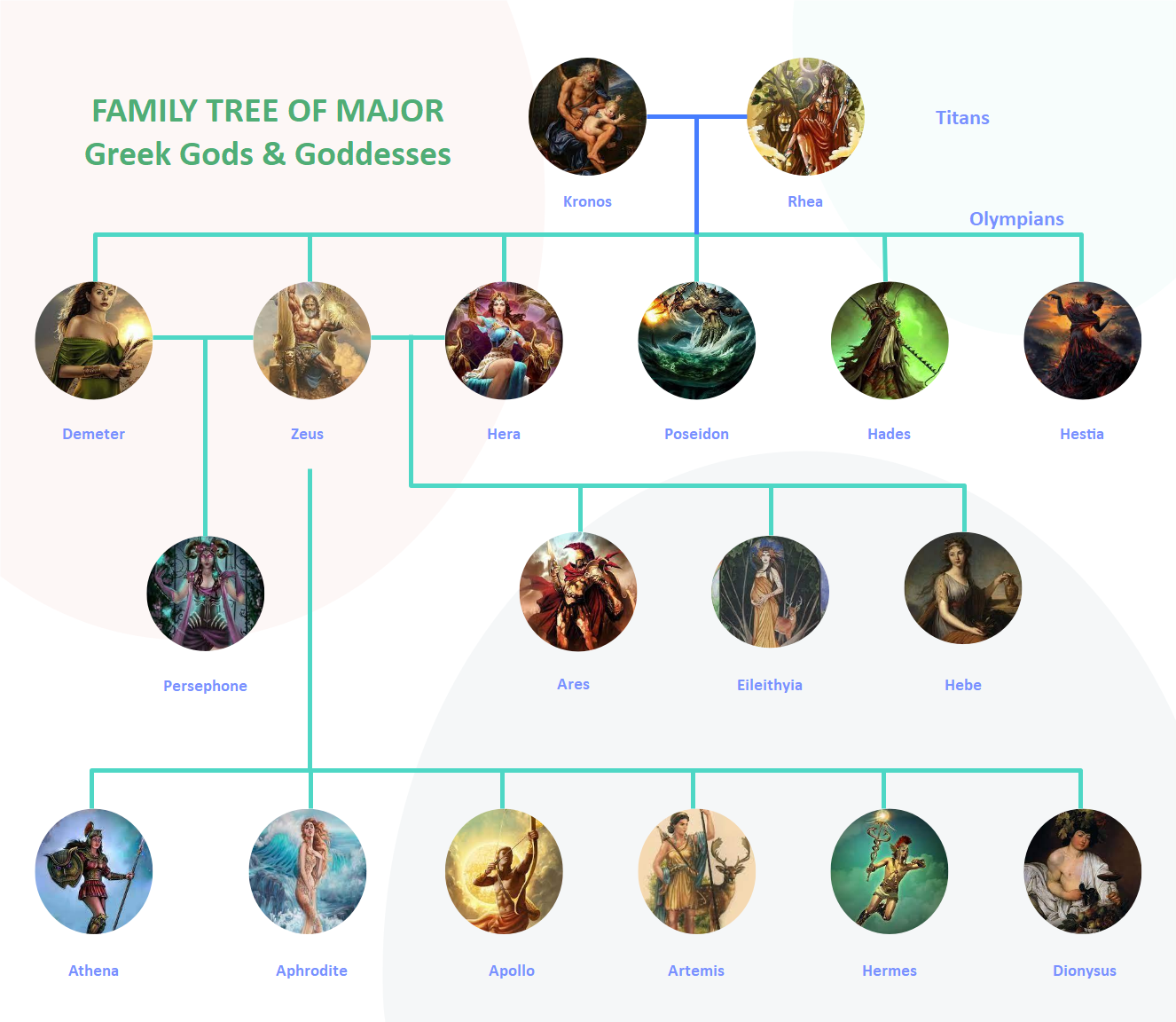
Ouranos covered Gaia as the sky, and also in the more intimate sense, when to the Greeks, time began. The seeding of Gaia produced twelve healthy, robust children – six male and six female. The males were OCEANUS, COEUS, CRIUS, HYPERION, IAPETUS and KRONOS. The females were THEIA, THEMIS, MNEMOSYNE, PHOEBE, TETHYS and RHEA. These twelve became the Second Order of divine beings.
In retaliation for Ouranos’s cruelty Gaia enlisted the help of her strongest son, Kronos, and took him to Mount Othrys, where she had hidden a weapon that she fashioned; a sickle. But this was no ordinary sickle, it was made from adamantine, which means ‘untameable’, along with a massive aggregate of grey flint, granite, diamond and ophiolite, and it’s half-moon blade had been refined to the sharpest edge. An edge that could cut through anything…
She instructed him to wait in the cleft where the sickle was hidden, and when Erebus and Nyx had cast the dark over them which would be when Ouranos was in the midst of his passionate overtures to Gaia, he was to strike.
Kronos felt rage towards his father, and so had no qualms waiting until Ouranos was vulnerable, swinging the scythe powerfully down and slicing his father’s genitals off. Probably the whole universe could hear the deity’s anguished screams.
And in his desperate pain, Ouranos cursed Kronos: May your children destroy you as you destroyed me.
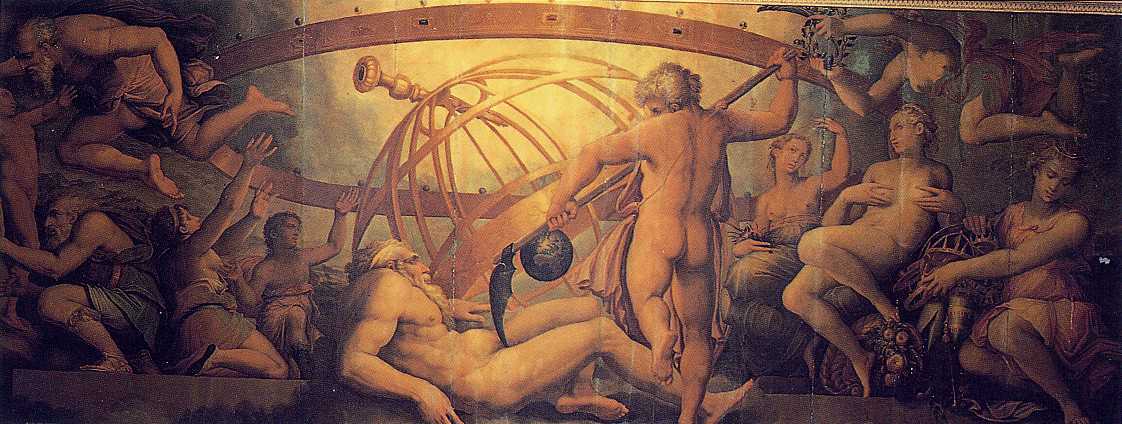
The Mutilation of Uranus by Saturn by Giorgio Vasari and Cristoforo Gherardi (Palazzo Vecchio)
Kronos then hurled his father’s bloody and semen soaked tackle far, far across Greece until his organs of generation vanished across the waters.
Ouranos compressed all his fury and divine energy into the very rock itself, hoping that one day some excavating creature somewhere would try to mine it and try to harness the immortal power that radiated within. For better or for worse, Homo sapiens are the race that has been successful in unleashing the power of Uranium…
The Birth of Aphrodite
Meanwhile Ouranos’s severed gonads splash down near the Ionian island of Cythera and as it bubbles beneath the surface a whirlpool of blood and seminal fluid foments, fizzes and foams, out of which rises a fully formed woman, the most beautiful in all creation. Her name is Aphrodite. Perfect love and beauty has made her way onto a beach in Cyprus, and the world will never be the same again.
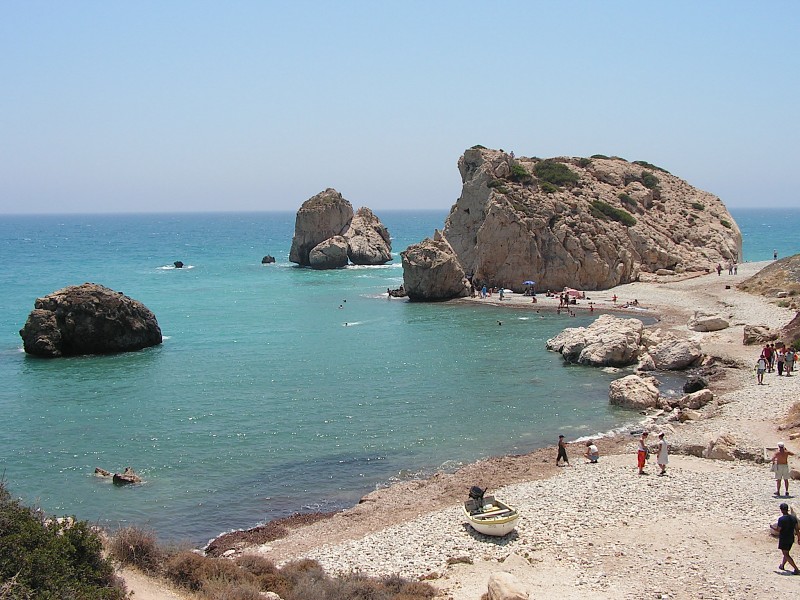
Aphrodite’s Rock, Paphos
Kronos was the master now, and he mated with his Titan sister Rhea, who soon became pregnant. But Kronos did not feel joy, rather foreboding at the curse Ouranos had placed on him to suffer the same fate.
Kronos usurped all his siblings and became a tyrant, ruler of the earth, sea and sky. Rhea gave birth to a girl; Hestia, whom Kronos snatched away and swallowed whole. Somehow they continued mating, and Rhea gave birth to Hades, who was devoured, then Demeter, Poseidon and Hera – all of whom were swallowed whole.
By now, naturally, Rhea hated Kronos for consuming all their children. When she discovered she was pregnant with a sixth child (a boy), she resolved to protect him from the same fate as his siblings. She left Mount Othrys and roamed the earth, calling out to Gaia and Ouranos and the three of them hatched a plan.

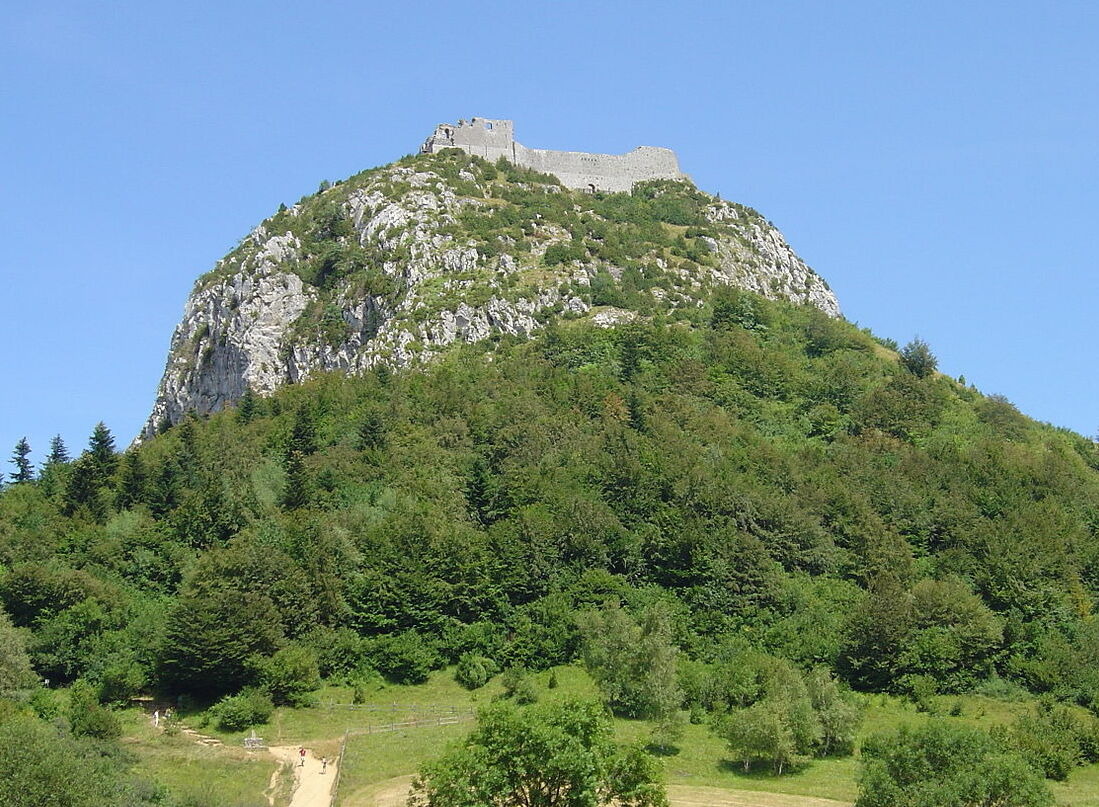
Mount Othrys, Greece
Rhea visited the she-goat Amalthea on Crete and then returned to Mount Othrys. With his father’s prophecy still ringing in his head, Kronos readied himself to devour this last baby. But Rhea had secretly taken a baby shaped stone of magnetite and swaddled it in linen. She pretended to give birth, and like the last five times before, Kronos snatched the baby boy (or so he thought), and gulped him down.
Rhea then left for Crete, where the she-goat and Meliae assisted her in giving birth on Mount Ida. A radiantly beautiful baby boy was born; and she named him Zeus.
Nourished by Amalthea and the Meliae, Zeus grew up strong, as Rhea raised him to take revenge on her brother and husband Kronos. The dreadful cycle of blood-lust, greed and killing that marked the birth pangs of the primordial deities would continue as prophesised into the next generation.
Knowing he was safe, Rhea returned to Mount Othrys, pretending that everything was hunky dory, all the while Zeus became strong and playful on nutrient rich milk and manna, hidden from his cruel father. The Romans called him Jupiter or Jove, he had quite literally a jovial disposition!
Now that he was a young adult, Rhea arranged for her wise friend Metis, (daughter of Tethys and Oceanus) to prepare her son for what was to come. Zeus was captivated by her beauty and tried to seduce her. But Metis resisted and taught him how to look into the hearts and judge the intentions of others, how to imagine and how to reason, how to find the strength to let passions cool before acting. He learned how to make a plan, and how and when to change that plan if necessary.
When Zeus turned 17, Metis made a tincture of mustard seeds, ground salt crystals and poppy juice. Rhea came for her son and they travelled to Mount Othrys, where Rhea tricked Kronos into thinking that Zeus was a cup bearer, and he offered his terrible father the potion. After drinking it all he did not feel well. First he vomited up the stone, and then with a massive heave his children were regurgitated one by one. Hera came out first, as she was last in, followed by Poseidon, Demeter, Hades and lastly Hestia.
Exhausted, and now feeling the soporific effects of the drink, Kronos fell into a deep sleep.
Each of the five siblings took it in turns to greet and hug their younger brother and rescuer, who was now their older brother and leader. They swore allegiance to Zeus and vowed to overthrow Kronos and the whole race of Ttitans and establish a new order.
There followed a 10 year war between the Gods, monsters and Titans, known to historians like Hesiod (8th Century BC) as the TITANOMACHY, unrivalled in its fury, its colossal energy and explosive power – a literal earth-shaking conflict.

Joachim Wtewael – Battle Between the Gods and the Titans
When the dust settled, new growth burst through to create a fresh, green world for the triumphant gods to inherit.
Kronos’s punishment as a defeated Titan was to ceaselessly travel the world as his father had foretold, measuring out eternity in inexorable, perpetual and lonely exile. Every day and hour and minute was his to be marked out, for Zeus doomed Kronos to count infinity itself.
He became the pathetic figure of ‘Old Father Time’, the embodiment of the inevitable and merciless ticking of Cosmos’s clock, like a remorseless pendulum. We find Kronos in all things ‘chronic’ or ‘synchronised’, in chronographs and ‘chronicles’.
The Romans gave this Saturnine, sallow husk of a defeated Titan the name SATURN. He hangs in the sky between his father Uranus and his son, Jupiter.
The Goddess Archetypes and their Cultural Expectation and Stereotypes:
In ancient Greece, women and men alike worshipped at the shrines and altars of the goddesses depending on their particular needs. Weavers and military strategists would have honoured Athena, young girls were under the protection of Artemis, and married women honoured Hera. A lonely youth would have pleaded for Aphrodite’s intervention to bring love into their life. Mothers may have paid their dues to Demeter for offspring and invited Hestia onto their hearths to make a house into a home.
The goddesses were regarded as powerful deities, to whom homage was paid. But also revered out of fear of divine anger and retribution if they did not.
Jean Shinoda Bolen divided the goddesses into three groups: the Virgin Goddesses, the Vulnerable Goddesses and the Alchemical Goddess.
I will explore the Virgin Goddesses in Part one, and the remaining archetypes will follow in Parts two and three.
Virgin Goddesses: Artemis, Athena and Hestia
These three goddesses personify the independent, active, non-relationship aspects of women’s psychology. Artemis and Athena are outward looking and achievement oriented, whereas Hestia is inwardly focussed.
The three Virgin Goddesses represent inner drives in women to develop talents, pursue interests, solve problems, compete with others, express themselves articulately in words or through art forms, putting their surroundings in order or spending time in contemplation.
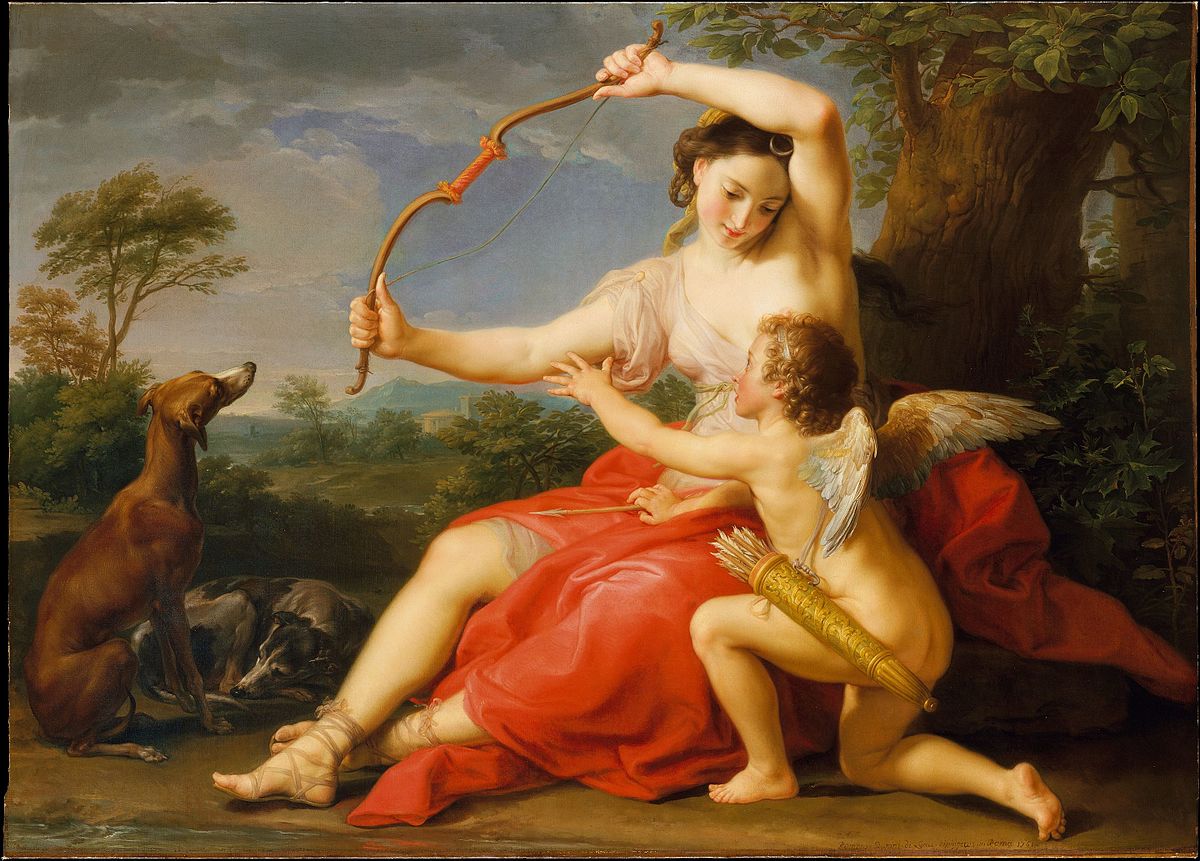
Diana and Cupid by Pompeo Batoni
The Virgin Goddess aspect is that part of a woman that is ‘un-penetrated’ by a man, that is untouched by her need for a man or to be validated, existing separate from him in her own right.
In Greek mythology these three goddesses never married, were never overpowered, never raped, seduced or humiliated by male gods or deities.
When these archetypes are dominant a woman is “one-in-herself” and belongs to no man.
Quality of consciousness – Like sharply focused light, (able to concentrate or meditate).
Artemis – Goddess of the Hunt and Moon, Competitor and Sister
Roman name: Diana
Artemis we hymn — no light thing is it for singers to forget her — whose study is the bow and the shooting of hares and the spacious dance and sport upon the mountains; beginning with the time when sitting on her father’s knees — still a little maid — she spake these words to her sire: “Give me to keep my maidenhood, Father, forever: and give me to be of many names, that Phoebus may not vie with me. ~ Hymn to Artemis by the poet Callimachus.
Artemis was the first born twin sister to Apollo (God of the Sun) and daughter of Zeus and Leto. Most art depicts Artemis as a tall, athletic goddess roaming the forests, mountains and glades with her band of nymphs and hunting dogs. She is usually armed with a silver bow and a quiver of arrows. She never missed her target! She is also depicted as a light bearer with the moon and stars surrounding her head.
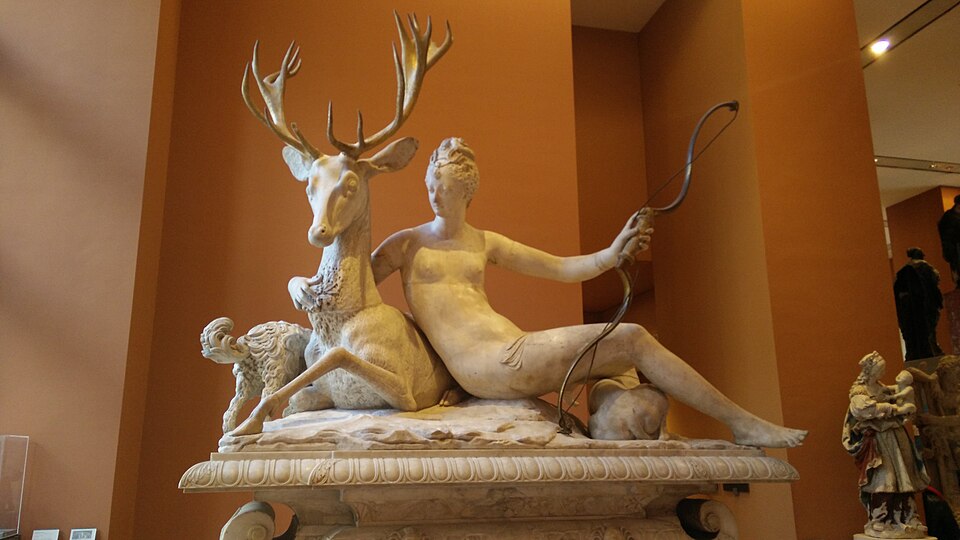
Fountain of Diana – Louvre
Her mother Leto was a nature deity, daughter of the Titans Coeus and Phoebe, an early lover of Zeus. Artemis and Apollo were conceived before Zeus married Hera, but the wedding took place during her pregnancy. She was shunned everywhere she went as others feared the wrath of Hera, who was jealous of Leto and sent the dragon Python to end her.
However Zeus saved her by sending the North Wind, Boreas, to carry her out to sea. She finally found sanctuary on the rocky island of Delos. After she was born, Artemis helped her mother give birth to Apollo (which took another 9 days of labour!). She is also known as the goddess of childbirth through her midwifery skills. Artemis and Apollo protected their mother.
In Greek mythology Artemis was a great protector to the young and those who asked for her help. She acted swiftly and decisively to rescue those in need. She was also quick to punish those who offended her. Mercy and ruthlessness were both part of her nature. She slew the giant Tityus who tried to rape her mother Leto as she was travelling to Delphi. Artemis repeatedly came to her mother’s aid.
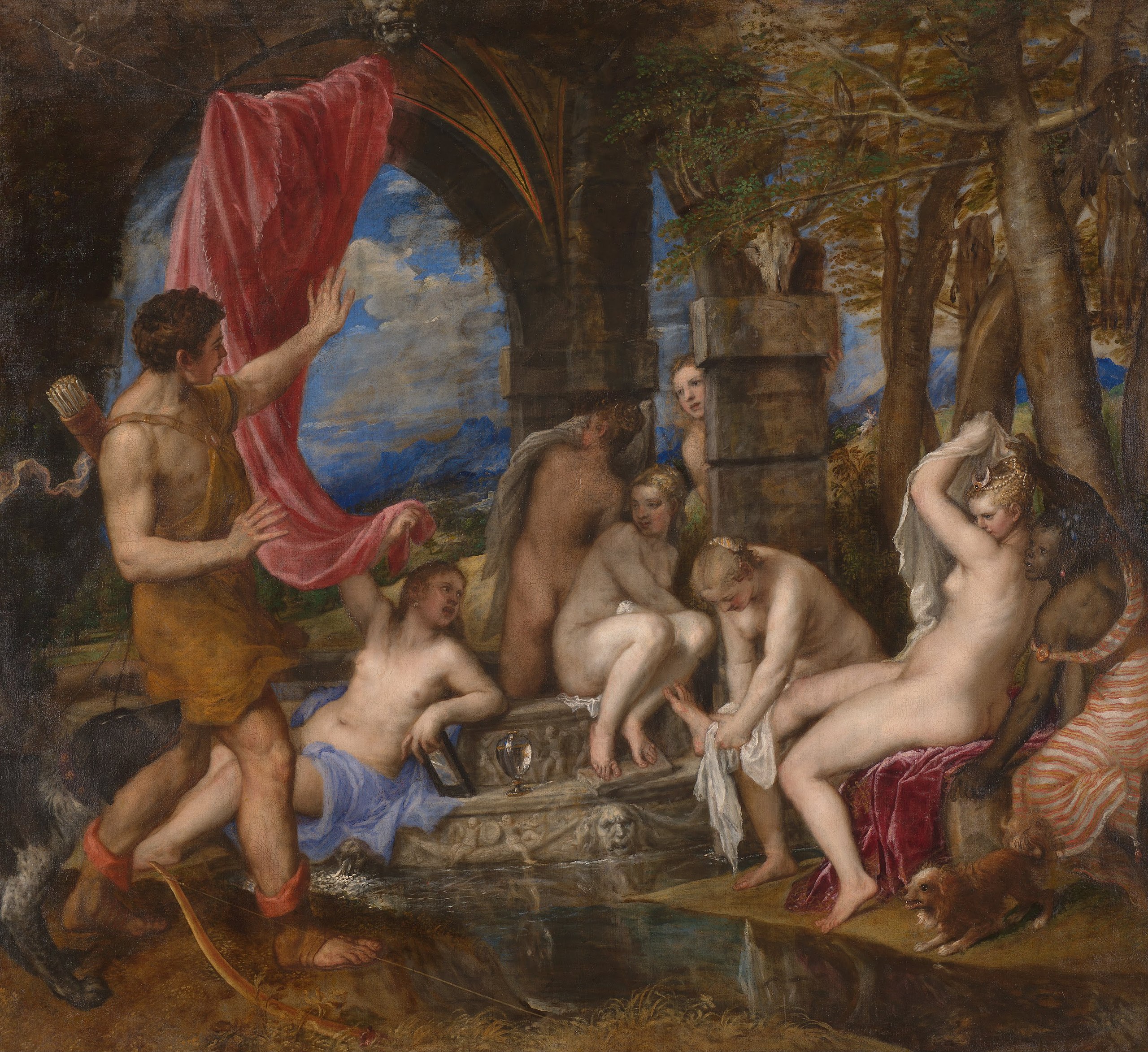
Titian – Acteon and Diana c. 1556 – 1559
The blundering Acteon also discovered (to his peril), the merciless side of Artemis. He came across Artemis and her nymphs bathing in a secret pool, but instead of quickly departing he stopped to stare at them. Big mistake. When Artemis saw him gawking she was offended and splashed water in his eyes. He was duly transformed into a stag and ran away in panic, but was chased down and killed by his own hunting dogs.
Artemis was in love another hunter – Orion. Sadly she killed him in error. Orion was swimming out at sea, and Apollo, jealous of her love for him goaded her to reach a target at sea (she could not see that it was actually Orion’s head).
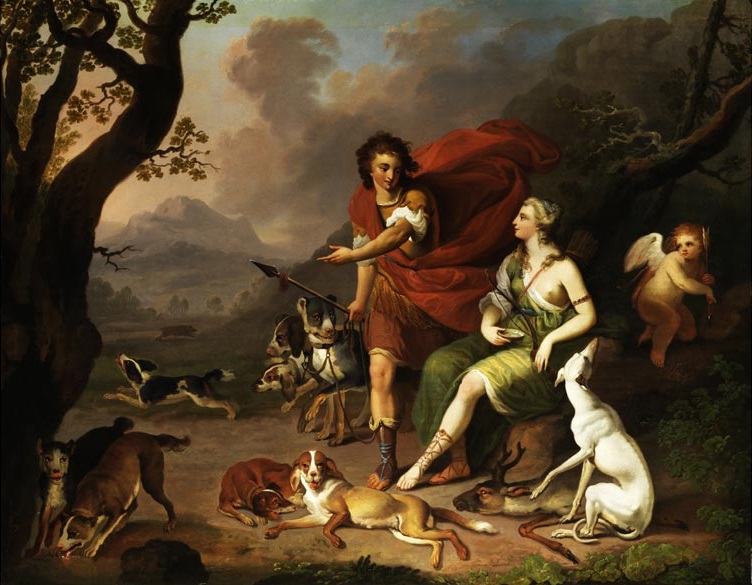
Diana and Orion by Johann Heinrich Tischbein c.1762
Her competitiveness meant that she would not ignore Apollo’s challenge, and her arrow reached its tragic mark. Artemis placed Orion among the stars with one of her own hounds, Sirius the Dog Star, to accompany him across the heavens.
Artemis the Archetype
Artemis as the Goddess of the Hunt and the Goddess of the Moon was a personification of an independent feminine spirit. The archetype enables a woman to seek her own goals on terrain of her own choosing.
This archetype enables a woman to feel whole without a man. She can pursue interests and work at what matters to her without masculine approval. Her identity or sense of worth is derived from who she is and what she does, rather than whether she is married or to whom.
She represents the goal focused archer. When this archetype is activated the woman will have an innate ability to concentrate intensely on whatever is important to her without distraction from the needs of others. She is not afraid of competition.
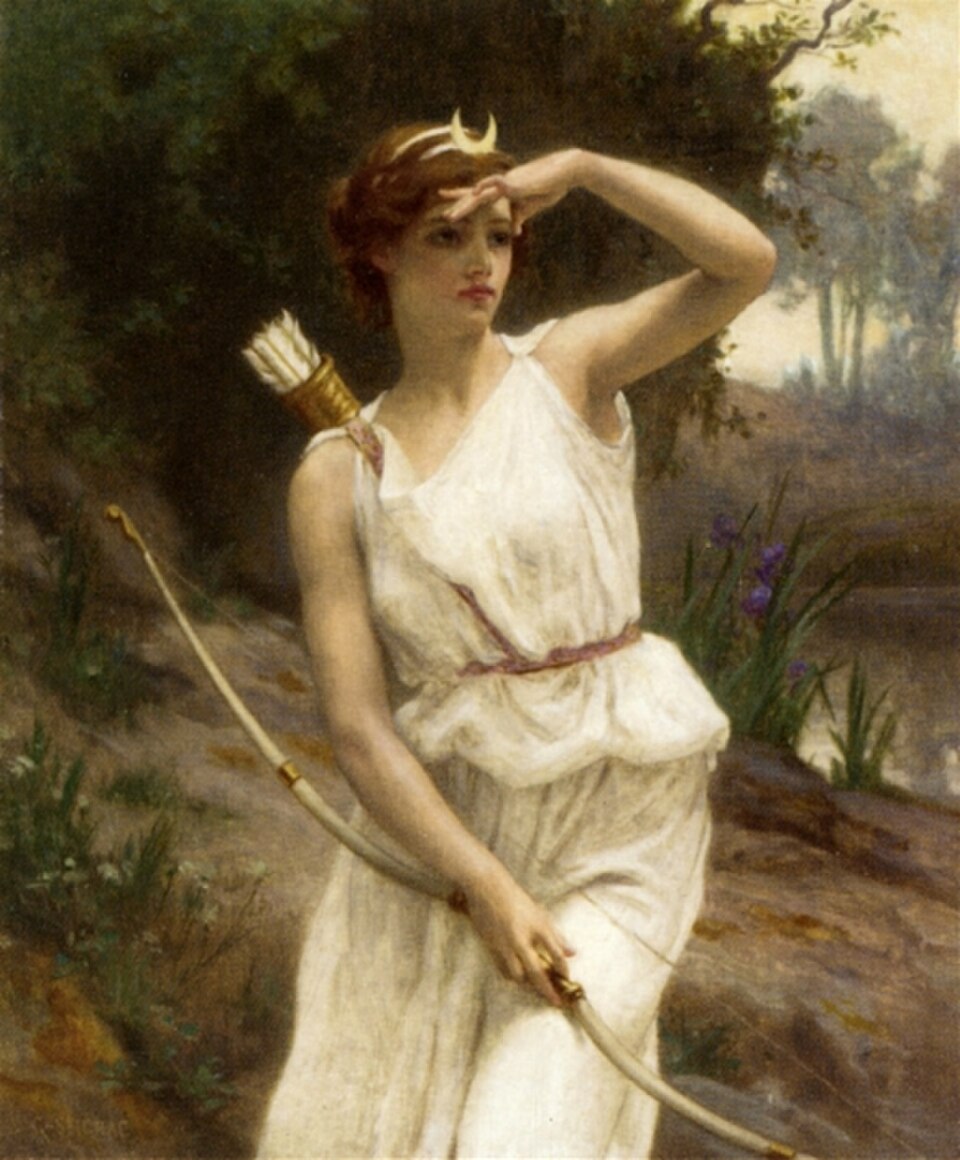
Diana the Huntress by Guillaume Seignac
Artemis is the foundation of the women’s movement or feminism, as she represents the qualities of achievement, competence and independence. She shows concern and empathy for victimised women and the young. She was the protectress of pre-adolescent girls.
Artemis embodies the ‘sisterhood’, she was usually roaming the land with her nymphs…
The journalist and social activist Gloria Steinem is the personification of Artemis. Interestingly literature is littered with archetypes – look at Wonder Woman, who disguised herself as Diana (the Roman name for Artemis).
The natural world is very important to Artemis women, they have an affinity for animals and feel at one with nature. I’m always happy when setting out on a hike and feel in spiritual communion with nature.
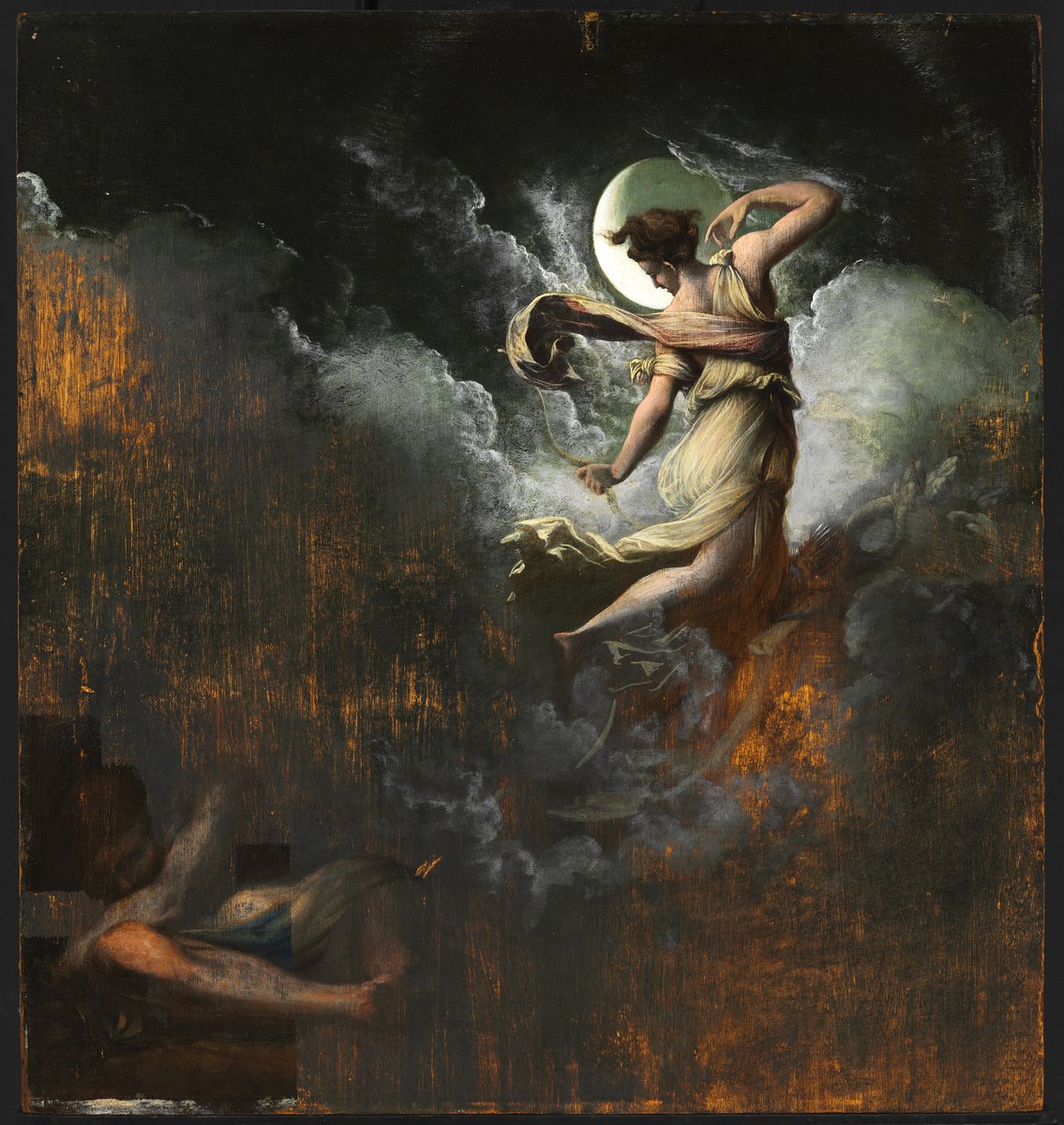
Artemis has two modes of vision: eye-on-target clarity and the ‘moon vision’, which is indistinct, beautiful and often mysterious. One’s vision is drawn upwards into the panoply of stars and moonlight. It is a reflective state.
Cultivating Artemis
A woman who marries young often goes from being a daughter to a wife (Persephone and then Hera), and she may discover and value Artemis qualities after a divorce, when she may be living alone for the first time.
Spending time with her own friends, taking up a sport or spending time in nature, doing her own activities or joining a women’s networking group are all helpful ways of encouraging our inner Artemis!
The Artemis Woman
Artemis qualities appear early. As a youngster she may become absorbed in new objects and she is active rather than passive. She has powers of concentration, even as a toddler, and a certain stubborn streak!
Artemis women are great explorers. Artemis feels strongly about her causes and principles and may have come to the defence of a younger sibling or friend, angry about a sense of injustice. She will demand equality.
Parents
Being able to recognise archetypal patterns in our offspring we can be of invaluable service to their wellbeing and development by accepting their innate traits with parental approval.
Artemis types need to feel good about who they are as people in order to succeed and achieve in life, to reach her Artemis potential. Ideally she may have a loving ‘Leto’ type mother and a supportive ‘Zeus’ like father who provides gifts that will help her do what she wants to do. These gifts can be both tangible and intangible. I think a good example would be Serena Williams who was coached by her father.
Opposition and disapproval of her independent nature may harm her self-esteem and self-confidence. It is important to accept if she is a tom boy and prefers looking for bugs in the dirt rather than wearing frilly dresses.
The damage psychologically if she is not encouraged to be herself will show up as self-doubt, and self-sabotage could ensue. Deep down she may struggle with feelings that she is not good enough, may hesitate when new opportunities arise and achieves less than she is capable of.
This pattern is culturally expressed by families and cultures that place a higher value on sons than on daughters (China and India), and that expect daughters to be stereotypically feminine.
Another danger area is when they may view their mothers as weak (if they have suffered from depression or been victimised) and feel that they had to take on the parent role. An Artemis daughter may lack respect for her mother whose major roles have been the traditional ones or if she is in a bind. If she does identify with her mother she may reject what is considered feminine; softness, receptivity, and stirrings towards eventual marriage and motherhood. She may be plagued by inadequacy in the realm of her feminine identification.
Adolescence and young adulthood
As a girl, the Artemis woman typically is a natural competitor, with perseverance, courage and the will to win. She will push herself to the limit in the pursuit of a goal. Activities such as the Brownies, Girl Guides and sports clubs will interest her. The unmistakable Artemis teenager could be horse or sport crazy.
She has a streak of independence and a predilection for exploration. She will venture into the woods, and usually finds a group of like-minded ‘spirits’ to run with. I certainly had my fair share of woodland adventures growing up, and ran for Bucks at national cross-country races. I was fortunate to have lived in a relatively rural area.
Work
The Artemis woman puts effort into work that is of subjective value to her. If she is in a creative field she is most likely expressing a personal vision. In business she may have started out with a product or service that she believed in. Artemis has a fundamental courageous quality.
Relationship to Women
Artemis women have a sense of affiliation with other women and she usually considers her friendships with other women to be very important. She may have had a few ‘best friends’ at primary school, and these friendships can span decades. An Artemis woman will usually feel that she is an equal of men.
Relationship to Men
As she had a twin brother, Apollo, her relationship with men has a ‘brotherly’ element.
Like his sister, Apollo (the God of the Sun) is androgynous; each had some qualities or interests that are usually linked with the opposite sex.
The Artemis-Apollo twin-ship is the model most commonly seen in the relationships that Artemis women have with men – be they friends, colleagues or husbands. The Artemis woman can be strongly attracted to a man whose personality has an aesthetic, creative, healing or musical side.
The Artemis woman is not charmed by ‘macho’ or dominating men, she prefers someone of her intellectual equal and with shared or aligned interests. However, if her partner is not physically active she may feel that an essential element of the relationship is missing.
The Artemis-Apollo relationship may result in an asexual, companionable marriage, in which partners are each other’s best friends.
Children
Artemis doesn’t usually feel a strong instinctual pull to be a mother and may abhor being pregnant, but she does like children.
When an Artemis woman has children of her own she is often a good mother. Like the female bear – which is her symbol – she will foster independence and teach her young how to fend for themselves and will also be ferocious in their defence!
Middle Years
The mid-life of an Artemis may usher in a more reflective time as she turns inward, more influenced by Artemis as Goddess of the Moon than by Artemis as Goddess of the Hunt.
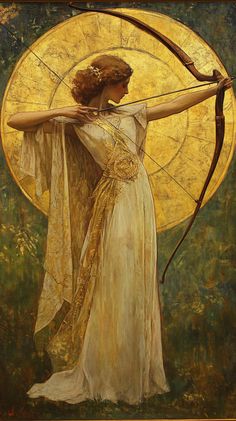
A menopausal impetus towards introversion is related to Hecate, the old crone who was the goddess of the dark moon, ghosts and the uncanny. Hecate and Artemis were both moon goddesses who roamed on Earth. The connection between these two goddesses is seen in older Artemis women who venture into psychic, psychological or spiritual realms, with the same sense of exploration they had as a younger woman in other pursuits. I strongly resonate with this aspect of Artemis at this stage in my life…
Later years
It is not unusual for a woman to have her Artemis qualities persist into old age. Her youthful activeness is still going strong. She may travel to new countries or take on new projects. She will retain her affinity for the young and be ‘young at heart’ herself.
I fully plan to be going on adventures with my grandchildren to be if I am so blessed at some point in the future.
Psychological Difficulties
Artemis did have a propensity to harm others who offended her, or threatened those under her protection. Similarly, any psychological difficulties that may arise with this archetype are that characteristically she may cause others to suffer rather than bringing pain on herself.
If she is not involved in interests that are personally rewarding she may find herself feeling thwarted and unable to find adequate expression, leading to frustration and ultimately depression.
The rage of Artemis is surpassed only by that of Hera. However, whereas Hera rages at other women, Artemis is likely to be more angry at a man for depreciating her or for failing to treat her with respect, or something she values. Beware of the rampage of the Calydon Boar!
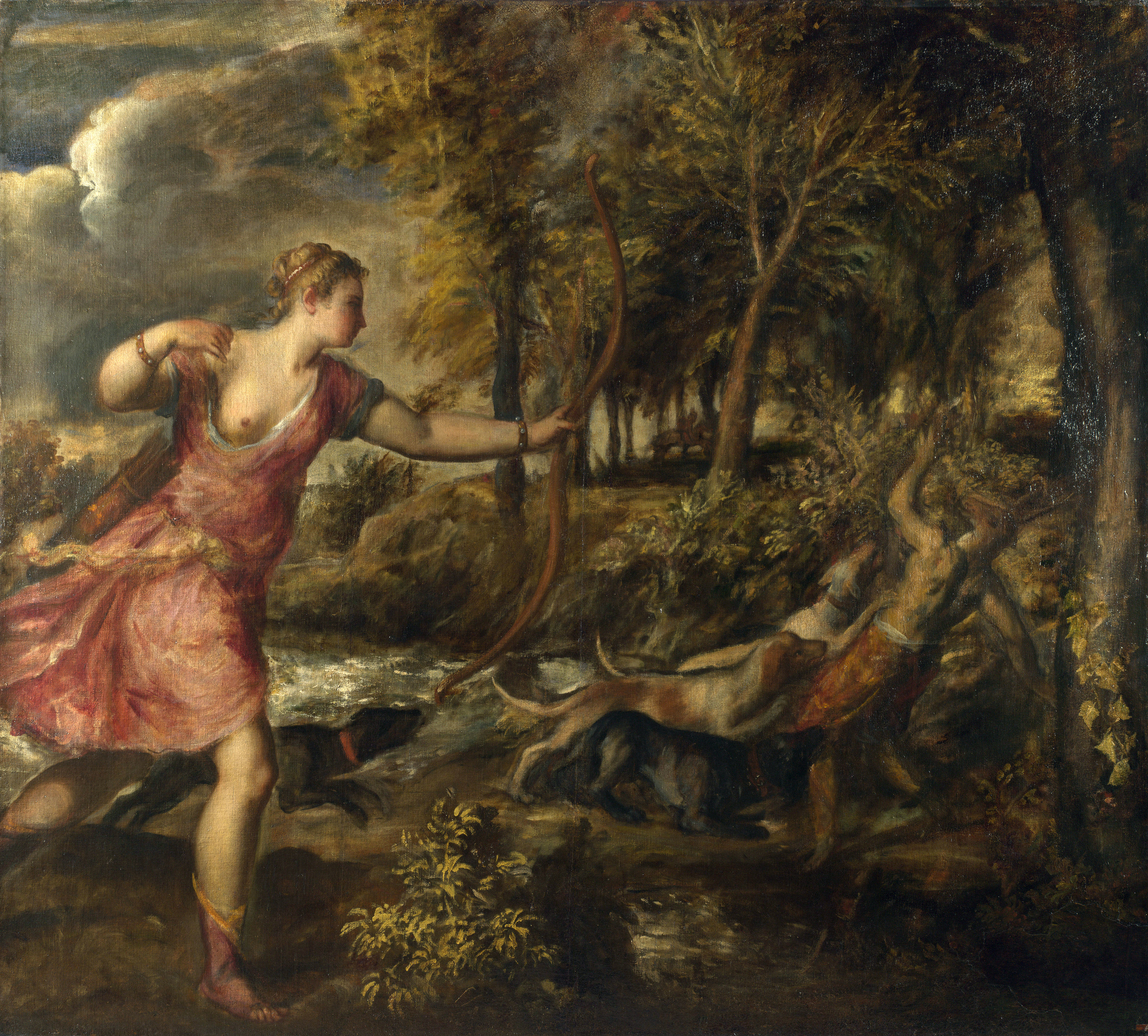
Titian – The Death of Acteon
The Artemis woman must confront her own destructiveness directly, and see it as an aspect of herself she must stop before it consumes her and devastates her relationships. It takes courage to confront the inner boar and view the damage she has left in her wake; she may no longer feel righteous and powerful.
Humility is the lesson that restores her humanity. She too is a flawed woman, not an avenging goddess!
Ways to Grow
An Artemis woman may feel justified in retaliating or punishing wrong-doers, and her lack of mercy can at times be appalling. She needs to develop compassion and empathy, which may come with maturity.
The myth of Iphigenia can speak to a significant choice for an Artemis woman.
In the story of the Trojan War, the Greek army could not set sail as there were no winds to billow and propel the sails. The seer declared that Artemis had been offended and could only be appeased by the sacrifice of Agamemnon’s daughter Iphigenia. Eventually, full of frustration, Agamemnon tricked his wife Clytemnestra into sending Iphigenia to him on the pretext that she was to marry the Greek hero Achilles.
Instead she was prepared for the sacrifice – her life in exchange for the fair winds to carry the fleet to war. It was a monstrous proposition.
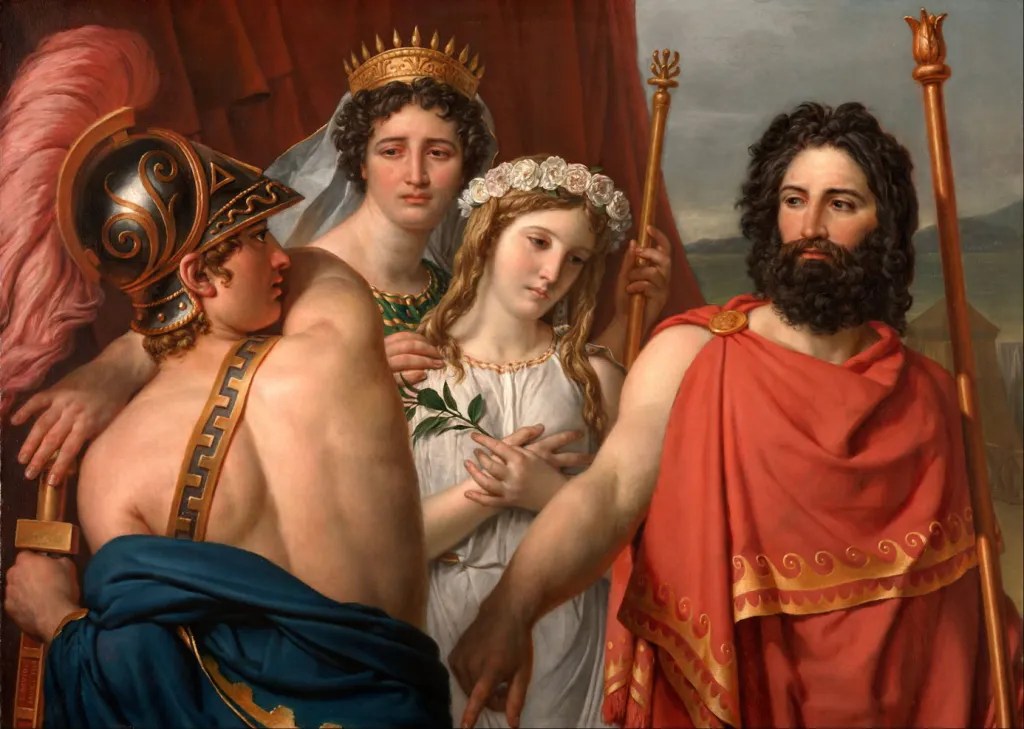
Jacques Louis David – The Anger of Achilles (Iphigenia)
There are two versions of the outcome of this story: one is that Iphigenia’s death was carried out as demanded by Artemis, the other tells that Artemis interceded just at the point of sacrifice, substituting a stag in her place, and transported Iphigenia to Tauris, where she became one of Artemis’s priestesses.
These two endings highlight two possible effects of Artemis. On the one hand she rescues women and feminine values from the patriarchy, which devalues or oppresses both. On the other, with her intense focus on goals she can also require that a woman devalue and sacrifice what has been traditionally considered ‘feminine’ qualities of receptiveness, nurturing and relating to others and willing to make sacrifices for the sake of others.
Every Artemis will be faced with the Iphigenia part of herself – but will she rescue and protect this aspect of herself so that it can grow as she moves through her life, aiming for what matters to her; or will she kill her inner Iphigenia that represents beauty, trust, vulnerability, potentiality for intimacy and dependency on others, in order to be as focused, hard and driven as possible?
Athena – Goddess of Wisdom and Crafts, Strategist and Father’s Daughter
Of Pallas Athene, guardian of the city, I begin to sing. Dread is she, and with Ares she loves deeds of war, the sack of cities and the shouting and the battle. It is she who saves the people as they go out to war and come back. Hail, goddess, and give us good fortune with happiness! ~ Homeric Hymn to Athena
Roman Name: Minerva
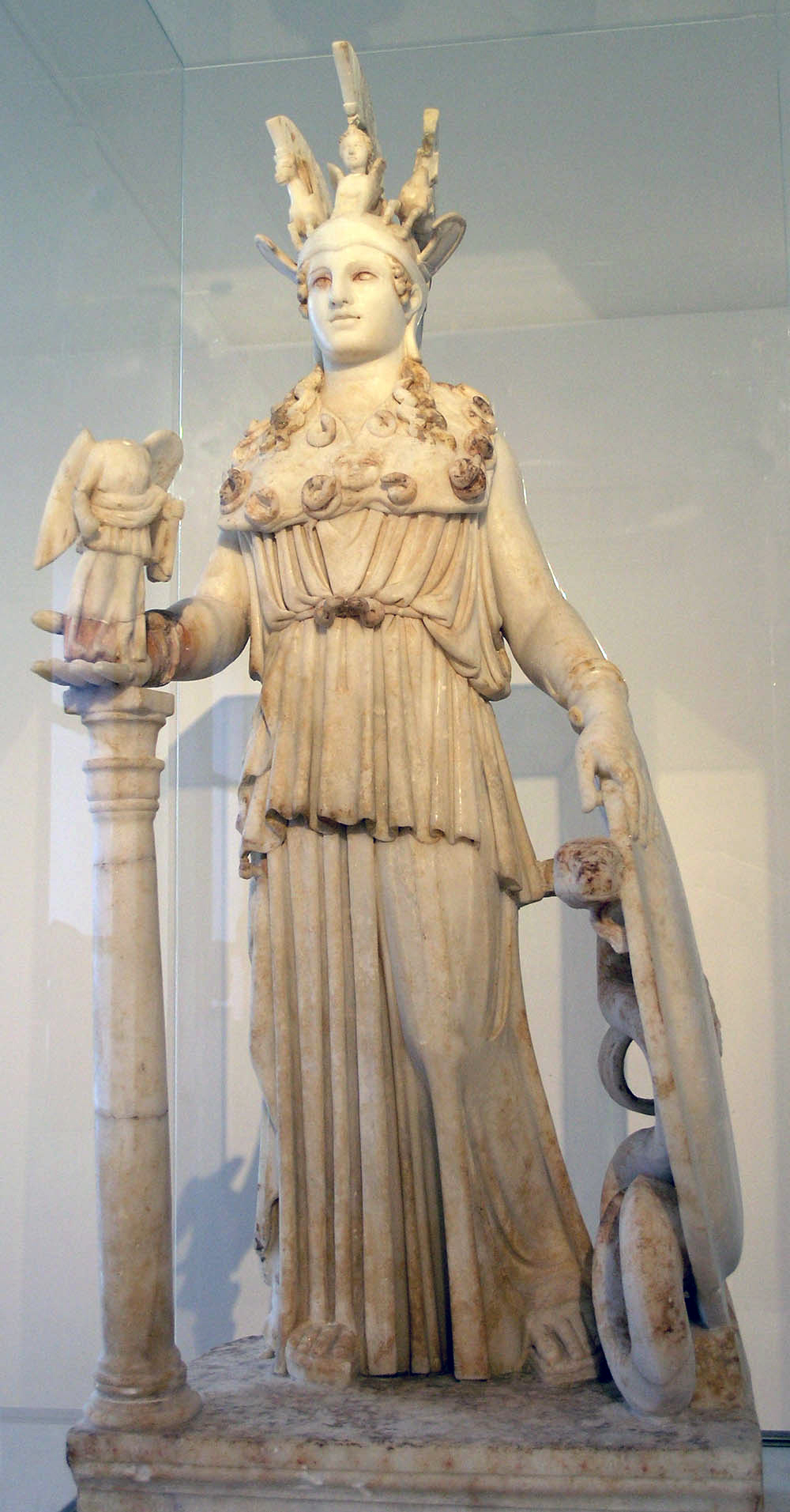
Like Artemis, Athena was a Greek goddess who was committed to chastity and celibacy. She was a stately, beautiful warrior goddess, protector of her chosen heroes and of her namesake city; Athens. She was the only Olympian goddess portrayed wearing armour. Many paintings and images of her reflect her role as the goddess who presided over battle strategy in wartime and over domestic arts in peacetime.
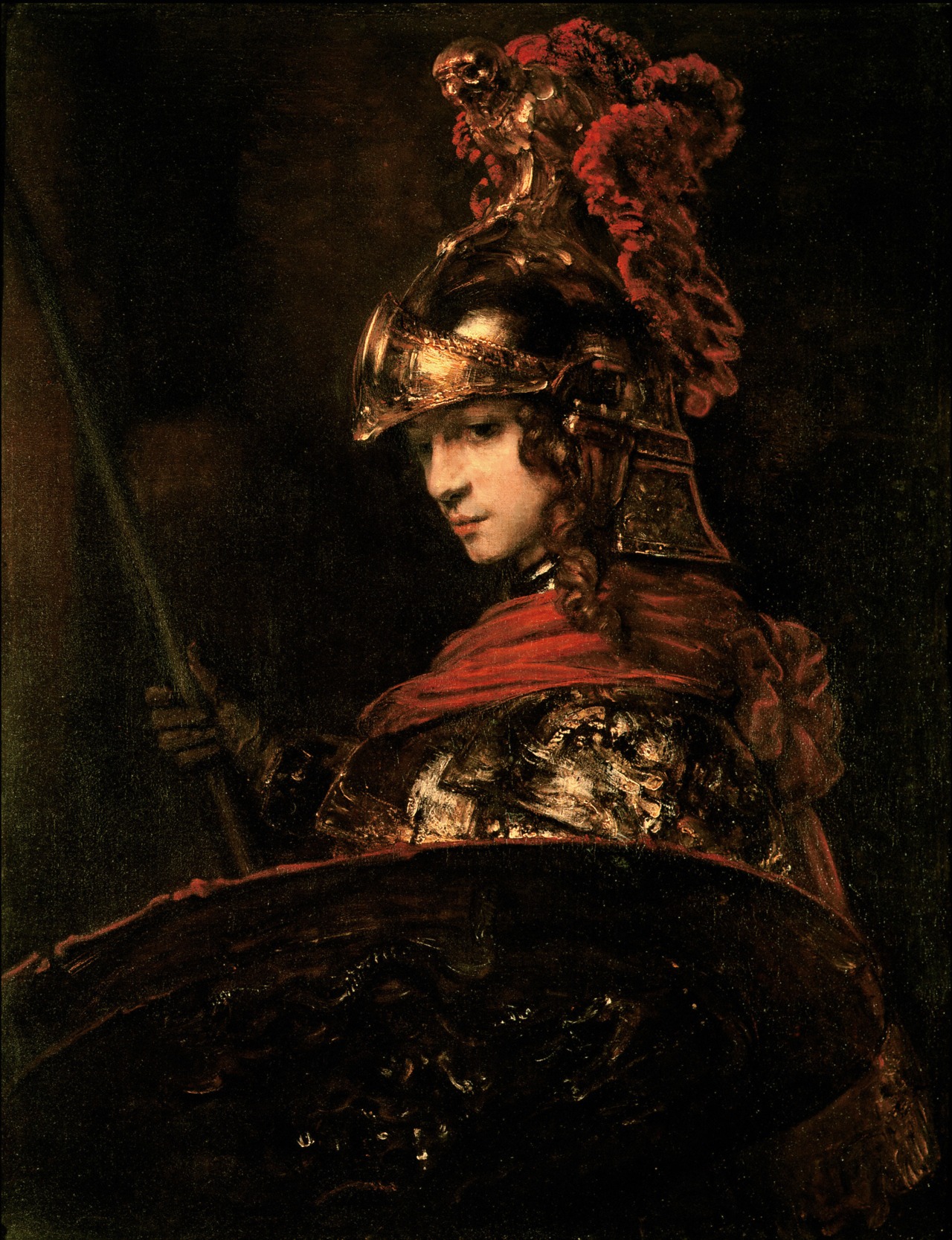
Pallas Athena by Rembrandt c. 1657
She was the protector of cities, patron of military forces, and goddess of weavers, goldsmiths, potters and dressmakers. Athena was credited by the Greeks with bestowing on humanity the bridle to the tame the horse, inspiring ship builders in their craft, and teaching people how to make the plow, rake, ox yoke, and chariot.
The olive tree was her special gift to Athens, a gift that led to the cultivation of olives.
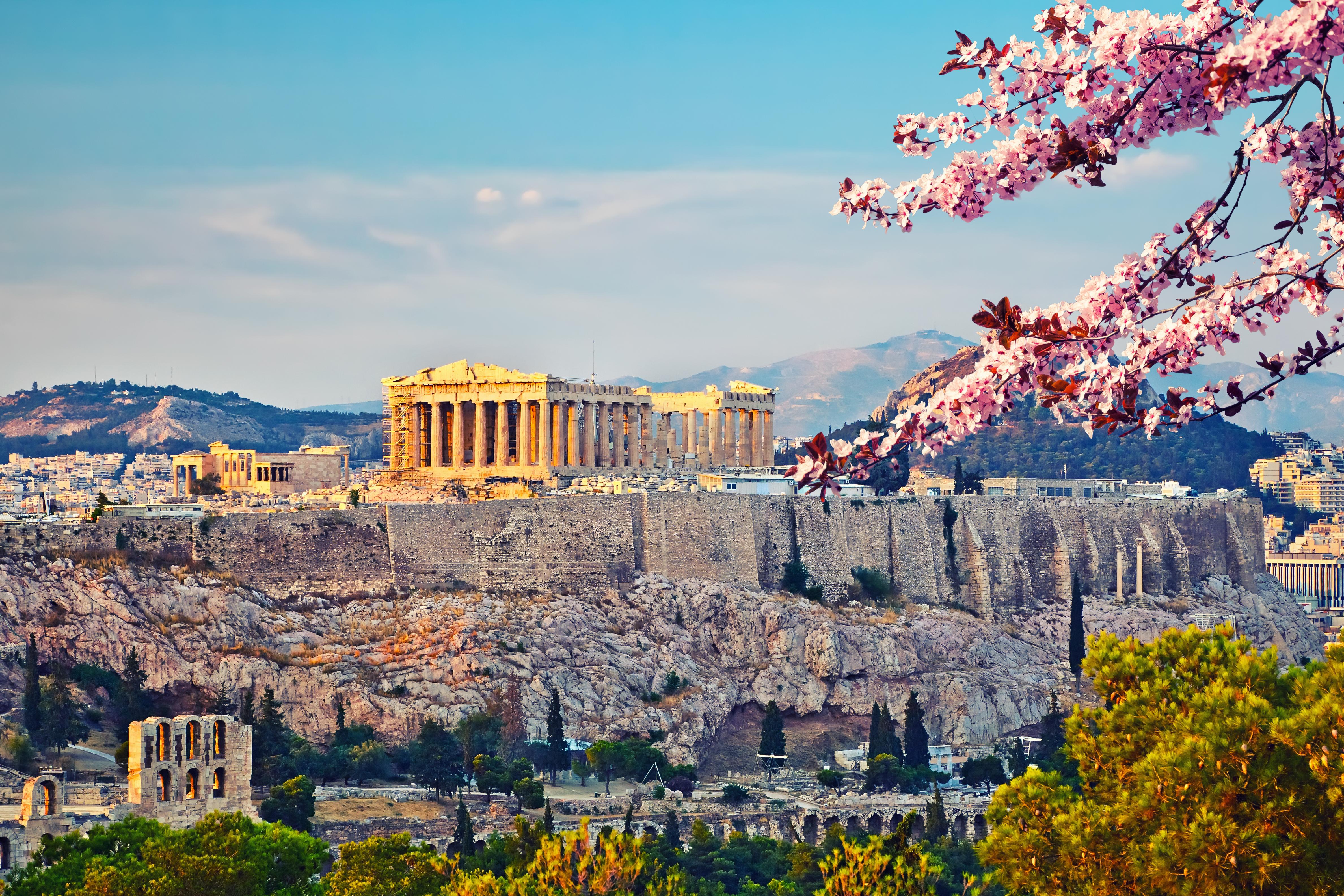
Athens – the city named after Athena
Athena was often depicted with an owl, a bird associated with wisdom and prominent eyes; two of her traits.
The martial and domestic skills associated with Athena involve planning and execution; activities that requite purposeful thinking, strategy and intellect. Athena values rational thinking and embodies the domination of will and intellect over instinct and nature. Her spirit is found in the city.
Mythology
Athena has a particularly colourful origin story! Her mother, Metis (as mentioned earlier), was an ocean deity known for her wisdom, and she became Zeus’s first royal consort. When she became pregnant with Athena Zeus tricked her into becoming small (not very wise I admit), and then he proceeded to swallow her, thus absorbing all her attributes as his own.
When the time came for Athena to be born Zeus had the mother of all headaches, so bad in fact that he enlisted the help of his son Hephaestus, the god of the forge, to strike him in the head with a double edged axe. With a mighty blow he cleaved open a birth canal in Zeus’s skull for Athena to emerge.
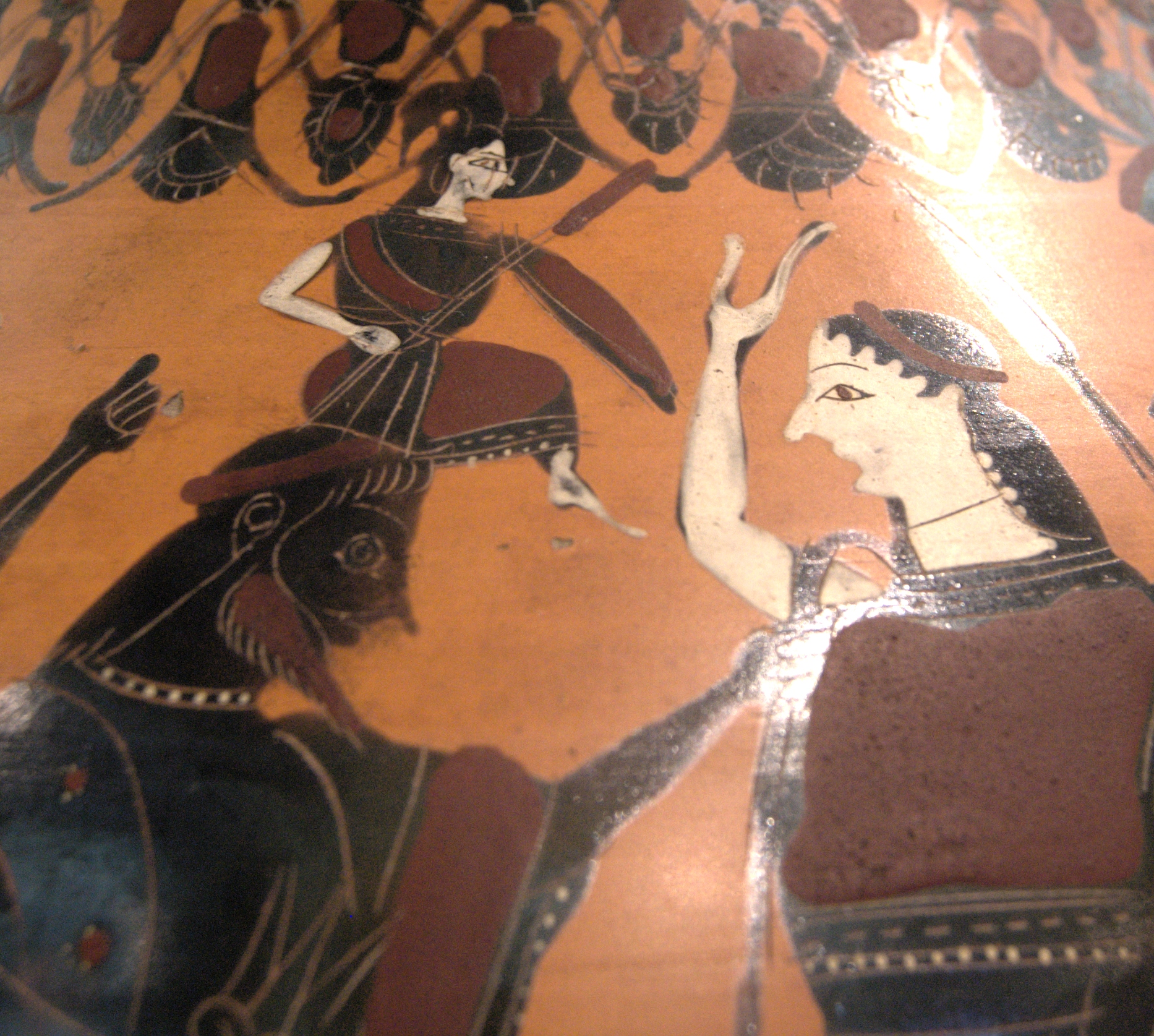
Amphora depicting the Birth of Athena – Louvre
She joined the Olympian family as a full grown woman, wearing bright gold armour, sharp spear on one hand and announcing her arrival with a mighty war cry.
Athena was her father’s daughter from the get-go, her father’s right hand woman. Athena was the only Olympian to whom Zeus entrusted his thunderbolt and aegis, the symbols of his power.
In her mythology, Athena was the protector, patron, advisor and ally of heroic men, including Perseus (slayer of Medusa), Jason and the Argonauts (to aid in the capture of the Golden Fleece), Bellerophon to tame Pegasus and Heracles to complete his twelve tasks.
During the Trojan War Athena sided with the Greeks, especially with the famous warrior Achilles and Odysseus, assisting his long journey home.
Athena sided with the patriarchy, ranking patriarchal principles above maternal bonds.
In the famous story of Arachne, a mortal woman was turned into a spider by Athena. The presumptuous Arachane was an extraordinary weaver who challenged Athena as Goddess of Crafts to a contest of skill. When they had both finished the tapestries Athena admired the flawless craftsmanship of her competitor, but she was furious at the depictions of her father Zeus in some of his amorous deceptions, and thus, the theme of her tapestry proved her undoing.
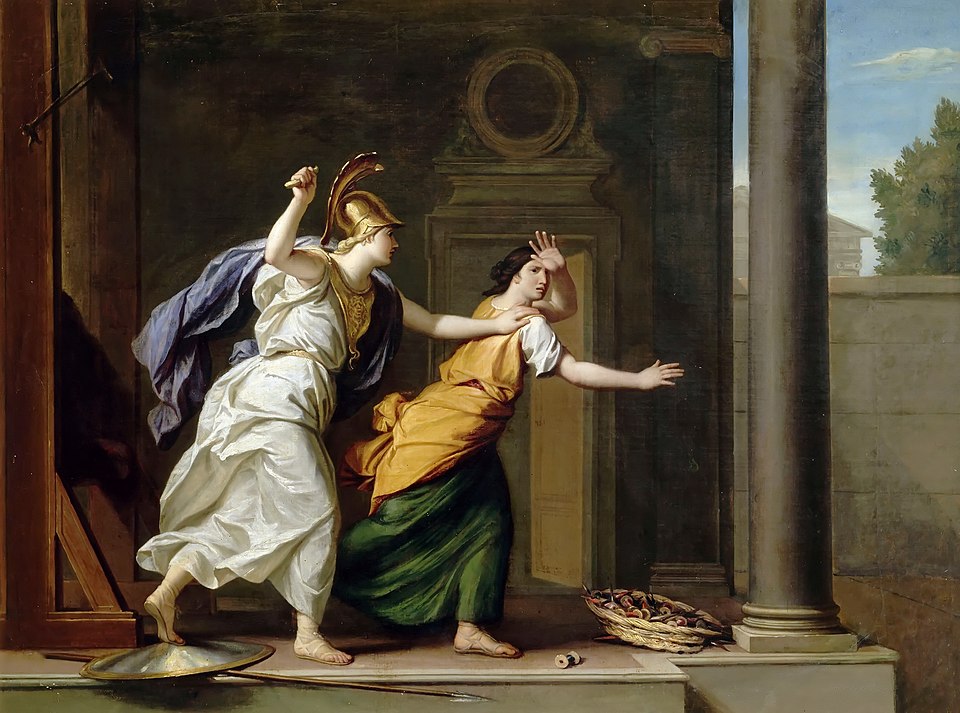
She tore the work to pieces and drove Arachne to hang herself. Taking some pity on her she let her live but transformed her into a spider, condemned to hang by a thread and spin. Hence we have the scientific name for spiders: arachnids.
Athena, being her father’s defender punished Arachne for making public Zeus’s illicit and deceitful behaviour, rather than the impudence of the challenge itself.
Athena the Archetype
As Goddess of Wisdom, Athena was known for winning strategies and practical solutions. As an archetype Athena is the pattern followed by logical women, who are ruled by their heads rather than their hearts. She was depicted in her mythology as taking an interest in worldly matters of consequence. I’m sure Athena was the dominant archetype of the late Margaret Thatcher.
When Athena represents only one of several archetypes active inside a woman’s psyche, rather than a single dominant pattern, she can become a great ally to the other goddesses.
In the midst of an emotional storm, if a woman can call on Athena as an archetype in herself, rationality will help her find or keep her bearings.
Like the Artemis archetype Athena predisposes a woman to focus on what matters to her, rather than the needs of others. Athena differs from Artemis and Hestia as Virgin Goddesses in that she seeks the company of men. She enjoys being in the midst of male action and power.
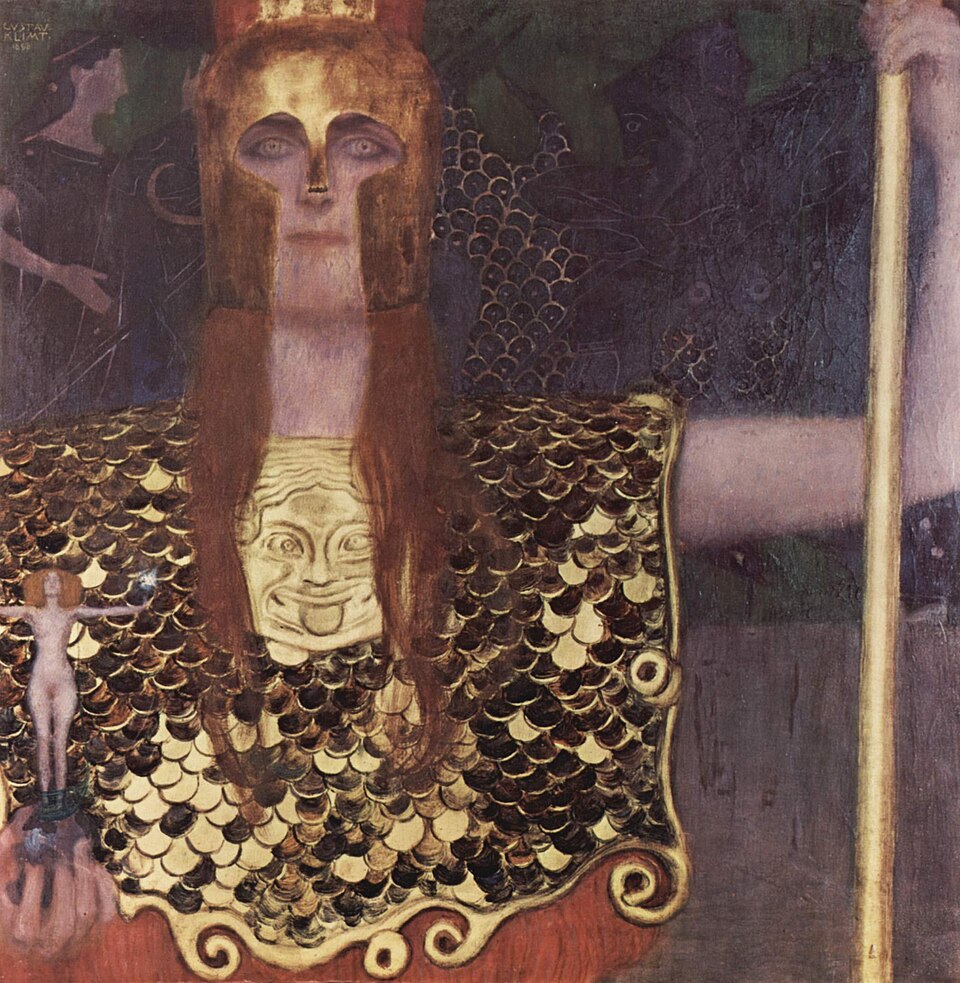
Athena with her Aegis by Gustav Klimt
She can be a confidante, colleague and companion of men without developing erotic attachments or emotional intimacy. She is the epitome of the ‘sensible adult’.
The Athena archetype thrives in the business, academic, scientific, military or political arenas.
Frontier women who spun thread, wove cloth, and made practically everything that was worn by their families embodied Athena in her domestic realm.
Athena naturally gravitates to powerful men – those with authority, responsibility and power – those men who fit the patriarchal archetype of the father or ‘boss man’. She looks to form mentor relationships with strong men who share mutual interests and will offer her allegiance, defending him ardently if required. Being born fully armoured Athena keeps her cool under pressure.
Cultivating Athena
Women with other dominant goddesses can cultivate the Athena archetype through education and work. Learning objective facts, thinking clearly, preparing for exams, and taking tests are all exercises that evoke Athena. Athena can develop out of necessity.
Athena becomes activated at any point a woman needs her wise counsel. Invite the ‘ever near’ Athena to assist with an emotional situation or whenever she competes with men in her chosen professional field.
The Athena Woman
Generally speaking an Athena dominated woman is practical, uncomplicated, unselfconscious and confident, someone who gets things done without a fuss. She is usually in good health, has no mental conflicts and is physically active.
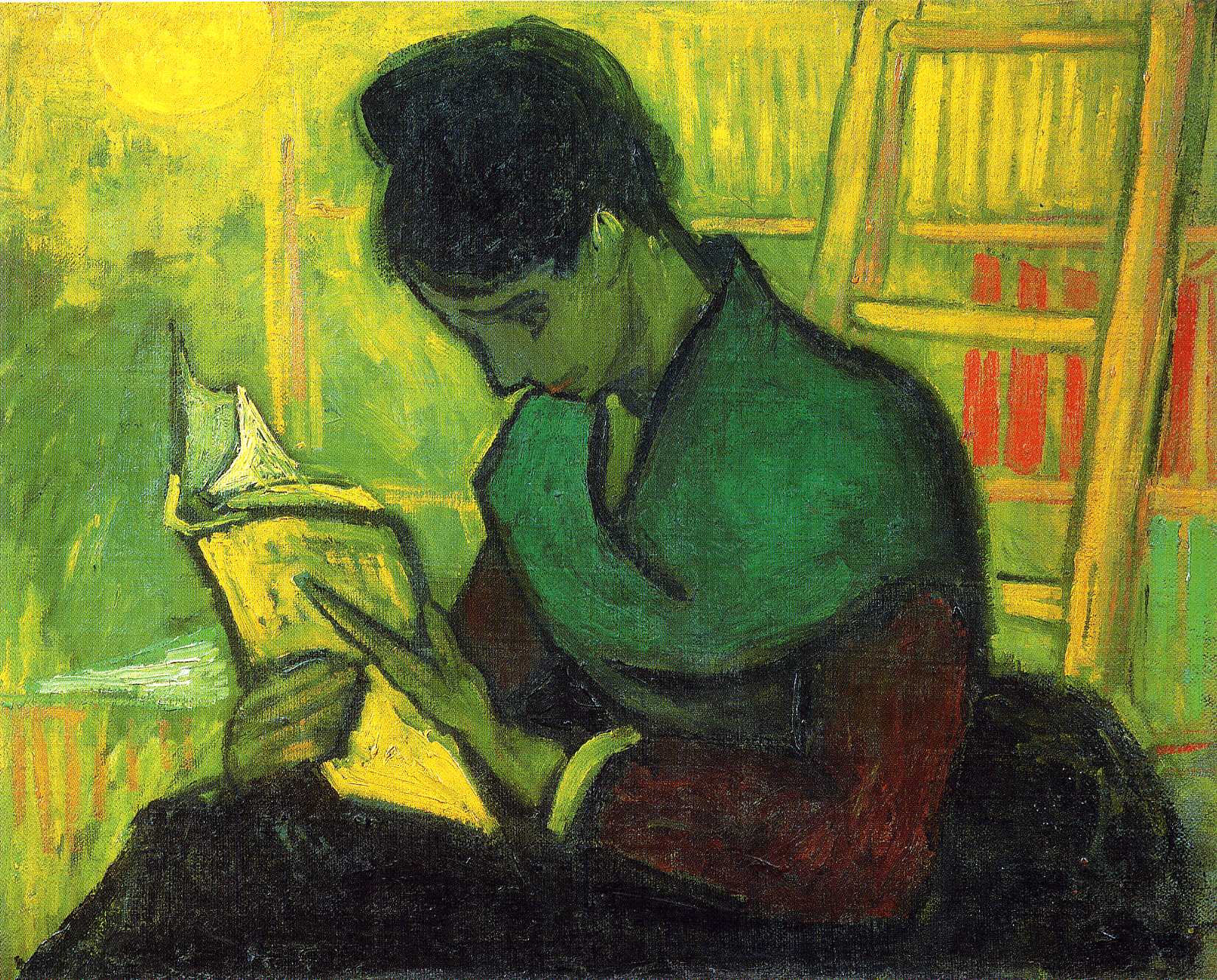
The Novel Reader by Vincent van Gogh c. 1888
Growing up she probably always had her nose in a book! The Athena girl is curious, seeks knowledge and wants to know how things work.
Parents
When an Athena girl grows up with a successful father who is proud that she ‘takes after him’ he helps her develop her natural tendencies. She can grow up to be bright and ambitious with such parental validation. If this is not the case she will grow up lacking confidence in her capabilities.
An Athena with a positive self-image, who has no conflicts about having ambition might also be the daughter of dual-career parents, or the daughter of a successful mother. She grows up having a mother for a role model and parental support to be herself.
Adolescence and young adulthood
Athena girls learn how to fix things. They will likely take to computer programming like a duck to water, they are at home learning about the stock market and who save and invest. She may enjoy and be good at various crafts. Athena girls are not usually problem daughters.

JW Waterhouse – I am Half-sick of the Shadows Said The Lady of Shallott
Rather than having hormonal or emotional meltdowns she can be found competing in the science fair or enjoy playing chess.
Athena women tend to plan ahead for their future life.
Work
The Athena woman tends to make something of herself and works hard to that end, accepts reality as it is and adapts accordingly. Her adult years are usually productive ones for her. In the world of power and achievement, her use of strategy and logical prowess enable her success.
Organisation at work and at home comes naturally to her. Athena makes an excellent teacher, and will not be likely to accept to excuses and expects to get maximum performance from her students.
In an academic field she will make an excellent researcher with attention to detail. Her fields of interest are usually those which value clarity of thinking and use of evidence. She tends to be good at maths and science and may go into traditional male professions such as law, engineering and medicine where she feels comfortable working with mostly male counterparts.
Relationship to Women
An Athena dominant woman usually lacks close female friends. In her mythology she accidentally killed her friend Pallas with a spear in the midst of a competitive game.
As in the myth, if the Athena girl’s lack of empathy does not kill her potential for friendship with other girls, her Athena need to win may do so. A lack of kinship with other girls usually begins in childhood. The ‘sisterhood’ is a foreign concept to most Athena women.
In her mythology it was Athena who cast the final vote for the patriarchy in the trial of Orestes.

In contemporary times it has often been an Athena woman who, by speaking against affirmative action, The Equal Rights Amendment or abortion rights was decisive in defeating the feminist position.
There are also parallels to the Arachne myth in that she may get angry with women who complain about the predatory behaviour of a powerful male ally and make public his misdemeanours, rather than be angry at the man who the complaint was against. She will not approve of subjecting the man to criticism. She is not a supporter of the ‘Me Too’ movement.
The feminist movement tend to understandably be angry at successful Athena women who enjoy the status and success of a career, whilst accepting the status quo and patriarchal positions on political issues involving women, who on the other hand appear to derive most benefits from the women’s movements’ influence on education, opportunities and advancement.
Relationship to Men
The Athena woman gravitates towards successful men and has a canny ability to spot winners. She is attracted to power, either seeking it herself, often with the help of a successful older male mentor, or more traditionally as a companion, wife, executive secretary or ally of an ambitious and able man.
For Athena women ‘power is the best aphrodisiac’.
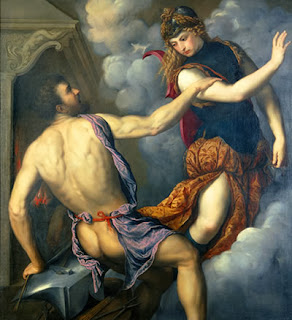
Paris Bordone (1500 – 1571) – Athena Scorning the Advances of Hephaestus
When it comes to men only heroes need apply! An Athena woman usually chooses her man. She values men who go after what they want, who are strong and resourceful, and successful winners of modern power struggles.
Jacqueline Kennedy Onassis appears to have been a predominantly Athena woman. She married Senator John F Kennedy who later became president of the US. Later, after his assassination she remarried Aristotle Onassis, reputedly one of the richest, most powerful and ruthless men in the world. Both husbands had extramarital affairs, however she did not appear to have reacted vindictively towards the other women. As long as the marriage itself is not threatened, an Athena woman can rationalise and accept the fact of a mistress.
Children
As a mother Athena women are keen for their children to grow up to the point where they can share activities and projects, hold conversations and visit places together. She is the opposite of the Demeter archetype who loves to hold babies and wishes they would never grow up. She may hire nannies and house-keepers to care for her children.
The Athena mother shines if she has competitive, extroverted, intellectually curious sons, who are her budding heroes in the making. She may be prone to reinforcing stereotypical male behaviour in her sons early on.
Athena mothers also do well with daughters who are like them, with an independent spirit who share their mother’s logical approach to life.
The Athena mother finds it difficult to deal with sons or daughters who are easily moved by feelings. She will not see any value in daydreaming.
Middle Years
The Athena often finds the middle years to be the best part of her life. She is rarely self-delusional and if all goes according to plan, her life unfolds in an orderly fashion. She may take time to reassess her situation, consider all options and make a fairly orderly transition to the next phase of her life. If work is her primary concern she will map out her trajectory, if a mother she may devote more time to new projects as her children have grown up.
Menopause is not usually a time of grief for an Athena type, she has never defined herself primarily as a mother, nor are youth and beauty an essential part of her self-esteem, which is based on her intelligence, competence and often indispensability. Hence growing older is not a loss for most Athena women.
On the contrary, she is more powerful, useful or influential in her middle years than as a young adult.
Later years
An Athena woman usually remains energetic and practical throughout her life, both at home and at work, and she can also be active in the community as a volunteer. She may not mourn an empty nest, as this will give her more time for her own projects, studies or work that she enjoys.
If she is widowed she will manage her own money, perhaps invest in the stock market or continue to run a family business or one of her own. The Virgin goddess ‘one-in-herself’ quality will serve her well to continue to be self-sufficient and active.
Psychological Difficulties
Rational Athena never lost her head, her heart, or her self-control. She was unmoved by irrational or overwhelming emotion, and her actions were deliberate rather than impulsive. Sharing these goddess attributes means that to live as ‘Athena’ one tends to live in one’s own head and act purposefully in the world. But this can lead to a one-sided existence – she lives for her work.
Although she enjoys the company of others she lacks emotional intensity, erotic attraction, intimacy, passion, or ecstasy. She can also be cut off from empathising with other people’s deep feelings, and from being affected by art and music that evokes deep feelings or mystical experiences.
Athena keeps a woman ‘above’ the instinctual level, so she does not feel the full strength of maternal, sexual or procreative instincts.
Ways to Grow
An Athena woman has an ability to intimidate others and to take away the spontaneity, vitality, and creativity of people who are not like her. This is her Medusa effect!
On her breastplate the goddess Athena wore a symbol of her power – the aegis, a goatskin decorated with the Gorgon’s head, the head of the Medusa. However, this breastplate can be removed and put back on.
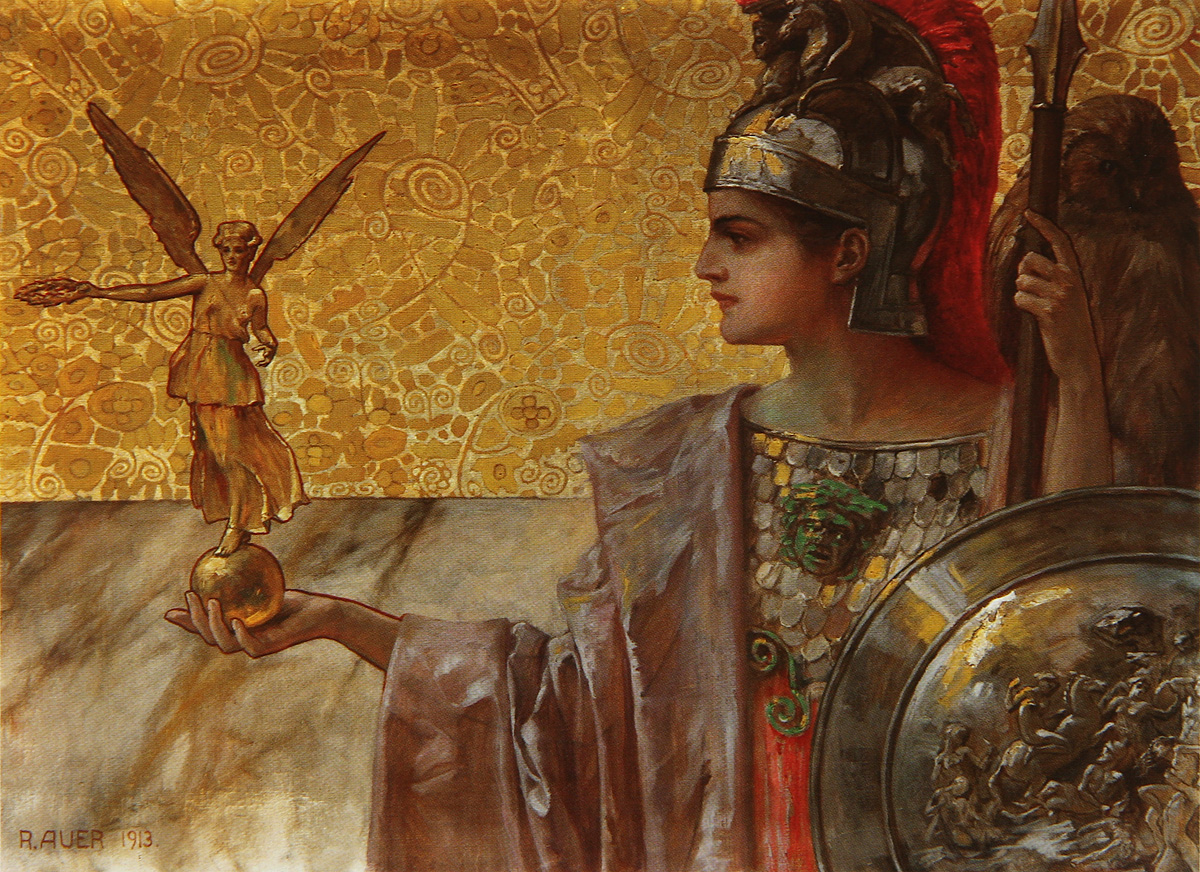
Athena by Robert Auer
When a woman is metaphorically wearing Athena’s armour she is not showing any vulnerability. Her intellectual authority is in control so her authority and critical gaze can keep others at an emotional distance.
Likewise, if a woman takes off her ‘armour and aegis’ she will no longer have the Medusa effect. This means she will no longer sit in judgement on others, inwardly claiming the authority to validate or invalidate the way other people feel or think or live.
Growing beyond the confining limitations of one goddess through the cultivation of others is one possibility that all goddess types share. An Athena woman can also follow several other strategies as well.
If she finds it hard to quieten her mind over work concerns or power games she can turn to her craft inventory and use sewing, knitting, pottery or any craft as a kind of therapy. Any craft offers an Athena woman an inner balance to an outer-world focus.
It can also be beneficial to relate to the world as a ‘sensible adult’ less and instead become a wild-eyed child where everything is new and full of discovery. To rediscover her lost inner child she needs to play and laugh, cry and be hugged.
They also need to allow themselves to be ‘mothered’. It is helpful to discover her own mother’s strengths, often before she can value any similarities in herself.
Hestia – Goddess of the Hearth and Temple, Wise Woman and Maiden Aunt
“That venerable virgin, Hestia, one of the three that Aphrodite is unable to subdue, persuade, seduce, or even awaken a pleasant yearning in.” ~ Homeric hymn to Hestia
Roman name: Vesta
Hestia is the least known of the Olympians. She was not represented in human form by painters or sculptors, but was instead felt to be present within the living flame at the centre of the home, temple and city. Hestia’s symbol was a circle. Her first hearths were round, as were her temples also. Neither home nor temple were sanctified until Hestia entered. Her presence made places holy, as she was a spiritually felt entity as well as a sacred fire that provided illumination, warmth and heat for food.
Mythology
Hestia was the first child born to Rhea and Kronos. She was the eldest sister of the first generation Olympians, and maiden aunt to the second. By birth right she was one of the twelve major Olympians, yet her place on Mount Olympus was eventually taken by Dionysus, God of Wine.
She made no protest at being usurped, and did not get involved with the drama that occupied Greek mythology. However she was greatly honoured, receiving the best offerings made by mortals to the gods.
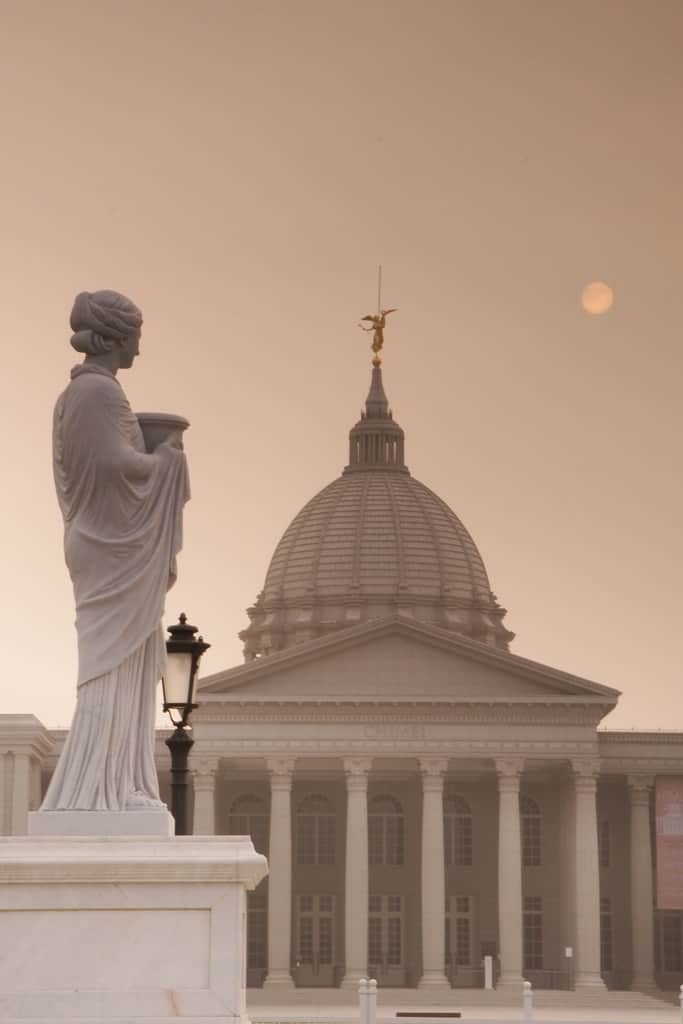
Aphrodite caused Poseidon (God of the Sea) and Apollo, (God of the Sun) to fall in love with her, but Hestia refused them both, taking a great oath to remain a virgin.
Instead of a wedding gift Zeus bestowed on her the beautiful privilege of being able to sit at the centre of the house to receive the best offerings.
Unlike the other gods and goddesses Hestia was not known through her myths or representations. Instead, Hestia’s significance is found in rituals symbolised by fire. In order for a house to become a home Hestia’s presence is required.
Torches were carried by the bride’s mother of a newly married couple to their new house to light their first household fire. This act consecrated their new home.
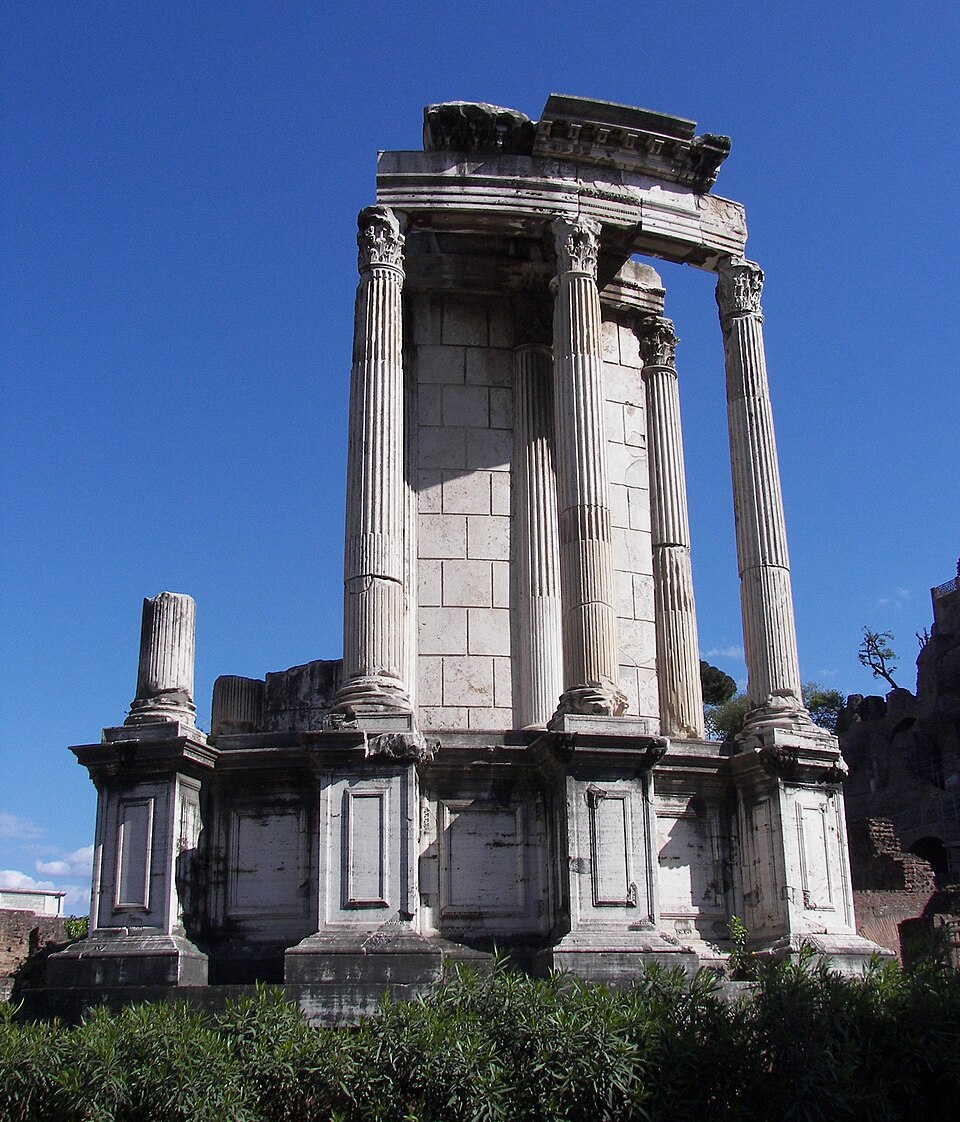
The Temple of Vesta (Forum in Rome)
After a child was born a second Hestian ritual took place. Similarly each Greek city-state had a common hearth with a sacred fire in the main hall. Here guests were officially entertained. Whenever a new colony or couple ventured out to establish a new home, Hestia came with them as the sacred fire, linking old home with new, perhaps symbolising the continuity of relatedness, shared consciousness and common identity.
Later in the temples of Rome her sacred fire was tended by the Vestal Virgins, who were required to embody the virginity and anonymity of the goddess. They were thus living images of Hestia, and in a sense human representations of the goddess; transcending sculpture or painting.
Hestia the Archetype
The goddess Hestia’s presence in the house and temple was central to everyday life. As an archetypal presence in a woman’s personality, Hestia is also important, providing her with a sense of intactness and wholeness.
Unlike her younger virgin goddess siblings Artemis and Athena, Hestia did not venture out into the wilderness or city, but remained inside the house or temple, contained within the hearth. But like her sisters, she was not victimised by male deities or mortals, and had the ability to focus on what mattered to her, without being distracted by the needs of others or by the need for others.
Hestia as goddess of the hearth is the archetype active in women who find keeping a house a meaningful activity rather than a chore. With Hestia, hearth-keeping is a means through which a woman puts herself and her house in order. A woman who acquires a sense of inner harmony as she accomplishes everyday tasks is in touch with this aspect of the Hestia archetype. Tending to household duties is a centering activity, equivalent to meditation.
With Athena’s help she might write a book titled ‘Zen and the Art of Housekeeping’.
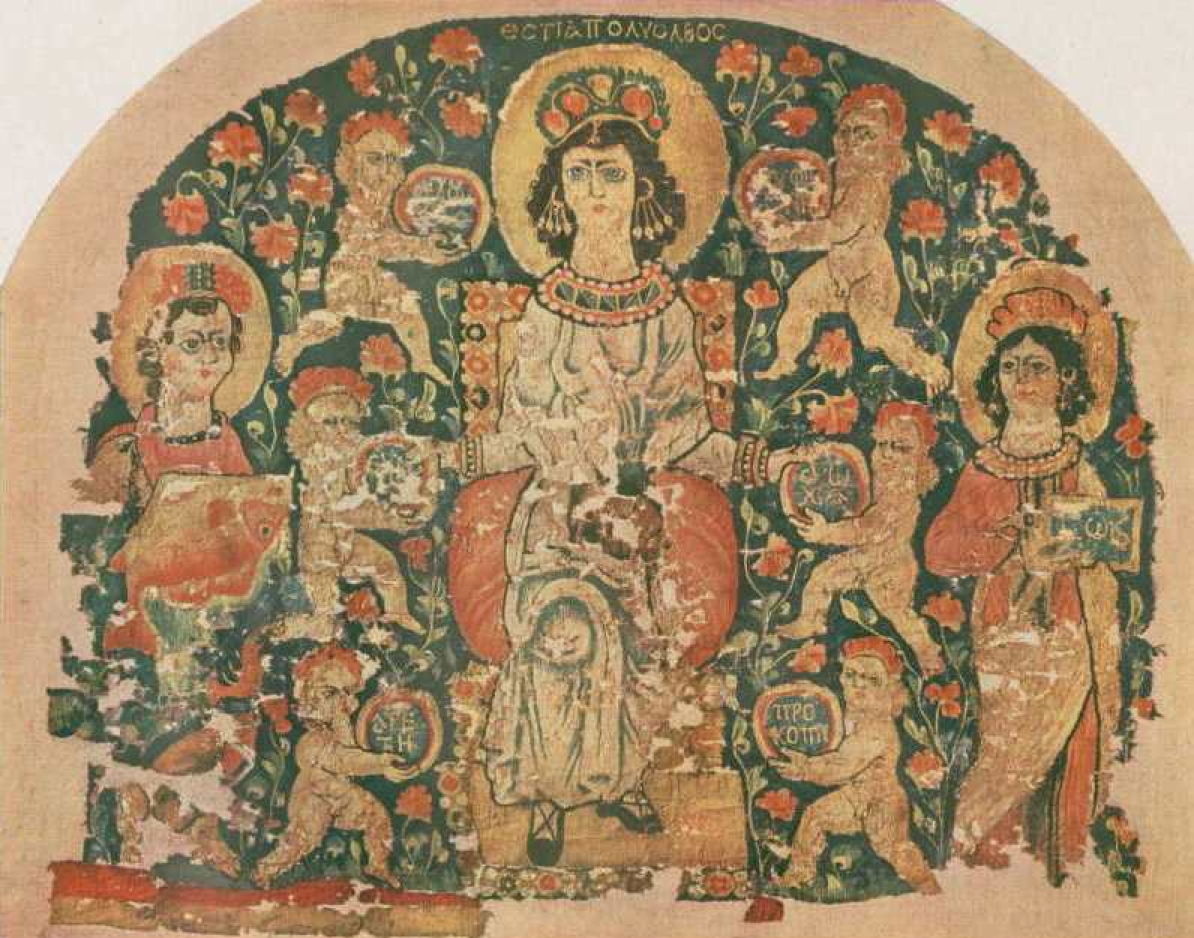
The Hestia Tapestry
If Hestia is the archetype, when she finishes her tasks she feels good inside. In contrast, Athena has a sense of accomplishment, and Artemis is simply relieved that a chore is finished, freeing her to do something else.
When Hestia is present there is no keeping track of time, no clock watching, she is in what the Greeks call Kairos time – she is ‘participating in time’, which is psychologically nourishing (as are almost all experiences in which we lose track of time).
As she sorts the laundry, washes dishes, cleans up the clutter, she feels an unhurried, peaceful absorption in each task. I do occasionally reach this state with house projects, but not very often! Hearth-keepers stay in the background maintaining anonymity and re often taken for granted.
Hestia women can also be found in convents and ashrams, or any discipline that that has a focus on prayer or meditation. As a long term meditator I experience this part of Hestia within myself. They place a secondary focus on community maintenance or housekeeping, which is done with an attitude that this task, too, is a form or worship.
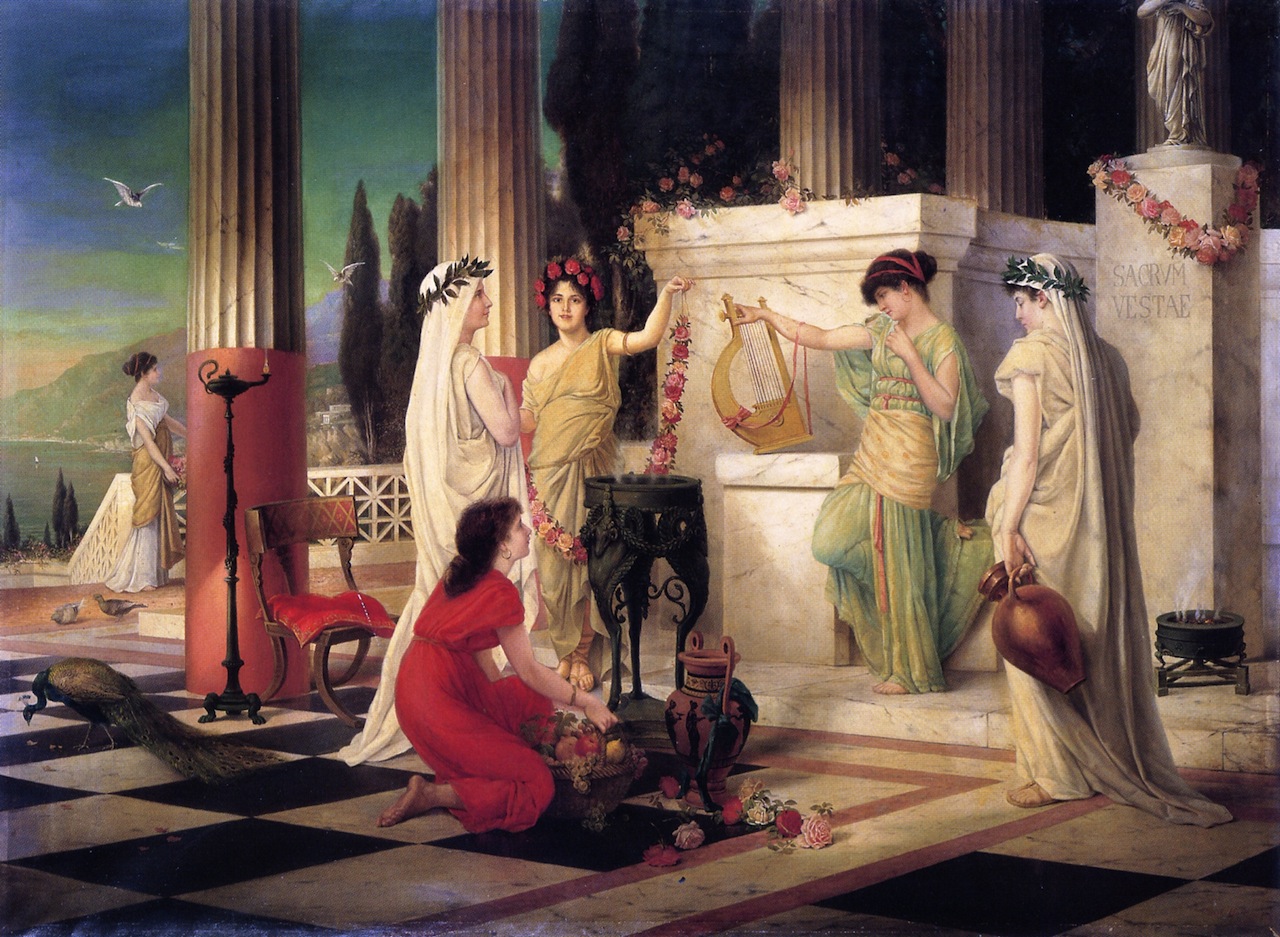
Constantin Hölscher – In The Temple of Vesta
Noteworthy women members of these communities combine Hestia with other strong archetypes, for example the mystic St. Teresa of Avila, noted for her ecstatic writings, combined an aspect of Aphrodite with Hestia. Nobel Peace Prize recipient Mother Teresa seems a combination of maternal Demeter and Hestia. Mother superiors who are spiritually motivated usually have strong Athena traits as well as Hestia.
With Hestia as an inner presence a woman is not attached to people, outcomes, possessions, prestige or power, she feels whole as she is. Because her identity isn’t important, it’s not tied to external circumstances, thus she retains a level of equanimity.
T.S. Eliot sums Hestia up in this verse from his Four Quartets:
The inner freedom from the practical desire,
The release from action and suffering, release from the inner
And the outer compulsion, yet surrounded
By a grace of sense, a white light still and moving.
Hestia’s detachment gives this archetype a wise woman quality. When Hestia shares this aspect of her personality with goddess archetypes she provides wise perspective on their aims and purpose. The excesses of all the other archetypes are ameliorated by Hestia’s wise counsel, a felt presence that often conveys a truth or offers a spiritual insight.
Hestia gives a woman’s life meaning. When this archetype provides spiritual centering and connectedness with others, it is an expression of the Self.
Cultivating Hestia
Hestia can be found in quiet solitude and a sense of order that comes from doing ‘contemplative housekeeping’. In this mode, the woman can be totally absorbed in each task, unhurried in doing it, with time to enjoy the resulting harmony. Even the most un-Hestian housekeeper can recall certain times in which she was governed by this archetype. For me that has usually been a decluttering day!
Women who are not Hestia woman can decide to spend time ‘with Hestia’ – the inward, quiet, centered part of themselves. This can be challenging for women who are more activity and relationship focused, which means finding the space and inclination to make the time.
For Hestia to be present a woman needs to focus on one task at a time, one area or room at a time, whatever feels most manageable in the time available. She must become absorbed in doing the task as if she were performing a Japanese tea ceremony, with a sebse of serenity in each movement.
Meditation activates and strengthens this introverted, inwardly focused archetype, providing an inner source of peace and illumination that access to Hestia brings.
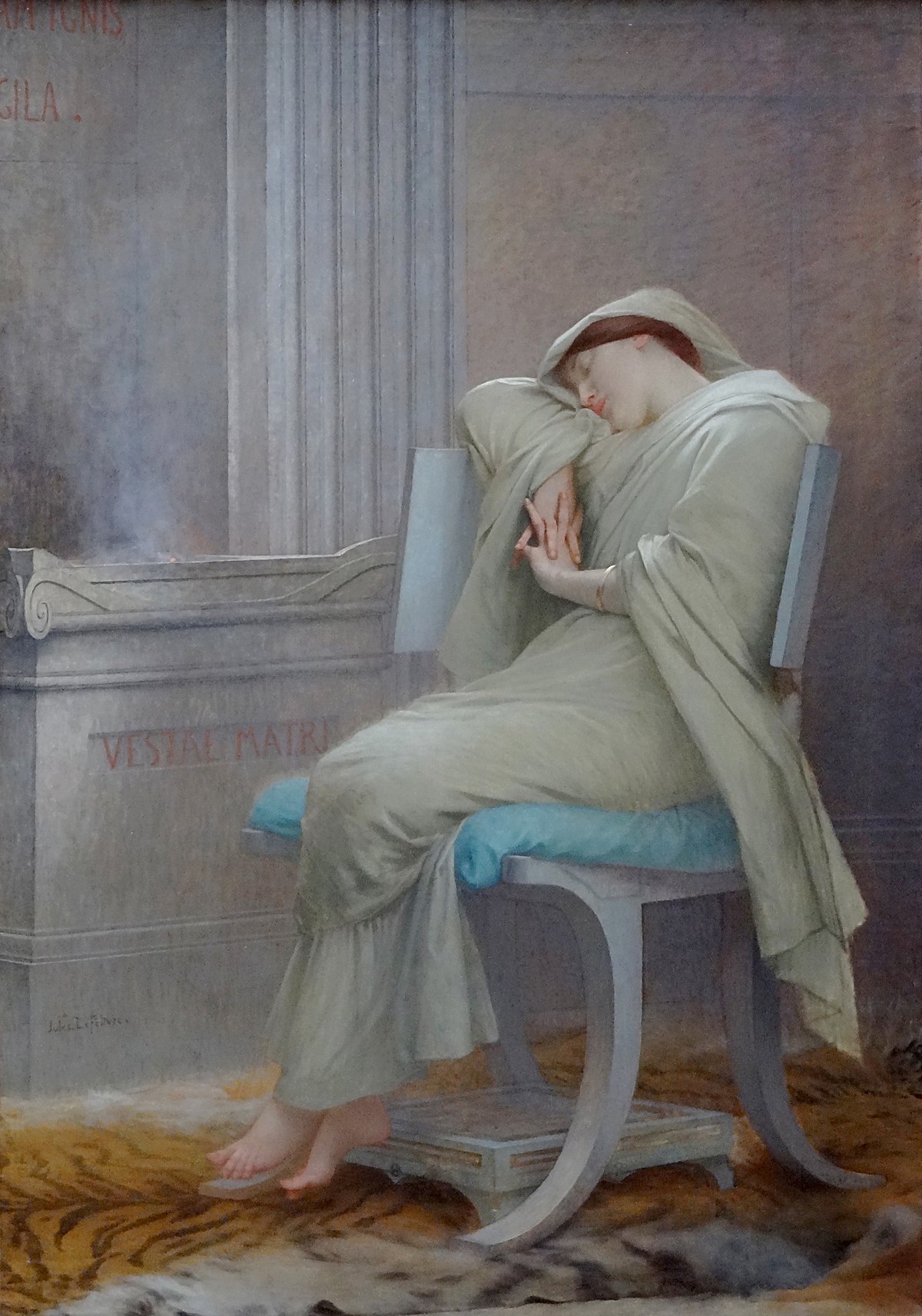
Sleeping Vestal by Jules Joseph Lefebvre
For some women poetry emerges when Hestia’s presence is felt. The author and poet May Sarton says that for her such writing “is possible only when I am in a state of grace, when the deep channels are open, and when they are, when I am both profoundly stirred and balanced, then poetry comes as a gift beyond my will.”
She is describing the archetype of the Self, which always feels beyond ego and effort – a gift of grace.
The Hestia Woman
A Hestia woman shares the attributes of the goddess in being a quiet and unobtrusive person, whose presence creates an atmosphere of warmth and peaceful order. She is usually an introverted woman who enjoys solitude. Her home is likely to resemble a sanctuary where the outer world drops away and a timeless calm pervades.
Parents
The goddess Hestia was the first born child of Rhea and Kronos, the first one to be swallowed by Kronos and the last one to be regurgitated, thus she spent the longest time of any of her siblings captive in the dark and oppressive bowels of her father, and the only one to be there alone. Of all the first generation Olympian children Hestia was the most on her own to cope in whatever manner she could.
If a Hestia woman’s early life is unhappy she is likely to withdraw emotionally, retreating inward for solace in the midst of a painful, conflicted family life.
In contrast a Hestia daughter from a loving family with supportive parents may not appear to be overtly Hestian and will receive help in overcoming any perceived shyness or timidity She can therefore develop a socially adaptable persona. But however she appears on the surface, she is inwardly true to Hestia, she has a quality of independence that comes from being centered.
Adolescence and young adulthood
Lucky are the parents of a teenage Hestia – who, like the goddess, will avoid social dramas, high passions and shifting alliances of her peers. If she has developed other facets of her persona she is likely to be involved in school activities with her friends, who appreciate her quiet warmth and steadiness, although they sometimes are exasperated with her for not taking sides in a controversy or wish she would be more competitive.
Work
A Hestia woman lacks ambition and drive, she does not value power, and strategies to get ahead are foreign to her. As a result a Hestia woman is likely to be found holding a traditional woman’s job in an office, essential but in the background, either taken for granted or seen as a ‘jewel’ who works steadily and dependably, staying out of office politics and gossip.
Hestia’s patience and stillness are qualities that reward a photographer, who must wait for the right moment for the perfect shot. Hestia may team up with another goddess to bring that quality to her work.
Relationship to Women
Hestia women often have a few good friends who appreciate being with them from time to time. A Hestia woman won’t engage in gossip or in intellectual or political discussions. Her gift is to listen with a compassionate heart, staying centered in the midst of whatever turmoil a friend brings to her, providing a warm place by her hearth. My best friend has a strong Hestia archetype, and she is such a great listener.
Relationship to Men
Hestia women attract men who are drawn toward quiet, unassertive, self-sufficient women who will be good wives.
The ‘job description’ of traditional married women seems to differ, depending on which goddess is the most active. Hera’s emphasis is on ‘wife’, Demeter’s is on ‘mother’, Athena’s is on maintaining an efficient and smooth running household, which makes ‘housewife’ her designation. Hestia would list her occupation as ‘homemaker’.
A Hestia woman may look like a dependent wife, comfortably living out the traditional role, but she will always maintain an inner autonomy as a one-in-herself virgin goddess. She does not need a man to feel emotionally fulfilled.
Children
A Hestia woman can be an excellent mother, especially if she has some Demeter in her psyche as well. She Takes good care of her children and provides a warm and secure home environment. Most importantly she allows them to be themselves.
She may struggle when it comes to helping her children to cope with social nuances or competitive situations, as well as ambitions or career development.
Middle Years
By mid-life a Hestia woman’s path often seems set. She could be content in her role as a homemaker, or if she didn’t marry may have the aura of a spinster. If she’s working or in an ashram she’s a ‘fixture’ who quietly does her part.
Later years
There is always something ‘old and wise’ about a Hestia woman; she has the capacity to grow old gracefully. She is well suited to live alone, and may be called on by other members of the family to help out when needed as an archetypal spinster aunt.
The two major emotional crises that face traditional women are the empty nest (my eldest daughter has now relocated to Brighton to attend Waterbear Music College, part of the University of Falmouth, and I miss her so much. Luckily I still have my youngest at home, studying for her A-Levels), and widowhood. Although most Hestia woman are wives and mothers, they do not have a deep need to be in either role. Consequently the loss of these roles does not result in depression for Hestia, as it might for Demeter and Hera women.
Psychological Difficulties
As an archetype of inner wisdom, Hestia lacks negativity, and is less likely to present the usual patterns of pathology.
The main difficulties for Hestia women, however, are related to what was missing in Hestia. Of all the gods and goddesses of Mount Olympus, she was not represented in human form – she lacked an image or a persona.
Therefore, to live as Hestia means to be self-effacing, anonymous, a nonentity who nonetheless has a central position in the household. Their work is often taken for granted or their feelings not taken into consideration. A Hestia woman lacks assertiveness and doesn’t speak up if she feels discounted or devalued.
The housework that can be a source of quiet pleasure and inner order loses this meaning if as soon as it is done others disrupt the order and produce disarray. The hearth-keeping Hestia can become burnt out, when her efforts feel meaningless and ineffectual to her.
The saying ‘still waters run deep’ describes Hestia’s introverted feelings, which lie below the surface. To grow beyond Hestia, a woman must learn to express her feelings, so that people who are special to her can know them.
Ways to Grow
A Hestia woman’s difficulties arise when she ventures out of the sanctuary of home or temple to make her way in the world.
The word ‘persona’ (which means ‘mask’ in Latin) once referred to the masks that were worn onstage to identify immediately the role that actor was to play. In Jungian psychology the persona is the mask of social adaptation that a person presents to the world. It is the way we present ourselves to others and how we are seen by them.
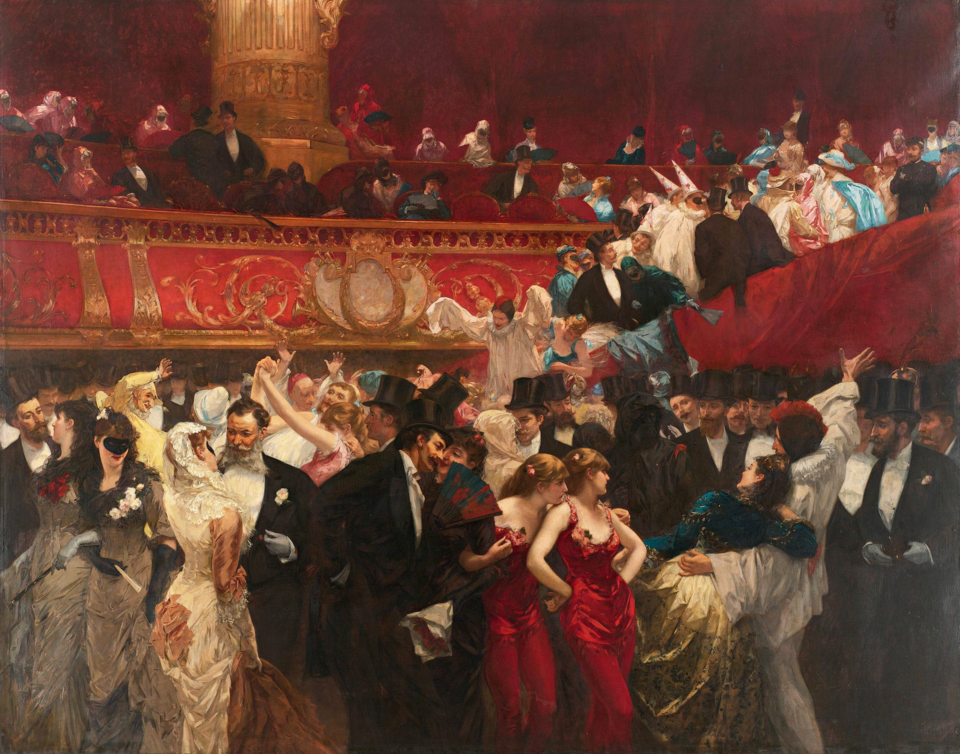
Charles Hermans – Masquerade
A person with a healthy functioning persona is metaphorically like a woman with a large wardrobe from which she can choose something to wear that is appropriate to the occasion, and to her personality, position and age.
Just like with clothes, a Hestia woman may need to try on different personas, having a clear picture of who she is in different settings, to discover a style that will feel natural, once she has ‘worn’ it enough.
Besides a persona a Hestia woman needs to acquire the ability to become assertive so that she can take of herself in the world. In her mythology Hestia did not compete for power or hustle for golden apples, she avoided Mount Olympus, was not involved in the Trojan War, and did not sponsor, rescue, punish or come to the aid of any mortals.
But a flesh and blood Hestia must live among people, venture outside of the home, and so must develop other parts of her psyche, which will help her to be active, expressive and assertive. Artemis and Athena can provide access to these abilities, as can the woman’s animus, or masculine part of her personality.
Hestia represents the Self, an intuitively known spiritual centre of a woman’s personality that gives meaning to her life. This central anchor can be shifted if she allows an ‘Apollo’ male archetype to pull her off centre with his male scientific skepticism. If such expression is allowed to penetrate spiritual experience to demand ‘proof’, the invasion invariably violates a woman’s sense of intactness.
She could also be overwhelmed by Posiedon, the God of the Sea, in the form of oceanic feelings bearing down on her like a massive wave. Preoccupation with an emotional situation may keep her from feeling centred. If the turmoil leads to depression, Poseidon’s watery influence can temporarily ‘put out the fire at the centre of Hestia’s hearth’.
When threatened by either Apollo or Poseidon, a Hestia woman needs to seek her one-in-herselfness in solitude. In quiet tranquillity, she can once again intuitively find find her way back to her centre.
“When I say that you are gods and goddesses I mean that your possibility is infinite, your potentiality is infinite.”
Rajneesh