Treading the Bard’s Floorboards – An Afternoon at Shakespeare’s Birthplace in Stratford

“A quibble is to Shakespeare what luminous vapours are to the traveller: he follows it at all adventures; it is sure to lead him out of his way and sure to engulf him in the mire.”

“He was not of an age, but for all time!” ~ Ben Jonson (1573 – 1637)
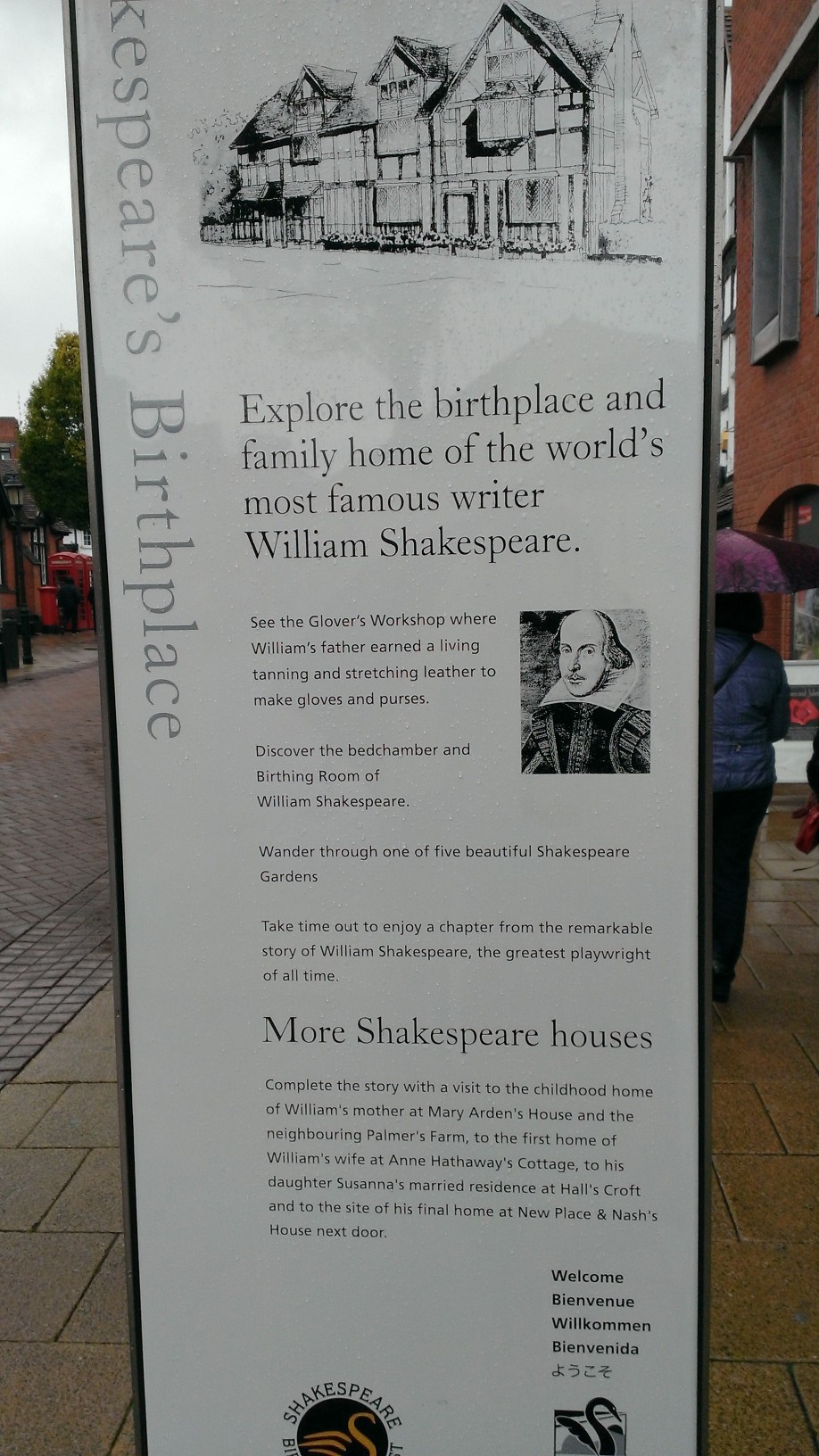
Birthplace signI say floorboards, but technically the ground floor of Shakespeare’s birthplace is stone. The original floor in fact, in the parlour, has remained in place for over 450 years. It’s something of a mystery to me why I’ve only just been able to visit the birthplace of one of the world’s greatest literary icons – but better late than never.

I had a few hours spare on my recent business trip to Stratford-upon-Avon, so I was determined to pay homage to ‘our William’, home grown poet, wordsmith and playwright. The weather was decidedly wet, and we had intermittent heavy rain showers, plus it was late in the afternoon; so luckily for me it wasn’t as busy as I suspect it usually is.  Without any of my beloved brood by my side to moan and whinge at me about how boring it was and when could we go, I was free to meander and absorb the environment of a time and place that has had a global impact and continues to define our cultural heritage to this day.
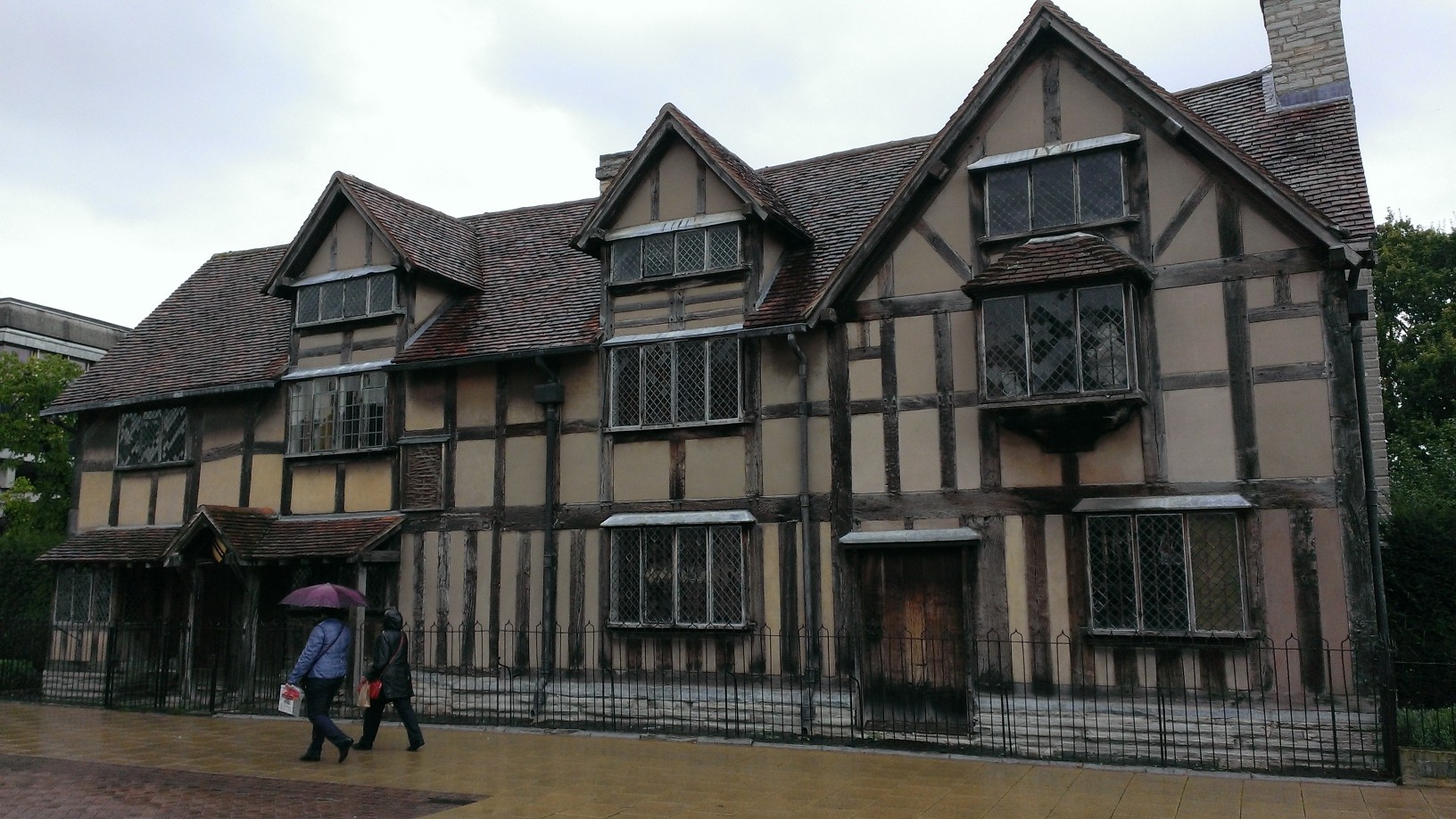
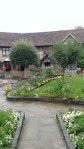
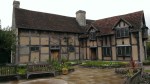
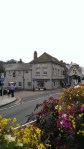
front of Shakespeares houseWalking up the old High Street, (now Henley Street), you see the Tudor house on your right. It’s wonderful, but you probably wouldn’t stop and stare for too long other than to admire a historic building if you weren’t aware of its illustrious son’s writings…

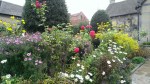
The main entrance is past the birthplace, through the modern building further up.  There’s a fascinating exhibition to take in before you pass out through the garden and into the rear of the birthplace.
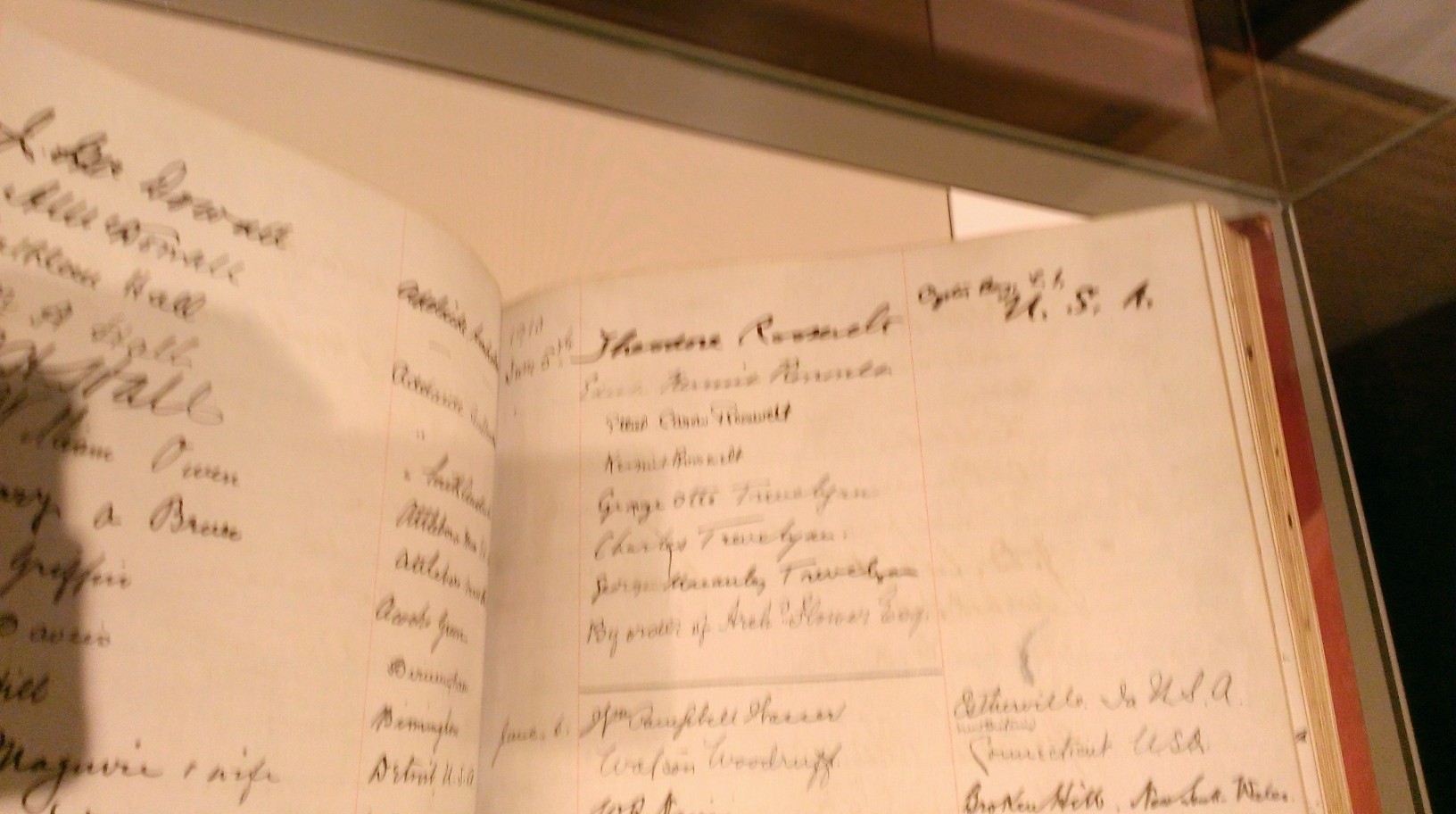
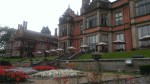
Rooselvelt signature visitors book 1910As part of the exhibition I was interested to see that American President Teddy Roosevelt visited the house in 1910 (and stayed at the same hotel as me, the Welcombe Spa), although in 1910 it was a private house owned by George Otto Trevelyan.

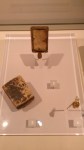
Also in the exhibition his family tree is laid out, clips of his plays and film adaptations run, some of his personal items, and a chronological list of his works are on display. The first folio was produced in 1623. There are no known surviving hand written papers of his individual plays, as penned by him with quill and ink, so we are very fortunate they were collated shortly after his death and have been in print ever since.

I have included a small photo album at the end of the post. The drag and drop option wasn’t working so I’m afraid they are a bit random!

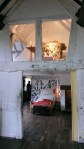
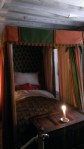
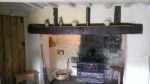
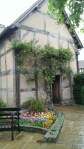
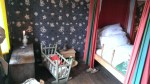
The entrance is through the dwelling next to Chez Shakespeare, a simple one up one down house which was also owned by William’s father, John Shakespeare, and rented out. From this small room you enter the parlour, which has a decent fireplace and a bed, which I was told was a sign of wealth. I suppose if you got bored of the conversation you could just snuggle down… Also what struck me is just how vertically challenged people were in medieval times, I had to stoop to pass under the low doorways.
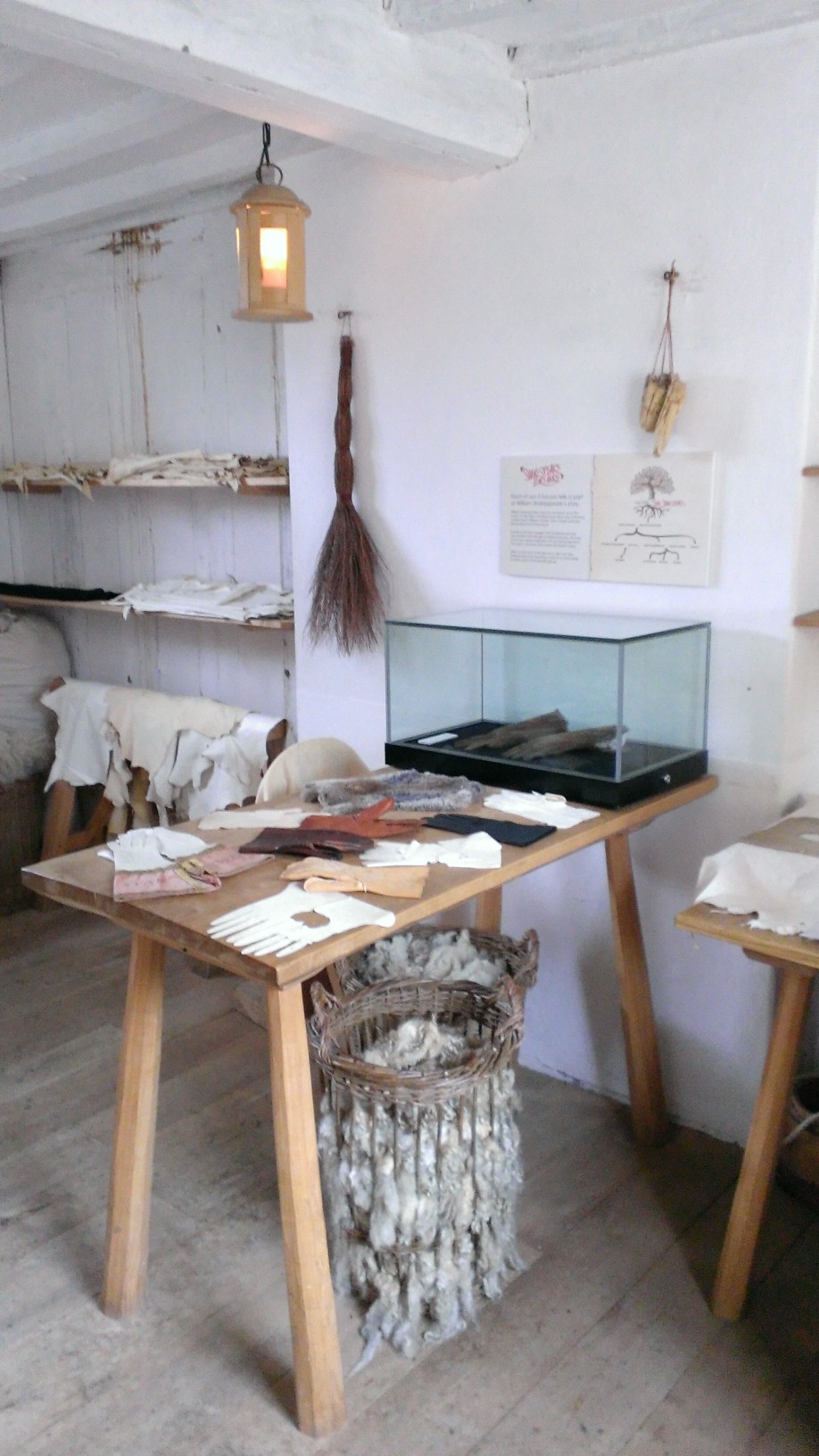
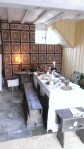
John Shakespeares work studioThere is more natural light in the adjoining dining hall. Again there is a large fireplace and a table and bench, and kitchen items.  Moving on from there you come to John Shakespeare’s workshop. This was easily the biggest room in the house, and the place where he made his leather and suede gloves and bags.  The window would have been absent 450 years ago, so that he could sell his wares directly to customers passing in the street. There would have been a market in the street in front of their house too. I couldn’t stop thinking how draughty and cold it must have been, especially in winter.

In the 1500’s Stratford had a population of around 1500 inhabitants, and at that time Birmingham didn’t exist, so it was a stop off point for travellers and traders journeying from Liverpool to London. It was roughly two to three days ride from Liverpool to Stratford, and four to five days from Stratford to London. John’s gloves sold well, and the family was wealthy. Although, his stint as a ‘brogger’ (illegal wool dealer) was probably more lucrative than glove making!

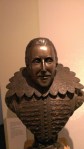
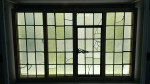
From there you follow the stairs up to the bedrooms. There is a bust, letters from famous visitors, the birth window that was signed by many literary figures, and of course, the birth room itself. A section of the wall has been left open so that visitors can see the original wattle and daub materials used in its construction.
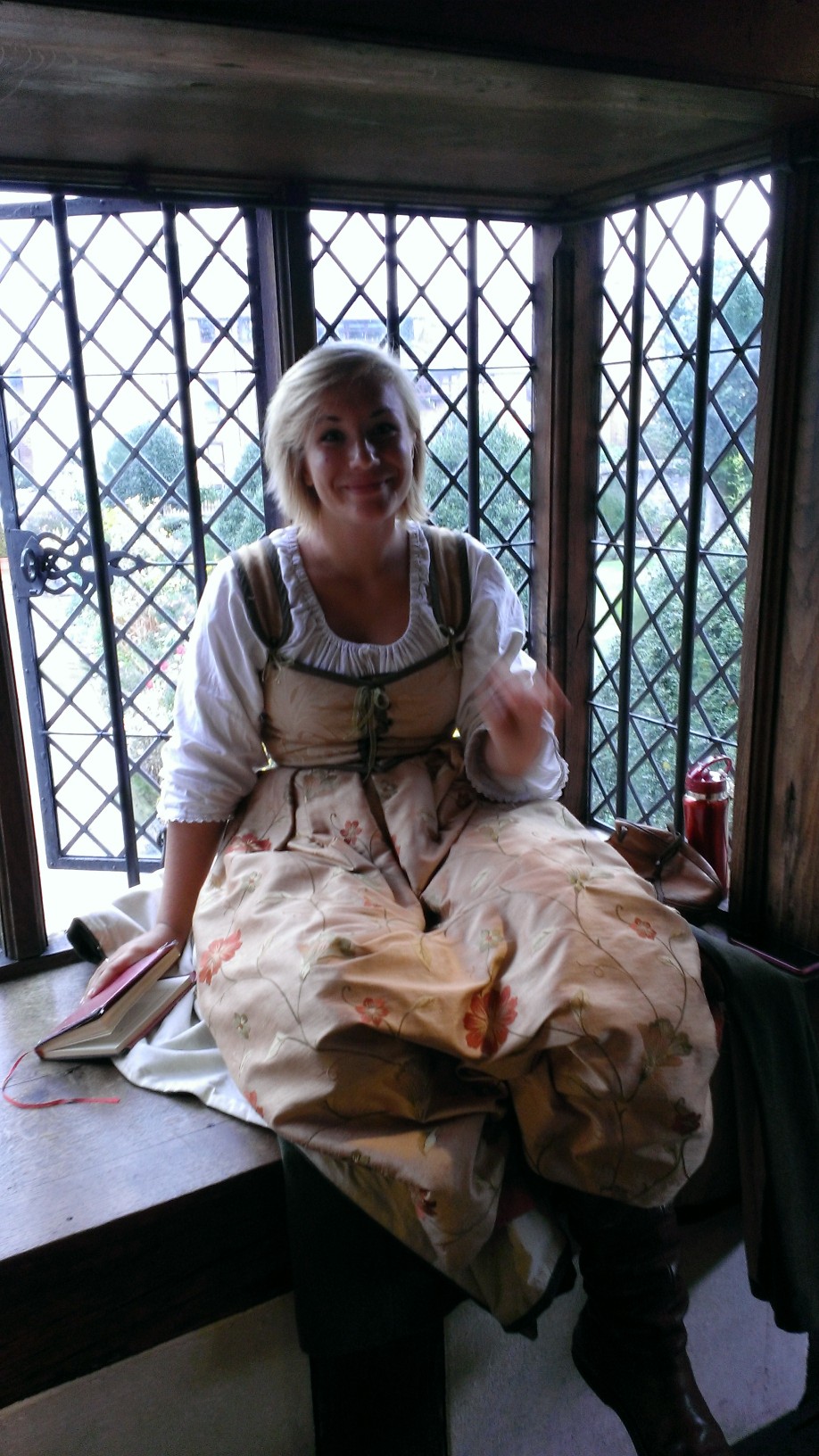
lady in period costume at Swan Inn SHFrom the birth room you then go to the extension made to the house by John Shakespeare, which served as an Inn. In the upper floor of the Swan Inn a lady in costume sat on the window sill and we shared some witty repartee. She told me she was wearing the traditional middle class costume of the era, a white chemise, long wool pinafore dress and silk overskirt, all held in by a corset.  I learned that the way a woman’s corset was stitched up said a lot about her status and moral standing. There were three ways to do up a corset. If it was cross-stitched (whereby a finger could unhook it all in a single lift and let it all hang out in one fell swoop) then she was considered a strumpet. The girl assured me that she wasn’t but that the costume had been easier to do up that way! Then you could strait-lace it (hence the saying about someone being puritanical), and the wealthiest women were done up at the back.

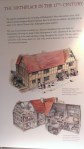
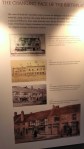
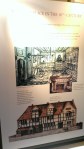
It was amazing to place myself into 16th century life, and imagine the place as William was growing up. He later inherited the house from his father and lived there with his own family. After his death the property passed to his sister, Joan Hart, and later his daughter, Susanna.  There is a timeline of ownership from his day to modern day, which also shows how the house was modified over the years.

What is the Shakespeare Birthplace Trust? Great video that features two of the guides I spoke to.

After purchasing a few tomes in the shop I went for a stroll past the Encore pub and along the canal and river, by the modern RSC theatre. In conclusion, Stratford and Shakespeare’s birthplace are well worth a visit if you ever find yourself in the heart of ye old England.

In Search of Shakespeare – a documentary for further education if you are a Bardolater!

A Time of Revolution:

The Lost Years:

The Duty of Poets:

For All Time:

“Till that I’ll view the manners of the town, Peruse the traders, gaze upon the buildings. ~ Comedy of Errors

The Eureka Effect – Where Does Creativity and Inspiration Come From?

“Creativity doesn’t wait for that perfect moment. It fashions its own perfect moments out of ordinary ones.” ~ Bruce Garrabrandt

Can you remember being at the receiving end of an enlightening or illuminating idea that flashed into your mind like an incandescent light bulb? Perhaps you’ve had quite a few moments of erudition? I’ve had a few too; and who wouldn’t want to have more of those those elusive but cherished aha! moments?

creativity lightbulbsUnfortunately the moment doesn’t tend to hang around long, you have to use it or risk losing it. I have taken to keeping a pen and pad by my bed, in my office and buried in the murky depths of my handbag, ready and waiting for rapid note taking… You never know when such blessings will infiltrate your consciousness, so it’s wise to be prepared! There have been times after stirring from slumber, when I am still in that twilight zone between lucid dreaming and being fully awake, when my subconscious mind has been streaming ideas into my conscious mind. Sometimes it’s so fast I just jot down whatever is in my head so as not to forget anything later on. I can always ditch the stuff that I may not use in the future.

In a minor aha! moment I thought it would be interesting to investigate such ephemeral phenomena, and try to understand how we can better manifest these fleeting gifts from the universe.

Etymology and language is constantly evolving, but essentially the definition of the word inspiration hasn’t changed much from its Latin roots: inspirare, meaning divine guidance, or in a more literal sense, breathing in spirit.

Creativity-takes-courage-Henri-Matisse-inspirational-quoteIdeas are everything. Ideas fuel man’s progress and make life better for humanity, especially in the areas of the arts, literature, health, science and technology. However, our ideas don’t all have to be on the same level as E=mc2, we can achieve smaller-scale wins by solving our everyday challenges, or, in my case, figuring out how to multi-task having a career alongside motherhood and running a home… I’m still figuring that one out!

Ideas are the intangible, ethereal side of our being. We cannot force them, but perhaps we can increase their frequency by learning a bit more about how they come about. Of course, they are nothing but useless data if they are not followed up by meaningful action.

Thomas Edison famously said, “Genius is one percent inspiration and ninety-nine percent perspiration.”

And here’s the rub: although that moment of glorious enlightenment may appear to be a bolt from the blue, it’s most likely the result of many smaller steps over time, and at times, a seeming impasse as to how to proceed. We do what we think we should, we hit obstacles, we try again, hit the repeat button a few times, and then, if we have the right mindset, the answer we have been seeking miraculously presents itself to us. We could be standing at the bus stop or be out on a hike, we could be in the middle of reading a book, we could be cooking, we could be drifting off to sleep…and ding! A passing, but profoundly brilliant thought pops into our heads.

Giovanna Mingarelli from the World Economic Forum highlights her take on the Eureka Effect:

The word ‘Eureka’ was coined by Greek polymath, Archimedes, after he had an epiphany about how to measure the volume of an irregular object.

Barry Evans gives an enlightened TED talk about Archimedes and his all important principle:

There are various theories about how creative insight works, this is my perception garnered from my personal experiences: I concentrate on a problem, mull it over, write down my ideas, follow the ones I think will work best, tweak if necessary, and then later try to empty my mind of it completely. Sometimes I forget about it for a long time, and then an answer or solution usually comes to me. I know that may sound simplistic, but it’s worked for me in the past.  I just have to get out of my own way. And of course, some Eureka moments are more recondite than others, but the fact that any kind of inspiration is flowing is a positive result. I have also found that meditation has greatly helped me to relax and clear my mind, to have that space when I have no thoughts and no content in my mind. In the right conditions I can easily go into the alpha brainwave pattern, and this seems to support my intuition and the mental settings needed for insight to take place. I find other than my meditation, nature and music are wonderfully conducive.

Transcendence seems to be key, as stated in this talk by author and entrepreneur Bernardo Kastrup (if you can put up with the audience coughing):

Here’s my previous post about meditation.

An absolutely brilliant presentation about the process of creative insight and why you need grit:

Again, they both draw the conclusion that eventually one should stop looking and focussing. Jonah talks about those all-important alpha waves again…and about the obsessive revisions that Beethoven made to his music to attain the level of genius that he is loved and admired for. Perseverance is half the battle, which reminds me of a famous Calvin Coolidge quote…

When worthwhile ideas come, it’s up to us to stick with them, hone them and improve them, and ultimately, to have faith in them.

Fabulous article by Eckhart Tolle on creativity.

CreativityI’m really getting into this mnemonic lark! Cognitive Random Ephemeral Attributes Transformed Into Valuable Expression

Wherever they come from, (perhaps it’s the infinite field of consciousness that all humans have access to), ideas will flow to you if the conditions are favourable. The Eureka Effect isn’t a domain just for the chosen few… Pay attention to the answers you seek, and then let it go. That song from Frozen sums it up perfectly! Take a walk, empty your mind and get ready for the influx…

“The desire to create is one of the deepest yearnings of the human soul.” ~ Dieter F. Uchtdorf

P.S. Any takers for the problems facing the Middle East at the moment??

An Evening with the British Association for Music Therapy (BAMT), in London

“The brain that engages in music is changed by engaging in music.” ~ Michael Thaut, Professor of Music and Professor of Neuroscience at Colorado State University

music solutionWe all know, on some level, how essential music is to human existence. We can recite instances when music has evoked powerful memories and emotional responses in us. Even if our involvement with music is only to the extent of listening to the radio now and then, to the more obsessive playing of our CDs, iPods and MP3’s on a constant loop, it has a major impact on the quality of our lives. Further up the scale, (sorry!) amateur musicians find joy and fulfilment from the pressures of everyday life by playing an instrument, and the more gifted of us make their living from bringing this lofty form of entertainment to the masses. Then there are those who specifically use the medium of music to reach out to segments of society that are suffering, either mentally, emotionally or physically. In the UK, there are over 700 of these caring and talented individuals who make up the membership of BAMT, which supports this network of highly trained and committed therapists.

I jumped at the opportunity to find out more about their valuable and pioneering work in this field when I was invited by Beth Britton to attend their exhibition: Music Therapy – The Art and Science, hosted by the Barbican Music Library in London on 10th September.

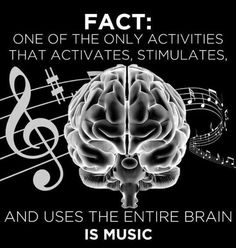
music factThe exhibition itself was full of amazing scientific facts about how music therapy has been successfully employed in the fields of neurology, child development, adolescent’s issues, autism, adult mental health, dementia, cancer and the challenges of old age. There were wonderful anecdotes and case studies from both therapists and recipients, as well as the history behind music therapy, not just in the UK but around the world, dating back to ancient times. Hippocrates, known as the father of medicine played music to some of his patients.

With a glass of wine in hand and a tasty selection of hors d’oeuvres on offer, I had had a lovely chat with a lady called Catherine; who is based in the north of England, working with seriously disturbed and mentally ill individuals. She told me her first instrument was the cello, but that she mainly used the piano and guitar in her sessions due to the sometimes unpredictable nature of the participants, as well as plenty of singing. She explained how singing was great to establish a rhythm and get patients moving, and she actively encouraged them to sing and dance.  I think she found her career very rewarding, but due to the intensity of the work and the time input she felt her own musical creativity was not being broadened.

The presentations were extremely interesting. Donald Wetherick,Chair of the BAMT Trustees, music therapist at Nordoff Robbins London Centre and music therapy tutor at Guildhall School of Music and Drama, highlighted the role of the charity in the UK, and explained about their work in the areas of research and collaboration in Europe and beyond. They are a point of contact for the public, for therapists and other professional bodies. You can find out more about them on their website. Or connect via Twitter: @musictherapyuk

“Currently provision of music therapy is uneven across the UK. We want to work with all those who champion music therapy to help change this, so that everyone who needs a music therapist can get access to one. Funding for large-scale research, such as the field of music therapy and dementia, is also vital if we are to harness the full potential of music therapy.” ~ Donald Wetherick

He introduced Richard Jones, the librarian of the Barbican Music Library, who gave us an overview of their set-up, They are only one of two music libraries in London (along with Westminster Music Library), and they have hosted various musical events from classical to jazz to rock. It seems appropriate that they are based on the second floor of the Barbican, which is also home to the London Symphony Orchestra and the Guildhall School of Music & Drama.

For more information click here. You can also follow them on Twitter: @BarbicanMusic

Donald then introduced my cousin, Beth, who is a Dementia Campaigner, writer and consultant, to talk about her experiences of how music helped her father, who lived with vascular dementia for the last nineteen years of his life. Discover more about her brilliant work here and on her blog: http://d4dementia.blogspot.co.uk/ and on Twitter: @bethyb1886

“Even as other abilities decline, music engages the brain through an extensive set of processes that are preserved and remain functional.” ~ Dr katrina McFerran, University of Melbourne

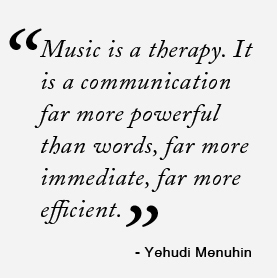
Yehudi Menuhin quoteThis explains why people who can no longer find the words to speak, may still be able to sing and play instruments. Beth related the story of her father humming and singing the last few words of his favourite songs as she sang to him, long after his ability to speak had gone. By encouraging and supporting active involvement in musical interaction and socialisation, music therapists can help clients living with dementia reduce feelings of apathy, anxiety, restlessness and depression, potentially lessening the need for medication.

These two videos express the essence and benefits of music therapy better than I ever could in words:

How does music therapy benefit children with special needs?

Music therapy, the empowering tool:

The final speaker was Professor Helen Odell-Miller, Head of Therapies at Anglia Ruskin University and Director of Music for Health Research Centre, who gave us a fascinating history of the origins of Music Therapy in the UK, and how the early pioneers established the framework of common practices and professional and personal qualifications that Music Therapists need, (a Master’s Degree in Music Therapy as well as having an advanced level of musicianship and skill, and also being registered with the Health and Care Professionals Council). Music therapists work in hospitals, schools, pupil referral units, day centres, hospices, care homes, therapy centres, prisons and in private practice across the UK.

BAMT is conducting cutting edge research into the role of music therapy on human health and wellbeing, in addition to providing support and training to music therapists. Notably, they are sharing the results of their discoveries with other health professionals as part of a multi-disciplinary team of speech & language therapists, physiotherapists, occupational therapists, doctors, paediatricians, teachers, social workers, consultants, psychologists and psychiatrists who are working to deliver the same aims in society.

Promotional video by Nordoff Robbins for those interested in training as a music therapist:

I hope the work of music therapy resonates with you! The BAMT exhibition is on display until 31st October at the Barbican Music Library in London.

A Study of J.S. Bach’s Baroque Violin Masterpiece: The ‘Chaconne’ in D Minor

“I was raised on Bach.” ~ Daniel Barenboim

Johann Sebastian Bach was one of the most dedicated, gifted and prolific composers that ever lived. Born in Thuringia in 1685, just a few days after fellow composer Handel; he was an accomplished organist, and his faith in the divine inspired him to write a substantial oeuvre of immortal music.

“Bach” is the German word for “brook”, hence Beethoven’s famous quote, ‘Not Brook but Ocean should be his name.’ Beethoven also referred to him as, ‘the immortal God of harmony.’

He wasn’t universally recognised as a great composer until the beginning of the 19th Century when Felix Mendelssohn championed his works, and later, by Pablo Casals, who was the first cellist to record his cello suites. What great artist is truly appreciated during their lifetime?

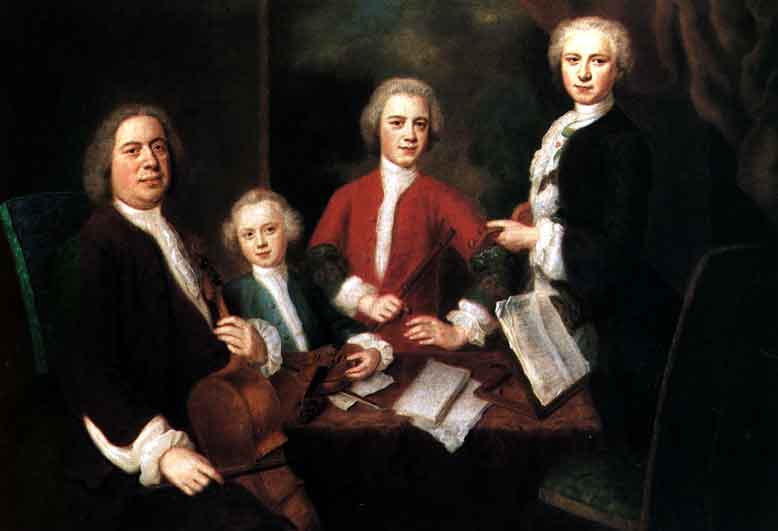
He hailed from a musical family, and is the patriarch of Europe’s largest musical dynasty. He fathered twenty children, seven with first wife and second cousin, Maria Barbara Bach, (only four survived into adulthood) and a further thirteen with his second wife, Anna Magdalena Wilcke, of which six made it past infancy and childhood.

All of his offspring were musicians, and two of his sons became notable composers in their own right: Carl Philipp Emanuel and Johann Christian Bach. J.S. Bach left the world an artistically and spiritually enriched place. No ordinary life…

His music spans time and space; three of his compositions were on NASA’s Voyager record, Music From Earth. Bach’s devotion to God shines through in his music, which speak to the soul on a primal level, regardless of one’s religious orientation. He was a rare genius indeed.

Brahms-Quote1

“I think that if I were required to spend the rest of my life on a desert island, and to listen to or play the music of any one composer during all that time, that composer would almost certainly be Bach. I really can’t think of any other music which is so all-encompassing, which moves me so deeply and so consistently, and which, to use a rather imprecise word, is valuable beyond all of its skill and brilliance for something more meaningful than that — its humanity.” ~ Glenn Gould

As a violinist, (other than Beethoven), he is my favourite composer to play and listen to, and I always play Bach at every practice session. He gives me a workout for my spirit, as well as my fingers and my brain. His sonatas and partitas for solo violin are essential repertoire for any violinist, not to mention his violin concertos.

But the ‘Chaconne’ in particular, (along with the adagio of the double violin concerto) touches me very deeply. It is a dance, and the minor key gives it a slightly melancholy feel; which is understandable, as it was written after his wife had died. If you are not already familiar with the work you are in for a treat. Immerse yourself in the music…

From Wikipedia:

The ciaccona (commonly called by the French form of the word, chaconne), the concluding movement of Partita No. 2 in D minor, BWV 1004, surpasses the duration of the previous four movements combined. Along with its disproportional relationship to the rest of the suite, it merits the emphasis given it by musicians and composers alike. The theme, presented in the first four measures in typical chaconne rhythm with a chord progression based on the repeated bass note pattern D D C♯ D B♭ G A D, begets the rest of the movement in a series of variations. The overall form is tripartite, the middle section of which is in major mode. It represents the pinnacle of the solo violin repertoire in that it covers every aspect of violin playing known during Bach’s time. It is still one of the most technically and musically demanding pieces for the instrument.

Yehudi Menuhin called the Chaconne “the greatest structure for solo violin that exists”.

Violinist Joshua Bell has said the Chaconne is “not just one of the greatest pieces of music ever written, but one of the greatest achievements of any man in history. It’s a spiritually powerful piece, emotionally powerful, structurally perfect.” He played the piece busking in L’Enfant Plaza for the Washington Post.

Piano transcriptions:

Since Bach’s time, several different transcriptions of the piece have been made for other instruments, particularly for the piano (by Ferruccio Busoni and Joachim Raff), and for the piano left-hand (by Brahms).

Johannes Brahms, in a letter to Clara Schumann, said about the Ciaccona:

On one stave, for a small instrument, the man writes a whole world of the deepest thoughts and most powerful feelings. If I imagined that I could have created, even conceived the piece, I am quite certain that the excess of excitement and earth-shattering experience would have driven me out of my mind.

Felix Mendelssohn and Robert Schumann each wrote piano accompaniments for the work.

I hope one day to be able to fully play the Chaconne. Maybe there is a teacher out there who can help me! The multi-stopping and chords are challenging to say the least. I must study Heifetz’s masterclass, but even that goes right over my head.

Reinvention:

His works lend themselves to transcriptions for other instruments more than any other composer I can think of. The composer and conductor Leopold Stokowski did many orchestral transcriptions of Bach’s works, as did Franz Liszt for the piano.

For me, there are three definitive solo violin recordings, (the original form of composition), which are by Menuhin, Stern and Heifetz. These clips perfectly illustrate the impact that personal interpretation and tempo have on the music:

I have listed below ten varied transcriptions I have enjoyed of this fabulous piece. Each conjures up a different mood. I’ll let the musicians do the talking…

Transcription for violin and piano by Schumann:

Piano version by Brahms for the left hand:

The Busoni piano transcription in a live performance by Marc-André  Hamelin:

It has to be John Williams on the classical guitar:

Orchestrated version by Leopold Stokowski:

Nicanor Zabaleta on the Harp:

Marimba:

ESP Saxophone group:

Viola:

This heartfelt Cello performance by Rustam Komachkov has oodles of rich, warm colours and soul:

Jean Rondeau on the Harpsichord:

“Bach is the supreme genius of music… This man, who knows everything and feels everything, cannot write one note, however unimportant it may appear, which is anything but transcendent. He has reached the heart of every noble thought, and has done it in the most perfect way.” ~ Pablo Casals

Which one is your favourite?

That’s it from me; I must get Bach to doing some more practice!

The Rewards of Letting Your Inner Child out to Play…

“One of the virtues of being very young is that you don’t let the facts get in the way of your imagination.”  ~ Sam Levenson

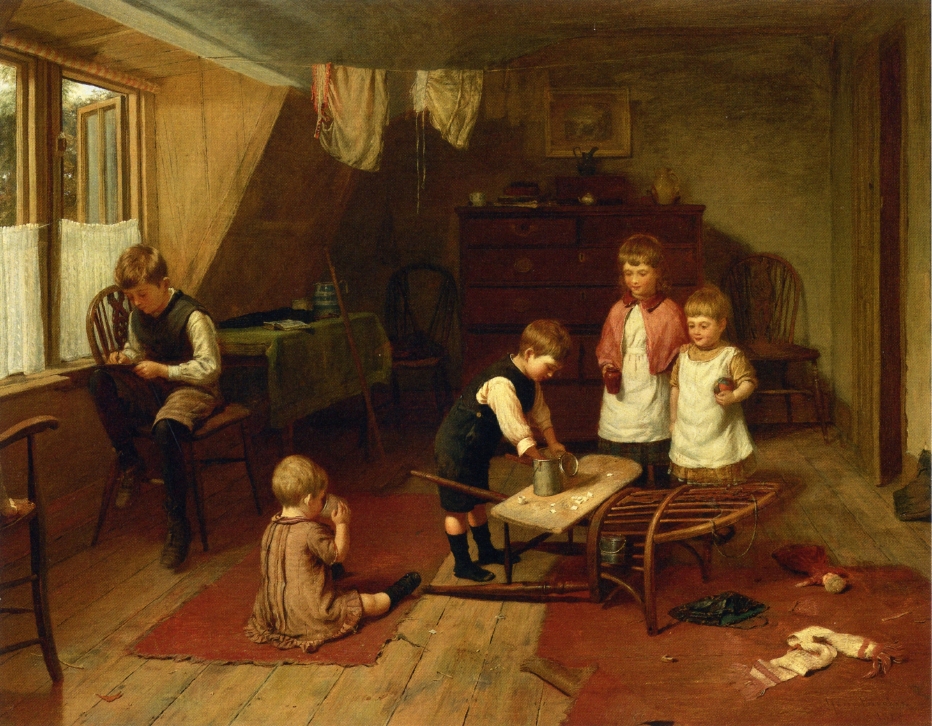
Children-at-Play by Harry Brooker‘You may say I’m a dreamer, but I’m not the only one…’ I can hear John Lennon’s immortal crooning in my mind. Isn’t that what children are so good at? They dream. They dream frequently, and they dream about anything they want, and they dream big. Left unfettered from cruelty, their minds are not naturally wired for questioning their self worth. They don’t think of excuses, they just follow their innate sense of curiosity and joy, they let their minds wander, and upon finding something of interest they become completely absorbed in whatever they are doing.

I love to watch Ruby play; she has such a vivid imagination. When she gets into her own little world she dresses up and tears around the house using whatever toys and props (usually kitchen utensils) are needed to fashion her make believe scenarios. If I call her name while she is ensconced in her imaginings she is completely deaf to me. Her excitement at what I would consider a mundane activity never fails to brighten my heart.

I think being a parent probably makes it easier to connect with our bounteous childlike energy, as our children help us to see the world through their amazed eyes.

Ignite Your Childlike State of Wonder:

How many of us can say at some point while we were growing up we were told by a parent, a teacher, or a well-meaning adult, ‘Stop daydreaming!’ It is misguided to think that so called ‘daydreaming’ is a negative trait. Far from it. This is the tool of creation. Creativity is inherently abundant in youngsters, and the school system with its rigid curriculum is not conducive to nurturing this very important aspect of a child’s development.

Federico Fellini - ChildlikeBy the time we reach adulthood most of us, (to some degree), have usually had the light of our dreams diluted or even drained out of us completely. A constant barrage of negative messages from the world around us can eventually drown out our intuitive childlike selves, fostering self-doubt within us instead. The mental baggage is accrued over time, and then it becomes so much harder to follow our dreams, for fear of failure. To be truly ourselves means letting go of other people’s expectations for how we conduct our lives. It means sticking our heads above the parapet. It takes courage to hold our dreams out in front of us like a lantern, glowing with the perseverance and faith that we experienced in our childhood.

“Creativity represents a miraculous coming together of the uninhibited energy of the child with its apparent opposite and enemy, the sense of order imposed on the disciplined adult intelligence.”   ~ Norman Podhoretz

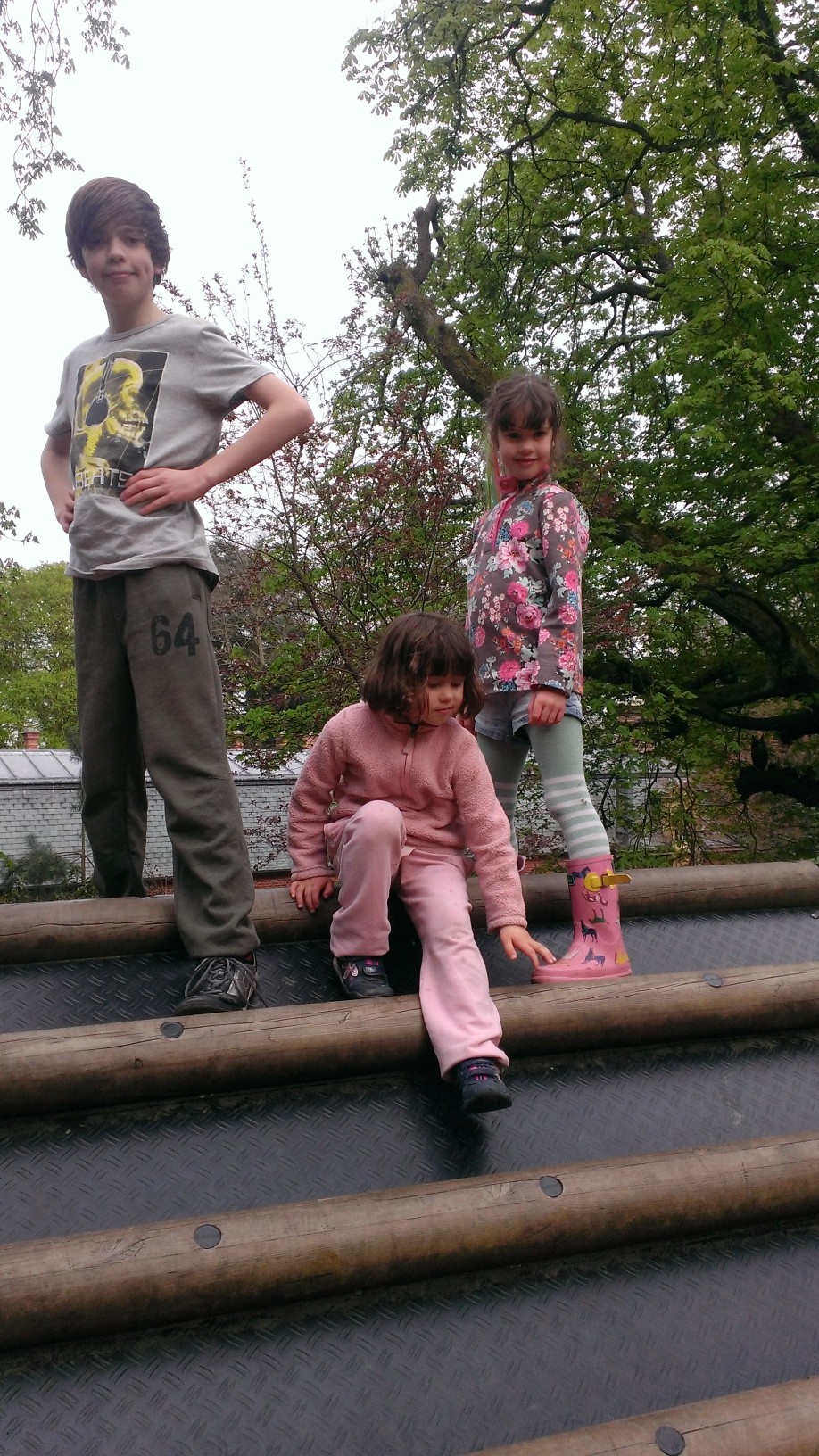
looking for adventure at Waddesdon ManorUnlike Peter Pan, we all grow up, (well, most of us!) but that doesn’t mean life has to be all serious. Although we have responsibilities, bills to pay and all the trimmings that go with adulthood to deal with; the inner child that dwells within each of us can make being an adult so much more fun. We have a responsibility to love, nurture and parent our own inner child. And when properly cared for, children are happy and they flourish. The benefits to us as individuals (and the people around us), of embracing our inner child are manifold: increased joy, laughter, spontaneity, love, emotional honesty, and chiefly, living in the present moment. We do not brood on the past or worry about the future when we are fully engaged in the now…

“Man is most nearly himself when he achieves the seriousness of a child at play.”  ~ Heraclitus

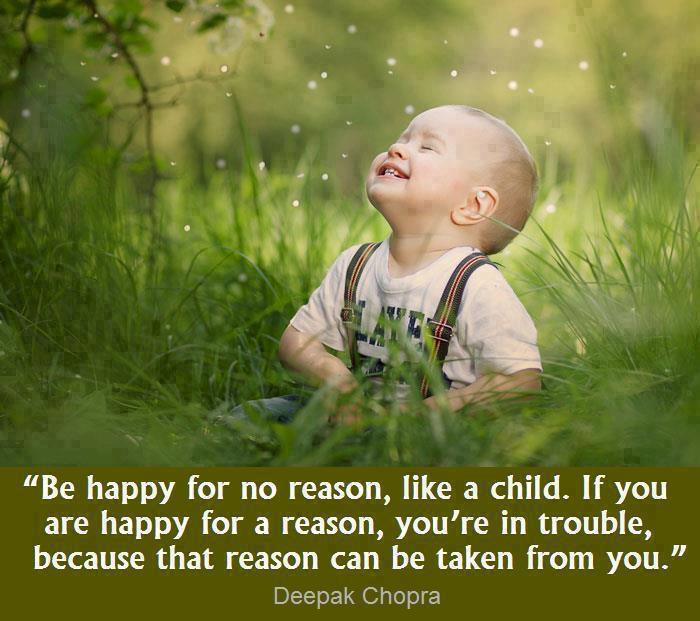
Deepak Chopra quoteI’m not promoting the kind of ‘throw your toys out the pram’ mentality of narcissistic demands or temper tantrums, dependency, neediness, petulance and general egocentric behaviour.  Neither am I suggesting that we live in a world of fantasy. But if we can access that playful and innocent side of ourselves, we can harness this enthusiasm in multifarious ways. We can use that sense of wonder and awe and intense focus (without judgement) in whatever endeavour we like, or indeed, even just to elevate our everyday lives. It is all about achieving that balance between our heads and our hearts. Not living life solely in our conceptual minds, or always wearing our hearts on our sleeves with complete naïveté.

The original Jungian Child Archetype was the basis for many theories and development of the modern term ‘inner child’ including the work of Dr Eric Byrne in Transactional Analysis, and study of the ego states: Parent Child, Adult.

Getting in touch with our feelings can sometimes bring up unresolved trauma or an emotional blockage. However, we can begin to heal when we become conscious of the past wounds our inner child has suffered. Suppressed pain can hinder our functioning at full capacity as an Adult and Parent.

I love this talk by Eckhart Tolle on being yourself:

To coin Ruby’s favourite word, existence is ‘awesome’.  Now I’ve got John Lennon in my head again! ‘I hope some day you’ll join us, and the world will live as one.’

Here’s my own mnemonic: Doing Really Exciting Activities Mindfully

Dream big!