Mozart – The Miraculous and the Mundane

“The passions, whether violent or not, should never be so expressed as to reach the point of causing disgust; and music, even in situations of the greatest horror, should never be painful to the ear but should flatter and charm it, and thereby always remain music.” ~ Wolfgang Amadeus Mozart from The Journal of Eugene Delacroix.
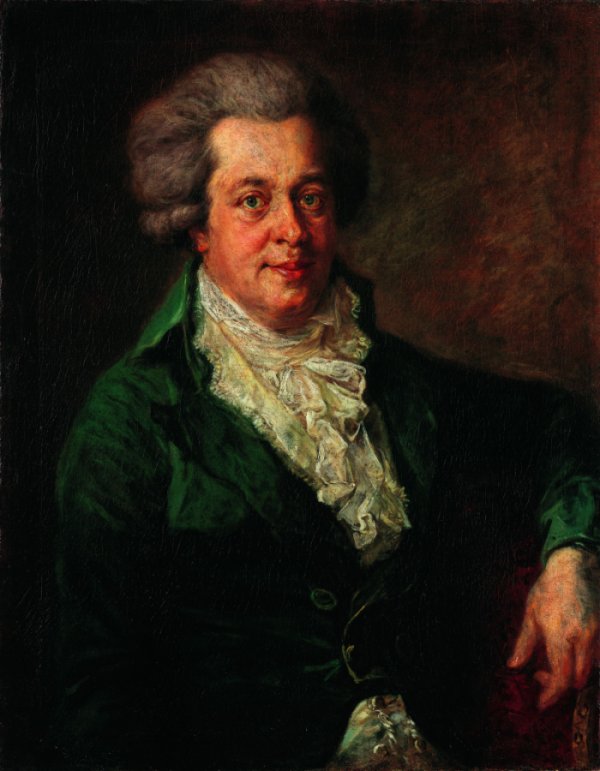
Mozart_Portrait_EdlingerThe name ‘Mozart’ conjures up an image of a divine genius, a demigod of music, unsurpassed child prodigy, composing savant with steam coming off his quill, operatic icon, inquisitive about the world and the mysteries of life, with an unquenchable thirst for knowledge and creative output. Not to mention an ardent admirer of women (especially ones who could sing), and who possessed a desire for fun and the simple pleasures of drinking and social discourse. An individual who was little in stature but large in intellect, who loved life and seemed to live it Allegro Con Brio.

At least, it does for me…

His fame has spanned centuries and his name is known by just about every human being on the planet. Whatever your impressions of this giant of classical music are, one thing’s for sure; his miraculous outweighed his mundane. By the time of his death in 1791 at the age of 35, he had written over a staggering six hundred compositions, in the form of sonatas, symphonies, concertos, chamber pieces, operas and choral music.

Revered by composers that followed, and most likely envied by his contemporaries (cue Salieri), Johannes Chrysostomus Wolfgangus Theophilus Mozart has probably touched more souls than any other composer in the history of music. And I think he was able to do that because of the mundane.

His mind was in another sphere, but his physical body was ordinary, and shared the same mundane functions as the rest of us mortals.  He experienced the everyday emotions of life that we all do: happiness, sadness, love, hate, desire, jealousy, pride, excitement, ambition, despair, longing, and well, the list goes on.

Because the miraculous isn’t possible without the mundane…
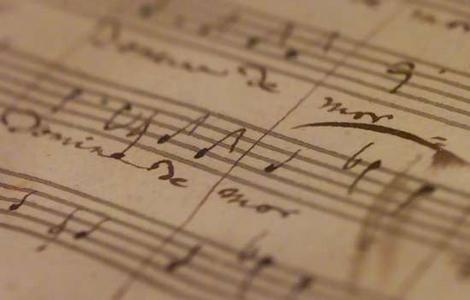
mozart_requiemTherein lay the very substance for transmutation into the sublime, his inspiration of what it means to be human in musical form: collections of notes and pitches, silence and resonance, arranged for different instruments in different styles, something for everyone, and that anyone can relate to today, 224 years after his death.

His star shone bright (I’m talking supernova), and burned rapidly, but luckily for us Mozart was a prodigious and prolific composer, and despite his often challenging circumstances he created a stunning legacy of music for the world to enjoy.
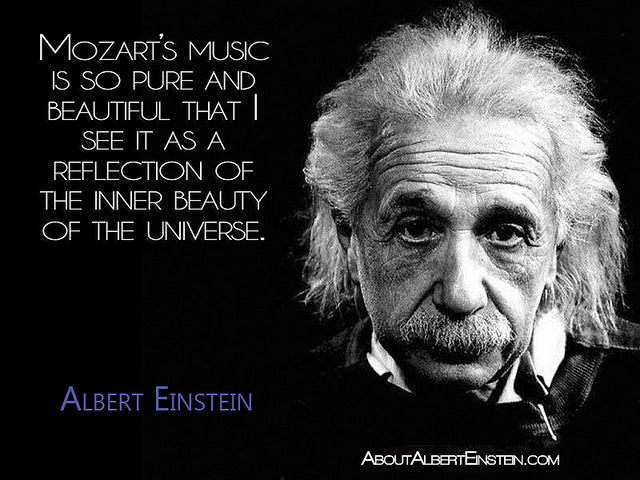
Einstein on MozartHis father Leopold would have been proud. His early tuition for Wolferl and Nannerl on the violin, clavichord and in classical composition (Mozart wrote his first sonata at the age of 5), along with their childhood travels across Europe, their family performances in front of royalty and the aristocracy, would eventually pay dividends far beyond his fatherly comprehension! Now his music is in space, courtesy of NASA.

He even has his own scientific phenomena: The Mozart Effect.  Play Mozart to your children, and even better, if they can learn to play him.

A list of Mozart’s musical compositions; which were numbered and classified in chronological order by Ludwig von Köchel as either ‘K’ or ‘KV’ in the Köchel catalogue.

A Few Mozart Facts:

  • His favourite string instrument was the viola, and he wrote the Sinfonia Concertante as a beautiful conversation between the violin and the viola. The andante from that music is one of the most moving pieces of music I’ve ever heard.
  • In the spring of 1770 whilst in Italy with his father, the Pope conferred on Mozart the Order of the Golden Spur. It was in Italy that he met and became friends with the violinist and British prodigy Thomas Linley (who also died tragically young).
  • Baron Gottfried van Swieten, who was head of the Imperial Library of some 300,000 volumes in Vienna, granted Mozart access to works by JS and CPE Bach and Handel. Thus Mozart learnt to graft ‘counterpoint’ onto sonata form and find his own unique style which wasn’t popular at the time.
  • Wolferl and Constanze had six babies, but only two of them survived into adulthood: Karl Thomas, born in 1784, and Franz Xaver Wolfgang in 1791, just before Mozart died.
  • Beethoven thought that Mozart had an affair with one of his (Mozart’s) pupils and had also borrowed money from her husband.  Even more bizarrely they were neighbours to the Mozarts, and the day after Mozart’s death the husband committed suicide after attacking his wife, who was five months pregnant, slashing her across the face, neck, shoulders and arms with a knife. It is thought the woman and baby survived the attack.
  • Mozart became a Freemason in 1783, at the time there were around thirteen ‘lodges’ in Vienna with 700 members, around half of which were nobles.
  • His opera Don Giovanni was popular in Prague, but the performance in Vienna was a flop.
  • In the year of his death it’s estimated that Mozart’s income was between 5,000 and 6,000 florins.
  • At the time of Mozart’s death only one fifth of his compositions were in print, whereas by the 1820’s nearly two thirds were.
  • Constanze claimed that Mozart thought he had been poisoned with Acqua Toffana, and that he was writing the Requiem for himself.

There’s a lot of information and myth about Mozart, and I could go on all day, but instead, I recommend watching the fascinating and fabulous BBC documentary: The Genius of Mozart.

Part 1 – Miracle of Nature:

Part 2 – A Passion for the Stage:

Part 3 – The First Romantic:

If you are on Twitter and you enjoy Mozart’s music why not join the celebration of his birth in the 6th annual #MozartChat on Tuesday 27th January, conceived and run by pianist and writer @waynemcevilly. Check out his website and piano masterworks for children.

You’ll be most welcome!

Kicking OCD’s Butt and Teenage Mental Health Issues

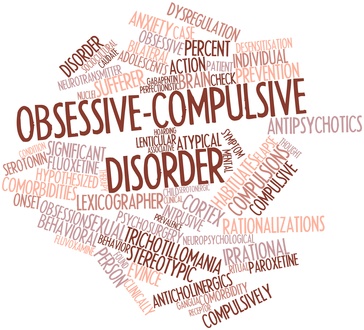
Word cloud for Obsessive-compulsive disorderUntil my younger son recently developed OCD (Obsessive Compulsive Disorder), I hadn’t realised just how prevalent it seems to be. I discovered some very well-known people (past and present) suffered with it, including one of my all-time heroes.

William was always prone to worry, and had certain proclivities towards cleanliness that his older brother didn’t! But the onset of adolescence seemed to take it to a whole new level.

I think there were several factors responsible for his increased ‘sensitivity’, and an overall increase in anxiety was definitely one of them.  He continues to work hard at school, and so far his grades are up at grammar school level, but he worries about his homework and his work in general.

On a personal level he seemed suddenly unsure of himself. Growing up he’s mostly been a confident and self-assured boy, but lately he started asking me if I still loved him. He seemed to need extra reassurance. I was happy to give him this, but it didn’t appear to quell his anxiety.

William was just the sweetest, kindest, affectionate and most lovable boy until his hormones kicked-in. Now I have to endure a know-it-all attitude, frequent rants, his being argumentative and confrontational with me and his siblings, mood swings, and on top of his typical teenage behaviour there is a debilitating voice in his head – his OCD; which undoubtedly adds extra strain to family life.

His appetite seemed to diminish, foods he liked previously were assigned to the ‘rank list’, and suddenly he started going a whole day at school not eating any of the restaurant food available. He couldn’t sit down without first putting an item of clothing on any seat and he had to have two showers a day. His hand washing became so bad his skin got really sore and cracked, and he developed an aversion to pretty much every smell in the universe! At one point he would only eat crisps with a fork!

After a visit to his GP (who made a referral), and a lengthy wait, he was admitted to CAMHS (Child and Adolescent Mental Health Services), part of the NHS that deals specifically with this age group, to have some CBT (Cognitive Behavioural Therapy). Looking round the waiting room at the tired and apprehensive faces of the other parents I took comfort from knowing that I wasn’t the only one with teenage offspring going through some kind of melt-down.

CAMHS has been a Godsend for us, and I feel that William has made some good progress. Whilst there is still work to do, his therapist, Sue, has really helped him to understand that he has the power to kick OCD’s butt.

I thought that sharing the generic information and tips she has given to William would be helpful for other parents and their children who may be going through similar trials and tribulations…

rsz_cbt_drawing (2)On his first session they talked about the relationship between his thoughts and behaviour. He was asked to focus in on the different emotions and sensations that he experienced, and he wrote them in a pie chart relative to what he was feeling. Sue then drew a couple of quirky pictures to illustrate to William how his thoughts created his feelings, and how they, in turn contributed to different sensations in his body, which then had a direct impact on his behaviour.

She drew him an ABC of thoughts:  Activity – Belief – Consequence

She asked him to consider:

“How helpful is my thought?”

“What evidence do I have to support my thought?”

“What evidence do I have to disprove my thought?”

“What would be a more helpful thought?”

“What’s good about this thought?”

“What’s bad about this thought?”

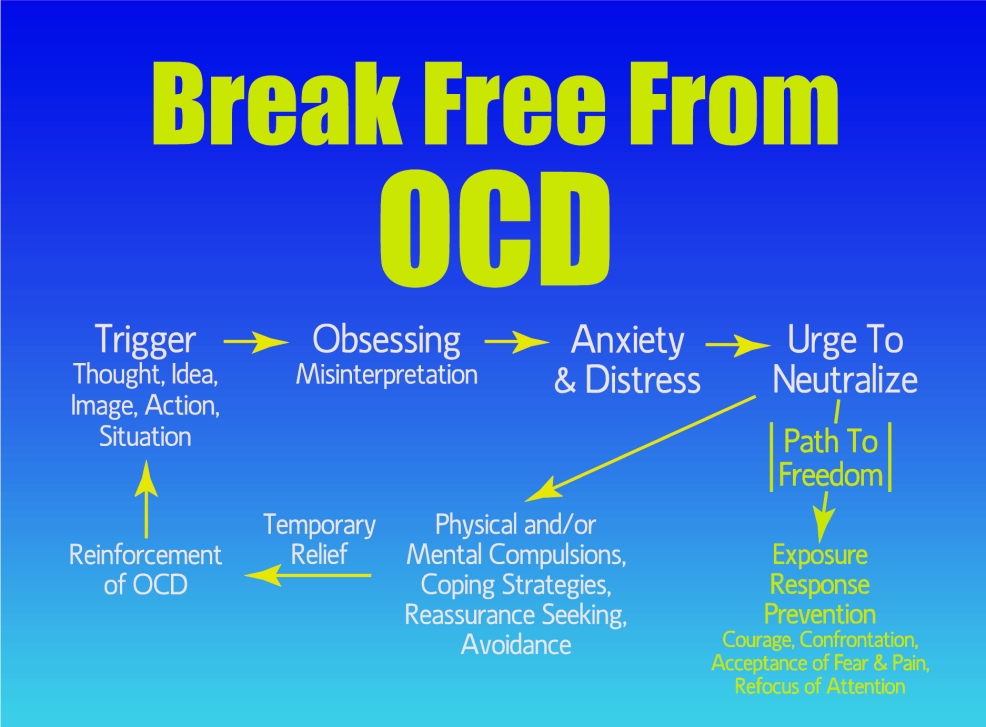
She then mapped his reactions to OCD to illustrate how the OCD wins, how he wins, and what happens at the intersection between the two.

OCD_Cycle_lrg

In later sessions he worked through an ERP programme (Exposure and Response Prevention), which is laid out according to the individual’s specific circumstances, where the activities and situations that cause the compulsions are deliberately undertaken.

At first, William was asked to participate in the actions that caused him the least amount of stress so that he could expose himself to the anxiety for short periods of time, gradually increasing the time and severity level of his activities. Sue drew a graph, and explained that his stress would always be high if he let his OCD rule him, and that to sit with the discomfort for a while would gradually lessen his overall anxiety around those activities, providing he made the effort to do the tasks that upset him.

“Exposure and Response Prevention (E&RP) encourages participants to expose themselves to their obsessions (or to situations that will bring on the obsessions), while they prevent themselves from using compulsions to get rid of the resulting anxiety.” ~ Fred Penzel Ph. D.

Over the weeks that followed Will worked on the strategies that were set specifically for him, and he began to see success. He gained confidence from the lesser tasks, so that he is now tackling the situations that he thought he never would be able to deal with.

My eldest son, Max (now 17 and towering over me), still has a few issues to deal with, but I feel we navigated his teen years through some scary storms into relatively calm waters. We have the odd squall, but on the whole he’s much happier. He also had a period of visiting CAMHS for different reasons, and they were instrumental in diagnosing his high functioning Autism. It also helped me enormously; mainly how to be a better parent to him, and I learnt not to take it personally when his lack of compassion or ‘mind blindness’ affected either me or the family.

I was dismayed to read in The Times last week that more cuts have been made to services directly affecting teenage mental health.

Modern society seems to be taking its toll on our youngsters, with increasing cases of depression, self-harm, eating disorders, mental disorders and in some cases suicide.  Government cuts to CAMHS are indefensible. Our youngsters need this service! The implications for society are dire if this vital service is diminished.

I am bracing myself for the next teenage era with my daughters, but thankfully I have a few years yet before I have to deal with that dreaded phase. My challenge before then will be to help shore up their self-esteem, confidence and our relationships so that even rough seas won’t be able to destroy the safe harbour we have built, or, at least that’s the idea…

Now it’s time to inject some humour!

I watched the ‘Kevin’ sketches again recently to have a laugh and reassure myself that we’d all get through it, even if I did have a few more grey hairs to show for it!

“When you change the way you look at things, the things you look at change.” ~ Dr. Wayne Dyer

Reaching for the Stars – Enlightened Goal Setting (Part 2)

“The important thing is to strive towards a goal which is not immediately visible. That goal is not the concern of the mind, but of the spirit.” ~ Antoine de Saint-Exupéry

The ancient science of Numerology, which originated in Babylon and Egypt, was also studied thousands of years ago in China, India, Rome, Japan and Greece. It was in ancient Greece where a certain Greek Philosopher and Mathematician, Pythagoras, felt that the entire universe could be expressed through numbers, and his theories expanded Numerology (so that he became known as the father of Numerology).

Infinity_by_TheUnlikedOne_1600x1000In modern Numerology 2015 is an 8 Universal Year, (calculated by adding the digits of the year together).  The number 8 is said to represent infinite abundance, which of course could affect many different areas of our lives.

Let’s hope we can all harness this cosmic power moving forward…

Having done some soul searching, decide your definite major purpose.

There are nine advantages to this:

  1. You start to notice resources and develop the possible qualities needed to achieve your purpose.
  2. Specialise – attract the knowledge you need. This gives you focus.
  3. Budget your time and money. You don’t waste precious resources.
  4. It alerts you to possibilities you may have missed before, when your radar is honed.
  5. You make quicker decisions.
  6. You attract help. When you’re on a mission people will want to help you.
  7. Experience of the 12 great riches mentioned in part 1.
  8. Develop faith. Not so much in the religious sense, but in yourself.
  9. Develop success consciousness.

It is recommended to make goal statements. These should be positive, specific and with a deadline. Ideally they should fall under the categories of what, why and how. They should also be influence-able, i.e. under your control.  Decide the price you’ll pay, know how you are going to do it, and what you’ll learn and do. Read it several times a day, and memorise it.

Outcome Acting & Thinking:

Brian Tracy goal-quotes2Model yourself on other people who have done what you want to do. Study not just what they did, but if possible what they believed and their values. What were they focusing on? If you can meet such people, many successful people are prepared to help those with a dream. You can also learn a lot from books and people online.  To some extent you will go through trial and error to gain wisdom.

Working backwards is helpful. First you look at the big picture, and like a puzzle gather and fit together the pieces you need to achieve to reach your goal. It’s common sense to break it down into doable steps.

Remember to ask the magic question if you hit a brick wall:

“How can I____________________?”

Fill in the blank with whatever it is you need to know. It’s amazing how the answer will come to you. It could be in the form of meeting someone influential or knowledgeable in the area you’re interested in. You might see an article, hear a radio interview, read a book etc. Somehow, the universe will answer you.

It’s worth noting that without awareness thoughts and events happen on auto-pilot, according to our early programming.

Thinking:

  • Align your beliefs with your goals for the year. Watch out for your un-resourceful or self-sabotaging beliefs.
  • Values provide a source of motivation.
  • Filters allow us to let in the information that you need to reach your goal.
  • Create the big picture and then chunk it down into manageable steps and actions, so that you don’t lose heart or become overwhelmed.
  • Look at your method of making good and fast decisions.
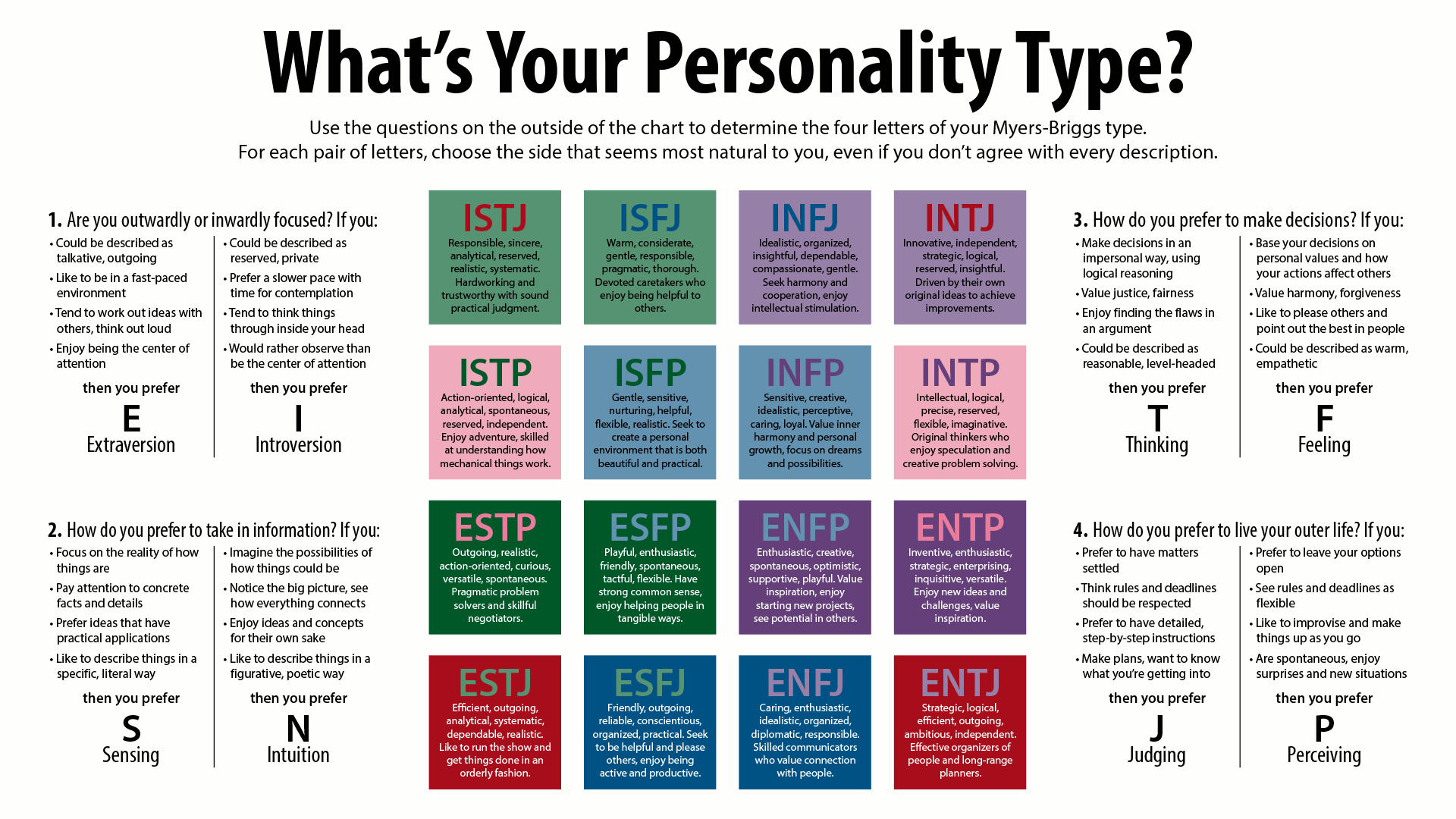
  • You might find it useful to be aware of your psychological preferences. Are you extroverted or introverted? Sensing or intuitive? Thinking or feeling? Judging or perceiving? Why not take the Myers Briggs Test based on Jung’s writings in his book Psychological Types.
  • Understand your internal representations and how they steer your actions.

MyersBriggsTypes

We are all bound to hit some rocks on the road to success. Maybe even a mountain or two. There’s no avoiding it. I’ve found it helpful at such times to remind myself of Napoleon Hill’s statement that every adversity carries with it the seed of an equivalent or greater benefit. It’s okay to feel temporarily discouraged or bad about it, but the most important thing to do is to evaluate the adversity and list its advantages.

Germinate the seed…

Shakespeare so often has the right words and wisdom for every occasion:

There is a tide in the affairs of men,

Which, taken at the flood, leads on to fortune;

Omitted, all the voyage of their life

Is bound in shallows and in miseries. ~ Julius Caesar 4.3.217-20, Brutus to Cassius

If we go the extra mile we will gain more satisfaction, make ourselves indispensable, increase our personal initiative, develop self-reliance and courage, integrity and eliminate procrastination. The qualities of all successful people.

Good luck! By that I mean: Labouring Under Correct Knowledge

“You are never too old to set another goal or to dream a new dream.” ~ C.S. Lewis

Reaching for the Stars – Enlightened Goal Setting (Part 1)

“Whatever the mind of man can conceive and believe, it can achieve.” ~ Napoleon Hill

It’s a new year, and we’re naturally focused on what we might do differently or better than last year. Those well-meaning new year resolutions to exercise more, give up smoking, and all manner of ‘should dos’ get attention for maybe a couple of months before they fall by the wayside; even if we’re super determined. Life has a way of testing us to the limit!

To me, the term ‘resolutions’ sets us up for failure before we’ve even begun. It sounds too much like iron clad will-power is required. There’s no fun or adventure and excitement in it. It sort of implies that we’ll need to be as serious as the United Nations are when they publish a Security Council statement of will.

Some lofty intention that we don’t really believe is attainable, eating away at our motivation for sustained action. We certainly do need intention and resolve to achieve our goals and dreams, but that alone won’t propel us to the heights of achievement.

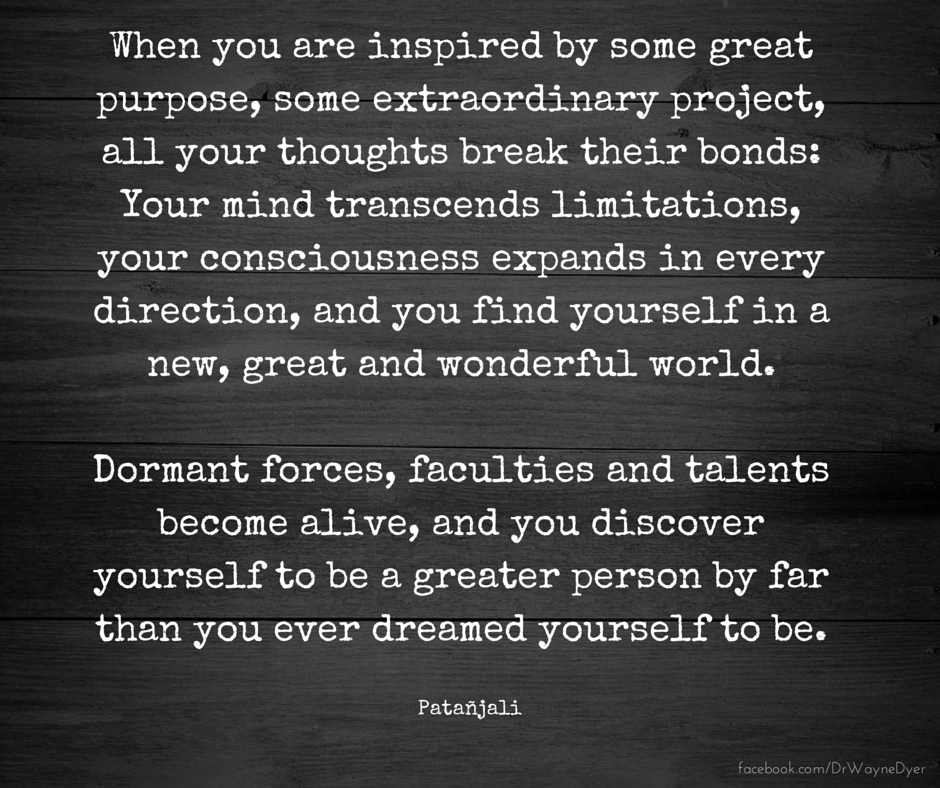
patanjali

In this and the next post I hope to break down the components of how to turn a few ideas on your 2015 resolutions list into a way of life: a step by step approach to create habits so ingrained that it wouldn’t occur to you not to behave in a way that takes you closer to your desired outcomes; so that when 2016 rolls around you can knock back the champagne knowing you did everything in your power to live the life of your dreams.

Every year is a stepping stone toward manifesting the full potential of your life.

It’s an ambitious task I know, but I wanted my first post of 2015 to be as meaningful as possible…

Perhaps we should start with questions.

Why create something?

For some it’s the joy of creating, but at the end of the day, we all need to survive. We all want stuff. That’s okay. For others, the challenge is the key. If you set yourself a challenge that’s just far enough away to motivate and stretch you, just a little more than you thought you could do, but not so far away that it’s frustrating and seemingly impossible, who knows what your life could look like in the process of striving for that goal.  The point is it has to be important and meaningful to you.

The dictionary definition of success is:  the favourable or prosperous termination of attempts or endeavours; the accomplishment of one’s goals.

Napoleon Hill studied the most successful people in America over a period of twenty years, and at the suggestion of billionaire businessman Andrew Carnegie, he distilled this collective knowledge in his 1937 best-selling book: Think and Grow Rich.

In it, he lists the 12 Great Riches of Life:

  1. PMA – Positive Mental Attitude
  2. Sound physical health
  3. Harmony in human relationships
  4. Freedom from fear
  5. Hope of achievement, e.g. setting yourself challenges, which gives you a zest for life
  6. Capacity for faith
  7. Sharing your blessings with others
  8. Having a labour of love
  9. Have an open mind on all subjects
  10. Self-discipline
  11. Understand people
  12. Financial security

Napoleon Hill’s words of wisdom from the great man himself:

Do you know what you want?

Some of us have been told as children that we shouldn’t want anything, and in other cases these decisions were made for us. Some of us may have decided that what we want is not possible anyway. Just deciding this one thing could be the most important step you ever take.

It’s important to have that key ingredient of awareness, and ask: what are my beliefs around what I want? Beliefs are self-fulfilling prophecies that can either help us or hinder us in our quest.

The next thing to decide is the price. What are you willing to do, or to give of yourself to achieve your goals? The price must be paid in full (even though it’s January there’s no discounting allowed, sorry!)

Six Step Formula:

  1. Know where you are – this is taking stock of your situation. What do I know or not know? What resources are available to me?
  2. Know where you want to be, and be very specific.
  3. Take action. Doing something will lead to learning and to further actions. You may not know every action you should take, but an elephant isn’t eaten whole (if you excuse the example), just act the best way you can.
  4. Evaluate the action. What worked? How can I tweak it?
  5. Refine the action. Continue to act, evaluate and you will attract the people and situations that will help you.

I must away…until part 2.

“If you cannot do great things, do small things in a great way. ~ Napoleon Hill