Lately I have been trying to make sense of how I act unconsciously. Watching to see what happens when I allow certain situations or people to push my buttons!
It has been a busy and somewhat stressful time for me over the past few weeks, and to get through this intense phase I know I need to be more aware of the emotions that I have disowned in myself, and therefore rub me up the wrong way when other people display that very ‘thing’.
To shine the light of awareness on my my own internal state is not easy, but it is helpful. For when we become conscious of a hidden belief or shadow that is driving us, we can integrate and ‘own’ it, and the dysfunctional behaviour that surrounds it will drop away. We rarely act in a way that is detrimental to our well-being once we are conscious of it.
Writing about this subject in the form of poetry has helped me to understand the concept better and apply it in my own life. I hope you enjoy the poem in its own right, along with the sublime art (which always reflects beautifully the human condition).
Long may the light shine on you (and your shadows!) Happy Sunday!
The Paradox of Polarities
Juliet lamented to Romeo: ‘parting is such sweet sorrow’,
Yet we love…yearning to insatiably consume,
Maybe fearing, perhaps craving the morrow.
What will fate serve us: fortune or doom?
Whatever may manifest in these given hours,
That which we truly see, is endowed with powers…
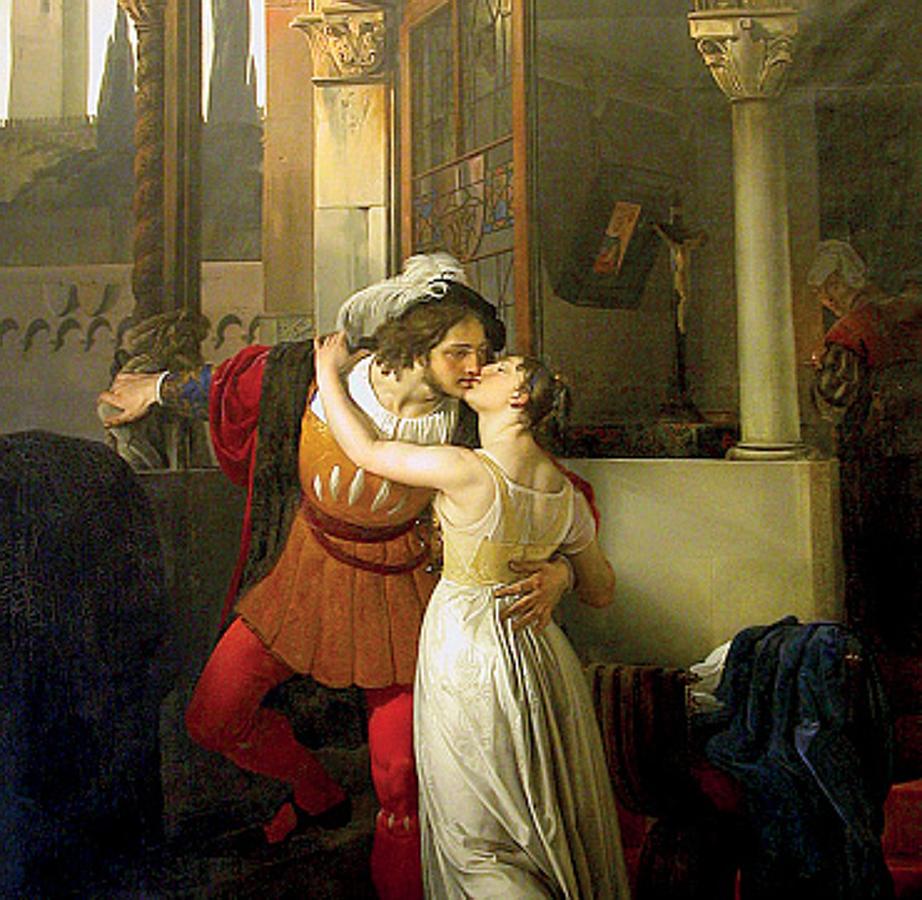
The Last Kiss of Romeo and Juliet by Francesco Hayez
Where our vision dares to go, energy will flow,
Born are we, into the realm of black and white,
Intrepid into the shadow side, we must not go.
To survive this masquerade we stay in the light,
Reprisals in childhood make us afraid to venture,
As adults, what is perceived as dark, we censure…
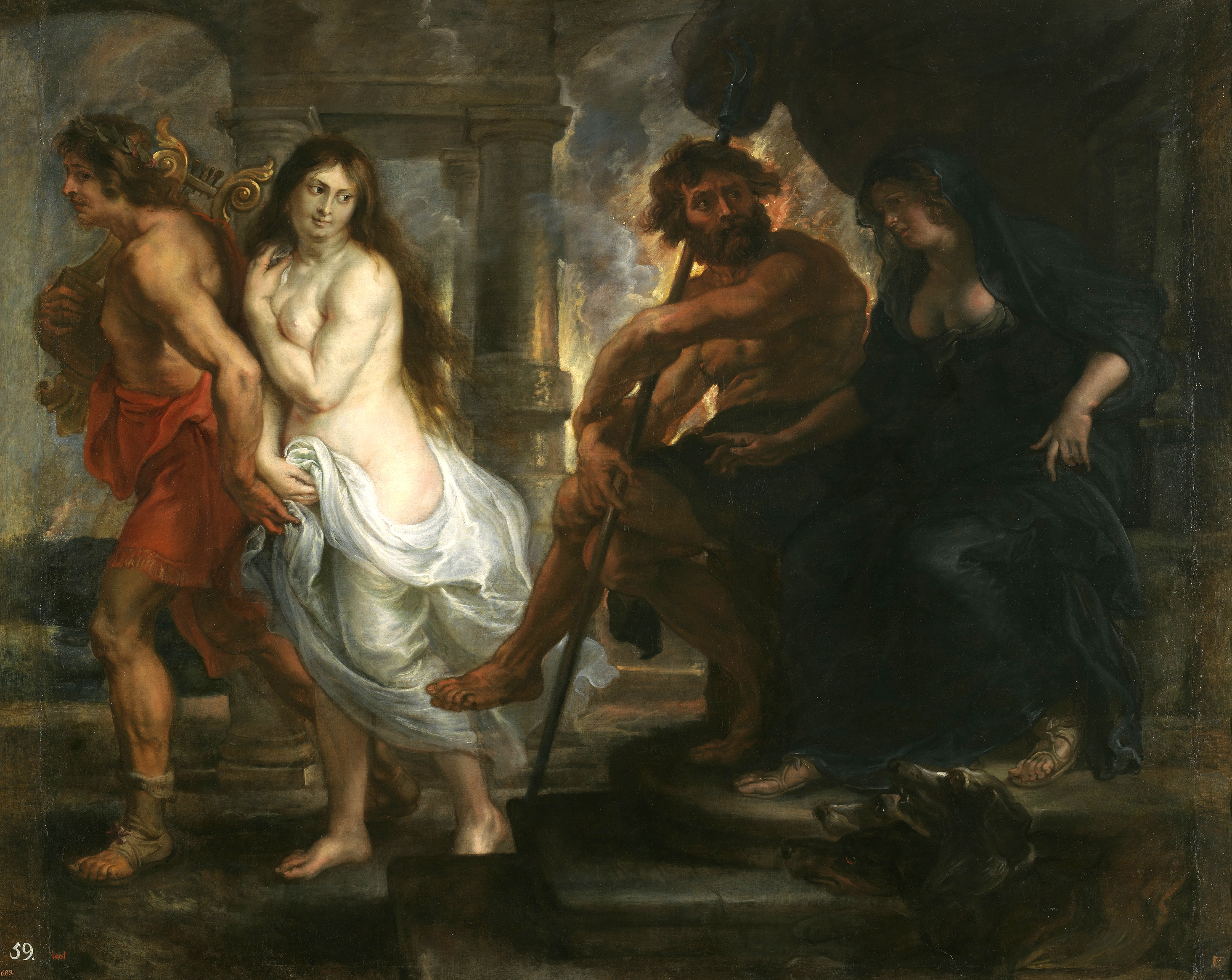
Orpheus and Eurydice in the Underworld by Peter Paul Rubens
Lurking somewhere beneath, dark soils unconscious mind,
It cannot be disowned, denied and repressed forever,
Expressing covertly as dysfunctional, not kind.
To exhibit that which we thought of never,
The voice we accept not in ourselves, or in others,
Speaks the loudest, drowns out, and smothers.
Othello and Desdemona by Christian Köhler
Despite our best efforts, eventually in vain,
We never will destroy shadows; our other side,
As night follows day, with pleasure comes pain.
The vast spectrum of life is not easy to divide,
Opposites attract, nay, depend on each other to exist,
Demarcation is purely conceptual, shrouded in mist…
Hamlet – Act IV Scene V – Ophelia Before the King and Queen by Benjamin West
How humans define polarity is arbitrary,
Endless primordial cauldron of emotion,
Good against evil can be so contrary.
Life and death, clarity and confusion,
Appear they, to be separate ideas of reality,
Isolated by social convention, for the sake of sanity…
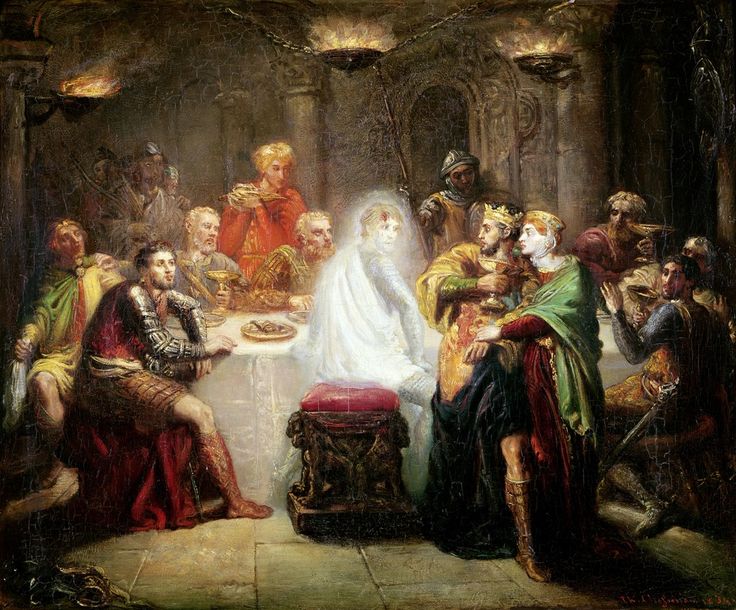
Macbeth and the Ghost of Duncan by Theodore Chasseriau
Thus, one ‘thing’ is split into a patchwork field,
We can only appreciate health because of illness,
Energy delineated, to create our journey we wield.
We can harm or heal; by practice, learn to witness,
The inner states with which we play the game,
Be we happy or sad, empty or full, of pride or shame…
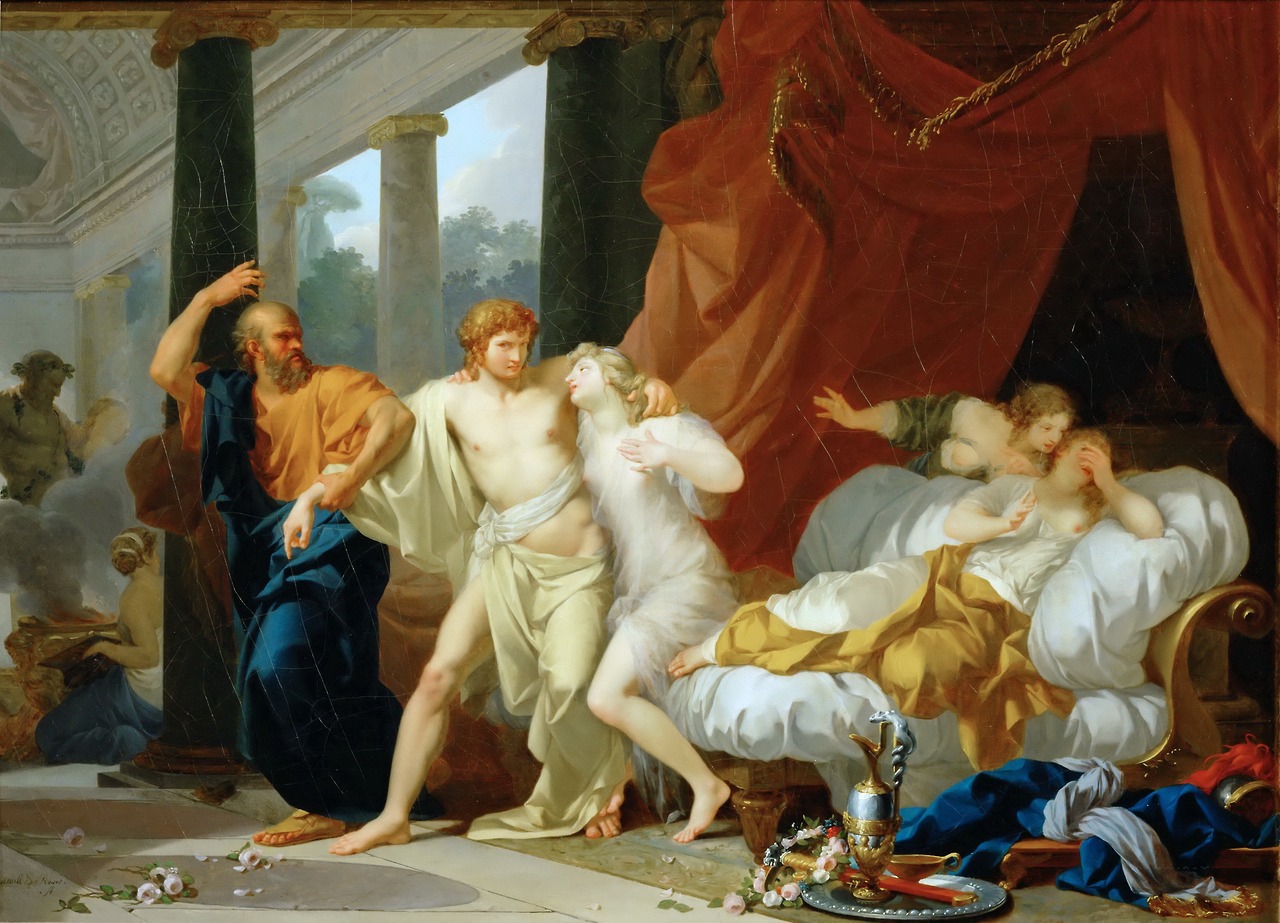
The Illness of Antiochus from Antiochus and Stratonice by Jean-Auguste-Dominique Ingres
To avoid any experience is to fall on our sword,
Better to watch and feel, then move forward,
Enjoy passion, shun apathy, either inspired or bored.
Awareness frees us from stagnation and being cornered,
To surf the panoply and panorama of tides,
Waves of dichotomy ebb and flow from all sides…
Tristan and Isolde by Herbert James Draper
The paths we take are followed in physics,
Nature’s eternal, divine laws unfold regardless,
To deny a part of the whole is to set limits.
What is buried, resisted and guarded will surface,
Dip into darkness again; find a flicker of light,
A single, bright, dancing flame expands in sight…
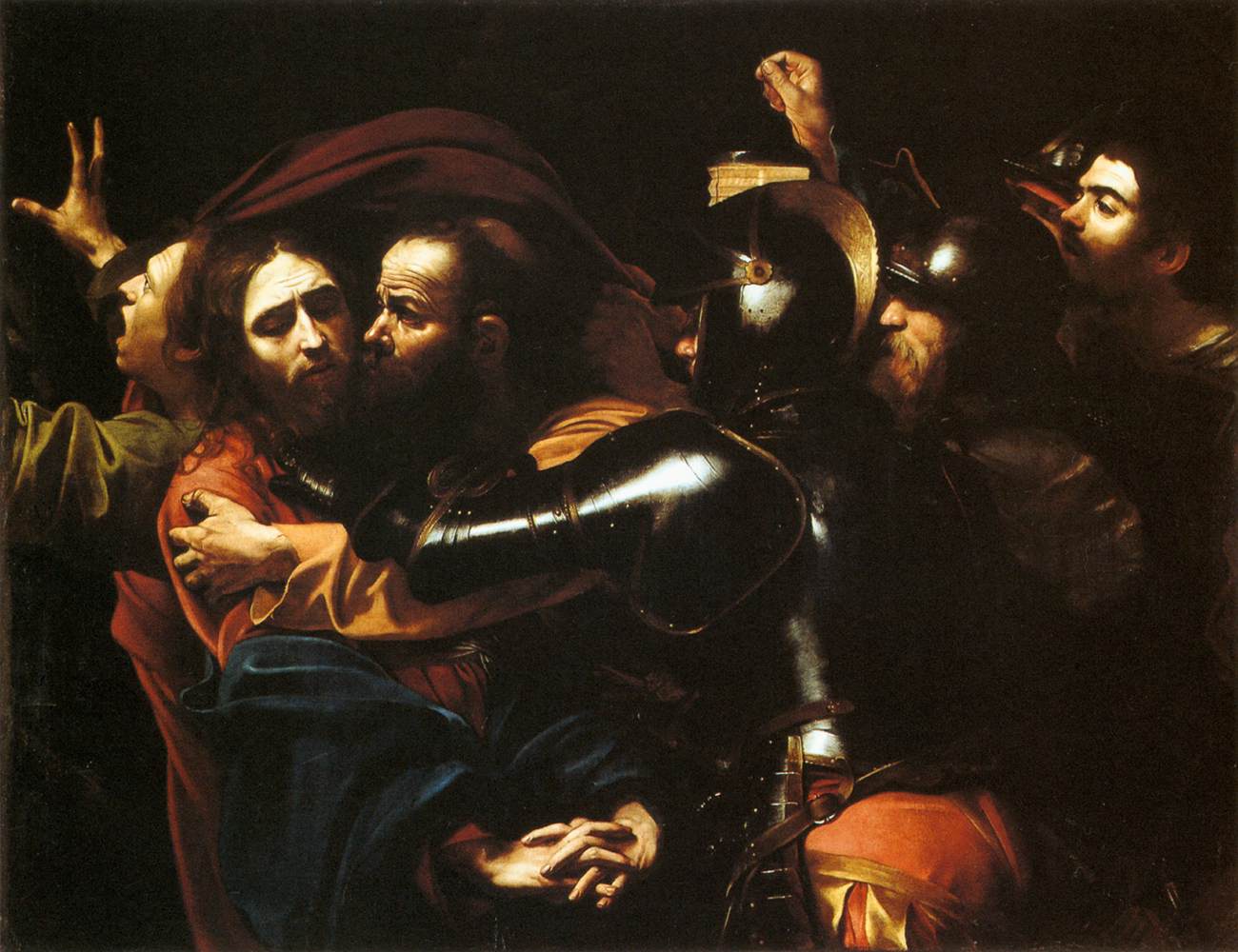
The taking of Christ by Caravaggio
We make up right and wrong as we go along,
Physical forms of the infinite, quantum reality,
Both here and not here; is a part of our song.
For singing softens the immutable tree of polarity,
“If a man devotes himself to art, much evil is avoided that happens otherwise if one is idle.” ~ Albrecht Dürer
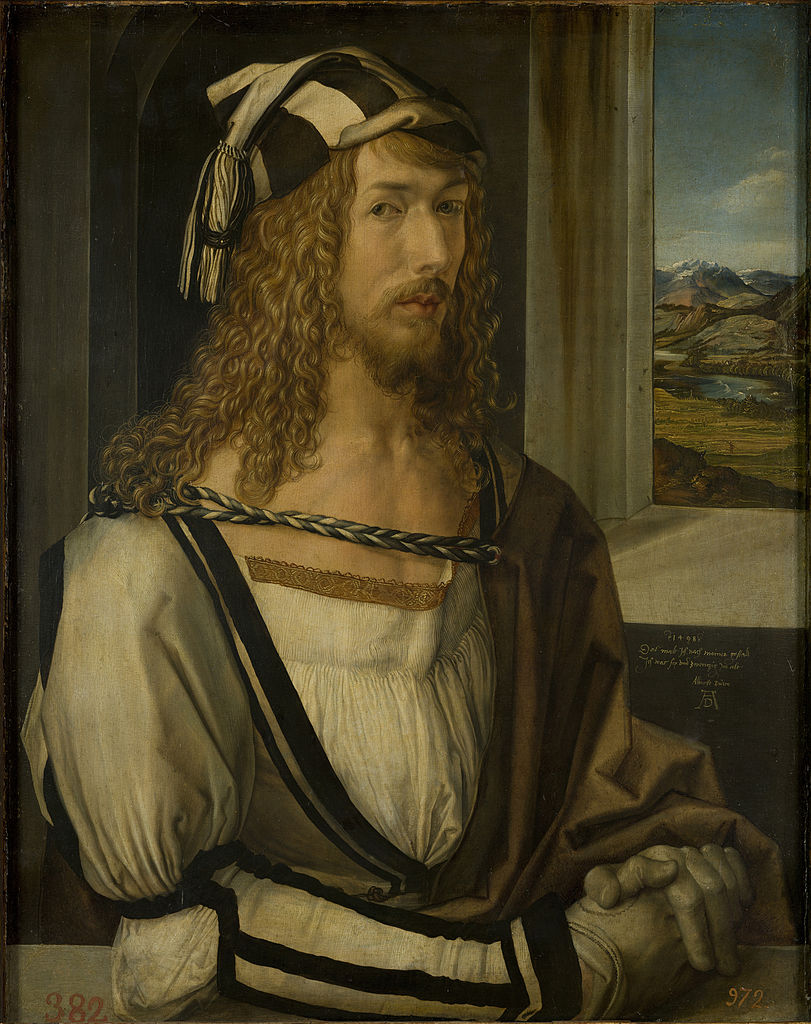
I tarried for a long while deciding which painting to cover next in the ‘What’s in a Painting?’ series. There’s just so much amazing art and many deserving artists to choose from! But for now, I have settled with Dürer’s beguiling and enigmatic Self-Portrait circa 1500, a mixed media composition on limewood, measuring 67.1 by 48.7 centimetres.
Dürer was the first ‘artist’ in the modern sense… This is for several reasons, which I’ll share as I go along.
First and foremost, the 1500 Self-Portrait is a mesmerising piece of art which I’m always drawn to, and was fortunate enough to see hanging in the Alte Pinakothek in Munich a few years ago. Looking at it I felt like I might have known him, it’s so…human. His image still speaks to us from the grave.
Perhaps it’s no coincidence that he painted it in the year 1500; the expected year of the Apocalypse that was foretold and dreaded in the late Middle Ages. But 1500 was also the first centennial year in Europe that was celebrated. It brought hope, change and new ideas.
You may also be thinking, ‘What’s there to talk about in a self-portrait?’ I almost fell into that trap until I started my research about the cosmopolitan Herr Dürer…
Da Vinci had drawn the iconic Vitruvian Man only ten years earlier, moving away from church art towards images of human beings, when human proportions became the standard for artistic creation.
What’s really incredible to me is the actual skill with which he depicts himself. It must be hard enough to paint a life-like portrait of another person, let alone oneself. What’s even more striking about this portrait is the fact that he is facing us full on.
You might think that is perfectly normal, and it is today, but back in 1500 only paintings of Christ were afforded that honour. Portraits by Dürer’s predecessor, Jan van Eyk, were always painted of a person slightly side on with their face at an angle. Had he painted this self-portrait just a few decades earlier, Dürer could have been burnt at the stake for what the medievalists would have considered unforgivable blasphemy.
Self-Portrait c. 1500 by Albrecht Durer, Alte Pinakothek
Indeed, he even has the audacity to show himself in a Christ-like pose, with his hand in front of his lapel, his gaze so utterly penetrating. It’s as if his kind, hazel eyes are looking right through me. I can’t be completely sure what his expression portrays.
If I were to put my finger on it I’d say self-assurance and serenity. His eyes radiate compassion and understanding; the windows to the soul of a deep thinker. Albrecht Dürer was twenty eight and at the height of his career when he painted it.
I’m also riveted by the detail and accuracy with which he has depicted his life-like hair. His long, flowing, spiralled curls are defined beautifully by the light glinting on the silky strands. Again, this natural, almost romantic look is not dissimilar to many images of Jesus, and he has also grown a short beard with tints of red. His powers of observation are amazing. It’s just so realistic. I even love the little tuft of fringe that tops his barely furrowed forehead.
Self-Portrait c. 1500 by Albrecht Durer, Alte Pinakothek
His skin is both luminescent and slightly ruddy. The shadows shape his face perfectly. There’s a symmetry about his proportions that is divine in nature, representative of an omnipresent being. To me, he is saying, ‘I am every man,’ but he is also a humanist finding Christ within himself. He is comparing his own features with miraculous self-portraits of Christ.
So he’s looking out at us, but, rather mysteriously, he also appears to be absorbed in his body and inner world. The small piece of fur at the base of his coat overlaps his fingers, indicating he is rooted in a physical experience. Paradoxically his gaze then, is also one of introspection.
I am totally obsessed with this work of art! Not only is it incredible as a painting, it’s the ultimate Self-Portrait in the history of art. One could argue it’s also ground breaking as the first ever selfie…
“I hold that the perfection of form and beauty is contained in the sum of all men.” ~ Albrecht Dürer
Medieval media mogul
The modern cult of artist as personality was ushered in by Dürer. Art reveals the person who created it (regardless of subject matter), by showing the skill and character of its maker.
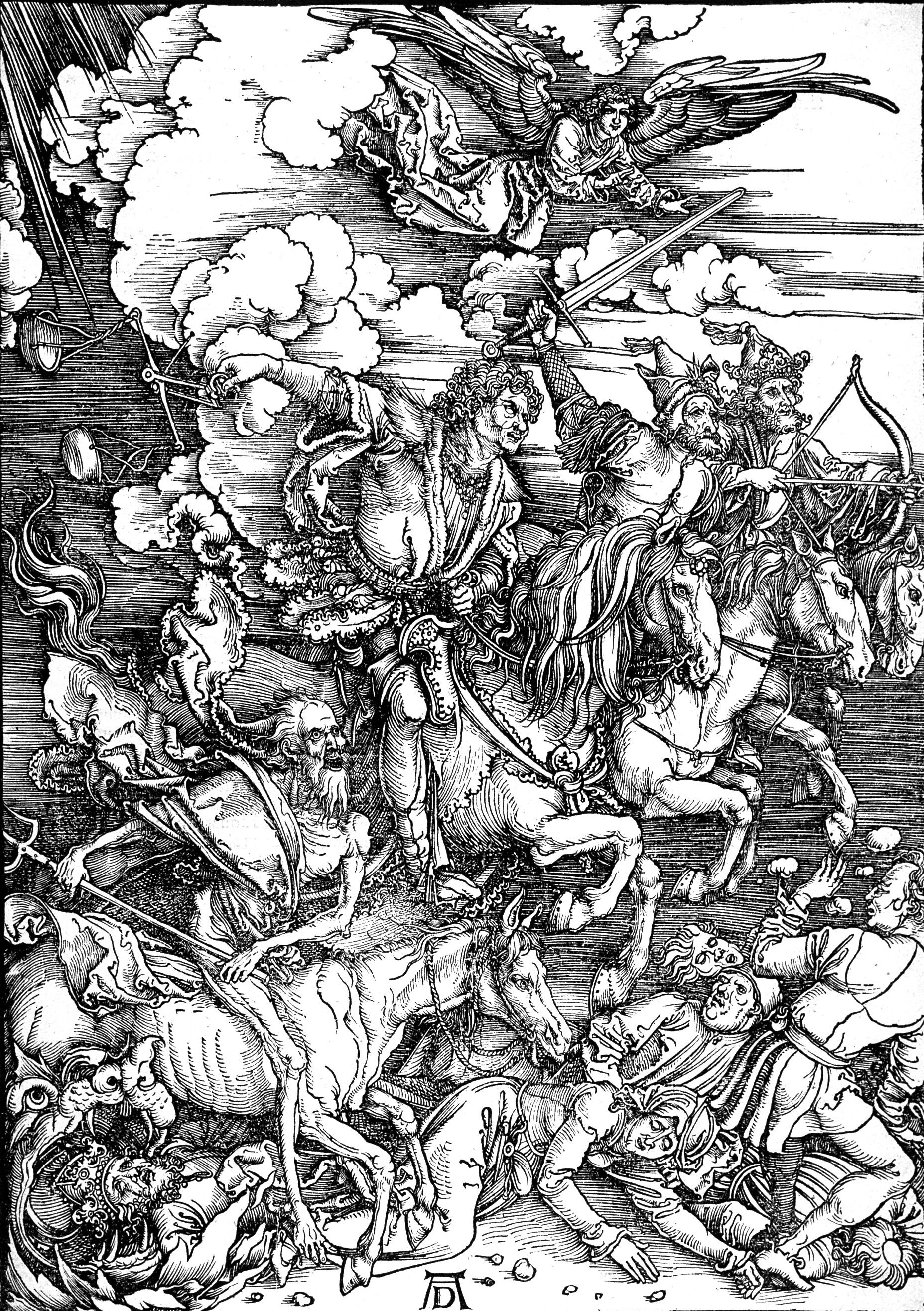
Four Horsemen of the Apocalypse – woodcut print by Albrecht Durer c. 1497-98
Not only was Dürer supremely confident and talented in drawing, etching and painting (both watercolour and oil) he also harnessed the power of the invention of the age: Gutenberg’s printing press. He was the first major artist to embrace the revolutionary way images were made and used with his iconic woodcut prints. Instead of making just one print he was able to make and distribute thousands. It was a total transformation in communication.
Branding expert
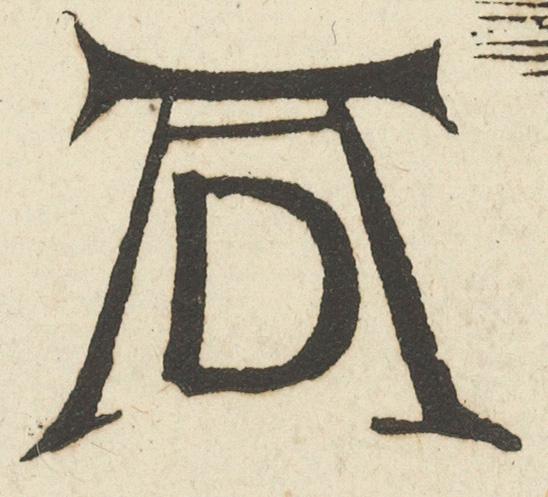
Dürer’s ubiquitous monogram of a large capital A above the smaller D that he placed in a prominent position on all his works could be considered the very first trademark and brand. How clever of him to make sure everyone knew he was behind such works of genius…
I doubt that the likes of Coca-Cola, Apple, Disney and other famous brands realise how the concept of branding began with this visionary artist.
He wasn’t afraid to push the boundaries of what was acceptable, exploring his talent and his art regardless of the religious turmoil of the age. Living during the Renaissance and the Reformation enabled his vast creative expression to flourish.
Further south on the other side of the Alps in Italy, Dürer’s contemporaries; Michelangelo, Raphael and Da Vinci were also making art history, but this did not seem to deter Dürer from forging his own path in Nuremberg.
Albrecht Dürer was the undoubted star of the Northern Renaissance; a polymath who mastered painting, printmaking, and theory. His fame and fortune was way ahead of its time for an artist of the early, modern era to experience in his lifetime. His popularity even reached as far as India.
Albrecht Dürer: Masterpieces at the Albertina
Earlier Self-Portraits
The very first self-portrait ever painted was also by the same artist, when he was just thirteen years old, and can be seen in The Albertina Museum in Vienna.
His 1498 Self-Portrait hints at an elegant, confident young man, with his shirt softly billowing in the breeze. However, each detail has been carefully considered and executed with the utmost technical precision.
Self Portrait c. 1498 by Albrecht Dürer in the Prado, Madrid
He is portrayed as a slightly ostentatious dandy compared to his previous more boyish portraits.
Other Self-Portrait sketches by Dürer depict him in the act of sketching himself as well as in a vexed state. He was also the first artist to draw a nude Self-Portrait. He was certainly preoccupied with his own appearance, for no other artist before him had left such probing accounts of their person. Maybe for him, art was his way of exploring who he was at his core.
Albrecht Dürer: 21 May 1471 – 6 April 1528
Albrecht Dürer was born during the Northern European Renaissance as a native of Nuremberg, the third child to a Hungarian born goldsmith, Albrecht Ajtósi and his wife Barabra Holper, who supposedly had eighteen babies. Albrecht was the eldest son (and only one of three children) to make it to adulthood.
The German version of their Hungarian name was Türer, which Albrecht the Younger changed to Dürer to better suit the German language and dialect.
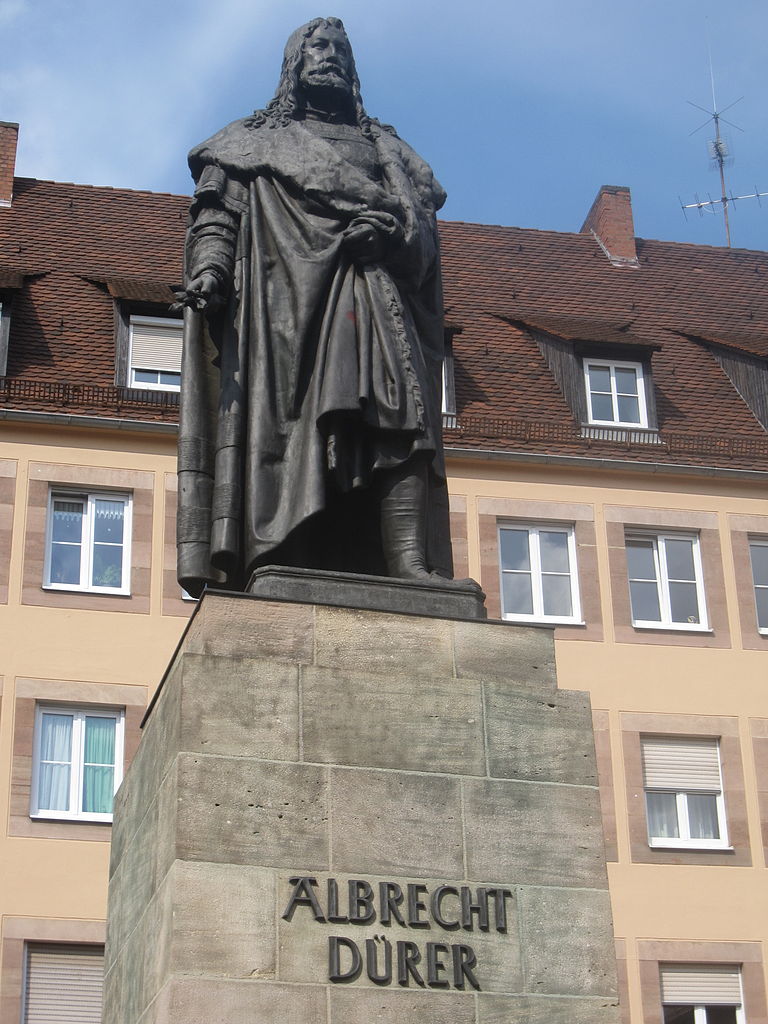
He grew up in the mythical German city of Nuremberg during its golden age as a trading centre and home to the treasures of the Holy Roman Empire. In 1828 a bronze statue of Dürer was revealed to mark the third centenary of his death, (the first public statue of its kind of an artist in the world), and miraculously, it survived the heavy bombing of the city during the Second World War. To Nuremberg’s credit the historic city centre was rebuilt in its original medieval style that was so reminiscent of Dürer’s Halycon days.
For those that wish to learn more about his life and work:
He was a remarkable man; a humanist, scholar, philosopher and intellectual, with an interest in literature and nature as well as many forms of art. He left an incredible cultural legacy for humanity.
“As I grew older, I realized that it was much better to insist on the genuine forms of nature, for simplicity is the greatest adornment of art.” ~ Albrecht Dürer
“Charisma is an authentic power that captivates the hearts and minds others.” ~ Nikki Owen
I’ve been through many self-development and training workshops over the course of my career. All of them have been valuable in their own right, but some make such a profound impact that the experience as well as ‘aha’ moments can continue to be applied to your life long after the initial learning has been assimilated. The Charisma Connection was one such day.
Creator of the Charisma Connection: Nikki Owen
Sylvia Baldock
I had not come across the work of Nikki Owen before I attended this workshop, but was persuaded by a dynamic business woman, Sylvia Baldock, the Regional Director of my local Athena networking group, who I know and trust; that it would be a worthwhile investment. I’m glad I listened to her!
Sylvia met Nikki through her membership of the Professional Speaking Association (PSA) and became fascinated by her work on charisma as it tied in closely with her own expertise on Talent Dynamics and Flow.
To cut a long story short, Nikki trained Sylvia so that she could be accredited to deliver her pioneering work.
Thirty years of research have been distilled into a life changing day of learning, laughter and limitless possibilities.
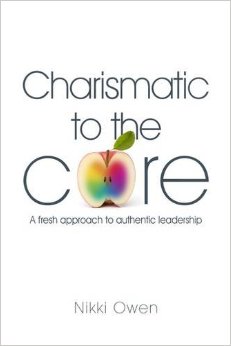
As part of the study materials for The Charisma Connection we each received a signed copy of Nikki’s ground-breaking book: Charismatic to the Core, our workbooks and access to her amazing Hypno Meditations, our online charisma profile to identify our charismatic potential as well as a follow up call with our trainer Sylvia.
Nikki’s story is incredibly moving and inspirational. You can read about her achievements, get your own charisma profile and more, on her website.
I had a few doubts in my mind before I arrived at the venue, the Crowne Plaza hotel in Marlow. Could I really afford to take a whole day out of the office that wasn’t geared to my business? I was thinking of all the writing I should be doing and the meetings I wanted to set up.
All the machinations in my mind were dispelled virtually the instant Sylvia greeted me. I knew it was going to be a worthwhile day and a much needed investment in myself. Sylvia’s positive energy radiated and connected with mine before she even said a word.
Our seats were laid out in a semi-circle with all our materials in a bright and airy room scented with beneficial aromatherapy oils, and Sylvia’s warm introduction set the tone perfectly. There were eight of us in the group which meant that we could get the most out of our individual and team exercises.
“When you are being true to who you really are inside, you shine in your own unique way.” ~ Nikki Owen
Format
Sylvia gave us a brief overview of the day and began by telling her story. It was an emotional and uplifting start which bonded us beautifully.
We then began our first exercise, which was discussing the charismatic advantage in the areas of success, engagement, resilience, talent and health.
We split into two groups and did a wonderful exercise that highlights the processes going on unconsciously in our heads and how that translates to our emotions and subsequent actions. We had to put the right terms onto a magnetic board to show what happens when we are subjected to information and sensory input. It was harder than it looks! However, with a bit of guidance from Sylvia we got there eventually.
According to Mihaly Csikszentmihalyi, professor at the Drucker School of Management in California, every moment our unconscious mind absorbs over two million bits of information through our senses. Professor George Miller, Harvard Business School states that consciously we typically only process around seven chunks of this stream of information.
Who are you?
In order to create the right internal conditions for our charisma to develop Sylvia grouped us into pairs to ascertain our authenticity and purpose, which is vital to help our charisma grow and flourish.
For the first part of the exercise we sat comfortably facing our partners. Person A wore a blindfold to promote deeper introspection and person B asked “Who are you?” every 15 seconds, while remaining present and focused on their partner. As person A responded, person B made a note of their answers. We did this for five minutes and then switched roles.
Having the question “Who are you?” repeated continuously for this period of time enabled us to reach beyond our early superficial responses and reach deep into our subconscious minds to access our truth.
For the second part of the exercise we followed exactly the same format, except Person A asked person B “What do you want?”
This was an incredibly powerful exercise, and I’ve been looking through some of answers my partner Gerry wrote down.
Just before lunch Sylvia treated us to one of Nikki’s relaxing Hypno Meditations. Her soft voice spoke to us, specifically recorded with two to three dialogues speaking at the same time to have maximum impact on the brain, accompanied by binaural beats and music. Lunch was a delicious, healthy buffet, and we even managed to sit out on the balcony before the rain descended.
Survival or Growth?
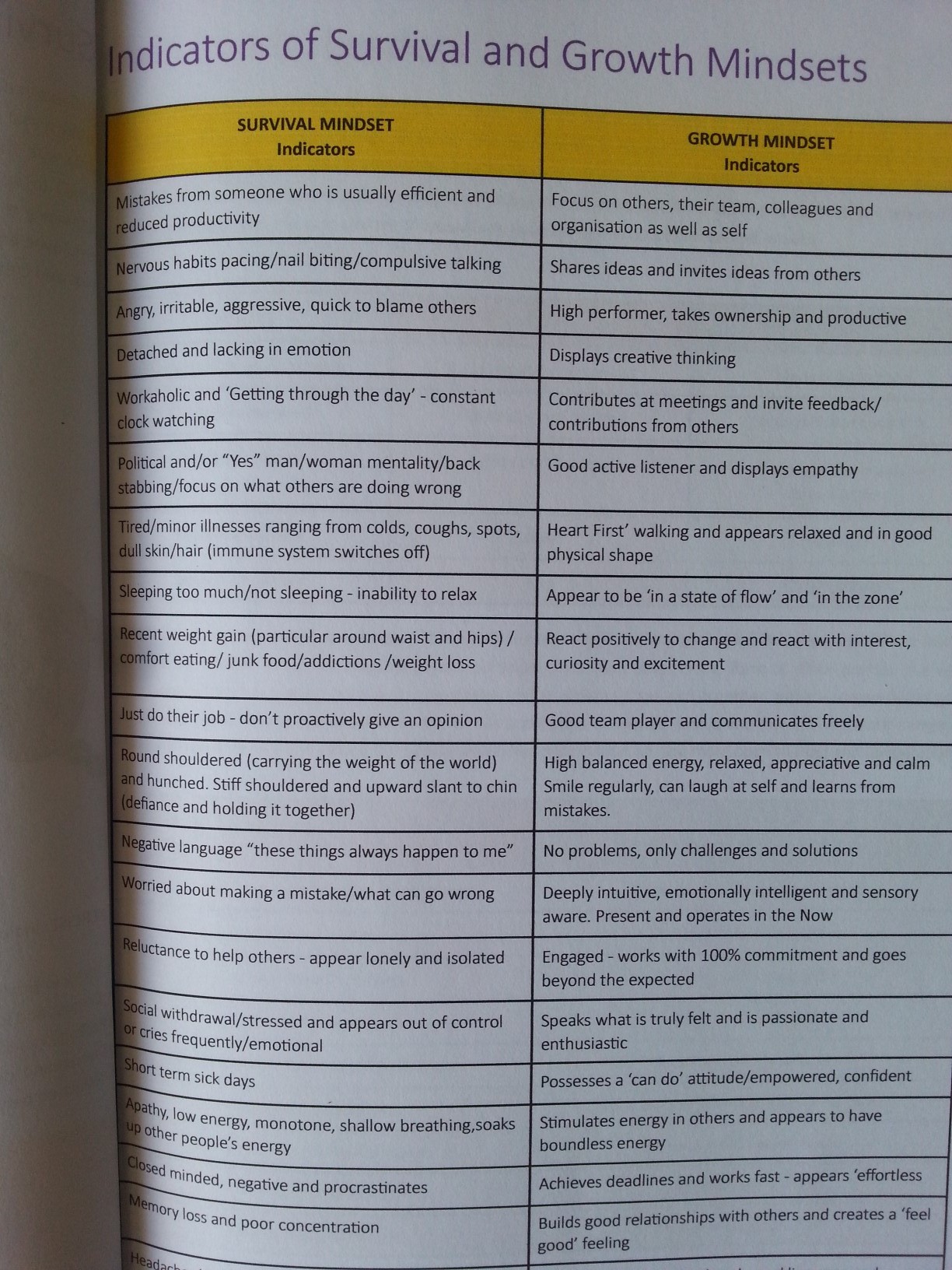
The afternoon session was equally eye-opening. We began by studying the attributes of someone in either a survival or growth mindset. Again, Sylvia split us into two groups, each taking a mindset. We shared our findings and reflected on the specific behaviours and physical symptoms.
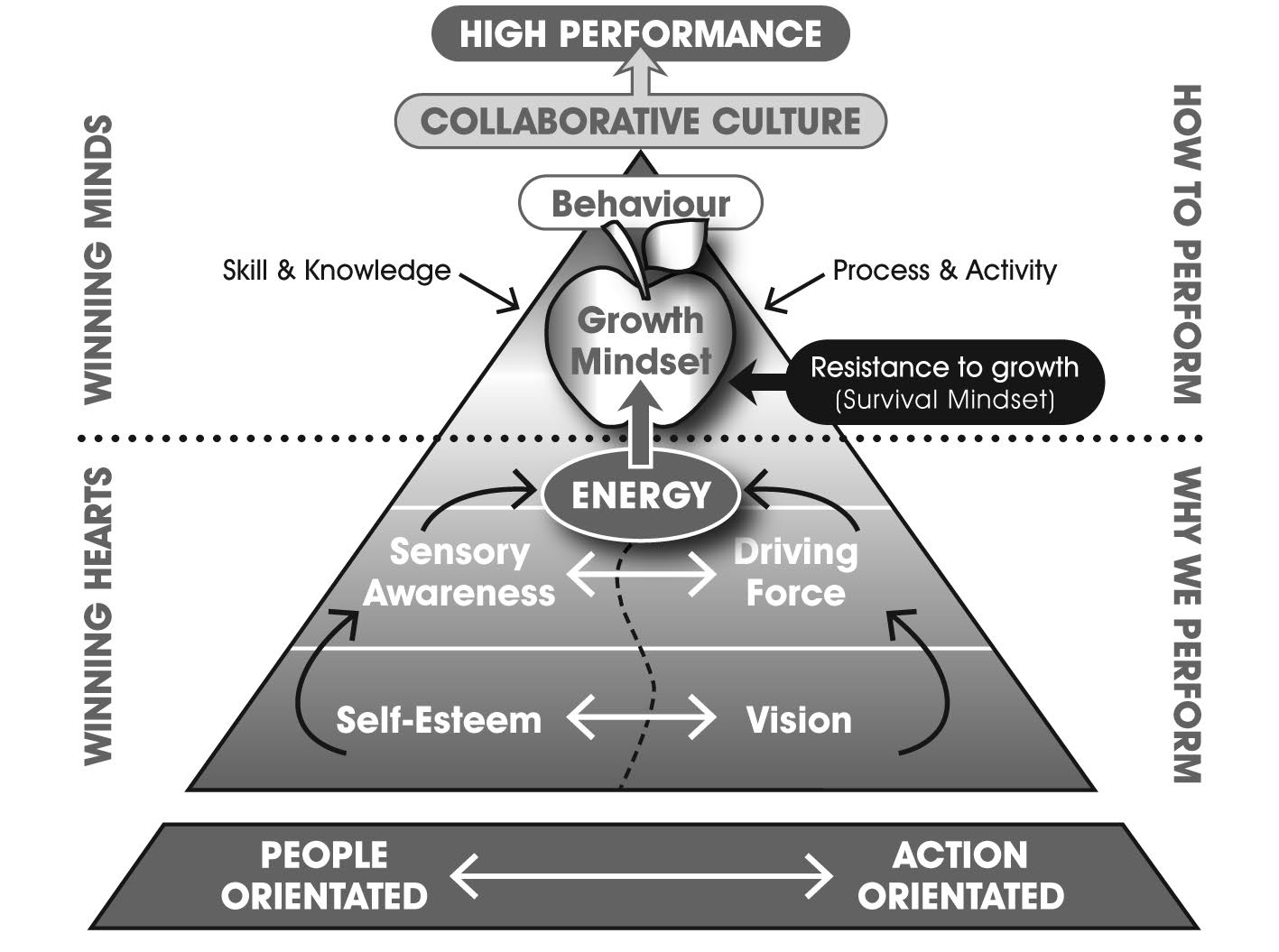
Afterwards we collectively went through the Survival/Growth models and Sylvia explained that when a person is in survival mode and typically stressed, their cells literally shut down, triggered by the release of cortisol and adrenaline. In order to protect themselves cells become closed silos by sealing themselves and moving into a protective operating mechanism. This in turn prevents other growth hormones from entering.
When we are living and working in a safe and supportive environment we release serotonin and oxytocin which increase an individual’s openness towards social belonging. This chemical reaction opens the cells so they can absorb nutrients for growth.
It’s obvious to see why some businesses and organisations go from strength to strength and others fail. If individuals are placed in an environment where they feel stressed, that encourages selfish, closed thinking – a silo mentality. Nikki points out that a safe and supportive environment will actively encourage open, selfless thinking – a collaborative and caring culture. And the key to silos lies in our cellular biology!
We talked about charismatic leaders and the importance of Maslow’s Hierarchy of Needs in attaining a growth mindset, both individually and as part of an organisation.
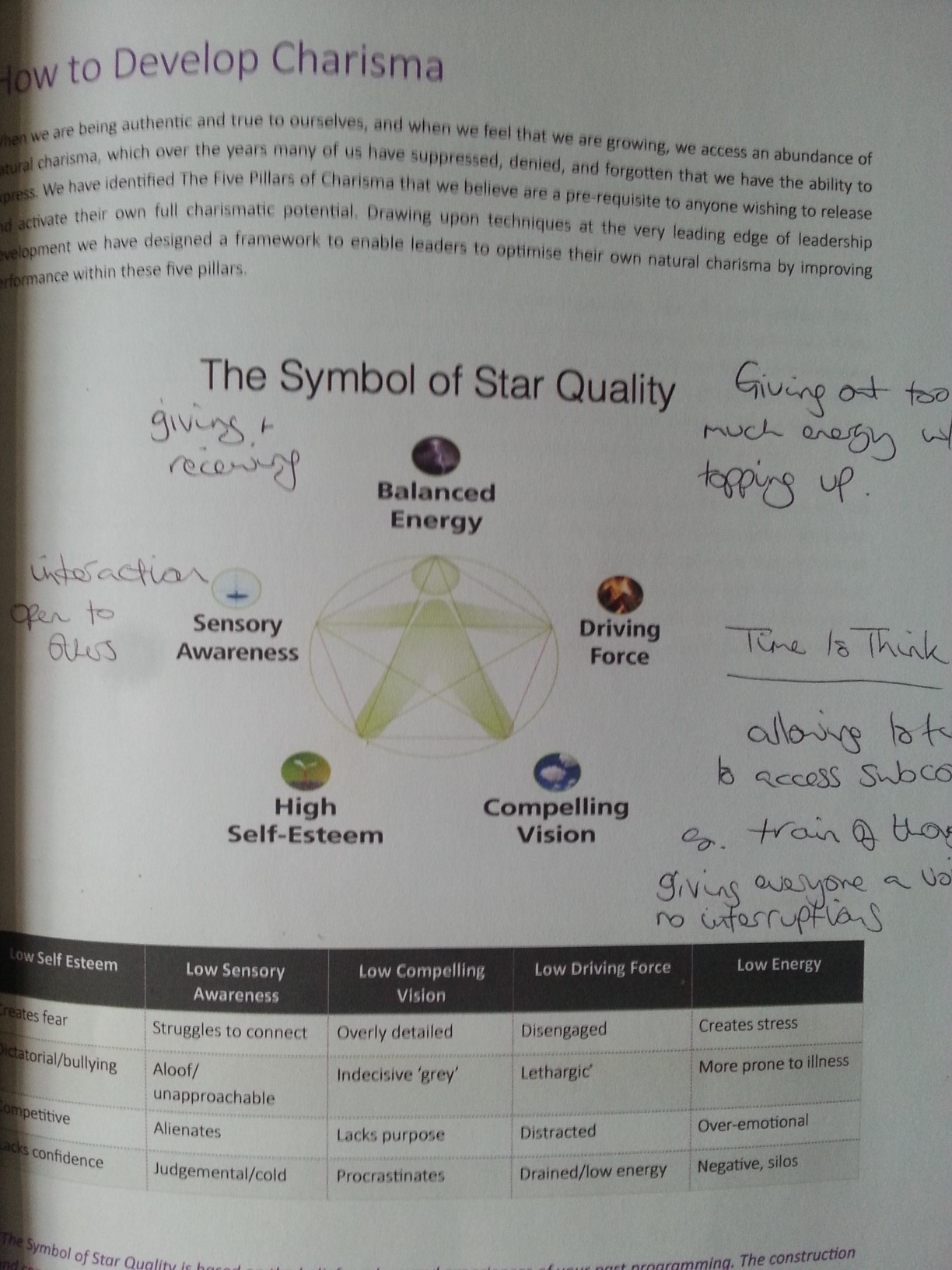
How to Develop Charisma
Sylvia showed us the five pillars of charisma and we covered each one in detail. These pillars were shown on a five point star. We could see how a downward spiral in the areas of balanced energy, driving force, compelling vision, high self-esteem and sensory awareness would create a silo, whereas strengthening these attributes develops charisma and improves your whole life.
“The symbol of star quality is based on the beliefs, values and experience of your past programming. The construction and constituents of each pillar is expressed through a variety of unconscious behaviours that in a work context influences a leader’s impact either positively or negatively.” ~ Nikki Owen
Charisma Constellation
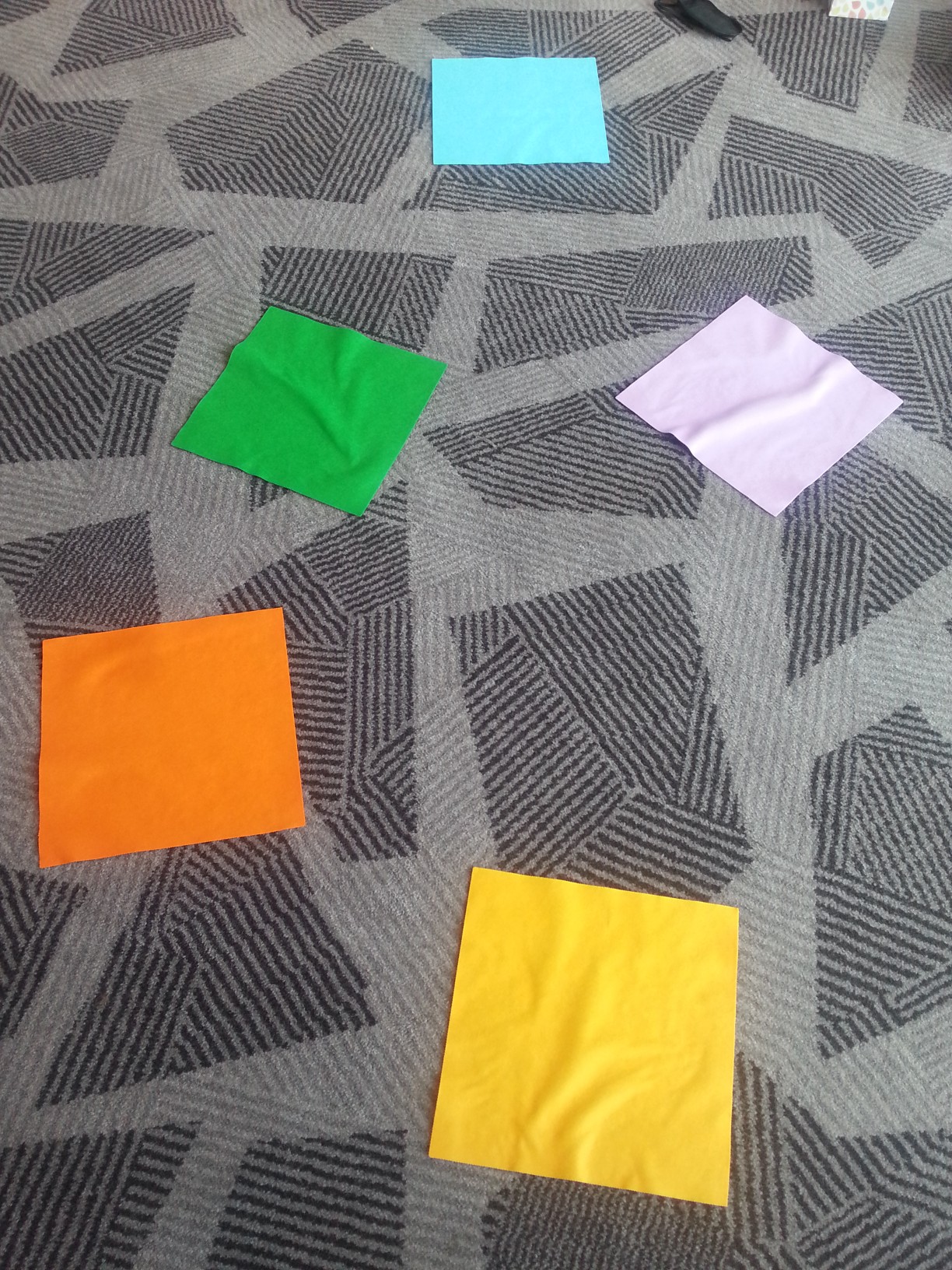
We did an interesting exercise (again in pairs) to establish our charisma constellation. This powerful process meant we could engage with the depth, wisdom and awareness of our unconscious minds to gain intuitive insights about our charisma.
It involved using colours for each pillar, some of which are representative of the Chakra System.
We placed the colour squares for each pillar onto the floor in the positions and colours that felt right to us. My balanced energy point was yellow, at the start, close to my driving force which I chose orange, close to self-esteem which was green, alongside my purple sensory awareness looking towards my vision for which I chose blue.
As we stepped on each square we had to notice how that colour made us feel in relation to each point on the star. We were allowed to rearrange the footprints until we established what felt in alignment with each person.
The Charisma Model
Thoughts Become Things
We saw the pictures of Dr. Masaru Emoto’s extensive experiments on the molecules of water crystals in samples that had been split into separate containers and labelled with worlds such as love and peace and hate and war. The resulting images he later studied under a microscope revealed that thoughts and intentions profoundly affected the matter they were directed at.
Nikki did her own experiment in 2009, which she termed ‘The Big Apple’. It involved cutting an apple into two halves, again directing positive, loving thoughts to one half, and negative, thoughts, beliefs and emotions towards the other half. The results were astounding!
These results highlight the power of focused intent. It really shows how a leader can impact on the culture, performance and results of an organisation, or indeed a country. Research by Goleman, Boyatzis and McKee (Primal Leadership) cite that the leader’s mood is not only contagious but it affects the bottom line.
Eliminating Limiting Beliefs
The final exercise of the day was invaluable. Sylvia discussed with us the impact that early programming in childhood can have as we grow up and thus implant self-limiting beliefs. I am always in awe of my children’s lack of guile, and of the generally open, honest and direct way they express themselves. They haven’t yet managed to sabotage their beliefs.
We paired up again with our course partner and chose a limiting belief that we wanted to exterminate. One person then asked the other various questions about their limiting belief, and in part two they asked more but different types of questions.
I had an amazing ‘aha’ insight that my empowerment doesn’t depend on anyone else. This was such a powerful exercise.
As I said to Sylvia, it’s a great feeling to challenge and destroy those beliefs that don’t serve our purpose, passion and potential. It’s liberating to cut loose the heavy ball and chain of the thoughts that hold us back.
I saw Gerry last week at our Athena meeting and she is as keen as I am for us to get together every month or so to continue our progress.
The day was rounded off with a different Hypno Meditation and Sylvia told us a very moving story. We each drew on a plate our thoughts of the day and explained a little about how we had arrived at our creations.
Insights
Lots of things ‘stuck’ for me on this day. Some of the teaching I had been exposed to before to some lesser degree, but it was taught in such a brilliant way that it affected me profoundly. The following days saw some incredible coincidences. I bumped into people I had been thinking about that I hadn’t seen for a year or more. Everything seemed to flow. I’m sure that’s because I was in a creative, growth place!
Big thanks and appreciation go to Nikki Owen for producing this material and to Sylvia Baldock for facilitating our learning in such a charismatic way. She certainly practiced what she preached!
I will continue on my charismatic journey. I have been starting and ending my day with the Hypno Meditations and working through the material again in my own time. I will continue to peel back the layers to reveal my authentic self. I have started to apply what I’ve learnt so that I can be a better parent and become a person who can inspire others.
If this post has inspired you, please do buy a copy of Nikki’s book, visit her website and that of our trainer Sylvia Baldock. You won’t be disappointed.
“Charisma is your birth right, it is a natural state that is within all of us, including you, just waiting to be awakened.” ~ Nikki Owen
After waking up with a bit of a hangover I felt the urge to write about the weather… How very British! I was also pondering on how the collective unconscious affects our perception of nature. I hope you enjoy it, and perhaps even relate to it on some level.
As I love the work of Joseph Mallord William Turner, Britain’s most prolific and famous landscape painter, I have used his art to help illustrate my prose.
Happy Sunday!
A British Summer
Heavy grey clouds claim the sky, suffocating hope,
Reflecting the changing moods of the nation,
Temperatures fluctuate; oppressive then cool,
Winnie-the-Pooh’s blustery day is upon us…
Raby Castle, the seat of the Earl of Darlington, by JMW Turner
Towering trees adorned with lush, verdant leaves,
Shimmer, bend and wave in nature’s breathy puff,
Wild flowers populate meadows and hedgerows,
Colourful petals spread succour for broken hearts
Thomson’s Aeolian Harp by JMW Turner c. 1809
Rays of sun breakthrough, beaming sporadic warmth,
Threat of violent showers always present, looming,
A green and pleasant land supports uncertain steps,
Whether bold or timid; blades of grass in their billions.
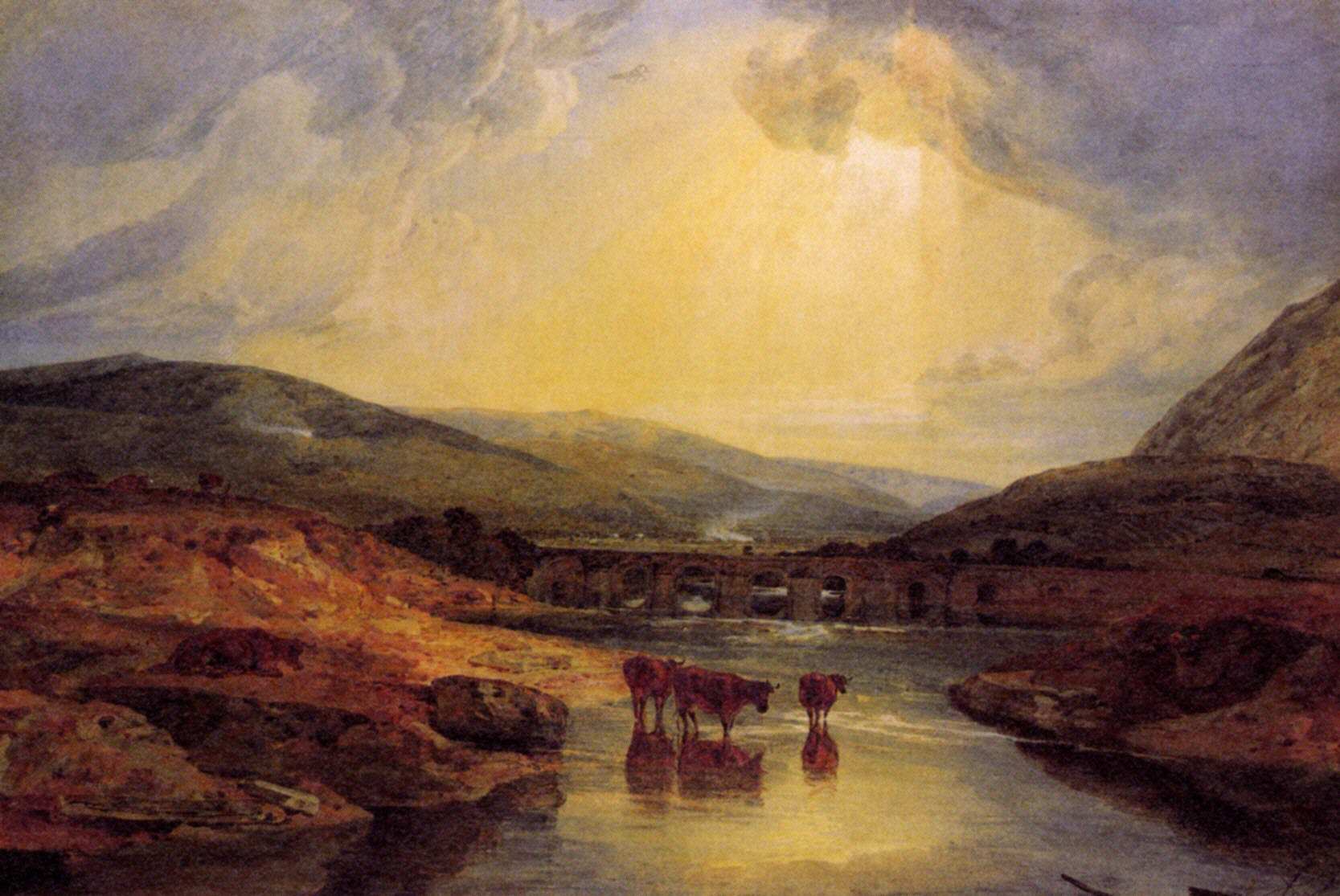
Abergavenny Bridge Monmouthshire by JMW Turner
Pimms and tennis distract weary, outraged citizens,
Quintessential Hundred Acre Wood of our nation,
Still holds surprises. The worker bees hide not;
Streams babble and burst lowly banks.
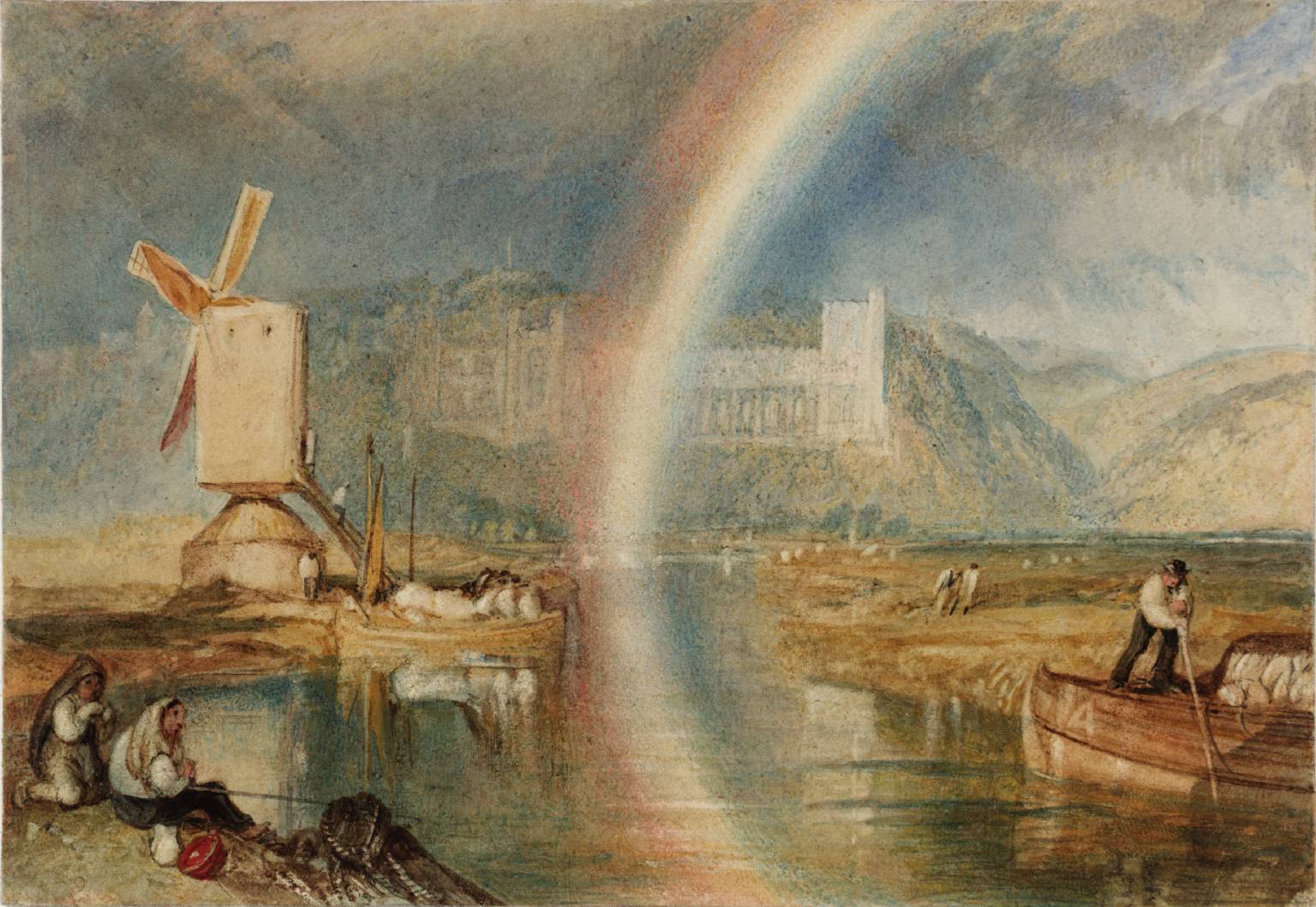
Arundel Castle on the River Arun, with a Rainbow c. 1824-5 Joseph Mallord William Turner
Life abounds in forests, fields and flowers,
Towns and cities go about their daily grind,
Forgotten worms thrive in velvety brown sludge,
Birds soar above gardens, manicured or wild.
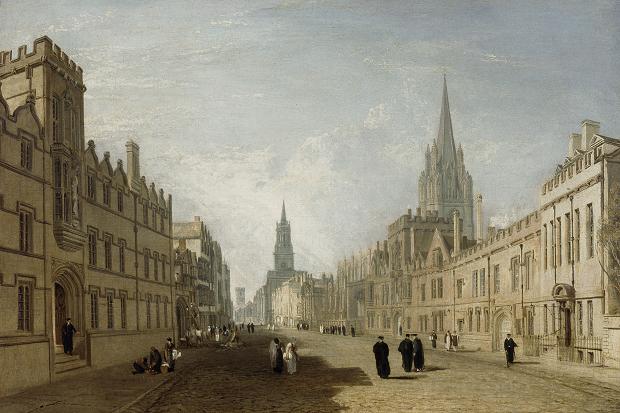
Oxford High Street by JMW Turner
In times of trouble the land is earthy and stable,
The cycle of death and rebirth ceaseless, reliable.
Gain strength from longer, lighter days, be
Fortified by the season of playfulness and revelry.
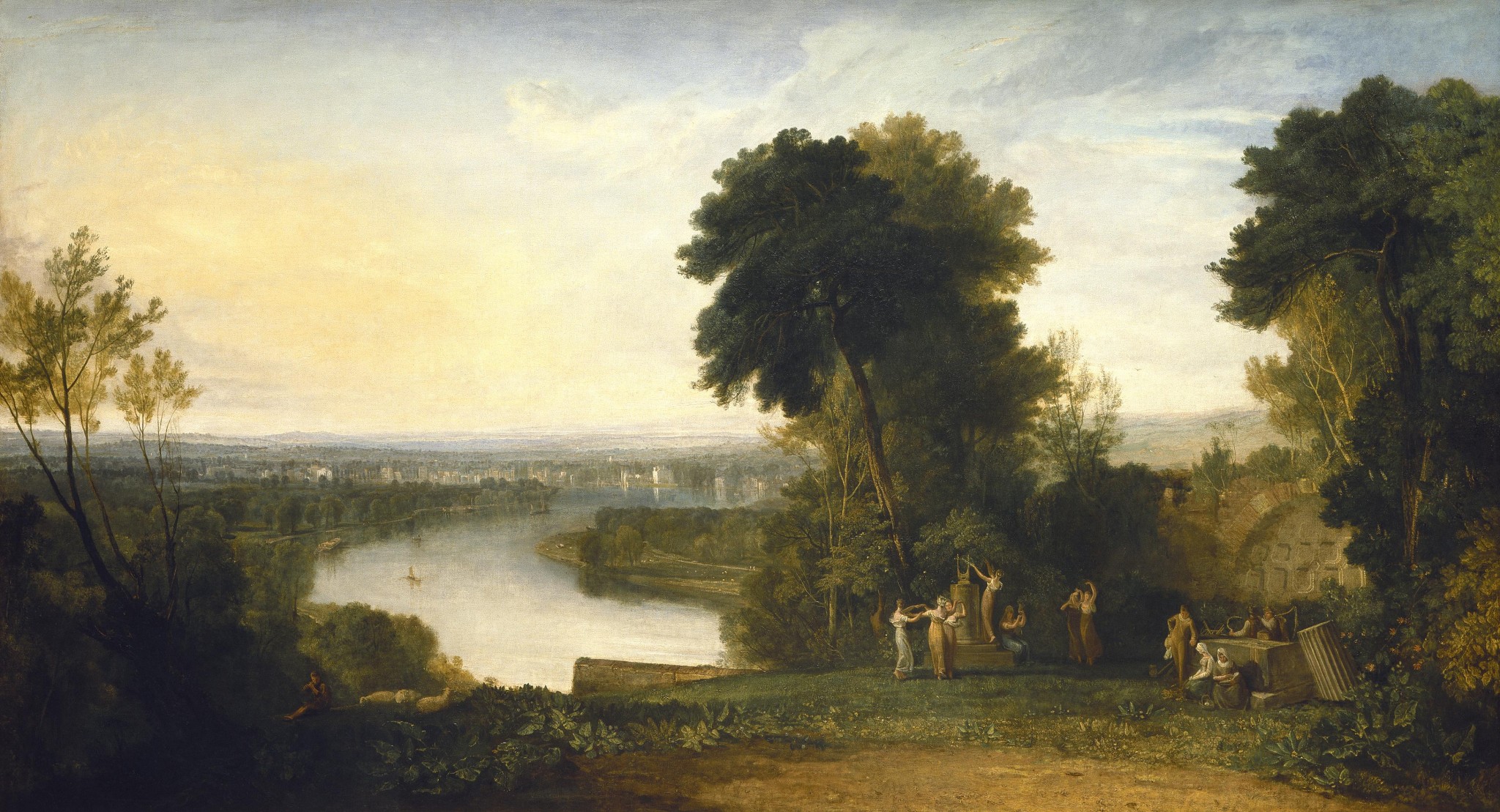
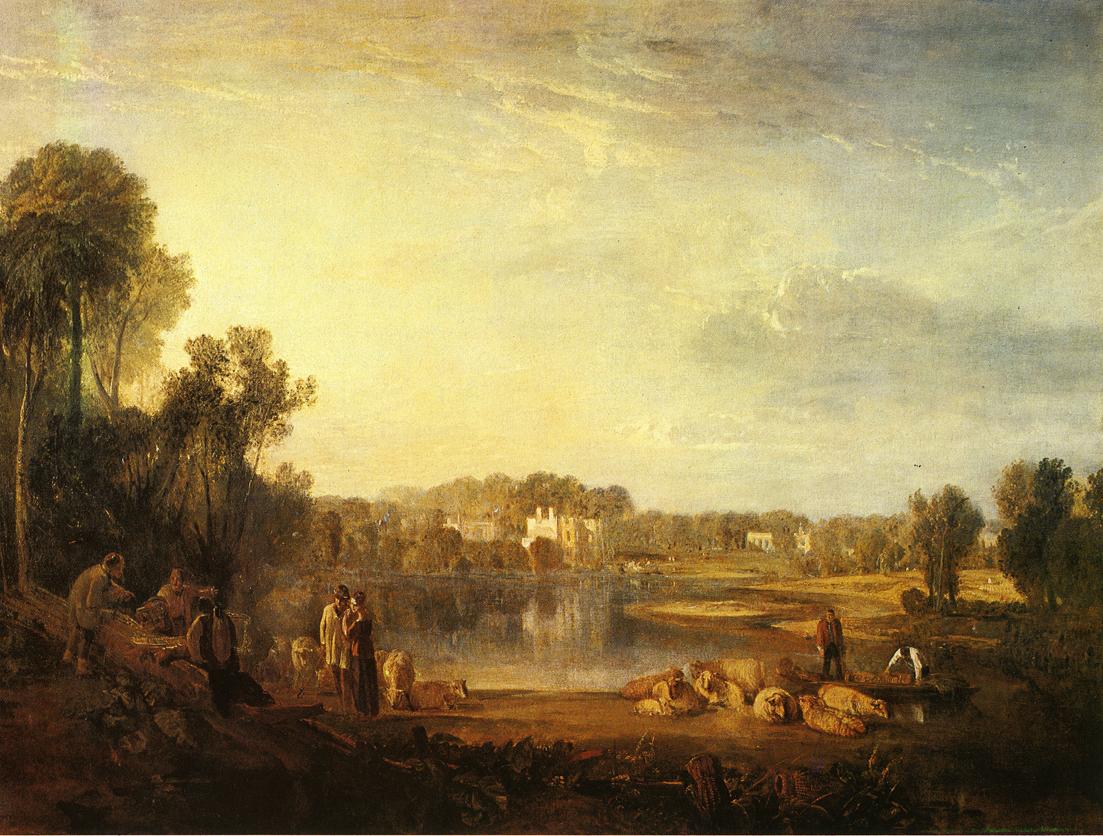
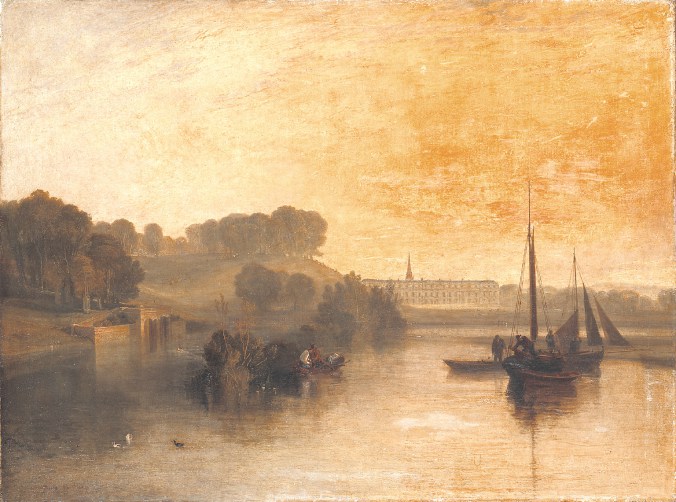
Pope’s Villa at Twickenham by JMW Turner
History lives on in ancient stone walls,
Land of democracy and freedom decays,
Only to grow back around human drama,
Scenery of ups and downs: metamorphosis.
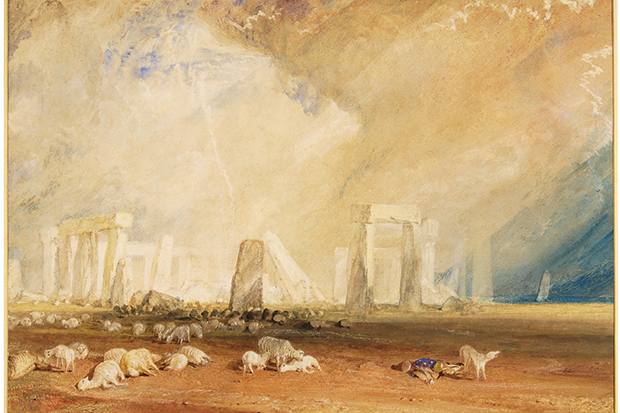
Stonehenge by JMW Turner c. 1827
Lakes and mountains, coasts and cliffs,
Magnificent island refuge to everyday strife,
Spires look upwards over quaint village greens,
Season of vitality to revive cynical souls.
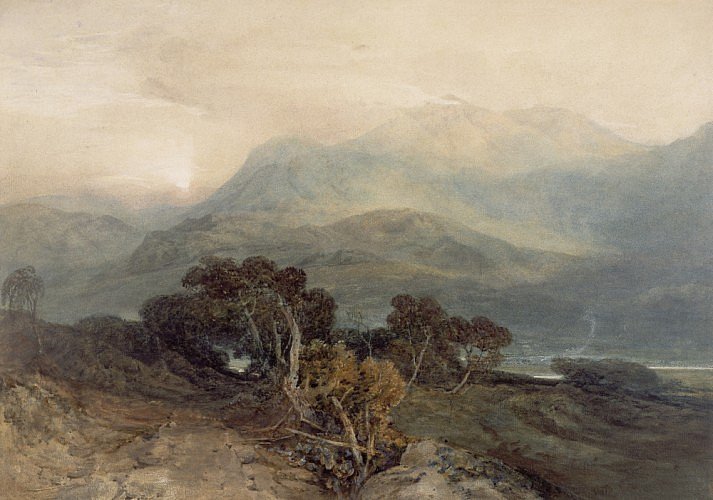
Scottish landscape by JMW Turner
English rose, soft symbol of beauty and summer,
She attracts us with her sweet, heady scent,
Draws blood with her protective, thorny fingers,
But we love her essence and fullness of life.
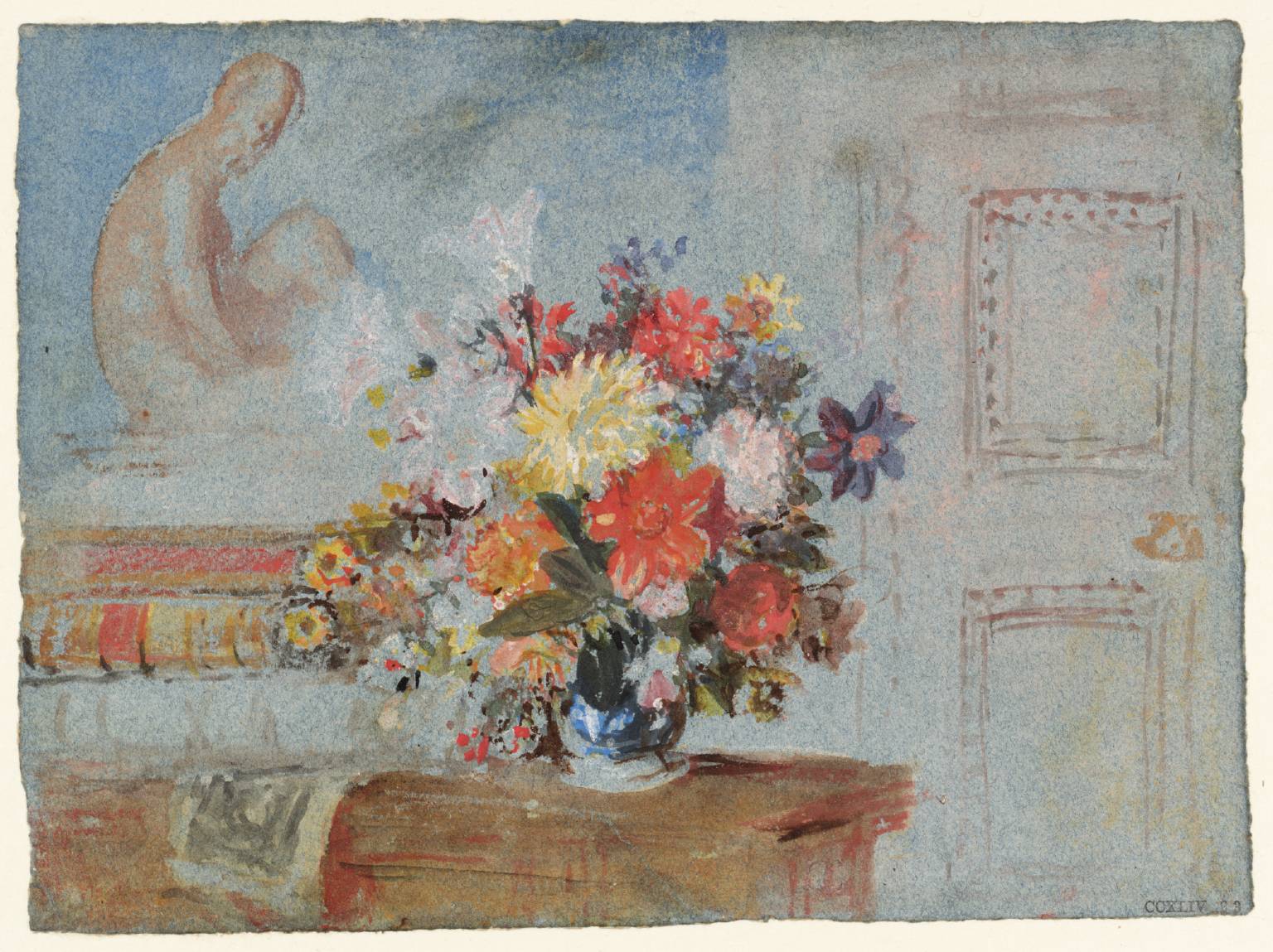
The Old Library: A Vase of Lilies, Dahlias and Other Flowers 1827 Joseph Mallord William Turner
Is this the summer of our discontent?
Rough winds do shake wounded spirits,
Sprites commit their mischief then sneakily retreat,















 rhap.so.dy in words