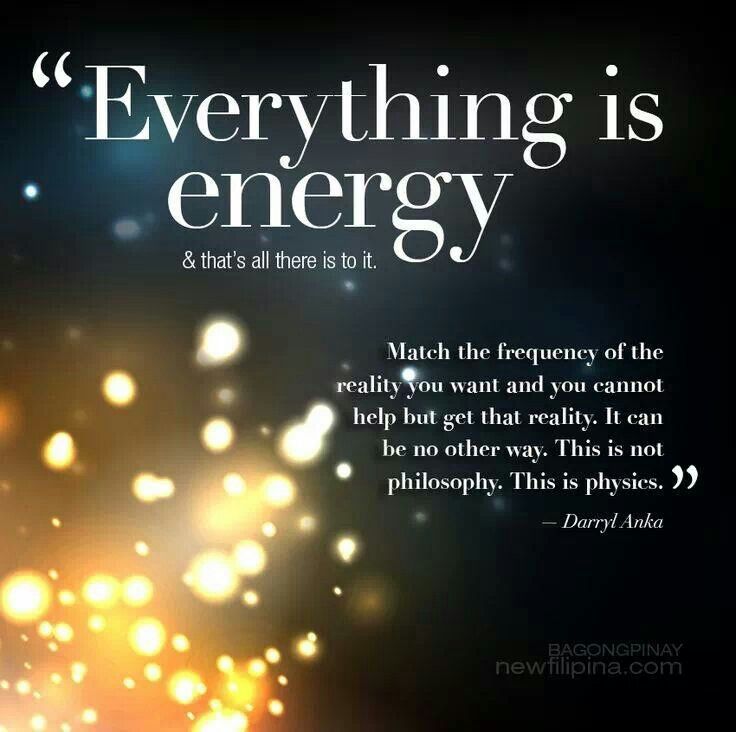
“We have been all wrong! What we have called matter is energy, whose vibration has been lowered as to be perceptible to the senses.” ~ Albert Einstein
It’s a rather plaintive opening to this week’s post. A series of recent events and stressful situations has caused me to feel overwhelmed, anxious, antsy and all in all, emotionally battered. With nasty old thought patterns rearing their ugly heads, my energy channels almost reached overload and I was feeling lost. I couldn’t see a way out and I wasn’t able to deal effectively with what life was throwing at me.
The trouble is, when you act unconsciously you are usually unaware of it at the time the behaviour occurs, and so a downward cycle can hinder us in balancing our energy and removing blockages that, if left buried and unexpressed or unreleased, can cause physical illness as well as emotional distress.
I was lucky to have the help and support of a close friend and very special lady who is helping me in many areas of my life.
Kim was able to help me release this heavy, negative energy, restore my energy flow and emotional equilibrium. The technique she used was new to me, (although similar in some respects to other energy healing therapies I have come across), known as EmoTrance, or EMO – Energy in Motion.
Quantum Physics asserts that everything in the universe is pure energy at the sub atomic level. Our planet, nature, our bodies, and our thoughts exist in space and time, and have a certain vibration.
The founder of EMO, Dr. Silvia Hartmann, explains how the metaphor of water is used in EmoTrance energy healing work:
After a thorough session I was feeling restored to my usual energetic self. I had some significant releases and it felt good to let go of the thoughts, feelings and energy that most definitely wasn’t helping me. As I discovered, it’s all about the flow. Blockages are bad with a capital B. Just think of drains, smells, stagnant pools and disease. My nose is crinkling already! It’s all about balance. Energy can’t be balanced if it does not flow through a system. Any system.
Walking along a sandy beach watching and listening to the regular, rhythmic sound of waves rolling onto the shore and pulling back a layer of sand or pebbles, you can fully appreciate the eternal flow of our planet. Even the unused particles of dead plants and animals get recycled into the cosmic energy field. Nature does not waste energy.
This will be an ongoing process for me as I work through my challenges. I had another realisation straight after the session, as I thought about what Kim and I had explored and its relation to a movie I had recently seen with my family, Fantastic Beasts and Where to Find Them. You may be wondering what the blazes has the Warner Bros. prequel spin-off to Harry Potter got to do with imbalances in energy?
All will be revealed post haste!
The main character in Fantastic Beasts and Where to Find Them is Newt Scamander, a wizard and magizoologist who wrote a book by the same name that was referenced in Harry Potter. JK Rowling wrote her first screenplay for the film. I thought she did a great job. She has imagined a whole new magical world that exists before Harry Potter that fans can get absorbed in.
The film is set in 1920’s New York as Newt becomes embroiled in the secret magical community just as they are battling a mysterious, powerful enemy whose spate of grisly murders are threatening to expose them to No-Maj’s (the equivalent of Muggles in Harry’s universe).
We learn that Newt, who is played by the young, quintessentially British, Oscar winning actor, Eddie Redmayne (The Danish Girl, The Theory of Everything), was expelled from Hogwarts and is very much an expert and lover of fantastic beasts across the world. He is making a new home for them in the wilds of Arizona where they can live safely and he can study them further. He plans to write a book about them someday…
An Obscurus in real life
Without giving away too much of the plot (in case you haven’t seen the film), I had a surge of insight about the dark, swirling entity in the movie, referred to as an obscurus.
I was especially taken with the concept of an obscurus; a malignant, uncontrollable energy form that arises in young magical children, who out of persecution and fear have suppressed their abilities and wizard identities to deny who they truly are. The obscurus eventually takes on a life force of its own, consumes and eventually kills its disturbed wizard hosts and creators. Obscuruses are destructive, malevolent and seemingly impossible to destroy.
Newt manages to capture and suspend one such entity from a dying girl with the purpose of understanding it more fully. When he comes across the source of the baleful one on the rampage in New York, the film takes a darker turn.
Through the action Rowling cleverly illustrates how unresolved anger, repression and negative emotions manifest in a fictional world.
But to me, the realm of fantasy doesn’t seem that far removed from reality. What happens to us energetically when we bury strong or unresolved emotions and transparent beliefs, is not so different to the lethal effect of the obscurus. It is an unconscious act of self-harm.
The light aspects of a person’s archetypes and their equivalent positive thoughts can become obscured by an overload to the energy centers (chakras, meridians, etc.) when a person suffers prolonged stress, or emotions triggered from a traumatic event or incident in childhood.
Left unchecked and unnoticed stagnant energy festers and can cause all sorts of physical ailments. As complex, integrated beings, our thoughts and emotions are intricately entwined with our physical bodies.
Our bodies and thoughts have been proven by physics to be nothing but energy forms, and these energy forms are either working for us or against us. I found the parallels between the field of energy healing and the Fantastic Beasts film helpful in visualising what trapped negative energy might look like, and the damage it can wreak on mind, body and soul, let alone a movie set!
Don’t feed your obscurus as I did; study it and be aware of it, and take time to top up your energy reserves if you feel depleted. I find it’s sorely needed at this time of year!
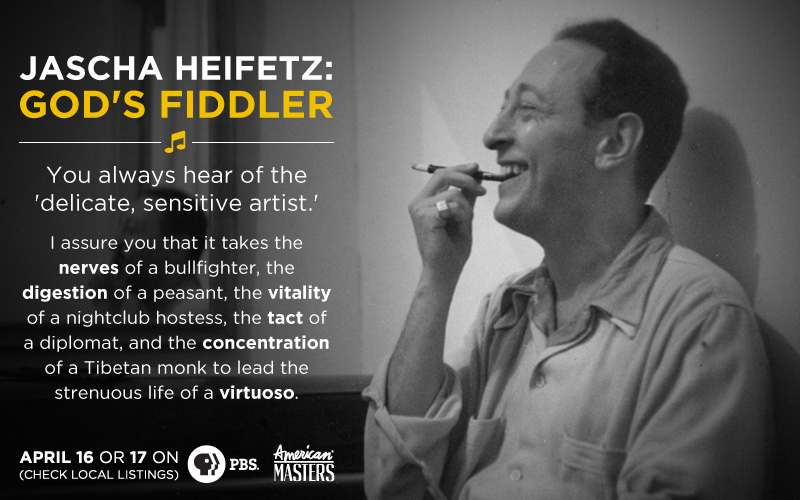
“An artist will never become great through imitation, and never will he be able to attain the best results only by methods adopted by others. He must have his own initiative.” ~ Jascha Heifetz
Jascha Heifetz needs no introduction to anyone familiar with classical music, or a fan of the violin; but out of respect to a great artist, here goes. There will be more than a hint of hero worship! As far as violin playing is concerned, he reached the peak of Mount Olympus. There wasn’t anything he couldn’t do. He was, quite simply, a legend in his own lifetime.
Jascha Heifetz (2 February 1901 – 10 December 1987)
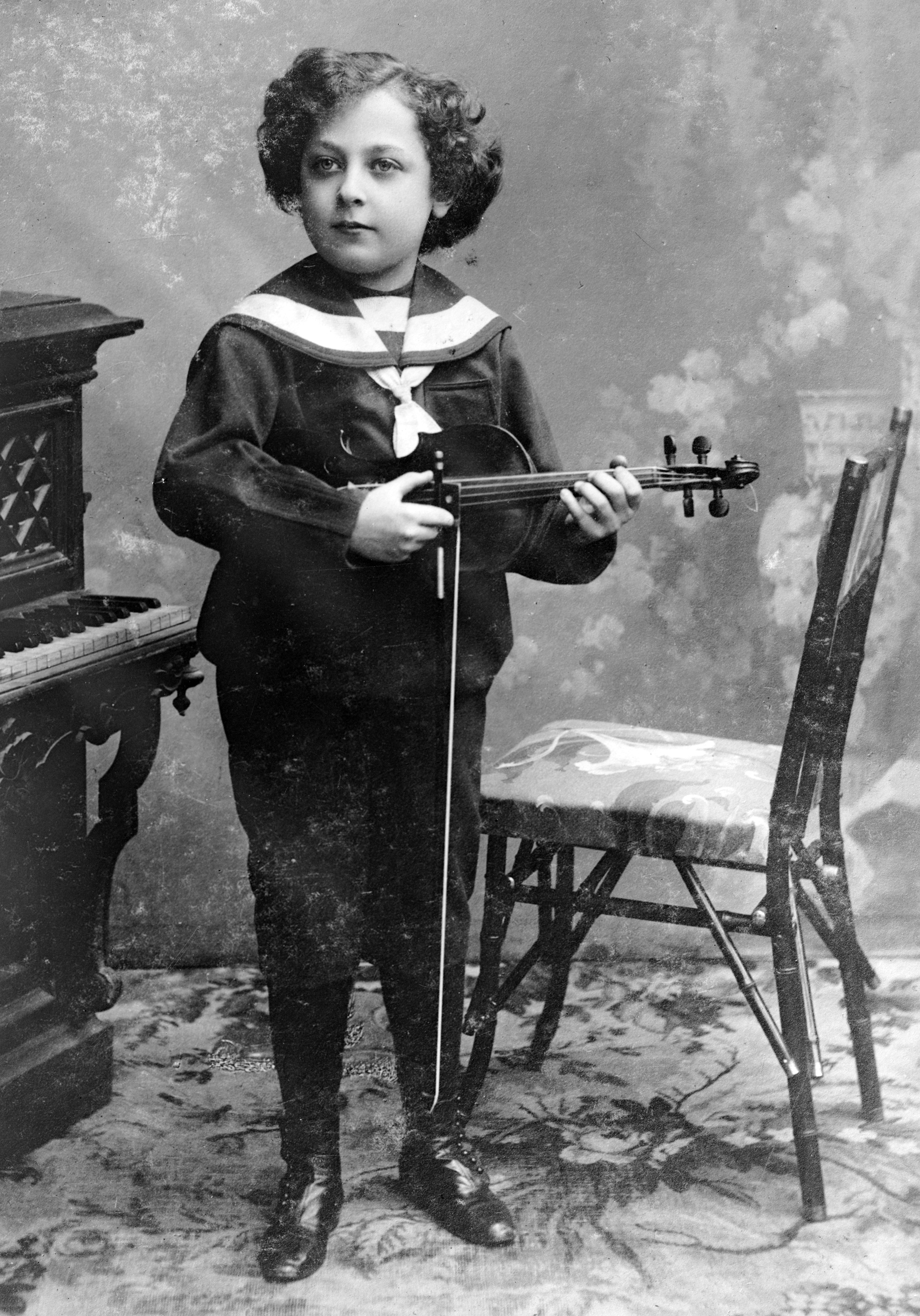
There are shades of Mozart in his youth: as a child prodigy he began playing the violin aged three, gave his first public performance aged five, and was accepted into the St. Petersburg Conservatory aged nine. He was first influenced musically by his father, played for royalty, took Europe by storm as a teenager, thrilled American audiences in Carnegie Hall at the age of sixteen and embarked on his first world tour aged nineteen. The rest, as they say, is history…
Many believe he has done more than any other 20th century violinist to elevate the standard of modern violin playing. But, paradoxically, he wasn’t all about technique. He was that rare breed of musician that transcended the physical boundaries of his instrument and became a true artist. Artistry for me, more so than technique is what sets him apart from other violinists. He took all the skills that were available to him, boundless natural talent, hours of practice, his almost flawless technical skill, emotional and mental mastery, and molded them into his individual, personal style, his unique artistry.
He was blessed with divine ability on the violin, which was brought about in a most heart-warming way. As a baby he would cry while his father was looking after him and he did not know how to calm him. Being a professional violinist and concert master of the Vilnius orchestra, (now in Lithuania), Rubin Heifetz would play his violin to baby Jascha, and it stopped him crying!
We should never underestimate the impact of early exposure to music on a human being. Whether they grow up to be one of the greatest musicians the world has ever seen or not, its benefits are immeasurable.
Probably the most well-known superlative that has been heaped on him was the sobriquet and documentary film title: ‘God’s Fiddler’. Even his teacher at the Conservatory in St. Petersburg, the revered Leopold Auer, when asked why he had not mentioned Jascha Heifetz in his list of top students retorted, “He’s not my student, he’s a student of God.”
The celebrated violinist Fritz Kreisler commented after hearing Heifetz’s debut in Berlin, “The rest of us might as well take our fiddles and break them across our knees!” From Kreisler!
In a letter from his father to his uncle, when Jascha was just 10 years old, his father talked of the praise that had been showered on his son, not just by his teachers, but by the St. Petersburg press and musical community, who had been gushing over him after his first professional recital, saying that he was unique, not just in Russia, but in the whole world. The weight of expectation was firmly on his young shoulders.
His name has become synonymous with excellence. Many musicians, regardless of their instrument, have heard the scathing phrase: “He’s no Heifetz!” The great cellist, Pablo Casals was dubbed the ‘Heifetz of the cello’. Pretty much every performance of Heifetz’s is a masterclass in violin mastery and perfection.
Performances
Jascha Heifetz’s performing career spanned over sixty years, during which time he played in a total of 2,368 performance events. The bulk of his performance was naturally given in recitals, both solo and with orchestras. He made 197 recordings and 82 radio broadcasts. His chamber work was the rarest of his performance appearances, with only 28 concerts under his belt.
By the time he gave his London debut in 1920 he had already sold 20,000 copies of his early recordings.
Jascha Heifetz was a crowd pleaser, an audience wower, he was born to perform.
But all the talent in the world would not have served him without the relentless work ethic and self-discipline that he exhibited throughout his life. The one time he allowed his practice schedule to lapse for a little too long served as a painful, but essential lesson in his blossoming career.
Let’s have a break and listen to some early, vintage recordings of the wunderkind!
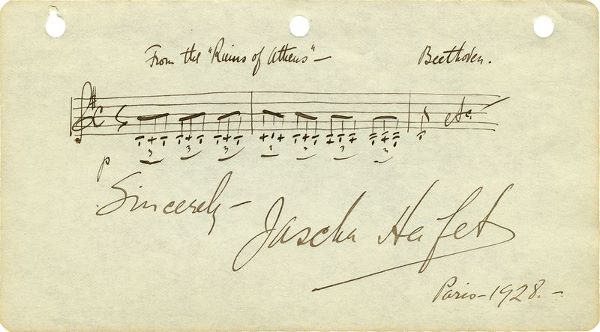
Soon after his debut Heifetz performed a devilishly difficult programme piece by Beethoven, the Chorus of Dervishes from The Ruins of Athens.
It has triplet fingered octaves, a previously unknown piece to me, but very evocative:
The Russian Revolution ensured that Heifetz remained in America and he became a citizen of his adopted homeland in 1925, where he lived for the rest of his life. At first he settled in New York and moved to California in the late thirties. During the Second World War he toured camps across Europe with the USO, playing to soldiers to lift morale and give some cultural interlude from the horrors of war.
“The performer must create an illusion for the audience.” ~ Jascha Heiftez
One of his students, professional violinist and pianist, Ayke Agus who later became his accompanist, assistant and confidante, tells of a story that Heifetz had impressed upon her about one such wartime recital:
“He had arranged to play to the troops in the open air, but the weather had taken a turn for the worse and on the day of the concert it was raining. Heifetz was offered the chance to pull out of his obligation, but he replied that as long as he could breath, move and walk he would perform. Only one soldier stood in the deserted, muddy, wet field to listen that day.”
Ayke insists that Heifetz told her he thought it was one of his best ever performances.
In his later life as his performance career diminished Heifetz would often reminisce to her about his soloist days. She relays the story of when Heifetz played a private concert for Hellen Keller, who very touchingly could feel the music vibrations through her fingertips as she held on the scroll of his violin. She had impressed Heifetz greatly.
Shock, horror, a bad review!
For most of his early life Jascha Heiftez had received nothing but praise. And rightly so, he was one of the most outstanding violinists of his time, and indeed of all time. But his popularity in America, which furnished him with success and freedom, enabled him to let his hair down a little and enjoy the good life. In his own words, Heifetz admitted that it was not until he had reach adulthood that he could behave like a child.
In his childhood he had endured a strict regime of musical studies. It’s certainly understandable that he would want to relax and enjoy the fruits of his success for a while. But the lack of practise during his first four years in America had begun to show in his performance.
Nothing had prepared Heifetz emotionally for a bad review, and when scathing criticism came his way after one fateful New York concert, it wounded him deeply and jolted him out of complacency. Although his pride was hurt, Heifetz actually agreed with the reviewer that he owed it to himself and music never to be content. It seems he became his own biggest critic from that day on.
After his ego recovered Heifetz applied himself to rigorous preparation and practice schedules before his concerts. He had set the bar impossibly high, and now the challenge was always to live up to an incredibly high standard.
“The discipline of practice every day is essential. When I skip a day, I notice a difference in my playing. After two days, the critics notice, and after three days, so does the audience.” ~ Jascha Heifetz
What really blows my mind was the speed, accuracy and co-ordination of his hands and bow. Heifetz’s hands in slow motion:
Philosophy
Jascha Heifetz believed that the audience should never feel like the artist is struggling to achieve anything. And in all his clips, no matter how fast and furious the piece, or even slow and legato, he has perfect control and makes it look effortless. He likened performance to making the perfect pitch in baseball. No-one would see, or even understand the effort that had gone into it.
When once asked by a student, “What are the most important attributes for an artist?” Heifetz responded candidly: “Self-respect musically speaking, integrity and enthusiasm.”
His personal philosophy was drawn from Rudyard Kipling’s poem, If, which he carried a copy of at all times. He said of particular relevance to him was the idea of treating the imposters of triumph and disaster just the same. He understood that an artist’s life meant treading that path between the two. Let’s face it; most of what he achieved was a total triumph, even to the extent that his unrivalled standard of perfection made him a target.
He was labelled as ‘cold’ and unemotional. It’s true that he didn’t show feelings so much on his face as is more common now-a-days. How silly for his critics to get their nickers in a twist over a lack of facial expression, when he clearly made the music his mode of expression. This video makes the point perfectly:
Jim Hoyl
At the height of his fame Jascha Heifetz wrote some popular songs under the pseudonym Jim Hoyl, which was easy to use with the same initials.
Here is Heifetz playing the piano to his own song, When You Make Love, which had been sung by none other than Bing Crosby :
He would also travel under this alias so as not to be easily recognised and identified. It struck me that he was humble and modest despite his international fame.
Teaching
After 1974 Heifetz dedicated himself to continuing the teaching legacy of his beloved tutor in St. Petersburg, Leopold Auer. In his own words Heifetz had said about Auer: “The professor was stern and very exacting, but a sympathetic teacher.” I feel these words describe his own pupils’ experiences. Ayke Agus had expressed what seemed close to terror, “It felt like we were victims.” She related how he would cover the technical aspects, the musical aspects as well as make them play on out of tune violins to prepare them for any eventuality they might face as professional musicians.
He held twice weekly lessons structured in the same way as Leopold Auer. My living hero on the violin, Itzhak Perlman, tells of his Masterclass experience as a 14 year old with Heiftez:
There is a great clip of Heifetz himself warming up for practice with scales, left handed pizzicatos and he even plays sections of the first movement of Beethoven’s violin concerto, which consists of beautiful melodic scales!
Ayke tells of how Heifetz would teach them the importance of bowing technique, and how Heifetz impressed on them that the colour of the tone came from the bow arm. He likened it to a painter with a brush never having the same evenness of colour and shade on the canvas, it wasn’t uniform. He taught them to reach out to people’s hearts.
Heifetz himself found staccato bowing the most difficult thing to learn and tried to in-still in his students what Ayke Agus refers to as an ‘honest staccato’, which can only be achieved by having a stiff arm, lifting the bow on and off the string slowly and accurately before attempting a fast tempo.
Hora Staccato:
Heifetz did a series of televised Masterclass sessions in the sixties. I have chosen the one dedicated to Bach’s ‘Chaconne’. If you have read this earlier post on one of my favourite pieces of solo violin music, then you will know that Heifetz’s interpretation is untouchable.
Interests and idosyncracies
Jascha became known for deliberately playing badly, in order to demonstrate how not to do it. It was something of a party trick. He was also a keen photographer, ping pong player and motorist. Years before Elon Musk was born, Jascha Heifetz spent a significant amount of his money building his own electric car in 1965. He didn’t like the smoke and pollution and decided he would do his bit for the environment.
Transcriptions for the violin
Heifetz also adapted other composer’s works for the violin. He met and admired George Gershwin, arranging his songs from Porgy and Bess for the violin.
Being a true patriot he also arranged the Star Spangled Banner:
The story behind one of his most beloved encore arrangements – Estrellita:
Heifetz’s Violins
Jascha Heifetz owned several high value violins, his preferred performance violin being the 1742 ‘ex-David’ Guarneri del Gesù, closely followed by his 1731 Stradivarius.
A touching interview with luthier Hans Benning, who Heifetz chose to maintain his violins:
Violin Concerto Recordings:
There are no words to describe the pure magic of these vintage recordings!
“You can ‘just listen’ to the Brahms violin concerto and enjoy it keenly. But if you read about Brahms’ life, you appreciate it more. And, if you’ve listened to recordings of it, you will appreciate it ten times as much.” ~ Jascha Heifetz
Heifetz’s sound was, and still is distinctive, original and silky, his tonal quality unsurpassed. His sublime phrasing, his unique musical language just send me to another realm and inspire me to practice. I love that you never get sentimentality from Heifetz, but you always get his enthralling blend of power and emotion.
If there was any downside to his stellar success I think it showed-up in his private life. He was married and divorced twice, and by some accounts wasn’t particularly close to his three children. He had to balance his career with his family, and I don’t think his relationship with his own father was a warm one. Heifetz was quite introverted and said in interviews that he had felt lonely at the top. His fame had come at a price.
I hope you’ve enjoyed his music as much as I have, and please share the post if you think the world needs more Heifetzes!
It feels fitting to bow out, (if you’ll pardon the pun!) with Heifetz’s final recital:
“A page-turner and moving journey filled with romance, Burges’s novel shows the possibilities of moving on beyond tragedy.” ~ Publishers Weekly
We authors are a sensitive breed. At least, I know am. Perhaps it’s because of my creative and open nature. Writers live in a world of words and pictures, with scenes floating around and playing out in our heads. Premises come and go; only the most compelling that take root in the depths of our imagination will be used for that next novel. Our heads are full of images: faces, voices, characters, traits, plots, places, descriptions, all coalescing and escalating to a breathtaking climax before breakfast. No, not that sort!
As Ernest Hemingway said with a hint of satire: “There is nothing to writing. All you do is sit down at a typewriter and bleed.”
Not literally I hope, but sometimes it feels like my head will explode. You craft your stories as best you can, edit them, get them read, incorporate feedback, edit and rewrite, get more feedback and go on until you’ve reached the end of your tether and just want to get the darn thing published.
You’ve probably gathered I don’t possess the patience of a saint!
Some writers are blessed with quick minds, maybe if they have no other work or family commitments they can churn out a book every year. It took me five to finally publish my debut novel, The Virtuoso. It was a labour of love. But that doesn’t mean to say I don’t care about its journey out into the big, wide, literary world.
With upwards of a million books on Amazon and the empowerment Indie publishing brings to many aspiring writers, it’s tougher than ever to stand out among the noise as a first time author.
I know if I could just get The Virtuoso featured on Classic FM or BBC Radio 3 I’d be in with a fighting chance of reaching many of my potential readers through the medium of music. After all, music is at the core of my novel, and so is an irresistible story. Sadly, I don’t have a large marketing budget to afford the advertising and an unknown author is a bit of a risk for the big radio stations.
And now to the question of how to make an author insanely happy: it’s twofold really, read their book and write an honest, constructive review. Social proof is the best way for a fledgling author to win new readers and build up a fan base so that they can hit the ground running with their next novel. Writers spend many hours obsessing over their ‘babies’ and want nothing more than to enrich readers’ lives with their work.
I haven’t found the process of marketing my book entirely comfortable, I don’t like to blow my own trumpet, but it is certainly easier to sound off someone else’s!
Hence my unashamed promotion of my first major book review; an awesome endorsement from industry giant, Publishers Weekly. When I submitted The Virtuoso for a review on their BookLife platform I wasn’t expecting anything to come of it. It was highlighted that many, many books were sent to them and only a select few would be chosen for a review.
Imagine my delight when I received this email from BookLife yesterday!
Dear Ms. Burges,
The Publishers Weekly review for your book, The Virtuoso, ran on Nov. 14th:
Thank you for submitting your book for review to Publishers Weekly. Of the hundreds of self-published titles received each month, only a handful of the very best are selected for review.
Thank you also for being a part of the BookLife community. We hope you will continue to use all of the resources at BookLife.com to support your work as an author.
Sincerely,
BookLife.com
Here it is:
Dare I finish by saying that the thing that would send this particular author into the stratosphere, would be to have a film adaptation made of The Virtuoso.
My dream cast
My readers tell me they think it would make a fantastic film. My dream cast would be Keira Knighly in the main role as Isabelle Bryant, the heroine of my novel. She has the perfect blend of spirit, talent, vulnerability, courage and beauty, (both inner and outer) to play the beleaguered violinist. her Her box office appeal doesn’t hurt either!
Sharon D. Clarke is the only woman I can visualise as the larger than life jazz singer, Hortense Lafayette. I think Damian Lewis could bring the right amount of the narcissist and tortured soul to conductor Howard Miller’s character. I’m not sure about Daniel Carter. Maybe someone like Hugh Grant could fill his shoes.
There are some wonderful locations as well, such as Madeira, New York, Vienna and London.
If you’ve read The Virtuoso, thank you, and if you’ve left me a review on Amazon or Goodreads, thank you from the bottom of my heart! Do feel free to share your ideal cast for the film adaptation, I’m open to suggestions…
I can always dream can’t I!?
At least the music soundtrack has already been recorded!
“To see the world, things dangerous to come to, to see behind walls, draw closer, to find each other, and to feel. That is the purpose of life.” ~ James Thurber (The Secret Life of Walter Mitty)
Mind-wandering is a fascinating topic. I thought I’d start this category off with a peek behind the scenes of our grey matter whilst it’s engaged in day-dreaming and mental time travel; better known as memory. You might think our brains are static while you’re not concentrating on a specific task, but quite the opposite is true.
Scientists have produced evidence that for half the day our minds are wandering, (obviously not in one continuous epic day dream), and at night, whilst in REM sleep our minds wander into dreams. Despite the bad rap mind-wandering has received (even from a recent Harvard study), this can be no bad thing if we are designed to spend considerable chunks of time doing it.
In his brilliant book, The Wandering Mind, Michael Corballis, emeritus professor at the Department of Psychology at the University of Auckland, has defended our innate tendencies to drift into these surreal synapses and put forward a compelling case for mind-wandering in various contexts.
It’s taken me a while to get my brain in gear for this post. There have been so many opportunities to ponder and wander…
Walter Mitty
The daring, audacious day-dreaming of fictional character Walter Mitty is something to behold. His adventurous perambulations on the colourful landscape of his imagination have no equal. OK, some authors might argue with me on that one…
To alleviate his rather dull life, Walter indulges in frequent, exciting bouts of ‘zoning out’, but his life becomes infinitely more interesting when he embarks on a real-life adventure. In the Ben Stiller film version, his day-dreaming facilitates him stepping outside his comfort zone and undertaking the journey of his life.
Mind-wandering is the portal to our memory, imagination, creativity, originality, mental time travel, the minds of others and psychic phenomena.
In fact, evolutionary psychologists believe that our cerebral escapades were one of the earliest mental faculties to evolve in Homo Sapiens; our relatively modern branch of the Homo genus that emerged in the Pleistocene period some 200,000 years ago.
Wander/won’der/intransitive verb. To go astray, deviate from the right path or course, the subject of attention, etc.
The day-dreaming taboo
At school, if the lesson was boring I’d often find myself day-dreaming despite my best efforts to concentrate on the task in hand. I would never have let on that I was day dreaming of course, for fear of the teacher’s wrath.
I’ve often noticed my children drifting off into other worlds during homework, reading, watching television and chores, concocting all sorts of outcomes. Depending on the activity I gently try to get them back on track. Sometimes though, when appropriate, I participate with them in some community and family mind-wandering.
Ruby’s favourite mind-wandering realm is that of the animal kingdom. She can do the most brilliant animal sounds (honorary dolphin), and act like a monkey with the best of them!
I’ve been surprised on many occasions at their problem solving abilities on issues that matter to them, most assuredly bolstered by their focus free interludes!
I think I will be more tolerant of my childrens’ mind wanderings, especially when I’m giving them instructions or when they are getting ready for school.
It seems that the taboo of mind-wandering is slowly lifting. Of course, there is a time and a place for mind-wandering. It’s definitely not when you are operating dangerous machinery, flying a plane or driving a car, as Walter Mitty does in the opening scene of James Thurber’s book, The Secret Life of Walter Mitty.
In fact, you could be doing the exact same thing right now. As your eyes scan these words maybe your mind is roving elsewhere!
Mind-wandering can be as intrusive as it can be pleasant. Perhaps we’re having trouble switching off; we can’t get that particular song or ear-worm out of our heads, we worry about trying circumstances or future events while we are trying to rest.
Alternatively, our minds can experience some respite from long periods of focus and engaging tasks. Taking a brisk walk always clears my head. We may deliberately swing from a hammock on a beach in the Seychelles, recall a favourite holiday, meander through nature or imagine rather more intimate activities…
Let’s take a break from the heavy mental lifting now and listen to a selection of popular culture’s music on the subject.
Measuring Brain Activity
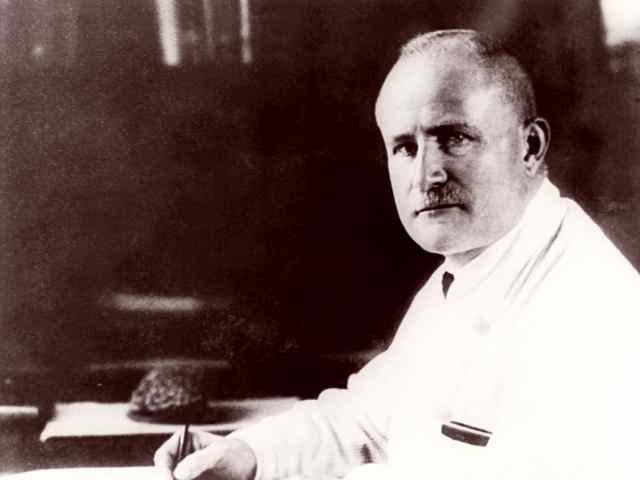
Our understanding of what the brain is doing when it’s zoning out is possible because of an accident. It was German physician Hans Berger’s fall from his horse into the path of a horse-drawn canon that precipitated his exploration of electrical activity in the brain.
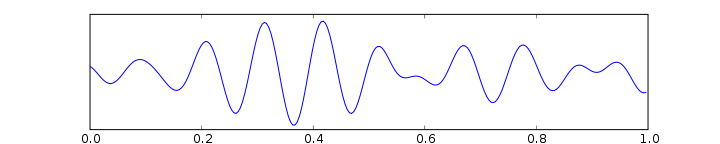
Had his sister not sensed that he was in danger several kilometres away and contacted their father Hans may never have considered the possibility of telepathy and invented a technique we still use today, electroencephalography (EEG). When subjects were in a resting state with their eyes closed the EEG showed a fluctuation in voltage frequency ranging between 8 to 13 cycles, which was named ‘Berger’s Wave’. Today it is known as the ‘Alpha Wave’. Alpha brainwaves are perfect for day-dreaming and creativity!
Alpha Brainwaves – Originally the Berger Wave
Neuroscience has since sought to continue understanding how our brains work. Newer methods for measuring blood flow to the brain were invented to study what was termed by David H Ingvar as ‘undirected, spontaneous, conscious mentation’.
Positron Emission Tomography (PET) involves injecting radioactive substances into the blood stream to map activity in the brain, as well as functional magnetic resonance imaging (fMRI), which uses a powerful magnet to detect haemoglobin carried in the blood and thus map the brain’s network. In this way researchers can see which parts of the brain are active when a person is involved in a specific task compared to when they are idle.
The Default Mode Network
Default Mode Network Connectivity
Surprisingly, the idling brain receives only 5 to 10% less blood than when engaged, and wider regions of the brain are active during idle moments. The brain regions active in the wandering mind have become known as the ‘Default Mode Network’.
The Default Mode Network covers substantial areas of the brain, mainly in the areas not used in perceiving the world or responding to it. This is the network that lights up when we embark on our mental meandering.
It seems that nature has equipped us with two equally important mental faculties: mind wandering and paying attention. How often we alternate between the two depends to a large extent on individual proclivities.
But it happens whether we like it or not and whether we realise it is happening or not.
The benefits of appropriate mind-wandering allow us to adapt to a complex world, especially when we need to escape the here and now, mull over past mistakes and consider possible futures and understand how other people’s minds work. Empathy would not exist without this ability. Neither would the creative spark of humanity and our innovations over millennia.
All our modern conveniences, possessions, clothes, cars, art, culture, buildings, technology and the like were once figments and flashes of inspiration in a zoned-out mind.
We are such stuff
As dreams are made on, and our little life
Is rounded with a sleep.
~ William Shakespeare (The Tempest)
A trip down memory lane
Our memory allows us to experience time as we know it, encompassing past, present and future, providing us with the ability to mentally time travel. We’ve all been there: trying frantically to remember someone’s name, retrace our steps to find lost keys, to recapture emotions and events that are meaningful to us and bury ones we’d rather forget. We use past events to help us envisage future events.
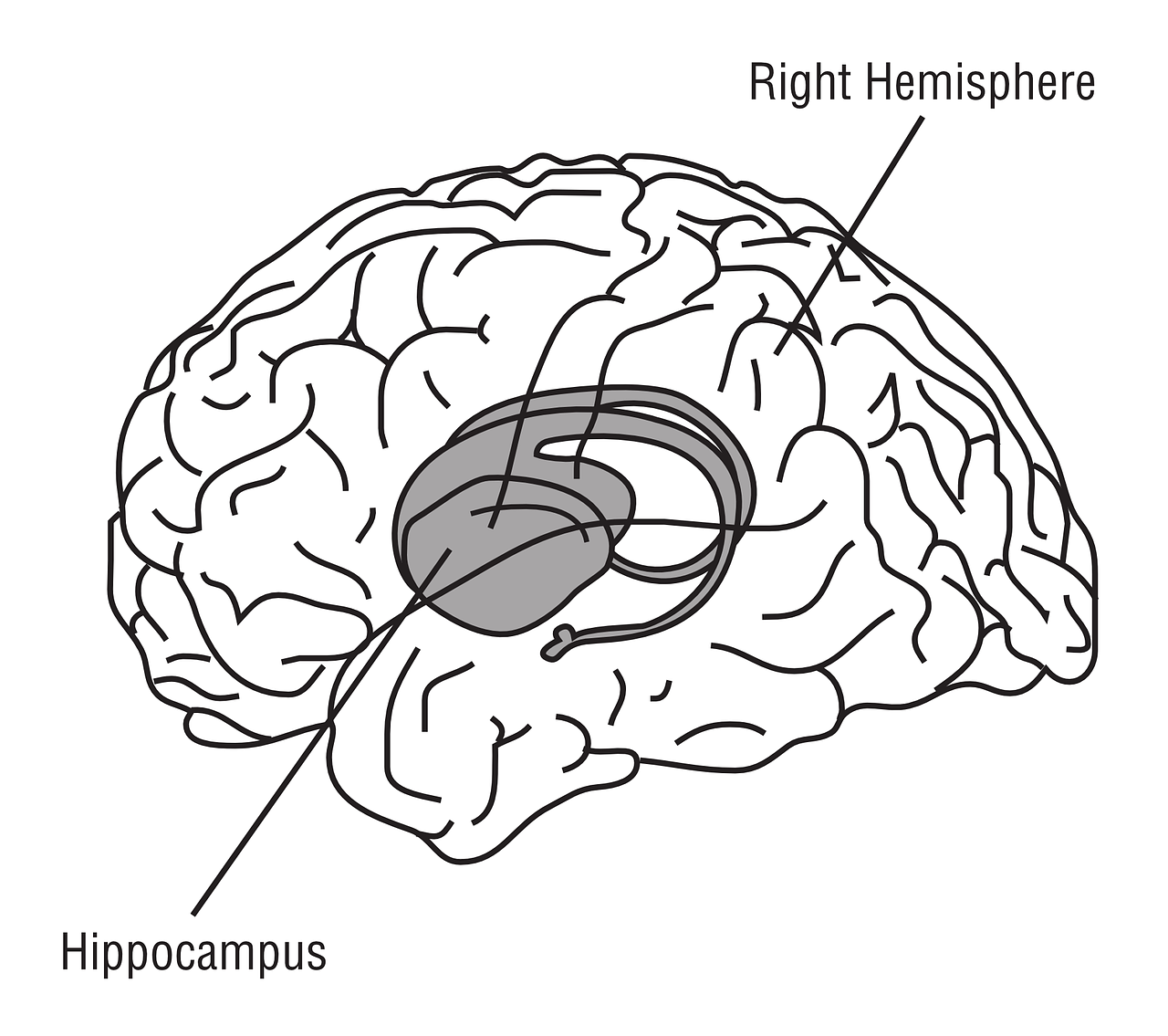
Memory is therefore a creative process. Memories are strengthened connections in the brain, all made possible by the Hippocampus (Major).
“She knew that she had a tendency to allow her mind to wander, but surely that’s what made the world interesting. One thought led to another, one memory triggered another. How dull it would be, she thought, not to be reminded of the interconnectedness of everything, how dull for the present not to evoke the past, for here not to imply there.” ~ Alexander McCall Smith, (The Novel Habits of Happiness)
The Hippocampus
This remarkable section of the human brain is what imbues us with a sense of where we are in space and time, and acts as a cognitive map.
It relates to personal matters, retrieval of personal events and making plans. Damage to this area can result in Anterograde Amnesia.
Because of its shape and resemblance to an equine sea creature, the name Hippocampus was derived from the Greek for seahorse. It’s located on the inner surface of the temporal lobes (behind the ears).
The Default Mode Network includes the prefrontal lobes, temporal lobes and parietal lobes, and activated areas overlap extensively. The Hippocampus is the hub of this network.
The hippocampus is so powerful that vividly imagined scenarios often appear to be real, and the line between fiction and reality becomes blurred. Sometimes these ‘scenes’ can be remembered as though they actually happened. This is how false memories occur.
It may seem the stuff of futuristic, nefarious thrillers (cue book idea), but it’s possible to put memories into people’s heads that weren’t there.
Now, what was I saying? Are you still with me?
Perhaps this is good place to rest and mind-wander for a bit. Next time I’ll explore the role of language, storytelling and psychical phenomena in our mind-wandering excursions.
In the meantime I’ll leave you with the exquisite reveries of Claude Debussy:
Thought is the labour of the intellect, reverie is its pleasure. ~ Victor Hugo




















 rhap.so.dy in words