“Behind every beautiful thing, there’s some kind of pain.” ~ Bob Dylan
Pain – either physical or emotional, is something most of us seek to avoid. Yet our pain is just as valuable as our joy.
Such perceived undesirable feelings are at the opposite end of the emotional spectrum from joy and ecstasy, but are essentially all part of the same energetic material. Pain is one of those things that we strive to remove and resolve once we’re feeling it, yet it has immense value to our lives if we can use it constructively. As a form of feedback it is invaluable.
It can lead us to an expanded awareness and an equanimity that would not otherwise have been possible, but for our moments of pain.
Pain that has been transcended can be compared to the physical pain of childbirth: it hurts like hell at the time, you have no idea how long the labour will last, how long you can bear the intensity, but when it’s finally over you have a priceless gift – a new life. After a few months it’s not possible to recall the acute pain of childbirth, it is consigned to a murky memory; all you know is that it was worth it, because you brought a human being into the world.
What recondite depths have inspired composers, writers, poets, artists, social entrepreneurs and people from all walks of life, wanting to make the world a better place for others?

Two Fridas by Frida Kahlo
In 1939 Frida and Diego divorced. She was devastated and her emotions were reflected in this painting. She drew two identical Fridas, but with different personalities. One is the “Mexican Frida;” the one Diego Rivera fell in love with. The other is “European Frida” – the new and independent artist that’s recognized worldwide, but also, the woman her husband abandoned.
Their hearts are exposed over their clothing, and there is a thin vein passing through them both, uniting them. Victorian Frida holds surgical scissors that cut the vein in her lap, and the blood spills on her white dress. Frida was experiencing real sorrow, the kind of sorrow that made her feel she could bleed from the pain. Both women are holding hands as if the artist accepted she was the only person who understood her, loved her, and could help her to move on. ~ Matador Network
Such motivations do not normally emanate from pain free lives. When we have experienced profound pain we genuinely develop more compassion and empathy, and are probably more willing to help alleviate suffering if we come across someone going through a similar situation.
Pain is a powerful motivator: it can spur us into action, prompt us to change course, widen our perception, and in many cases, make us more accepting and less judgmental and align us to a meaningful purpose.
“Numbing the pain for a while will make it worse when you finally feel it.” ~ J.K. Rowling, Harry Potter and the Goblet of Fire
For me, intense pain formed the bedrock of my determination to follow my dreams and made me a stronger, more resilient person. I learned to listen to the inner longing that wasn’t based in my head.
Through pain I liken myself to a carbon atom that has been pressured, pulverised and heated inside the earth’s mantle; a violent process that forms a striking crystalline structure which is dense yet clear, still rough around the edges, yet with further cutting and refining will one day gleam with the best of them.
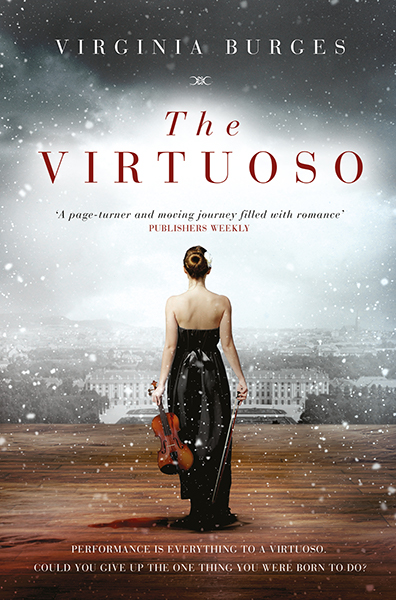
I have taken the gems (no pun intended!) of my own suffering, and used them in a coalescence of knowledge, experience and imagination in the form of my novel, The Virtuoso.
There was a time in my life when I considered making an early exit from existence, but fortunately I decided against that idea. My love for my family spurred me to turn my life around. One day at a time.
It has been said that suicide is a permanent solution to a temporary problem. Most people don’t want to consciously end their life, they want to end their pain. Sadly, not every one can get past their pain.

The Death of Chatterton by Henry Wallis
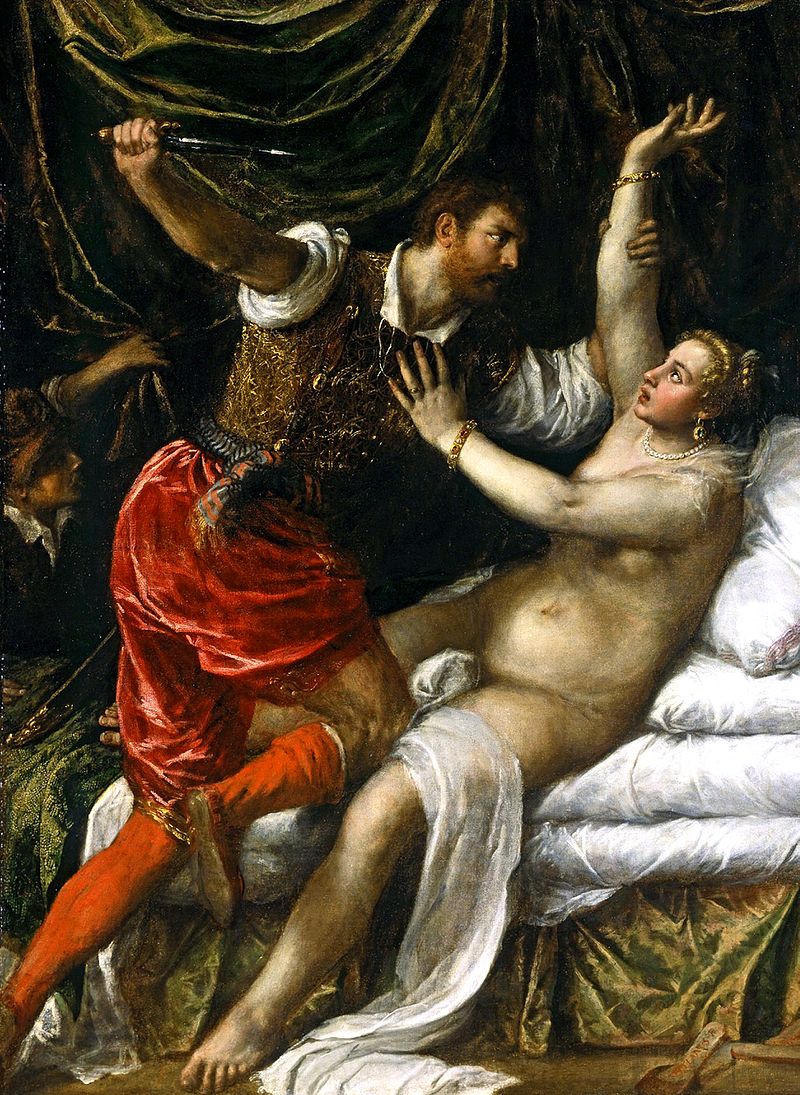
Tarquin and Lucretia by Titian c. 1571
The other day I was reading an email from Vishen Lakhiani, the founder of Mindvalley, telling a very personal story about how a painful experience became the catalyst for the values he lives by.
In Vishen’s words:
Your values became the healing you want to give to the world because of past pain.
My first core value was sparked from a horrible incident in 2003.
Just imagine, for a minute, being forced to leave the country you love because you were put on a watchlist based on a bullsh*t idea that, because of your place of birth, you were somehow a potentially dangerous immigrant.
But that was the situation I was placed in 2003 while living in America. I don’t blame anyone…it was the years following September 11th. And this was part of global politics. But boy was it painful…
I had lived in America for a decade and it was a place I had called home. My wife from Estonia and I lived in New York. We were newly married and I’d been living in the United States for 9 straight years. This was our home and I wanted my son born as an American.
But then – one day in 2003 arriving at JFK airport I was taken into a special room and told that I could no longer travel as freely. I had been added to an early version of the same Muslim-watchlist that Trump has been recently pushing for.
See, because I happened to be an immigrant from a Muslim-dominant country (Malaysia), I, alongside 80,000 other men, weren’t afforded the same freedom of movement as everyone else. I could no longer board flights or get off a plane without enduring 2 to 3 hrs in interviews in tiny rooms at the limited airports I was allowed to fly from.
Worse, I was expected to report to the government every 28 days. Interrogated for hours, get my picture taken, and have my credit card purchases scrutinized. Sometimes after waiting in line for up to 4 hours. And I had to repeat this. Every. Four. Weeks.
The funny thing was that I was not even a Muslim. Nor should that even matter.
Waiting 4 hours in the cold New York weather every 28 days just to be subjected to a really degrading process was something I could only tolerate for so long.
That was it.
And I had enough.
I was deeply saddened that I had to leave America this way, but I felt I didn’t really have a choice but to relocate Mindvalley to Malaysia.
In the end, in 2008 the then-new President Obama ruled the whole dumb process unconstitutional and this Bush-era regulation was tossed into the garbage bin.
I was finally free to travel.
But this pain served me. It set me up for the value of UNITY.
Unity is the idea that we align not with our country, our flag, our religion, or our ethnicity first — but that we align first and foremost with humanity as a whole.
My kids are half-Indian and half-white. You know what that means? It means they look middle-eastern. I don’t want MY children ever ending up on some stupid “watchlist” because fact-challenge old men with racist tendencies think something like a Muslim-ban is somehow a good idea.
So, I made it my mission to bring humanity together.
And the result was the value of Unity in everything we do at Mindvalley.
For example, our events typically welcome people from 40 different countries. Our team of 300 people now come from 49 countries.
And we make effort to represent the under-represented. Mindvalley University for example had 55% women speakers. Our courses feature people of all ethnicities and sexual orientations.
And we actively stand up for pro-Unity politics.
Unity was a value that made me who I am.
I was once on the popular talk show “Impact Theory” and the host Tom Bilyeu asked me.
“Are you an entrepreneur or a philosopher?”
I replied that I think the label ‘entrepreneur’ is pointless. Anyone can be an entrepreneur.
“What defines a person”, I said, “is not the label – but what they stand for.”
I could lost my business. I guess that happens to many people. But it won’t make me lose my identity.
But if I lost my stand. And my stand is Unity. I would not be Vishen Lakhiani. Everything I do, including Mindvalley, is designed to bring unity to the human race.
That’s how deeply entrenched unity is in my DNA.
And you can see how PAIN – can lead to the strongest values.
The healing, transforming power of music
Nowhere is the transformative quality of pain more evident, accessible and immediate than in the experience of listening to, performing and writing music. Like all the creative arts, music can be a miraculous medium for ameliorating pain – leaving a legacy of great benefit to many people, no matter if they are alive at the same time in history.

The Violinist by Joseph Rodefer DeCamp
All types of music fulfill this role for people. Some prefer rock, pop, country, jazz, tango, rap, heavy metal, dance anthems, not forgetting the more established and earlier types such as romantic, classical and baroque. I find my mood and activity selects the music, but the kind that reaches the parts others cannot is – surprise, surprise – classical music.
I have included a few examples of pieces that continue to resonate with audiences centuries later, due to the emotion that was fundamental to their creation. It seems many of the most loved and enduring musical works were hammered out on the anvil of pain…
As you can imagine, keeping this list short is quite impossible for me, so forgive my alacrity if we’re not on the same musical page.
The andante con moto of Schubert’s chamber masterpiece ‘Death and the Maiden’ speaks to me deeply of pain. When I hear it, any unresolved pain I feel comes through and tells me it’s there…
It connects me to the composer, to myself and to humanity. It has even inspired the title of a trilogy of psychological thrillers, quietly brewing in my psyche.
Schubert composed the String Quartet No. 14 in D Minor, D. 810 in 1824, after he had been seriously ill and realised that he was dying. It is Schubert’s testament to death. The quartet takes its name from the lied ‘Der Tod und das Mädchen’, a setting of a poem of the same name by Matthias Claudius which Schubert wrote in 1817.
Only one who suffered such as Schubert could have written it. Much of Schubert’s music reflects the deep chasm of human emotion. It some of the most heart-felt music I think I will ever hear.
“My compositions spring from my sorrows. Those that give the world the greatest delight were born of my deepest griefs.”
~ Franz Schubert
An incredibly moving performance of Schubert’s Piano Fantasie in F minor, D. 940 for four hands, by Dutch brothers Lucas and Arthur Jussen:
The bittersweet quality of the melody and their sensitive, nuanced interpretation makes me well up.
The touch of a master makes the Impromptu No. 3 Op. 90 sound like it’s coming straight from Schubert’s heart…
“The wound is the place where the light enters you.” ~ Rumi
Variations on this sentiment:
“There is a crack in everything God has made.” ~ Ralph Waldo Emerson
Antelope Canyon – by Madhu Shesharam on Unsplash
“The crack is where the light gets in.” ~ Leonard Cohen
“Blessed are the cracked, for they shall let in the light.” ~ Groucho Marx

Beethoven similarly expressed profound depths through his music, in way too many pieces to share here. Works that could only have come about because of his physical and emotional wretchedness. He was the epitome of the tortured genius!
The Piano Sonata No. 23 in F minor, Op. 57 (Apassionata), was written at a time of great political and personal turmoil, and it seems that Beethoven has bared his soul within the notes. The famous triadic motif from his fifth symphony can be heard in the opening movement, indeed, it pervades much of his musical output.
You can hear the violent rage, anguish, torment, passion and determination expressed either consciously or unconsciously by Beethoven, as if he is unashamedly showing us his inner core, which was clearly on a stormy setting at the time.
He was reeling from a broken heart, just when his brother Karl announced his marriage to Johanna, a woman Beethoven despised. He could not bring himself to dismount from his moral high horse and be happy for them.
Oh my, it was quite the maelstrom… I think Richter played it like the mercurial maestro would have:
Prior to publication of the Apassionata, Beethoven erupted with fury in a disagreement with a great patron of the arts, his aristocratic benefactor, Prince Lichnowsky. The altercation supposedly took place one stormy night at the prince’s country estate near Graz.
Lichnowsky asked Beethoven if he would perform for him and some of Napoleon’s officers he was playing host to. Beethoven refused in his combustible, irascible manner, and strode off into the rainy night with his Appassionata score under his arm; but not before telling Lichnowsky that there were many princes, but only one Beethoven!
The blotches caused by the contact of rain and ink from that fated evening are still visible on the original autograph manuscript.

Even though Beethoven never quite forgave Lichnowsky for his transgression, he still wrote to his estranged patron sometime later to complain of his “thoroughly lacerated heart.”
The pain of parting is so beautifully transferred to the ivories by Alfred Brendel in this recording of Beethoven’s Piano Sonata No. 26 in E-flat major, Op. 81a, ‘Les Adieux’:
In his brilliant analysis of Beethoven’s Piano Concerto No. 4 in G Major, Charles Hazlewood highlights that the piano and orchestra are in a conversation; a dialogue that becomes increasingly tense through the first and second movements.
He enthuses that Beethoven created a new era for the role of the piano by not starting the concerto with a grand orchestral opening, as was the custom, but instead with a tentative phrase on the piano, which seeks to dictate terms to the orchestra.
Discord permeates each phrase of the conversation as the tension becomes more pronounced in the andante con moto. When the piano finally breaks out it seems that the gulf between the piano and the orchestra is unbridgeable, until the third movement brings about resolution and reconciliation. The piano mollifies the orchestra and they unite musically.
I could not leave out the incomparable second movement of his Piano Concerto No. 5 in E-Flat Major minor, Op. 73 (Emperor), which seems to encompass the entire history of mankind at the molecular level within its sublime, poignant melody.
The whispered opening makes me hold my breath for eight unbearably beautiful minutes, floating in suspended animation, soaking up the apotheosis of all that is…
James Rhodes blends notes and emotion perfectly in the third movement of Beethoven’s Piano Sonata No. 30 in E Major, Op. 109:
Backed by Stanford University’s Ensemble in Residence, the St. Lawrence String Quartet, Robert Kapilow, (composer and radio commentator), explores the notion of illness as a potent source of creativity, (e.g. appreciation for existence) through Beethoven’s ‘Heiliger Dankgesang’, which Beethoven wrote in thanksgiving after recovering from a life-threatening illness.
Tchaikovksy could also pack in the pathos, as expressed in his Serenade Melancolique Op. 26, via Itzhak Perlman on his violin:
The sobriquet ‘Suffocation’ is a fitting description for Chopin’s Prelude No. 4 in E minor, Op. 28:
I think the addition of the cello brings out a lyrical, lugubrious quality to the melody:
The original lyrics to ‘So Deep is the Night’ by André Viaud and Jean Marietti were set to Chopin’s Etude No. 3 in E Major, Op. 10 ‘Tristesse’, perfect on its own:
In the medium of opera and vocal works suffering finds an outlet through the voice. I find Camille Saint-Saëns’s ‘Mon coeur s’ouvre à ta voix’ from Samson et Dalila one of the most moving arias ever written. Maria Callas was no stranger to emotional pain, and you can hear it as she pours out her heart:
Callas is also unmatched as Norma in Bellini’s eponymous opera singing the aria Casta Diva:
Puccini and Pavarotti are a match made in heaven…
I love the strong sentiment in this interpretation by Marita Solberg of Edvard Grieg’s ‘Solveig’s song’ from his Peer Gynt Suite:
Bach’s eternal, prayerful and beseeching ‘Erbarme dich mein Gott‘ (Have mercy Lord, My God) from his epic St. Matthew Passion:
Get the tissues ready for Handel’s signature aria ‘Lascia ch’io pianga’ from his Opera Rinaldo.
Let me weep
over my cruel fate,
and sigh for freedom.
Let my sorrow break the chains
of my suffering, out of pity.
Dimitry Shostakovich takes us to the abyss as he performs the andante from his Piano Concerto No. 2 in F Major, Op. 102 in this vintage recording:
Albinoni finds a sorrowful voice for the oboe in the adagio of his concerto No. 2 in D minor, Op. 9:
I couldn’t leave out maestro Mozart, who proved he was equally at home with a deep and meaningful as well as a galloping allegro.
Vladimir Horowitz always takes me to another dimension with this recording of the adagio of Piano Concerto No. 23 in A Major, K. 488. The heartache is palpable…
In my humble opinion this is no ‘feeble adagio’ as Brahms had labelled the slow movement of his Violin Concerto in D Major. The oboe, bassoon, brass and violin share the profound melody.
To me it is poetic and purifies the soul.
Franz Liszt wasn’t always a showman, as he proves in his nostalgic and tender Consolation No. 3:
Love hurts and pleasures at the same time when Wagner gets involved! The immortal Tristan und Isolde, Prelude & Liebestod:
The Symphony of Sorrowful Songs is a symphony in three movements, composed by Henryk Górecki in Katowice, Poland, between October and December 1976.
In the second movement a solo soprano sings the Polish message written on the wall of a Gestapo cell during World War II, from the perspective of a child separated from a parent. The dominant themes of each of the three movements of the symphony are motherhood and separation through war.
The symphony is constructed around simple harmonies, set in a neo-modal style which makes use of the medieval musical modes. The nine-minute second movement is for soprano, her words are supported by the orchestra and the movement culminates when the strings hold a chord without diminuendo for nearly one and a half minutes.
The final words of the movement are the first two lines of the Polish Ave Maria, sung twice on a repeated pitch by the soprano.

Maternal Affection by Adolphe Jourdan c. 1860
Górecki dedicated the work to his wife, Jadwiga Rurańska. He never sought to explain the symphony as a response to a political or historical event. Instead, he maintained that the work is an evocation of the ties between mother and child.
You can certainly feel the fathomless pain of parental separation, as well as the music’s roots in the Holocaust, and indeed every war:
Honestly, I could go on forever, but I think you get the idea!
In his book, The Joy of Music, Leonard Bernstein makes a point about the futility of trying to extract the meaning of music, contending that it stands in a special lonely region, unlit…
The composer and musical artist bring their own ‘wounds’ and life experience to their work. In the process there is catharsis, release, healing, beauty and meaning. For them, and for us.
For violinist Ji-Hae Park, music was part of the pain and the resolution:
One could go as far as to say that a completely happy life provides no substance for a creative individual.

Hirzel, Switzerland by Ricardo Gomez Angel on Unsplash
I have had my fair share of pain, but also incredible joy, and it makes you appreciate the good times. I’m reminded every day to extract every drop of life from each precious, present moment…
Letting go
Letting go of pain takes patience and practice. At least for me.
When I finally decided I was sick of the perverse way my ego was getting off on my pain, I decided to let it go. I could stand in the fire and not be burnt by it. But that took time and awareness.
In hindsight we can understand how our painful experiences have made us who we are, and how they may have served us, but rarely is this possible when we are in the thick of it.
When we step out of the victim archetype we regain our power.
I find this profound teaching by Dr. David R Hawkins (in terms of the paradigm of Content and Context) really helpful in managing and transcending pain. The best course of action is to focus on the totality of the experience, (context) and not the specifics, (content). He was a wise and wonderful real-life Yoda!
#BeTheBowl
I recently had a candid chat with a good friend of mine, who happens to be a spiritual coach, and I was relaying what a horrendous first six months of the year I’d had, and how I’d struggled to maintain my usual positive outlook and get back on track with my plans. I put on a humorous slant, relieved that I’d got through it. She listened and smiled, and gave me the most amazing advice.
She said, “Ginny, be the bowl!”
I must have looked a bit dim and confused, because she went on to explain that in Japan, they have a custom of not throwing out damaged or broken things. So a precious vase that may have been knocked over and smashed is glued back together using a special gold lacquer.
Rather than cover up the imperfection of the object or throw it away, they appreciate and celebrate it.
I really love that ethos. The practice is known as Kintsugi.
I thought #BeTheBowl would make a great hashtag to embrace life in all its manifestations.
We all go through rough patches, but rather than bury the hurt, or wallow in it, we can always bring it into the light to mend it with our personal application of liquid gold.
Our life experience comes moment by moment through our thoughts, emotions, words and deeds, and to expect that it will always be perfect is setting us up for unnecessary suffering. We have to just roll with the punches, knowing that they are coming, but not necessarily how hard, how many, where or when…
It seems a much more reasonable proposition to love and accept each other despite our random gold seams.
#BeTheBowl is my new mantra whenever I’m feeling low or the proverbial hits the fan.
#BeTheBowl helps me see myself and humanity as a work in progress.
Khalil Gibran’s poem On Pain, from his timeless book, The Prophet, is a great reminder that pain is the divine taking us to a different dimension of life. It’s futile to oppose and resist the inevitable.
The only reason we suffer with our pain is that we don’t want to accept its existence and don’t recognize its value. We think that pain is not fair, that we didn’t deserve to experience it, that perhaps we are being punished for something we have or haven’t done.
My biggest question to God during the depths of my despair was always, ‘why me?’ In truth, pain chooses us when it sees that we are ready for transformation.
“Mental pain is less dramatic than physical pain, but it is more common and also more hard to bear. The frequent attempt to conceal mental pain increases the burden: it is easier to say “My tooth is aching” than to say “My heart is broken.” ~ C.S. Lewis (The Problem of Pain)
I can’t think of anyone who transformed his pain into such beauty and an enduring legacy more than Beethoven…except Jesus!
As I tell the W.I. ladies whenever I do a fiction talk, there is no greater fodder for your fiction than that of your life, or the lives of loved ones.

Grampians National Park, Australia by Manuel Meurisse on Unsplash
The soul has to be breached to be opened, and wounds do the breaching. The deeper the wound, the richer your story will be, the greater the journey, and the more satisfying the transformation.
This is just as true for real life as it is for fiction.
“Only the wounded physician heals.” ~ Carl Jung






















































 rhap.so.dy in words