“When you play a violin piece, you are a storyteller, and you’re telling a story.” ~ Joshua Bell
To me, the beauty, mystique and resonance of the violin is both beguiling and irrefutable. The instrument’s tone, agility and versatility is unsurpassed in classical music repertoire. Of course, I adore all stringed instruments, with the cello coming a close second.
 Looking at the design of the violin I love the way the wide curves of the upper and lower bouts contrast with the inverted C-bouts (the waist), to give it that sensual shape, and the elegant f-holes, along with the combination of the long and graceful fingerboard leading to the peg box and the scroll, which can be quite elaborate on older violins. Then you have the sheen and shine of their wood exteriors, usually spruce and maple. It is a thing of beauty!
Ancient liras, violettas and violas were created by the school of Brescia in the late 14th century, and in 1574 the Bertolotti Gasparo da Salò family made what is considered the finest carved and decorated Renaissance violin in the world, which was once owned by Ferdinand II, Archduke of Austria. Its current home is the Vestlandske Kustindustrimuseum in Bergen, Norway.
From Wikipedia:
Early History:
The Persian geographer Ibn Khurradadhbih (d. 911) of the 9th century, was the first to cite the bowed Byzantine lira as a typical instrument of the Byzantines and equivalent to the rabāb used in the Islamic Empires of that time. The Byzantine lira spread through Europe westward and in the 11th and 12th centuries European writers use the terms fiddle and lira interchangeably when referring to bowed instruments (Encyclopædia Britannica. 2009). In the meantime rabāb was introduced to the Western Europe possibly through the Iberian Peninsula and both bowed instruments spread widely throughout Europe giving birth to various European bowed instruments.
Over the centuries that followed, Europe continued to have two distinct types of bowed instruments: one, relatively square-shaped, held in the arms, known with the Italian term lira da braccio (meaning viol for the arm) family; the other, with sloping shoulders and held between the knees, known with the Italian term lira da gamba (or viola da gamba, meaning viol for the leg) group. During the Renaissance the gambas were important and elegant instruments; they eventually lost ground to the louder (and originally viewed as less aristocratic) lira da braccio family of the modern violin.
Between the 16th and 19th centuries, several changes occurred, including:
- the fingerboard was made a little longer to be able to play even the highest notes, in the 19th century.
- the fingerboard was tilted a little more, to produce even more volume as larger and larger orchestras became popular.
- nearly all old instruments were modified, including lengthening of the neck by one centimeter, in response to the raising of pitch that occurred in the 19th century.
- the bass bar of nearly all old instruments was made heavier to allow a greater string tension.
- the classical luthiers nailed and glued the instrument necks to the upper block of the body before gluing on the soundboard, while later luthiers mortise the neck to the body after completely assembling the body.
- the chinrest was invented in the early 19th century by Louis Spohr.
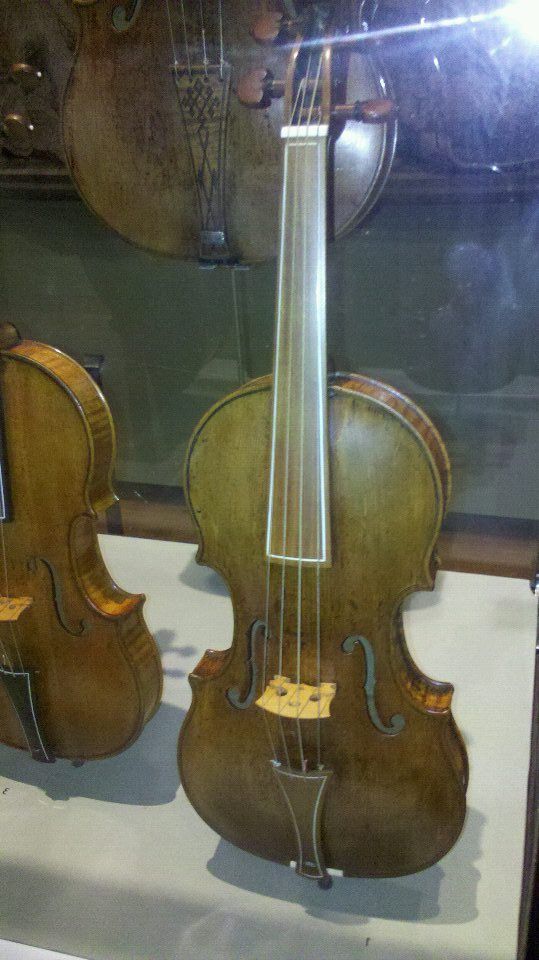 We can thank the French Renaissance for what we know today as the ‘modern’ violin. In Cremona, Andrea Amati created the first batch of violins in 1564 at the behest of King Charles IX, who wanted to create a new musical sound for the kingdom of France. Amati was credited with adding the fourth string to the existing three-stringed ancient violin type instrument. His instruments were beautifully adorned with art work. There is a wonderful display of Amati instruments at the Ashmolean Museum in Oxford.
Andrea passed his violin making skills down to his two sons, Antonio and Girolamo, who in turn inspired the latter’s fourth son, (Andrea’s grandson), Nicolo Amati. Among Nicolo’s aspiring students were Andrea Guarnerius and Antonio Stadivari. Alongside the slightly newer violins of Jacob Stainer of Austria, these instruments are the most sought after and valuable in the world.
Zsolt-Tihamér Visontay (the Leader of the London based Philharmonia orchestra), does a great job of explaining the basics about the violin and his role in the orchestra:
One of my heroes on the violin, Itzhak Perlman, has made some very helpful short videos to assist us amateur violinists with our technique!
For violin lovers here is a fabulous documentary titled: The Art of Violin:
Part 1:
Part 2:
After discussing the ‘ordinary’ Strad (if there is such a thing), played by the late David Oistrakh, and the amazing sound that he achieved with it; Itzhak Perlman concludes that, ‘the sound comes from the individual, not the instrument.’
Renaissance artist and sculptor Gaudenzino Ferrari painted the earliest known depiction of the violin. And now to the visual art of violin! I have included a small gallery of some of my favourite paintings and images of the violin in still life and in a living setting:
-
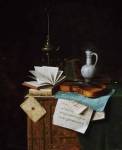
- William Hartnett – Violin Still Life
-
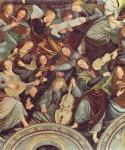
- Gaudenzino Ferrari – The Glory of Angels (in Santa Maria dei Miracoli in Saronno
-

- Anders Zorn – The Fiddler
-

- Arthur Hughes – A home Quartet
-
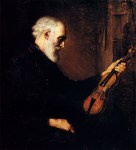
- The Violinist
-

- Jacob Ochtervelt, The Music Lesson (1671)
-

- Pieter Claesz – Vanitas with Violin
-

- Pieter de Hooch
-
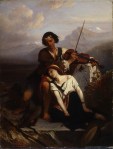
- Louis Gallait – The Power of Music
-

- Gustav Igler – The Music Lesson
-

- Frederick Daniel Hardy
-

- Fabritius – View of Delft
-

- Evaristo Baschenis
-

- Eduard Charlemont – The Violin Lesson
-

- Edgar Degas – The dance lesson
-
- My dream shoes by Kobi Levi
-
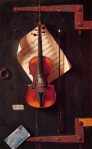
- William Hartnett – Violin Still Life
-

- The best swimming pool in the world!
-
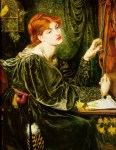
- Dante Gabriel Rossetti – Veronica Veronese
-
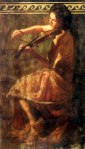
- Tomasz Rut – Girl Playing the Violin
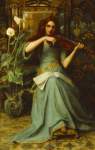
-

- Arthur Hughes – The Music Lesson
-

- Caravaggio – The Musicians
“You are the music while the music lasts.” ~ T.S. Eliot



 rhap.so.dy in words