The legendary words of Marcus Aurelius most definitely apply to the arts. “What we do now echoes on to eternity.”
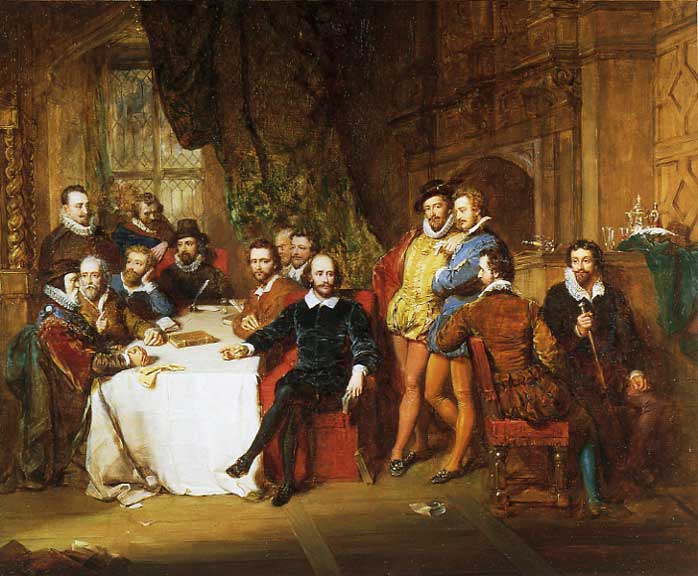
John Faed – Shakespeare and his contemporaries 1851
It’s only natural that the early composers served as inspiration for the musical creators that followed, but in this post I thought I would explore the rich cultural legacy that poets, playwrights and literary greats have inspired in composers, choreographers and purveyors of the arts. Of course, writers haven’t just provided mythical fodder for music, they have also been prolific in the imaginations of artists and painters through the ages in the world of art. However, today I’m going to stick to music.
I’ll be exploring opera, ballet and instrumental works. There are a range of writers who have provided creative juice to our musical geniuses, but Shakespeare due to his incredible literary legacy, features more than most. There are ‘Bardolaters’ aplenty to investigate!
As opera is musical storytelling it is the perfect medium for literary adaptations, and I believe it’s on the stage of the vocal arena where Shakespeare’s plays have become a most popular muse to composers and librettists of the last two hundred or so years.
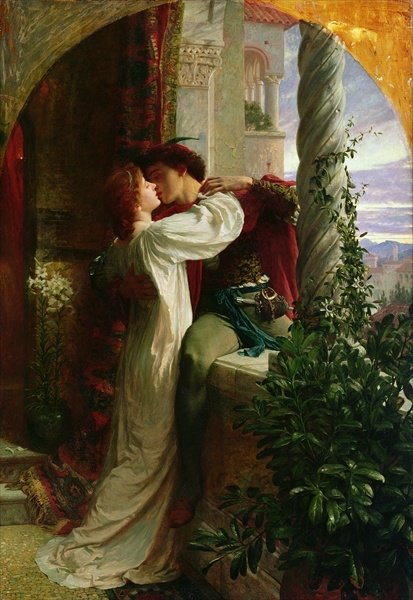 In many ways, the music that came after the words has cemented the iconic status of certain plays in our hearts and minds, ensuring they remain at the forefront of popular culture, as the music transports us into these fictional worlds and helps us transpose them into our own lives.
Perhaps Shakespeare was hinting at musical imitation when he penned the immortal phrase: If music be the food of love, play on…
The Italian operatic composers Gioachino Rossini and Guiseppe Verdi both wrote operas based on Othello, and here is an aria each from each composer:
Rossini – Otello ‘Assisa a pie d’un salice’ sung by Cecilia Bartoli as Desdemona:
Verdi – Otello ‘Willow Song’ with diva Maria Callas as Desdemona:
A powerful aria sung by Piero Cappuccilli from Verdi’s opera Macbeth ‘Perfidi! … Pietà rispetto amore’:
Prokofiev’s immortal ballet Romeo and Juliet was first performed in Brno in the Czech Republic on 30th December 1938, but was then revised and shown again at the Kirov Ballet in January 1940. Since then it has become a firm favourite in both ballet and instrumental repertoire with choreographers such as Frederick Ashton, Sir Kenneth Macmillan, Rudolf Nureyev, Yuri Grigorovich and Peter Martins amongst others, who all had their own stylistic take on this most tragic and classic of love stories. Prokofiev also arranged his ballet music for solo piano.
Montagues and Capulets (also known as Dance of the Knights) Act I, Scene II:
Sticking with Romeo and Juliet I couldn’t leave out Tchaikovsky’s orchestral masterpiece, the ‘Fantasy Overture to Romeo and Juliet’. Here is Valery Gergiev and the London Symphony Orchestra with a wonderfully evocative performance that always pulls on my heart strings:
Tchaikvosky also wrote instrumental music for The Tempest and Hamlet. But it is the music of little known Thomas Linley the Younger (1756 – 1758) who was childhood friends with Mozart and later became known as the ‘English Mozart’ that I feel best encapsulates the theme of ‘The Tempest’.
Chamber orchestra Pratum Integrum and vocal ensemble Intrada perform “Arise! ye spirits of the storm” directed by Ekaterina Antonenko:
In the nineteenth century Felix Mendelssohn, a child prodigy, virtuosic pianist and violinist, turned composer and conductor, was inspired by Shakespeare’s Midsummer Night’s Dream and wrote the overture at the age of 17 in 1826, followed by the incidental music for the play in 1842.
Kurt Masur and the Gewandhausorchester Leipzig do a great job of bringing this spritely comedy to life!
Romanticism:
“Romanticism is the art of presenting to people the literary works which …can afford them the greatest pleasure. Classicism presents them with works which gave the greatest possible pleasure to their great-grand parents.” ~ Stendhal
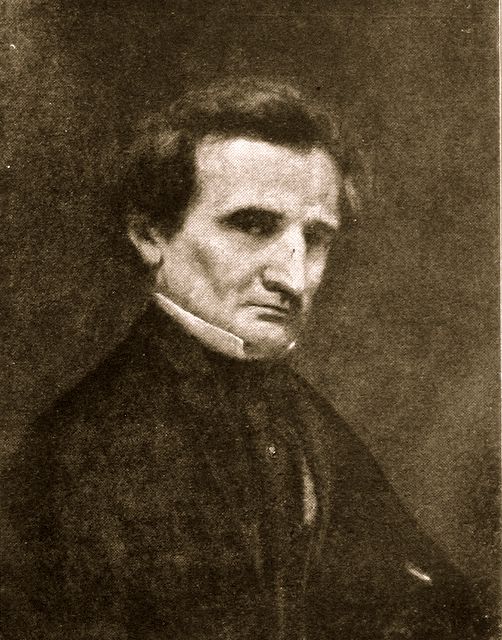 Born into the world just before Napoleon was crowned Emperor , the French composer Hector Berlioz grew up with a love of literature, and was greatly inspired by the works of Virgil, Shakespeare, Goethe, Byron, Thomas Moore, Sir Walter Scott and French poet Theophile Gautier. His musical God was Beethoven, (which is hardly surprising as Beethoven was the catalyst for the Romantic era of music), with his non-conformist and rebellious nature that dared to breach the traditional classical rules about structure and content; his passion for the notions of freedom and brotherhood, and above all else for his art, no matter what was deemed popular and the ‘done thing’ at the time. With such a combination of dramatic and artistic love it’s no wonder Berlioz wrote many works inspired by the Bard and the Romantics!
Dispensing with a career in medicine he focused on his music, and as an incomparable romantic he wrote the choral symphony Roméo et Juliette, after seeing Harriet Smithson star as Ophelia when a London Theatre Company was performing Hamlet in Paris. The cream of the Paris literati were also in the audience that night; Victor Hugo, Alfred de Vigny, Alfred de Musset and the painter Delacroix.
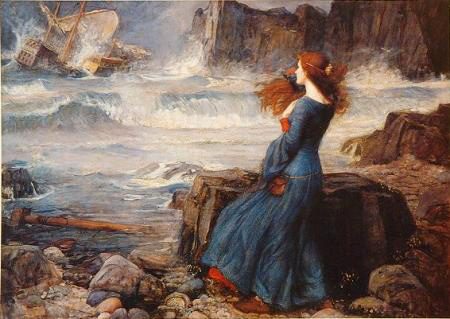 This music was followed with an Overture to King Lear, and also to the Tempest, which, as legend would have it, on the night of the performance in Paris the worst storm for fifty years was unleashing its wrath over the city and hardly anyone ventured out. Franz Liszt did attend however, and was later to transcribe his Symphonie Fantastique for the piano. The two became great friends.
Here is an excerpt from his last work, the comic opera Béatrice & Bénédict, loosely based on Shakespeare’s comedy ‘Much Ado About Nothing’ the aria ‘Nuit paisible’:
Debussy had a thing about gothic writer Edgar Allan Poe, Wagner’s operatic output is steeped in mythical legend, and composer and piano virtuoso, Franz Liszt wrote the ‘Dante Symphony’ and we can also thank him for creating a new art form: the symphonic poem. Here is his dramatic ‘Hamlet’ with Bernard Haitink and the LPO:
Generations of composers have written work from Shakespeare, I’d love to include their music but there’s only so much room! Worthy of mention are Henry Purcell, Shostakovich, Smetana, Sibelius, Poulenc, Debussy, Elgar, von Weber Ambroise Thomas, William Walton and Ralph Vaughan Williams.
The English poet and writer John Milton who was himself a keen musician and composer, inspired composers such as Joseph Haydn, who’s oratorio ‘The Creation’ (with the libretto by Baron van Swieten), was based on his epic poem Paradise Lost, and an opera was written on it by Polish composer Krzysztof Penderecki. More recently contemporary composer Eric Whitacre wrote an ‘Electronica Opera’ entitled Paradise Lost: Shadows and Wings inspired by Milton’s text.
A section of Miguel de Cervantes’ timeless chivalric novel ‘Don Quixote’ has been a firm favourite in the dance community, having been adapted and featured over the years as a ballet. The music was written by Ludwig Minkus with the original choreography by Marius Petipa, and it was first performed in 1869.
An excerpt from The Bolshoi Ballet with Maria Alexandrova & Mihail Lobuhin:
More recent literary works and novels have also been turned into ballets, such as the classic Alice In Wonderland by C.S. Lewis, The Sun Also Rises by Hemingway, As I Lay Dying by William Fualkner, Sophie’s Choice by William Styron, Heart of Darkness by Joseph Conrad and even Bram Stoker’s Dracula. Who would have thought that John Steinbeck’s iconic working class tale Of Mice and Men could be done? I wonder what George Orwell would have made of 1984 on the stage at Covent Garden in 2005, a much critically maligned production by the late maestro Lorin Maazel.
I think it is most fitting for me to end with Beethoven, the great titan of classical music composition, who served as inspiration himself for many musicians to follow, and who is still an icon of his art today. He wrote music to some of Goethe’s poems but my favourite of his Goethe inspired pieces will always be his eponymous overture for Count Egmont, with its themes of heroism, which was later adopted as the unofficial anthem of the 1956 Hungarian Revolution.
Herbert von Karajan and the Berlin Philharmoniker on top form:
“Music begins where words end.” ~ Richard Wagner



 rhap.so.dy in words