#TheVirtuoso – First the Book, Now the Music!

“When you play a violin piece, you are a storyteller, and you’re telling a story.” ~ Joshua Bell

I’ve been itching to write this post for weeks….

Paradoxically, now the time is here I’m slightly lost for words. I have many superlatives for the work of film/TV composer Tim Johnson and virtuoso violinist Adelia Myslov, and to tell the truth, I feel quite emotional…

In a good way I hasten to add!

Whenever I listen to the superb soundtrack that Tim and Adelia created I can hardly contain myself. The music is playing on a continuous loop inside my head alongside the events of the novel.

After I finished writing The Virtuoso I knew I wanted to have an original piece of music written for it. To tell the story of a violinist and not have a musical narrative to complement it seemed somehow incomplete.
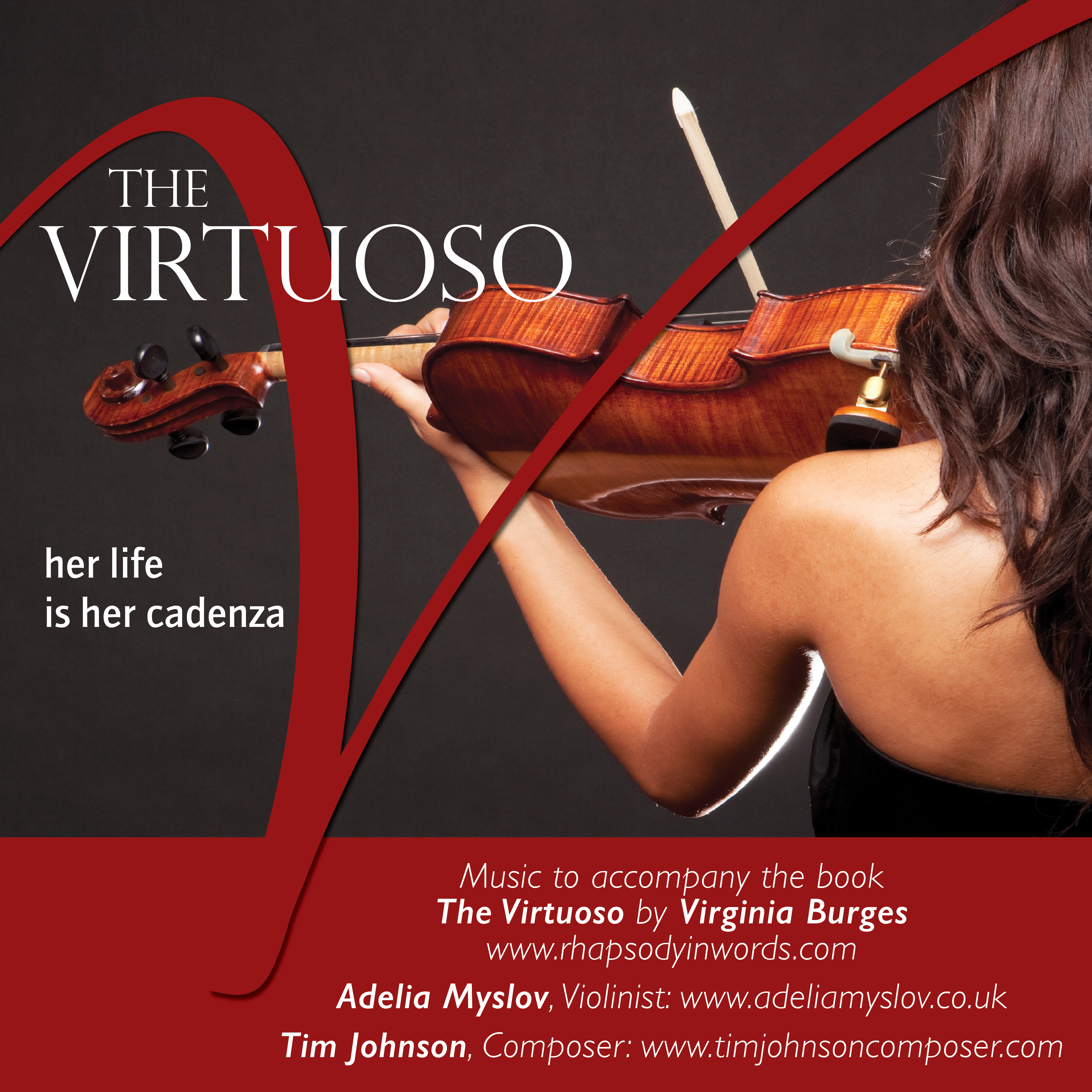
Virtuoso iTunes Cover ONLINE ARTWORK (2)

The journey so far…

Adelia and I met last summer after one of her concerts – she had just given a tear-inducing performance of Mendelssohn’s Violin concerto – and I was bowled over by her talent. We met briefly afterwards, and I wrote about her in one of my early posts: Gem of a violinist illuminates Church Concert. We hooked up on Twitter, and Adelia read my book prior to publication.

I was quaking in my boots, I can tell you. Luckily she enjoyed it, and endorsed how ‘real’ it was, so I was relieved that a virtuoso violinist had authenticated the musical aspects of my story. I suggested it would be wonderful if she could play the ‘theme’ for it, and to my absolute delight Adelia agreed!

We met up to discuss the project, and Adelia put me in touch with Tim (who she met while studying at the Royal College of Music), and the rest, as they say, is history!

About Tim

Tim began playing classical guitar at the age of 9, then moved to electric shortly after. He has always enjoyed music that was loud and fast, regardless of the genre, be it punk, metal, drum and bass or Bach.
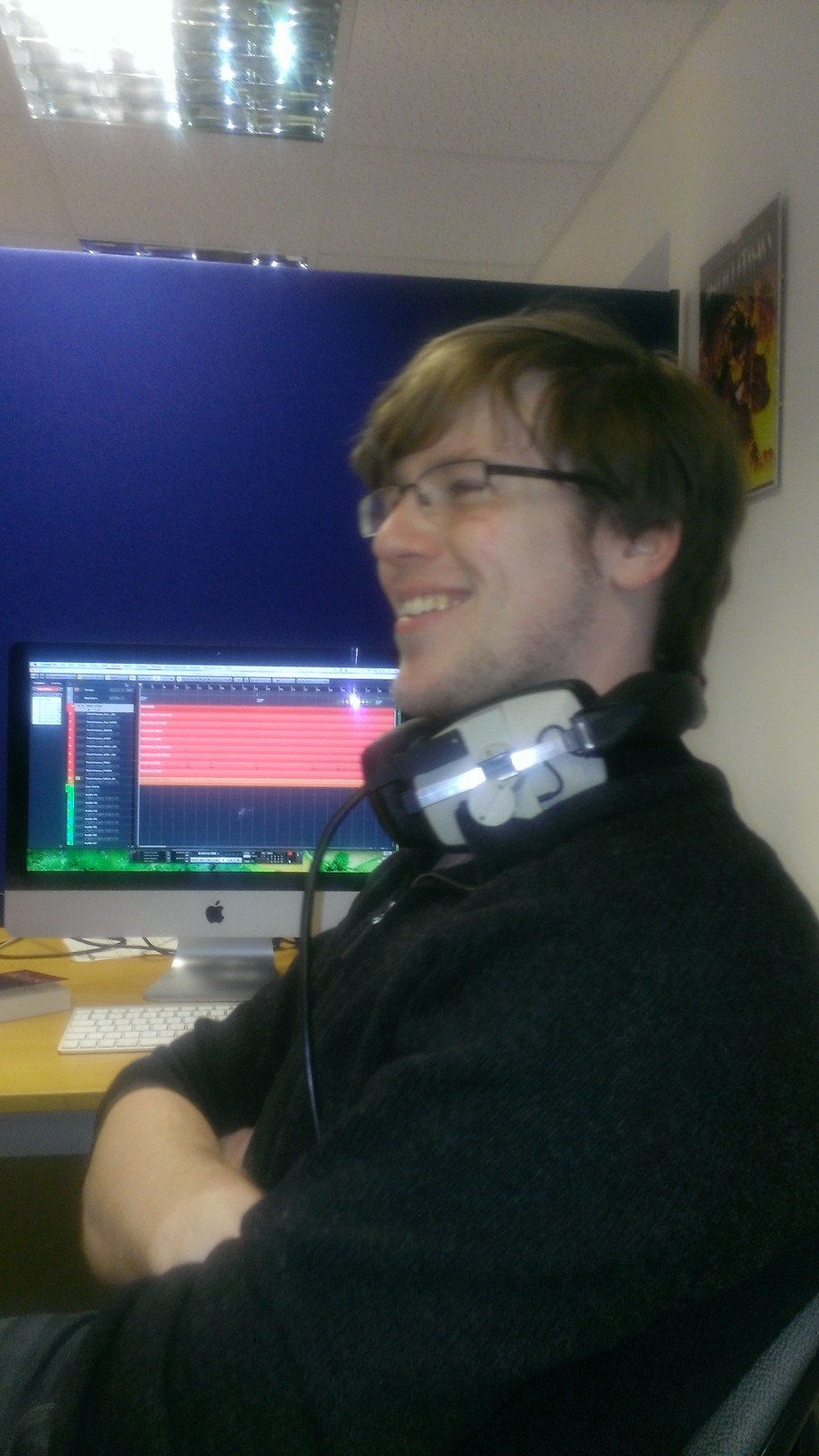
Tim JohnsonOn track to study as a sports scientist in college, Tim did a U-turn and decided he wanted to be a professional musician. He completed his music technology A-level in just one year (instead of the usual two), alongside a traditional A-level; after which he gained a place at the University of Hertfordshire to study for a B.Sc. in commercial music composition and technology. During that time he discovered a love for writing film music.  He always enjoyed listening to it, but it was during his time at university when he decided that it was the career for him. Tim left Hertfordshire with a 1st Class Honours degree.

Despite fierce competition in the world of film composition Tim managed to write for a few adverts and other jobs when he started out, but in light of how tough it was to get hired he decided he should continue his education. He was accepted into the Royal College of Music to study Musical Composition for Screen under Francis Shaw.

Along with a good friend, Konstantine Pope, Tim was the first student to be allowed to use the main concert hall for a live electronic concert, with full orchestra, rock band, electronics and a cinema screen with visuals.

“They obviously saw enough potential in me. The experience was incredible and I learned a colossal amount, about how to write good music, about the industry, about networking and communicating with musicians… respect for musicians and their talents.”  ~ Tim Johnson

Since then, Tim has written music (or created sound design) for AAA games, trailers, movies and of course, for The Virtuoso!

The Brief

I explained to Tim that I wanted a unique theme with a classical feel to it, perhaps a little Beethovenesque (due to his part in the novel), that would serve three aims: to dramatise the story, give the listener an idea of Isabelle’s character and also a musical experience of the overall essence of The Virtuoso.

After we recorded the music Tim told me about how he initially struggled with the concept of a virtuosic piece, and the idea of playing notes for the sake of playing them. He confided in a respected colleague; the conductor and film composer, Nic Raine, who advised him that just a single note can sound virtuosic; it’s how the musician plays the note that matters, it’s their interpretation that makes the difference. He said that Tim should concentrate on a memorable theme. His advice clearly paid off!

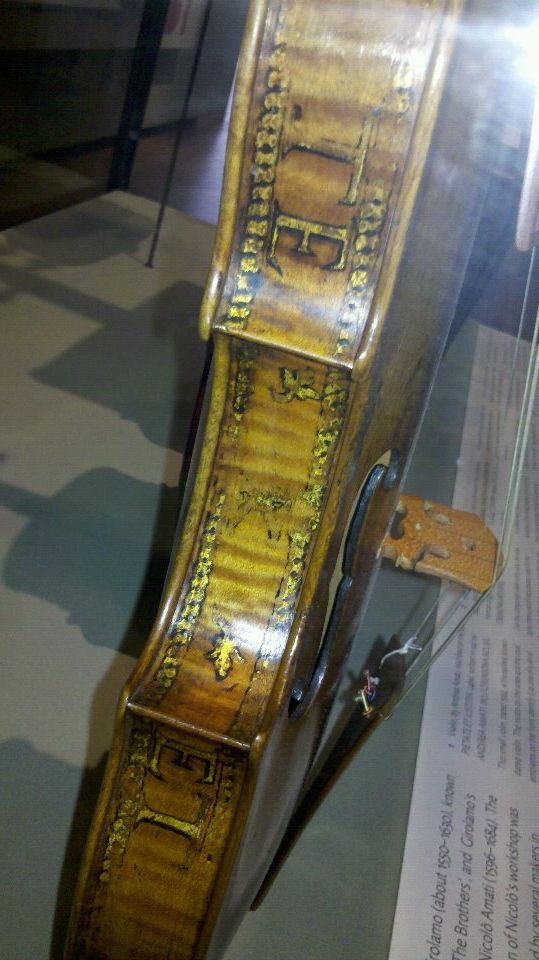
Tim has done that and more, with a divine melody that Adelia has brought to life on her 18th Century Lorenzo Storioni violin, crafted in Cremona.
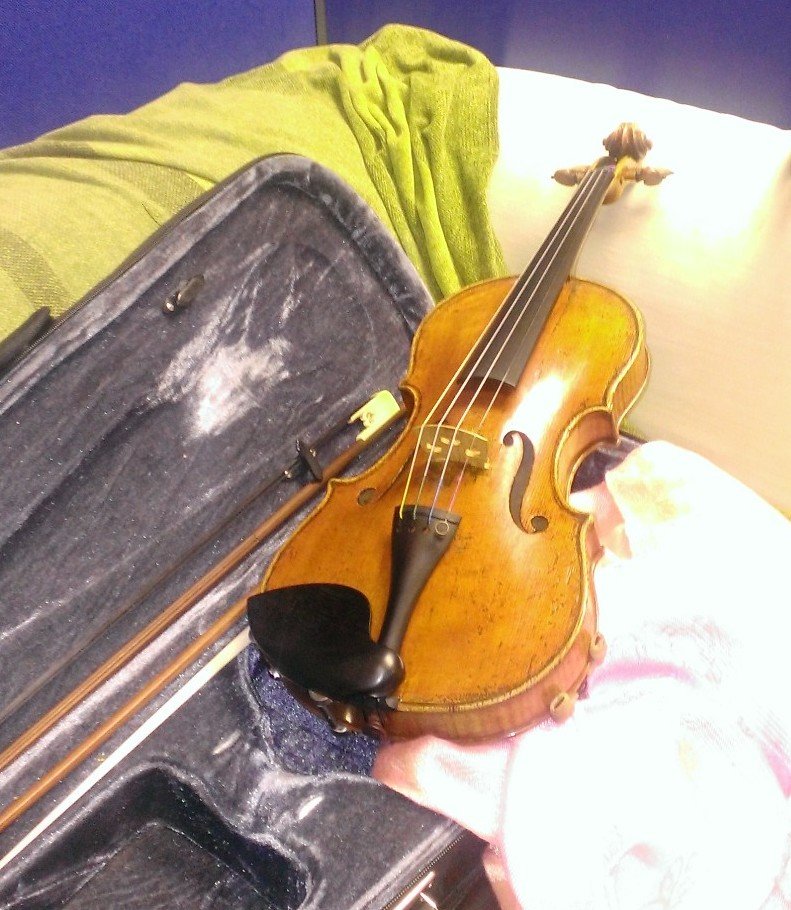
Adelia's Storioni Violin

Adelia’s Storioni Violin

As an aside, I recently learned that Arnold Steinhardt (the leader of the legendary Guarneri Quartet), also plays on a Storioni violin.

The Music

The theme has three distinct parts, akin to the novel. The beginning has a very upbeat feel. You immediately hear Isabelle’s virtuosity on the violin, as well as a sense of her personal struggle, culminating in a flurry of semiquaver passages ending with the dramatic chords synonymous with her terrible accident. It then proceeds in a minor key with the most heart rending melody. This is my favourite part of the composition.

Adelia plays this movement incredibly soulfully. Her performance is laden with powerful vibrato and a profound palette of emotional colours, reflecting the time of deep sadness, devastation and introspection for Isabelle; delivered with flawless intonation in a smooth legato style. The tone she gets from her Storioni is so full and resonant.

The finale returns to the opening theme and changes key into C major. There are some incredible semibreve and minim high notes (she makes her Storioni sing, even at the top of the fingerboard in 8th position), which has the effect of fully immersing the listener in Isabelle’s fateful journey before ending on a similar note to the novel.

The Recording
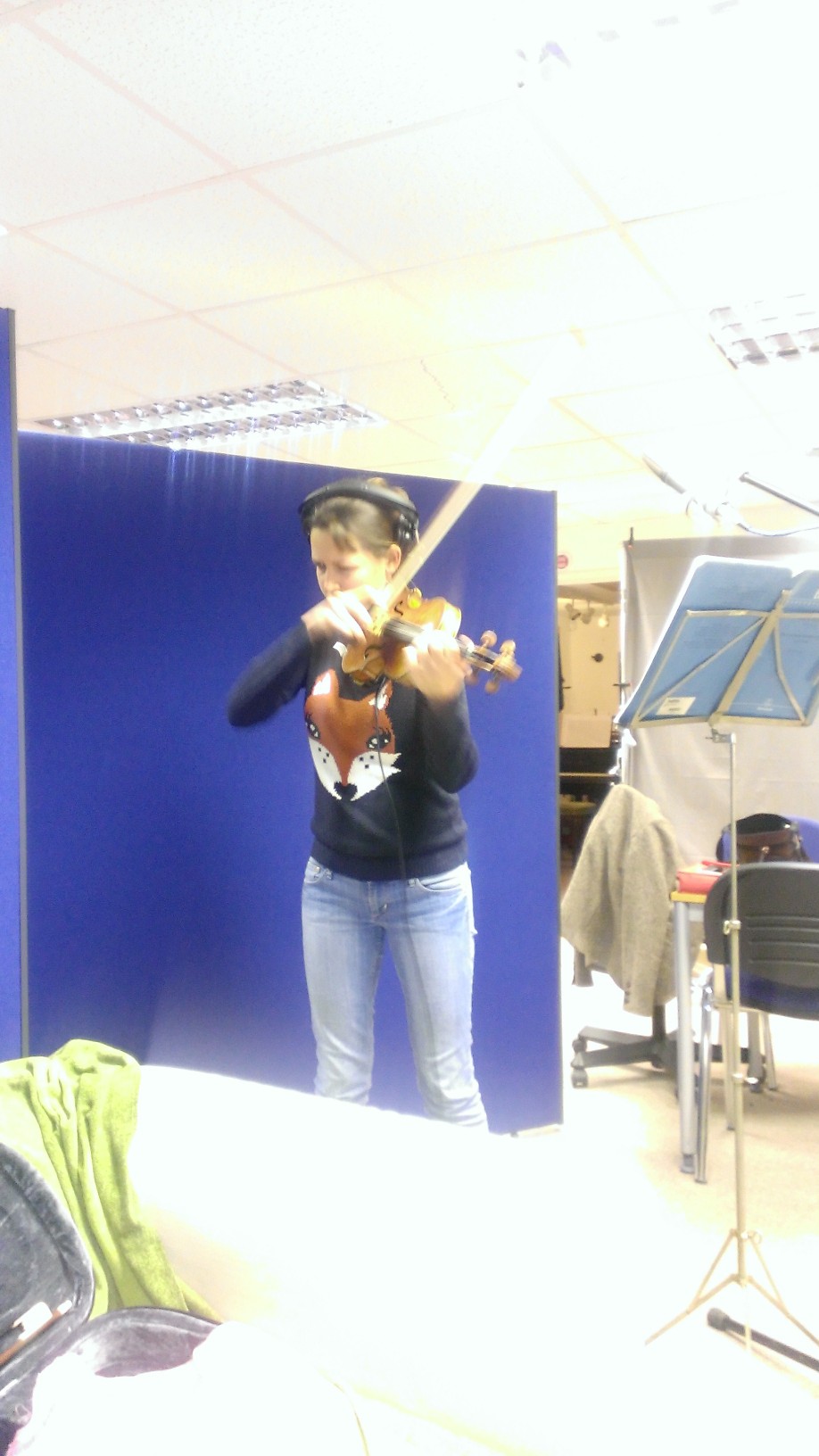
Adelia in action2We got together over the May Bank Holiday to record it. I’m full of admiration for Adelia; both as a person and as a musician. She had the difficult task of playing a demanding piece alongside a backing track with a large microphone in front of her. To play normally is one thing, but to play so beautifully and at a fast tempo wearing chunky headphones is quite another!

Eat your heart out Jascha Heifetz!

As a much in demand concert violinist, her energy and enthusiasm during the recording process – and indeed for the whole project – has been nothing short of miraculous.

“I am grateful to have met Virginia and to have been part of Isabelle’s story through music. Her novel, The Virtuoso is powerful, beautiful, and very human; and sure to touch many hearts like it did mine.” ~ Adelia Myslov

I couldn’t imagine anyone else telling the musical story of The Virtuoso quite like Adelia does.

We were able to take sections of the score and make sure we were happy with the result before moving on to the next phrase. Tim, in his sound wizardry, was able to take all the best bits and put it together in this finished version.

The Official Soundtrack

In a few weeks the official soundtrack to The Virtuoso will be available to purchase on Amazon and iTunes alongside the novel.

I put together a You Tube video to showcase the music, but please do support the artists by purchasing the track if you like it as much as I do!

When I started writing The Virtuoso I could never have imagined that Isabelle’s theme would be so exquisite and encapsulate so perfectly the story I have written. Bravo Tim and Adelia!

I’m so grateful to them for working with me and sharing their immense talents on The Virtuoso.

I’d be delighted to hear your thoughts on the music, please do leave a comment or get in touch. I know it would mean a lot to Tim and Adelia as well.

I now have a book launch to organise! Until the next time folks…

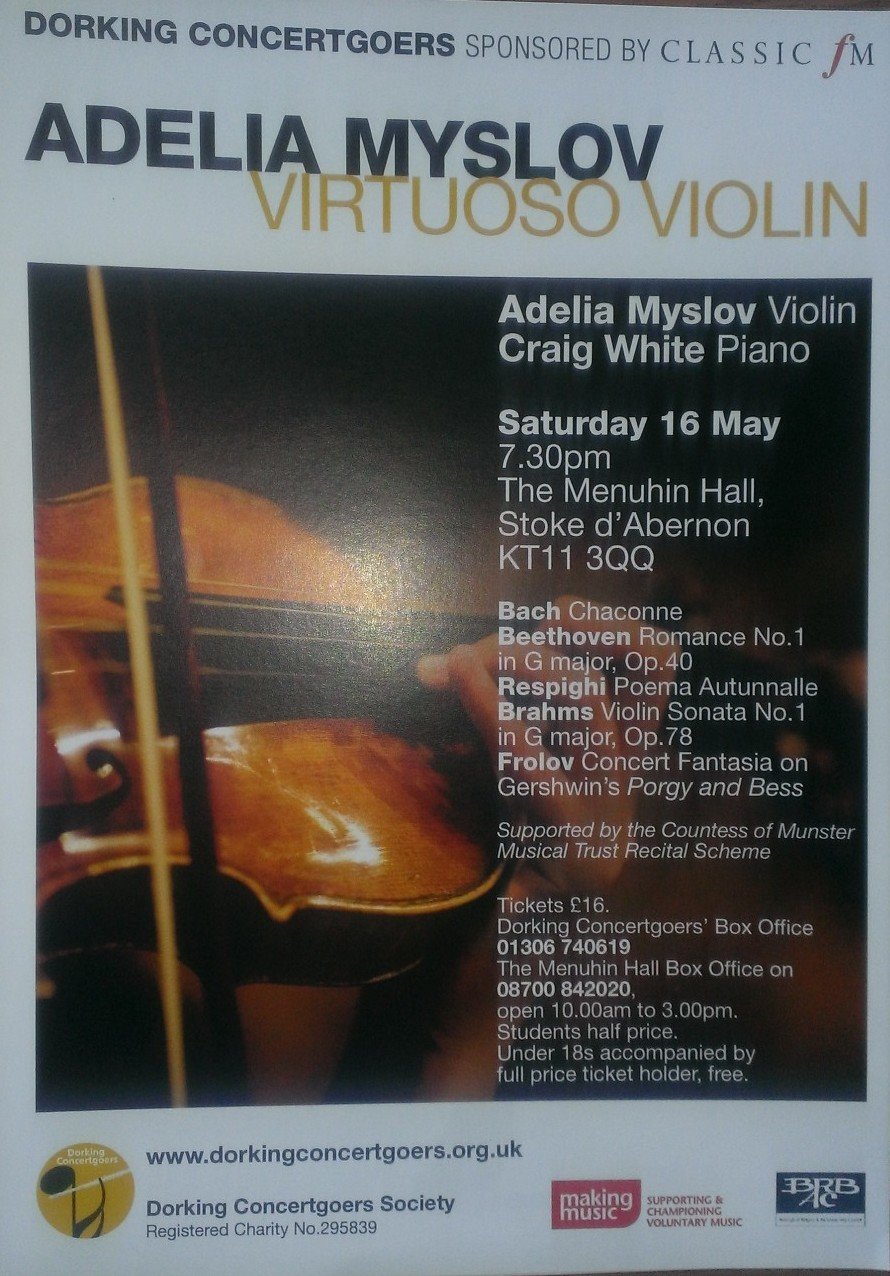
Concert Review: Adelia Myslov Virtuoso Violin – Menuhin Hall 16th May 2015

I just had to tell you all about the concert mum and I went to last night!

Lord Menuhin would have been proud of one of his former students…
Adelia_Menuhin_Hall_concert_poster

In the fabulous setting of the Menuhin Hall we were treated to jaw dropping virtuosity with a mixture of baroque, romantic and jazz favourites for violin and piano.

Adelia opened with Bach’s Chaconne, giving a powerful performance of passion, pathos, precision and pure delight!

Her technique and delivery was flawless: she gave us rich and sustained chords, never missing an incidental note, in a dazzling array of light and shade in tone and tempo. Her vigorous, visceral build-up towards the middle section was infused with tension and restraint, leading to an explosion of emotion made possible by her incredible her bow control. It was a heartfelt and soulful recital of Bach’s spiritual and iconic solo violin masterpiece.

Both Adelia and Craig achieved a perfect balance between the dialogue and interplay of the violin and piano in Beethoven’s Romance No. 1 in G major. Their performance was ablaze with his romantic spirit, not to mention immaculate double stopping and exquisite phrasing.

Respigi’s Poema Autunnale was just divine. I could picture the rustic leaves swirling in the wind as the colours of her performance perfectly matched its seasonal theme.

So you can hear her brilliance for yourself, here is an earlier recording of Adelia & Craig performing the Respigi:

Equally impressive was her uninhibited expression of the Brahms Violin Sonata No.1 in G major.

Their finale was Frolov’s Concert Fantasia on Gershwin’s Porgy & Bess – what thrills and trills!

Their energy and enthusiasm for this rhythmic, jazzy gem shone through.  Adelia was up and down the fingerboard at lightning speed with accuracy, intonation and slides made in heaven. I doubt even Stephane Grappelli could have played it any better.

As of today (19th May), Adelia has been able to upload the recording made by the Menuhin Hall, and so it’s my pleasure to present her stunning live performance:

Adelia’s love and understanding for the music was etched on her face and clearly translated into beautiful sounds from her violin.

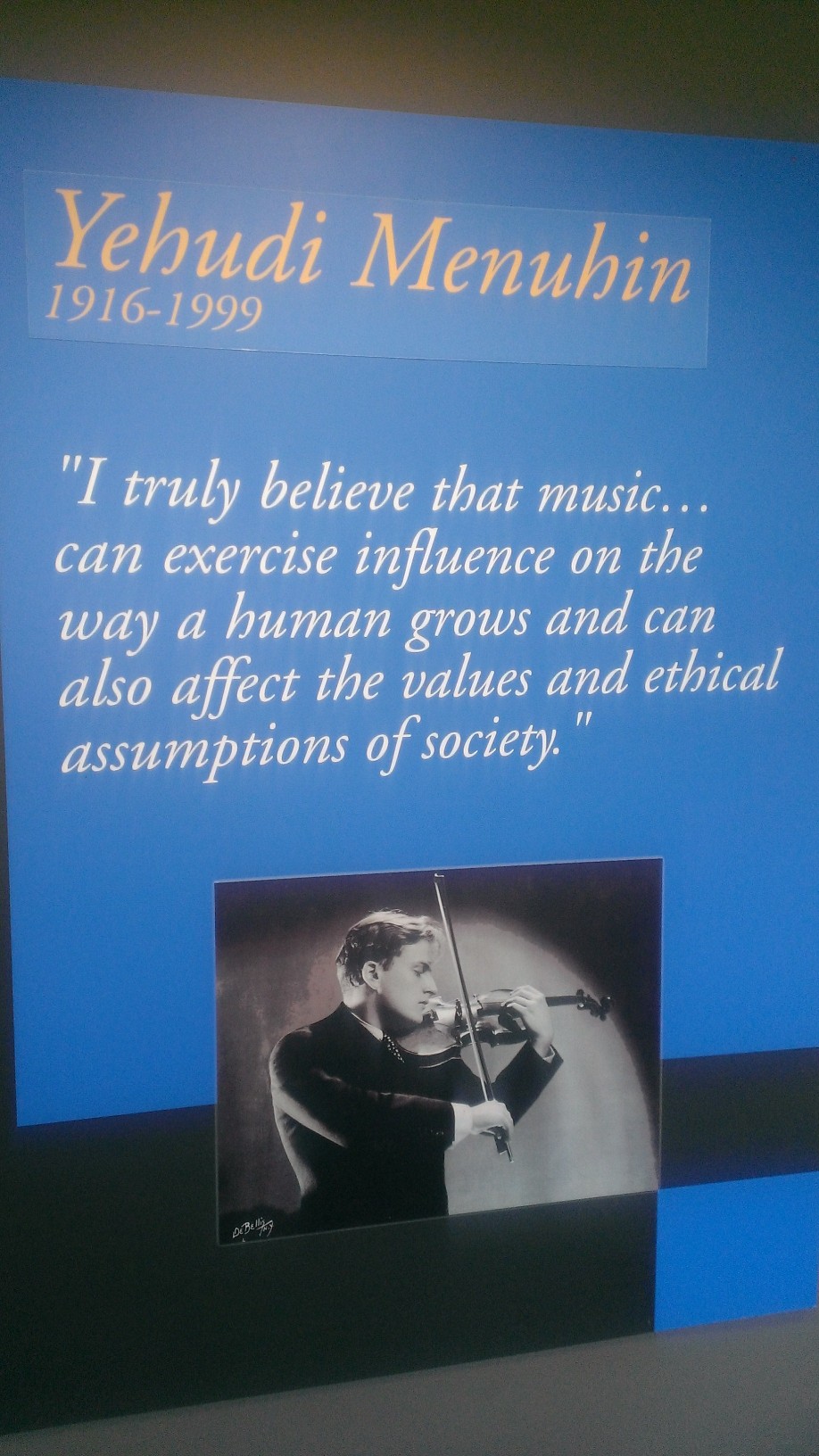
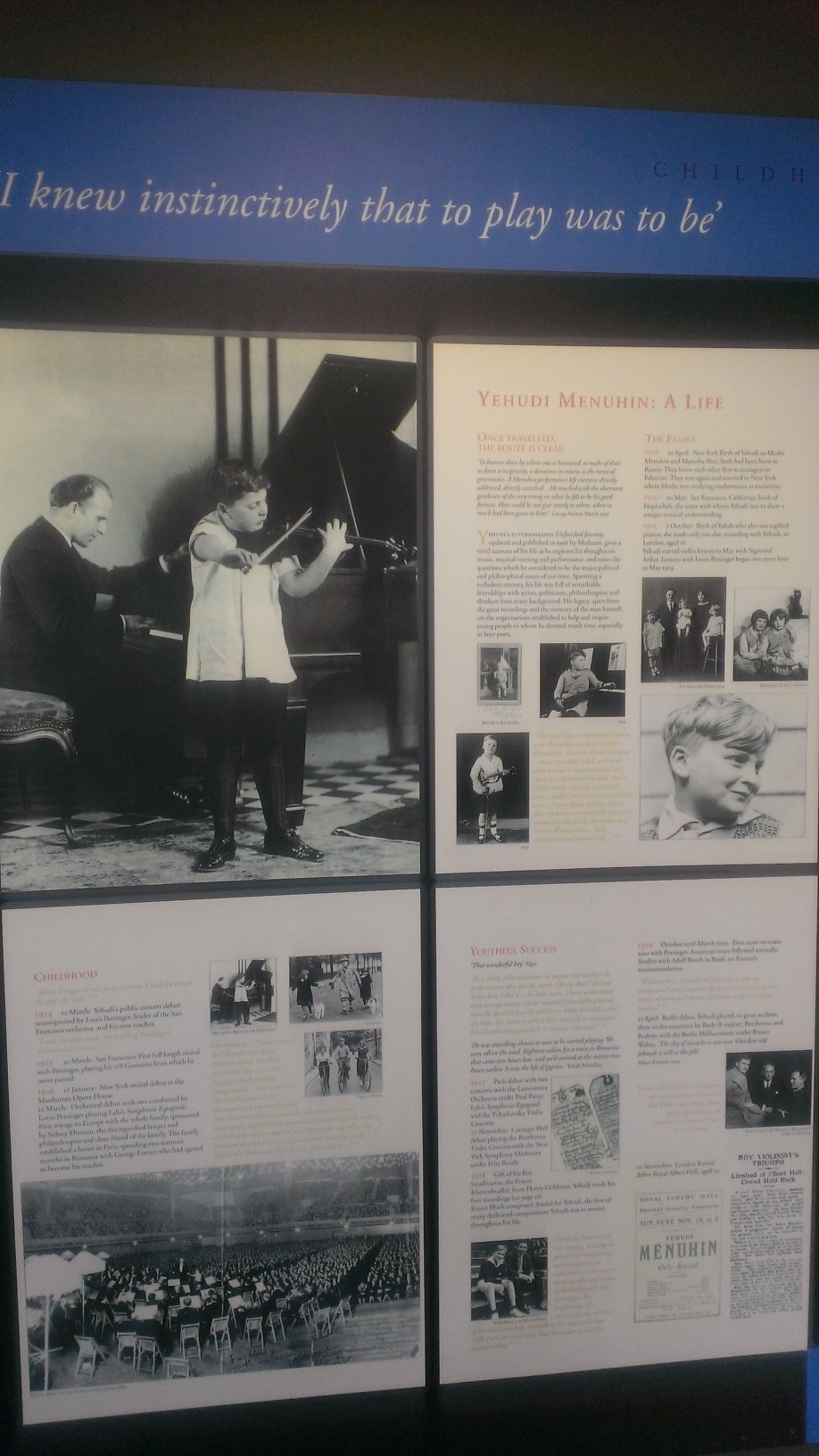
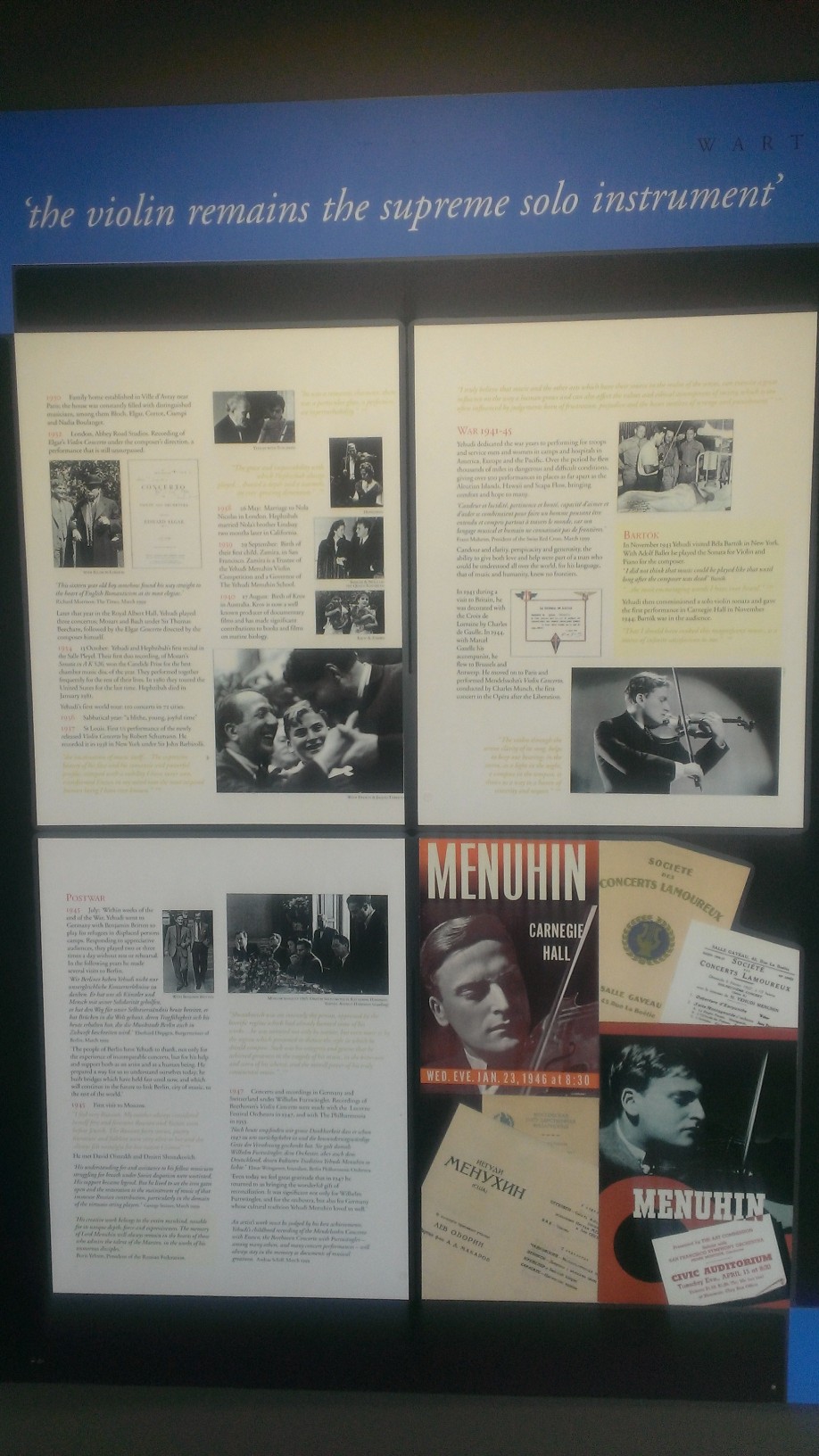
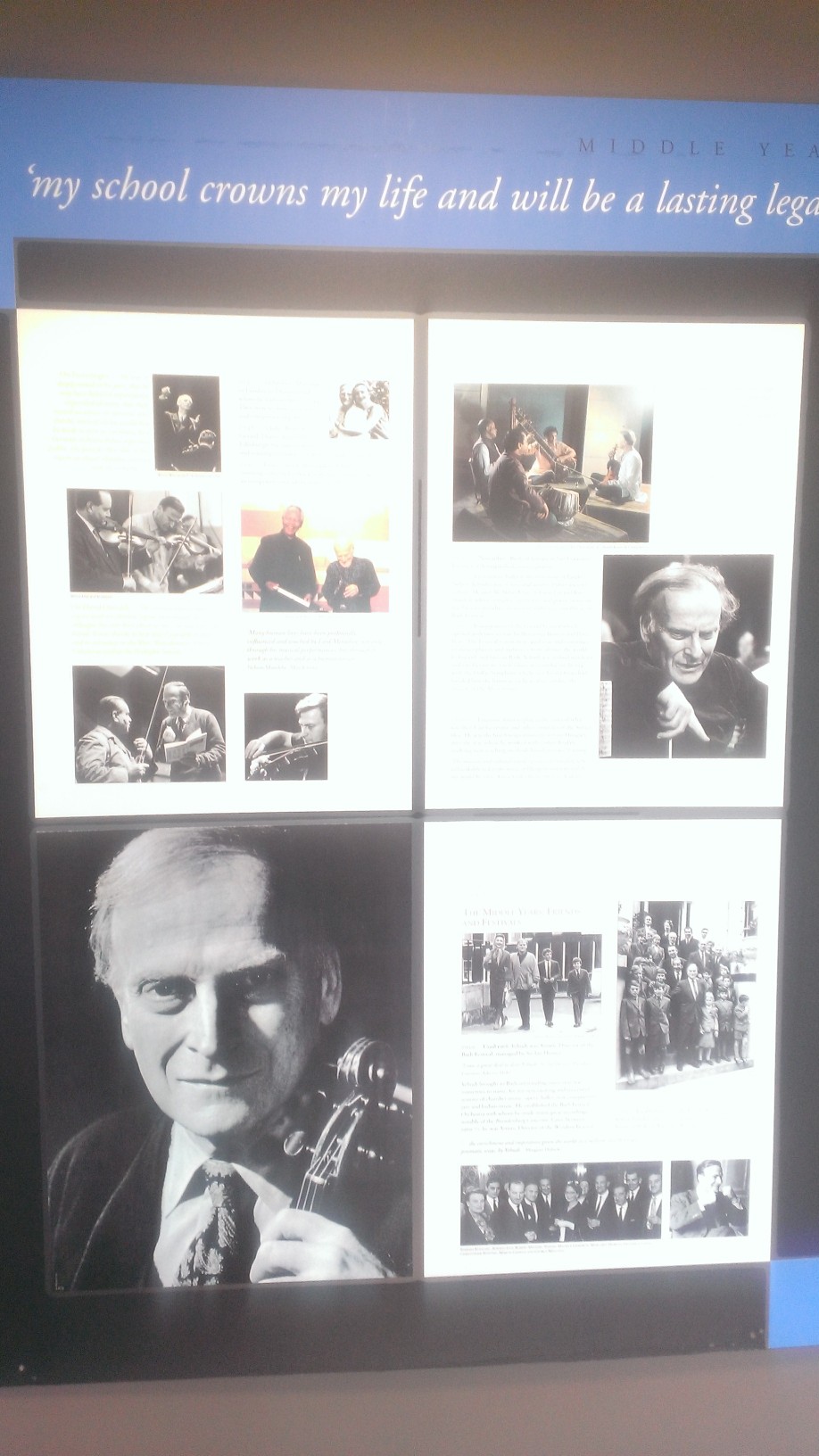
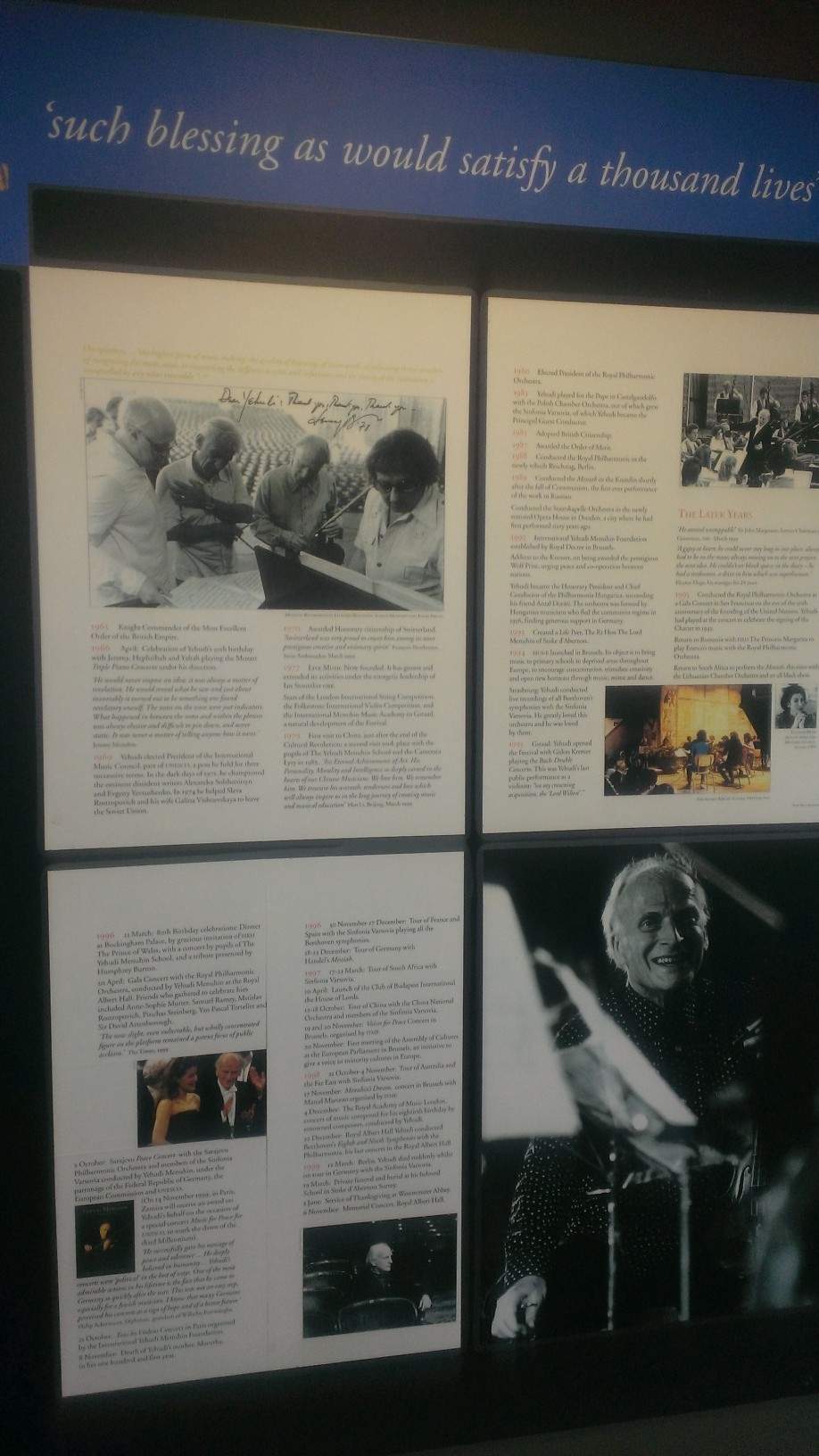
The acoustics in the hall are wonderful; needless to say mum and I enjoyed our evening very much. It was amazing to stroll along the public areas of the hall beforehand and read about the highlights of Lord Menuhin’s life and musical career – truly inspirational.

Located just outside Cobham in substantial rural grounds, the Yehudi Menuhin School continues to grow with the times, with a planned new state-of-the-art music centre and library, which, when built will house multiple studios ideal for music tuition, performance and recording.

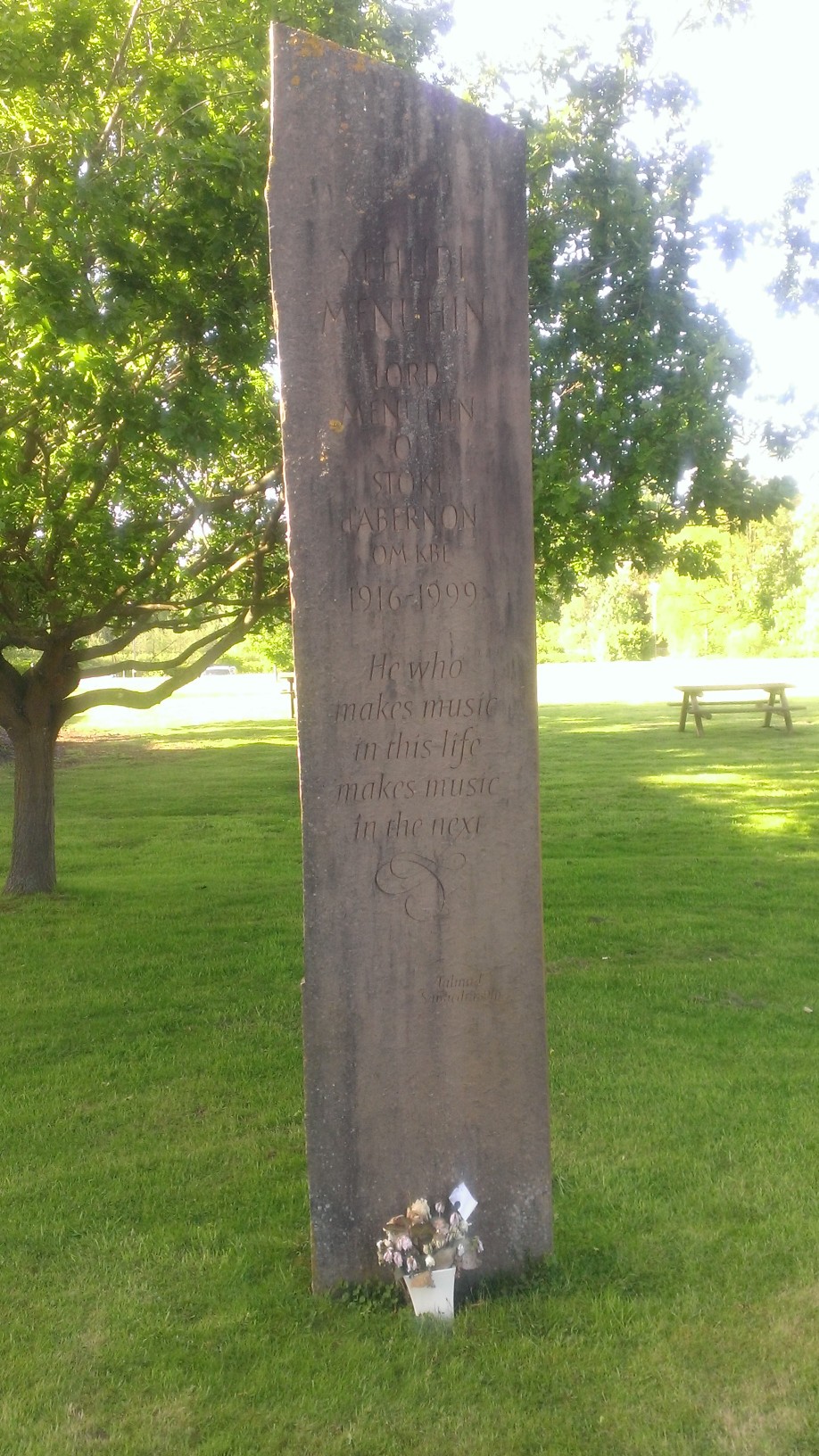
It is, perhaps, the spiritual home of violin performance, with Yehudi Menuhin’s grave situated not far from the entrance to the hall.

The inscription on his tomb stone says it all:

“He who makes music in this life makes music in the next.”

Some more of my photos:

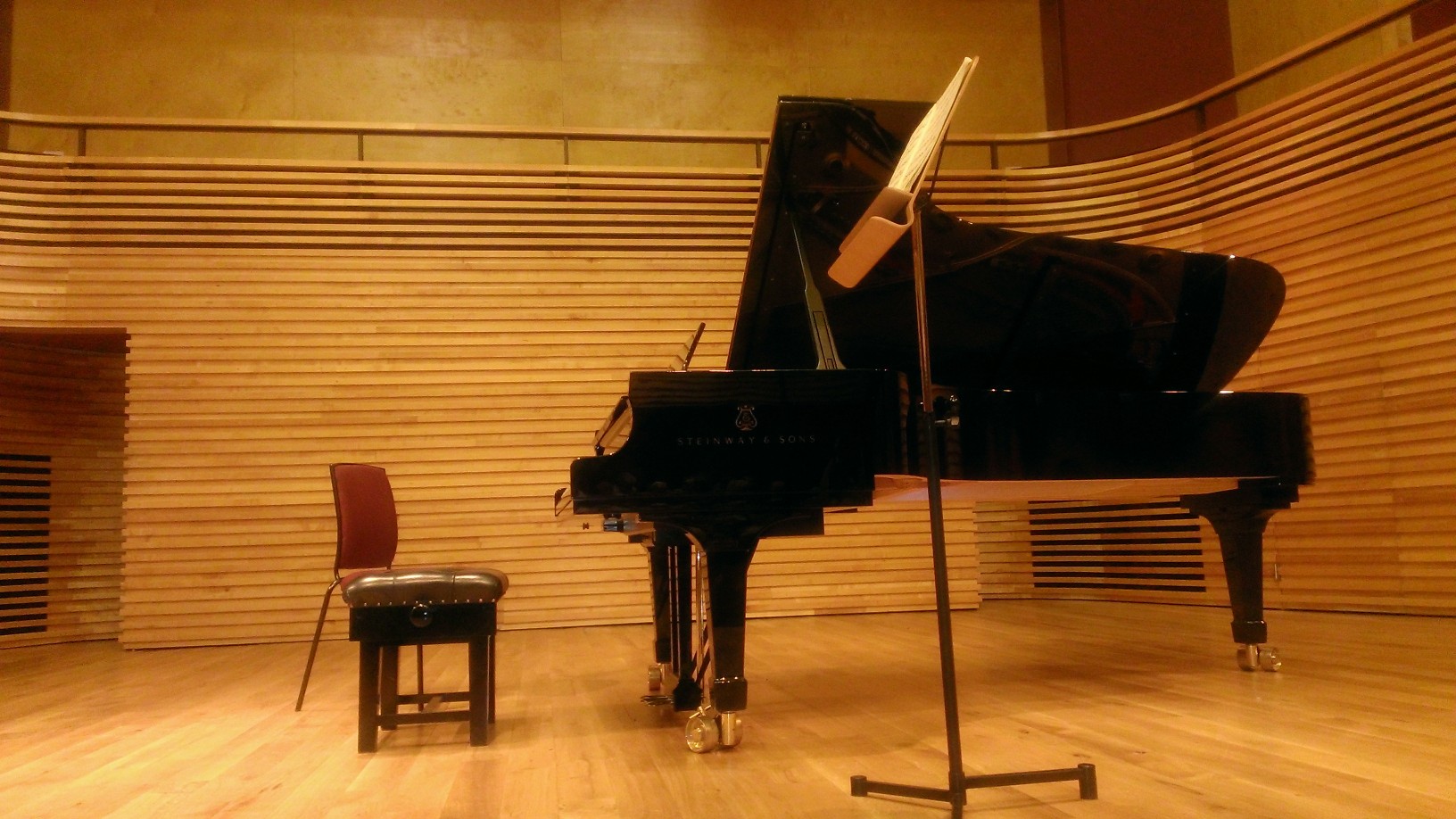
Menuhin Hall

View from the front row of the Menuhin Hall


Menuhin grave

Lord Menuhin’s grave


Menuhin Hall Poster5


Menuhin Hall Poster4


Menuhin Hall Poster3


Menuhin Hall Poster2


Menuhin Hall Poster


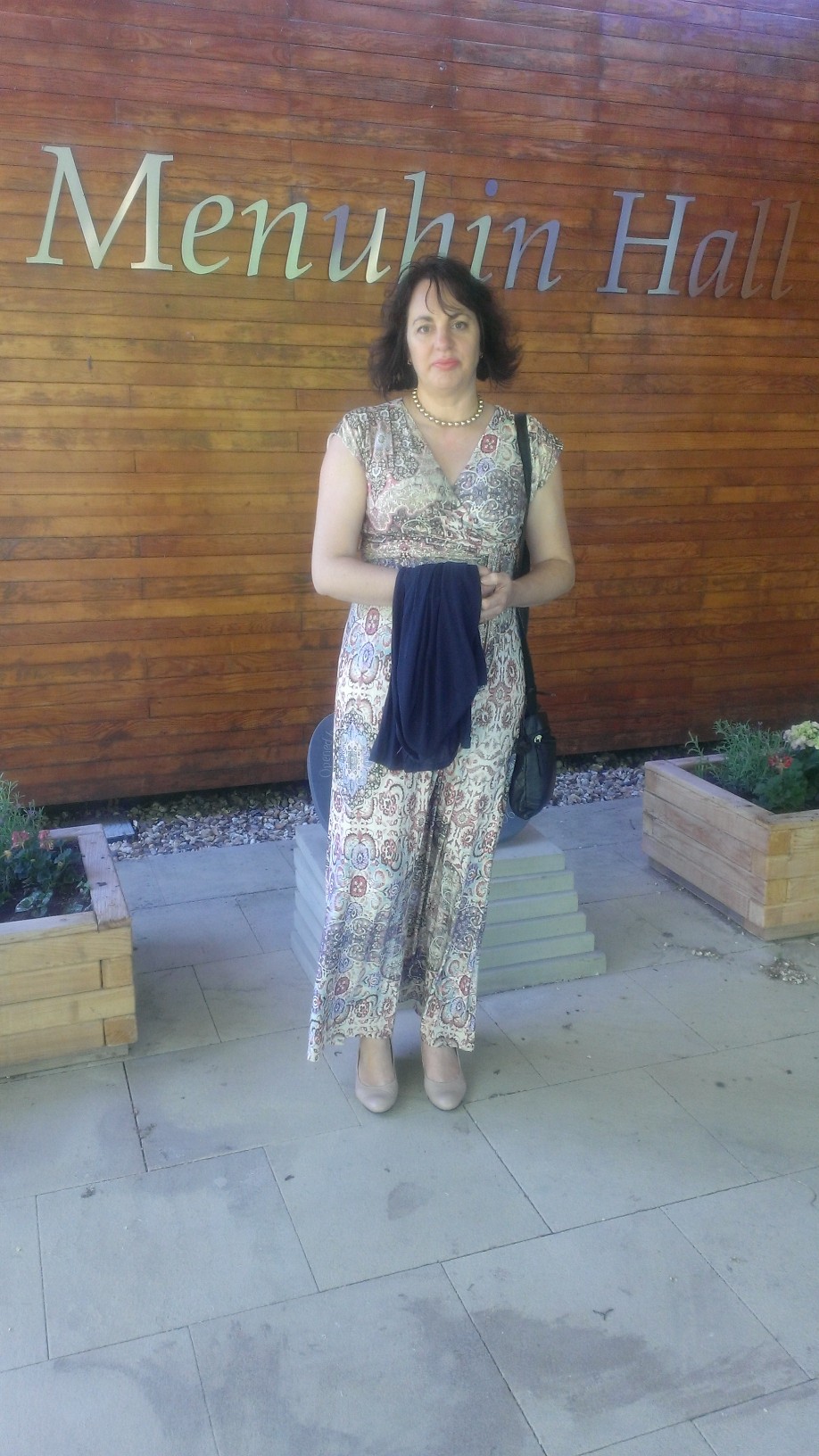
Yours truly outside

Yours truly outside

The Great Virtuoso Violinists/Composers of the 18th Century: Paganini

(c) Royal Academy of Music; Supplied by The Public Catalogue FoundationWhen asked to name a famous violinist, the first person on most people’s lips is Niccolò Paganini. To this day, he is probably regarded as the greatest violinist of all time.

His legendary status, through both performance and composition, has continued to influence composers and violinists 175 years after his death, making him the foremost innovator of technique in violin repertoire.

This will be the first in a series of posts over the next few months, spanning the 18th and 19th centuries, featuring the great violin virtuosi of the classical and romantic eras in music.

Niccolò Paganini (27 October 1782 – 27 May 1840):

Anecdotally, it was the mandolin that little Niccolò learnt first, moving on to the violin when he was aged seven. He was also proficient on the viola and guitar. Born the third of six children in Genoa, he had a rare congenital disorder that meant he had freakishly flexible fingers.

He was so incredibly talented that many thought he had sold his soul to Satan. When you are able to compose and play music that is so fiendishly difficult it’s no wonder his superstitious audiences came to that conclusion! Cue the trailer for the recent film starring German violinist, David Garrett as “The Devil’s Violinist”:

In fact, Paganini was literally ‘born’ to play the violin, as his genetic makeup meant he had long fingers and could stretch his hands abnormally wide, a definite boon for a concert violinist.  Because of his rubbery connective tissues he could apparently move his little finger (fourth finger on the violin), out sideways at right angles to the rest of his hand. However, this rather unfair advantage to his musicianship would come at a price, plaguing him with a plethora of other ailments.

It is now thought that Paganini’s genetic condition was Marfan Syndrome, which would explain his bouts of ill health, especially in his later life. Paganini suffered with joint pain, poor vision, breathlessness, chest pains and fatigue. These less desirable symptoms meant that he frequently had to cancel public performances and he died at the relatively young age of 58.

In addition to his congenital health problems Paganini contracted Syphilis in 1822 and took Mercury and Opium as a remedy, albeit one with serious side-effects.

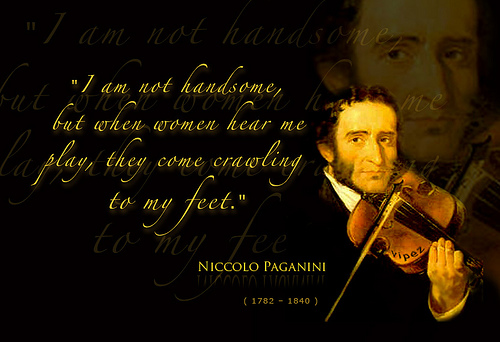
Paganini quote

Despite his physical challenges Paganini liked the high life, with a taste for gambling and womanising. He had a son (Achilles), with singer Antonia Bianchi, but they were never married. After his death, the Catholic Church in his hometown refused to bury him for decades (such was his reputation).

His first concerts were held mainly in Italy, but as his fame spread he travelled across Europe; spellbinding audiences in Vienna, Germany, Poland, Paris, Bohemia and Britain. He was the complete package as violinist. He possessed passion, flexibility, dexterity, technique, flair, imagination and innovation. He was able to write music that specifically showcased his particular style and skills that would be unmatched by any other violinist in his lifetime.

Influences: 

From Wikipedia:

Much of Paganini’s playing (and his violin composition) was influenced by two violinists, Pietro Locatelli (1693–1746) and August Duranowski (1770–1834). During Paganini’s study in Parma, he came across the 24 Caprices of Locatelli (entitled L’arte di nuova modulazione – Capricci enigmatici or The art of the new style – the enigmatic caprices). Published in the 1730s, they were shunned by the musical authorities for their technical innovations, and were forgotten by the musical community at large. Around the same time, Durand, a former student of Giovanni Battista Viotti (1755–1824), became a celebrated violinist. He was renowned for his use of harmonics and the left hand pizzicato in his performance. Paganini was impressed by Durand’s innovations and showmanship, which later also became the hallmarks of the young violin virtuoso. Paganini was instrumental in the revival and popularization of these violinistic techniques, which are now incorporated into regular compositions.

His celebrated Violin Caprice No. 24 in A minor has provided inspiration for transcriptions and variations and themes on other instruments such as the cello, piano, flute, oboe, trumpet, saxophone and guitar.

Some of my favourite Paganini performances:

Caprice No. 24 in a vintage, virtuosic recording by Jascha Heifetz:

‘La Campanella’ for Violin and Orchestra by Ivry Gitlis:

https://www.youtube.com/watch?v=V97yWbApDlw

Sonata in E minor, Opus 36 for violin & guitar, performed by Ruggiero Ricci and pianist Louis Persinger:

The heavenly tones of Leonid Kogan – Sonatine for Violin & Guitar in A Major:

Whilst his Moto Perpetuo isn’t melodic, it’s quite a feat to play accurately, and even more so on the cello. Top marks to Miklós Perényi:

Duet for one violin, performed by both Salvatore Accardo and, yes, you guessed it, Senor Accardo!

I Palpiti beautifully executed by Maxim Vengerov:

And finally…Yehudi Menhuin is wonderful in this vintage performance of the Violin Concerto No. 1  2nd & 3rd movements:

https://www.youtube.com/watch?v=lqGTkkS-YnA&feature=related

Paganini works that inspired other composers:

Paganini’s virtuosity and music was much admired by the likes of Franz Liszt, Frédéric Chopin, Sergei Rachmaninoff, Robert Schumann, Johannes Brahms, Johann Nepomuk Hummel, Johann Sedlatzek and Eugène Ysaÿe to name but a few.

Here is a small selection of classical pieces written in homage to Paganini.

Recollections of Paganini, a Fantasia for the pianoforte, by Hummel performed by Marco Pasini:

Liszt’s inimitable Paganini Etude No. 6 played with passion by Marc-Andre Hamelin:

I adore Rachmaninoff’s Rhapsody on a Theme of Paganini, played to perfection by Arthur Rubinstein:

Tárrega’s Variations ‘Carnaval de Venecia de Paganini’ sound wonderful on the classical guitar with David Russell at the helm:

https://www.youtube.com/watch?v=ov1yBmsAZtE

I’d like to finish my finale with this quote from violinist.com:

 “When it comes to violinists, virtuosity is not entirely the result of mechanical finger velocity and sheer technique, as it is with pianists. The violin is an instrument which has almost human whims—it is attuned to the mood of the player in a sympathetic rapport: a minute discomfort, the tiniest inner imbalance, a whiff of sentiment elicits an immediate resonance . . . probably because the violin, pressed against the chest, can perceive our heart’s beat. But this happens only with artists who truly have a heart that beats, who have a soul. The more sober, the more heartless a violinist is, the more uniform will be his performance, and he can count on the obedience of his fiddle, any time, any place. But this much-vaunted assurance is only the result of a spiritual limitation, and some of the greatest masters were often dependent on influences from within and without. I have never heard anyone play better—or, for that matter, play worse than Paganini . . .”

~ Heinrich Heine (1843) Thoughts on the Violin and on Violinists

A Musical Surprise from Johann Sebastian Bach

“Joy, sorrow, tears, lamentation, laughter – to all these music gives voice, but in such a way that we are transported from the world of unrest to a world of peace, and see reality in a new way, as if we were sitting by a mountain lake and contemplating hills and woods and clouds in the tranquil and fathomless water.” ~ Albert Schweitzer

With my children and their friends running me around in circles this half-term I almost gave up on the idea of publishing a new blog post. But then I made a discovery, and I wanted to share it. By the way, if all you guys and gals out there already know about this gem do feel free to tell me…

I thought I knew all Bach’s violin concertos. I often play them when I practice. His Double Violin Concerto in D minor BWV 1043 is so well known, it seemed odd that he would have written a Triple Violin Concerto that is virtually unheard of.

However, the other day as I was browsing through YouTube that is exactly what I came across!

It was the 2nd movement being performed by Sir Yehudi Menuhin and David Oistrakh’s musical dynasty, (his son, Igor and grandson Valery), in Moscow. I was intrigued. It’s not in mainstream repertoire, or surely I would have heard of this piece before?

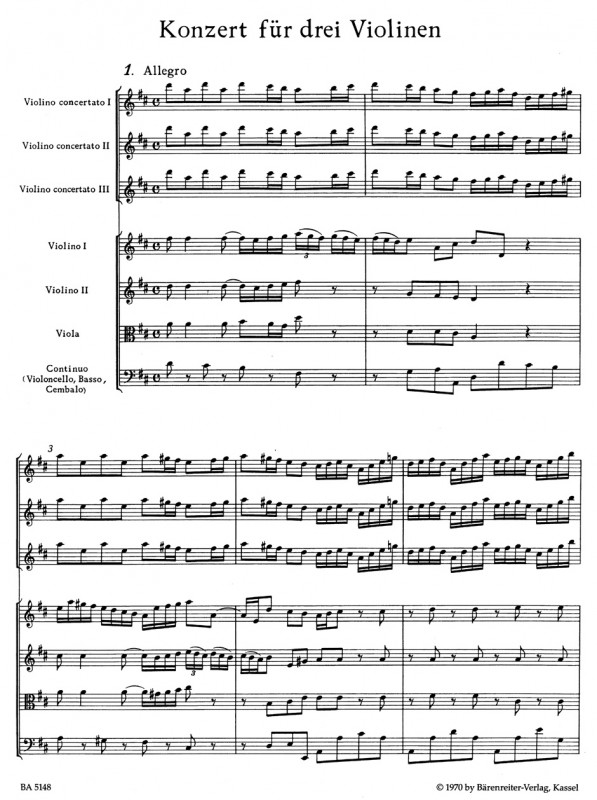
So I did a little digging, and unearthed the reconstructed Concerto for 3 Violins in D Major BWV 1064R.  This wasn’t published as an original Bach violin concerto; it’s a reconstruction of the Concerto for 3 Harpsichords, strings and Continuo in C Major, BWV 1064.

Bach - Triple Violin Concerto BWV 1064R

Here’s where the uncertainty creeps in. Whether Bach used one of his own earlier (now lost) violin concertos or one composed by Vivaldi is unclear. But the point is, there actually was a violin concerto used as the basis for BWV1064, and the piece has been transcribed back to the violin in the key of D Major to give us that wonderful original sound.

Whilst it may not be as melodic and lyrical as Bach’s Double Violin Concerto, the Triple Concerto has a certain charm, and so as far as I’m concerned it’s a case of ‘better late than never’.

All of Bach’s harpsichord concertos (with the exception of the Brandenburg concerto) are thought to be arrangements made from earlier concertos for melodic instruments probably written in Köthen. In many cases, only the harpsichord version has survived.

Here is the Freiburger Barockorchester, on period instruments, performing the entire concerto:

https://www.youtube.com/watch?v=tKog41NwNxo

Christopher Hogwood Transcription for chamber ensemble musicians.

The original published version for harpsichord with Hogwood, Moroney and Rousset:

I also really like it arranged for 3 pianos:

https://www.youtube.com/watch?v=q8h-4GlrG8M

Again, it just goes to show how versatile and universal Bach’s music is that it suits so many different instruments.  See my earlier post about the Chaconne for solo violin.

With a plethora of top violinists recording Bach, it’s hard to imagine that the early recordings of Bach’s violin music were made back in 1904, when Fritz Kreisler first performed the Prelude in E and ‘Air on the G String’ in Berlin. The Double Violin Concerto was recorded by Kreisler and Efram Zimbalist in January 1915, the first time a complete recording of a major work by Bach was made, and also the first time that two leading violinists played together in a recorded performance.

With such a large body of work it’s hardly surprising that Bach’s music continues to offer surprises, and I’d like to toast to many more to come.

I must scoot Bach to doing the housework now, humming as I go…

“No one can give a definition of the soul. But we know what it feels like. The soul is the sense of something higher than ourselves, something that stirs in us thoughts, hopes, and aspirations which go out to the world of goodness, truth and beauty. The soul is a burning desire to breathe in this world of light and never to lose it – to remain children of light.” ~ Albert Schweitzer

The Path to Publication

“Every secret of a writer’s soul, every experience of his life, every quality of his mind is written large in his works.” ~ Virginia Woolf

When I was eleven I had a nasty accident at school. It was positively gruesome. I remember the day vividly; my class had just come back from a P.E. lesson and we were making our way into the changing rooms. I wanted to tell my best friend something (I can’t even remember what it was), and in my haste to talk to her I placed my right hand next to the hinge of the door as she was closing it. Only I didn’t quite have my finger out of the way…

PhotoFunia-The Virtuoso2The ensuing carnage must have been quite a shock for my head teacher, who was greeted by a very pale screaming girl, with the end of her finger missing and copious amounts of blood flowing everywhere.  The trail of blood running from the girls changing room to the classroom must have been redolent of a murder scene. The whole of Bledlow Ridge Primary School knew that something quite grisly had just happened.  He duly picked up the top of my finger and wrapped it up (I never asked what in), and I was driven straight to hospital. The car journey was awful, I was clutching my tawdry severed finger, and as the initial shock wore off the pain grew in intensity.

It wasn’t a clean separation, and I was told that they would try and sew it back on. My mum and my family came to see me before the anaesthetic to reassure me. I had never been under before, and I was terrified I would never wake up again, as the anaesthetist counted down from ten. By the time he reached five I was out cold.

When I regained consciousness my finger was throbbing in agony and I felt groggy. The wonderful get well cards made by my classmates helped to cheer me up in the aftermath of my surgery. The only consolation was that I’m left handed, so it could have been worse, and I got to have quite a bit of time off school.

My mum dug those handmade cards out of her loft recently. They still bring a smile to my face. I remember I couldn’t play netball for months, (which I was absolutely gutted about) and when the bandages eventually came off I was shocked to see that the top of my right index finger wasn’t actually recognisable as a finger. The nerve endings gave me hell in the cold. It was like needle points stabbing my flesh until it went numb.

Needless to say, I have a thing about fingers and doors, and my kids have received several lectures about the dangers of getting a digit caught!

In the midst of my trauma little was I to know that the experience would surface many years later from the depth of my psyche, to provide my muse with inspiration for the misfortune of my first heroine and protagonist of my novel, The Virtuoso.

So you could say the idea has been brewing for a good many years!  Eleven was also the age when I started learning to play the violin. I can’t help thinking that the foundations of the path to publication were laid in 1981…

Stepping Out Onto the Worldwide Amazon Stage

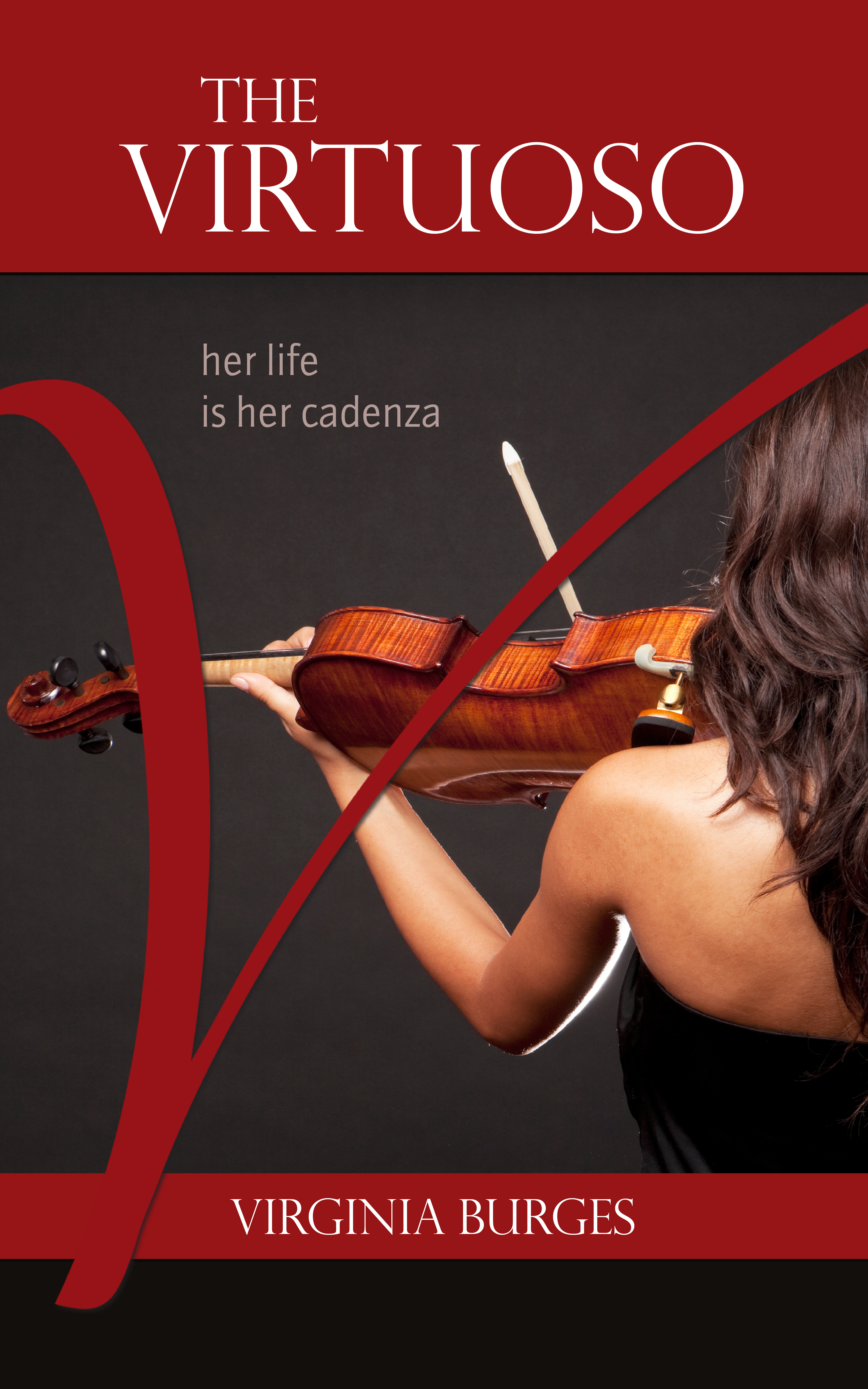
New Kindle Cover

New Kindle Cover

I’m happy to announce that The Virtuoso has now been published on Amazon Kindle today, Monday 15th December 2014 at a launch price of £3.59. There will also be a paperback version available on Amazon next year. (US Link)

I’m sure I’ll feel a certain amount of satisfaction that I made it this far, for persevering over the seven years it’s taken me (on and off) to complete The Virtuoso, so that I can finally say my work in progress is now a work in print!

I’m now at the stage where I’m excited that my work can open the door to other related creative pursuits. I was fortunate to meet and hear the violin virtuoso, Adelia Myslov in the summer. She played a stunning performance of the Mendelssohn Violin Concerto. I asked her if she would be interested in playing a specially composed unique ‘theme’ for The Virtuoso, and to my delight she said yes! The music project is still ongoing and I hope it will be composed and recorded in the not too distant future. Eventually it will be available on iTunes and Amazon.

There is also a book trailer that has been produced for The Virtuoso by 13Media Arts in Daventry. Along with my voice, words and pictures, and Kevin and Darren’s digital jiggery pokery (I mean expertise), I am hoping it will prove to be a successful team effort!

During these years I’ve battled my demons of self-doubt that I could actually be a writer, and a half decent one at that. Well, I’ll leave the judging to my readers (I do hope I have some soon), after all, my daughter Emily is telling everyone she knows: ‘my mum is an author.’

The path to publication hasn’t always been like the yellow brick road! At times I had so many other ‘distractions’ beckoning for my attention; mainly life happening around me. But I found that the more time and effort I put into it,  the more I got sucked into my characters’ world of make-believe, and the more I felt as if I was becoming a proper writer.

“Fiction is the truth inside the lie.” ~ Stephen King

The Art of Violin

“When you play a violin piece, you are a storyteller, and you’re telling a story.” ~ Joshua Bell

To me, the beauty, mystique and resonance of the violin is both beguiling and irrefutable. The instrument’s tone, agility and versatility is unsurpassed in classical music repertoire. Of course, I adore all stringed instruments, with the cello coming a close second.

gottlieb-painting-violin_bigLooking at the design of the violin I love the way the wide curves of the upper and lower bouts contrast with the inverted C-bouts (the waist), to give it that sensual shape, and the elegant f-holes, along with the combination of the long and graceful fingerboard leading to the peg box and the scroll, which can be quite elaborate on older violins. Then you have the sheen and shine of their wood exteriors, usually spruce and maple. It is a thing of beauty!

Ancient liras, violettas and violas were created by the school of Brescia in the late 14th century, and in 1574 the Bertolotti Gasparo da Salò family made what is considered the finest carved and decorated Renaissance violin in the world, which was once owned by Ferdinand II, Archduke of Austria. Its current home is the Vestlandske Kustindustrimuseum in Bergen, Norway.

From Wikipedia:

Early History:

The Persian geographer Ibn Khurradadhbih (d. 911) of the 9th century, was the first to cite the bowed Byzantine lira as a typical instrument of the Byzantines and equivalent to the rabāb used in the Islamic Empires of that time. The Byzantine lira spread through Europe westward and in the 11th and 12th centuries European writers use the terms fiddle and lira interchangeably when referring to bowed instruments (Encyclopædia Britannica. 2009). In the meantime rabāb was introduced to the Western Europe possibly through the Iberian Peninsula and both bowed instruments spread widely throughout Europe giving birth to various European bowed instruments.

Over the centuries that followed, Europe continued to have two distinct types of bowed instruments: one, relatively square-shaped, held in the arms, known with the Italian term lira da braccio (meaning viol for the arm) family; the other, with sloping shoulders and held between the knees, known with the Italian term lira da gamba (or viola da gamba, meaning viol for the leg) group. During the Renaissance the gambas were important and elegant instruments; they eventually lost ground to the louder (and originally viewed as less aristocratic) lira da braccio family of the modern violin.

Between the 16th and 19th centuries, several changes occurred, including:

  • the fingerboard was made a little longer to be able to play even the highest notes, in the 19th century.
  • the fingerboard was tilted a little more, to produce even more volume as larger and larger orchestras became popular.
  • nearly all old instruments were modified, including lengthening of the neck by one centimeter, in response to the raising of pitch that occurred in the 19th century.
  • the bass bar of nearly all old instruments was made heavier to allow a greater string tension.
  • the classical luthiers nailed and glued the instrument necks to the upper block of the body before gluing on the soundboard, while later luthiers mortise the neck to the body after completely assembling the body.
  • the chinrest was invented in the early 19th century by Louis Spohr.

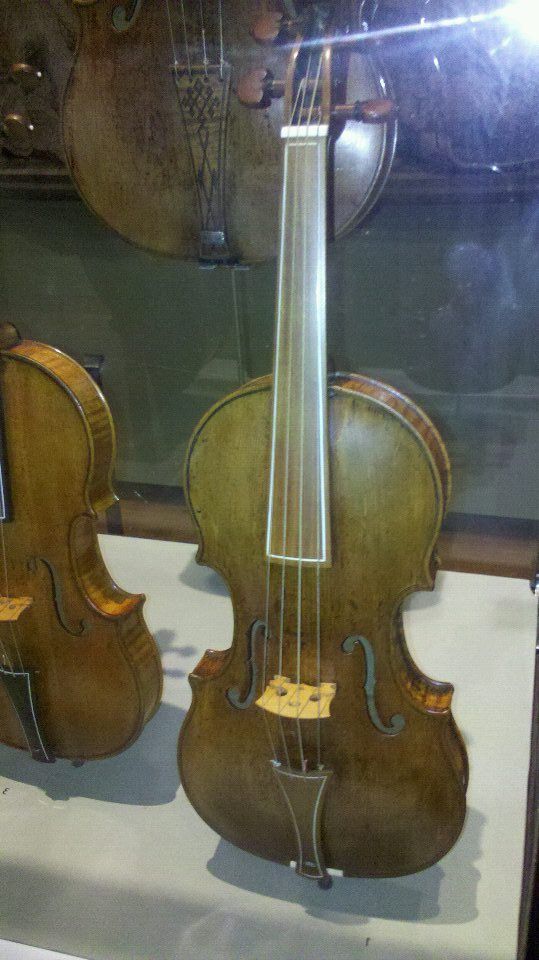
Amati eldest dated violinWe can thank the French Renaissance for what we know today as the ‘modern’ violin. In Cremona, Andrea Amati created the first batch of violins in 1564 at the behest of King Charles IX, who wanted to create a new musical sound for the kingdom of France.  Amati was credited with adding the fourth string to the existing three-stringed ancient violin type instrument. His instruments were beautifully adorned with art work. There is a wonderful display of Amati instruments at the Ashmolean Museum in Oxford.

Andrea passed his violin making skills down to his two sons, Antonio and Girolamo, who in turn inspired the latter’s fourth son, (Andrea’s grandson), Nicolo Amati. Among Nicolo’s aspiring students were Andrea Guarnerius and Antonio Stadivari.  Alongside the slightly newer violins of Jacob Stainer of Austria, these instruments are the most sought after and valuable in the world.

Zsolt-Tihamér Visontay (the Leader of the London based Philharmonia orchestra), does a great job of explaining the basics about the violin and his role in the orchestra:

One of my heroes on the violin, Itzhak Perlman, has made some very helpful short videos to assist us amateur violinists with our technique!

For violin lovers here is a fabulous documentary titled: The Art of Violin:

Part 1:

https://www.youtube.com/watch?v=3_kS_UPylmg

Part 2:

https://www.youtube.com/watch?v=BLPIoh5C92A

After discussing the ‘ordinary’ Strad (if there is such a thing), played by the late David Oistrakh, and the amazing sound that he achieved with it; Itzhak Perlman concludes that, ‘the sound comes from the individual, not the instrument.’

Renaissance artist and sculptor Gaudenzino Ferrari painted the earliest known depiction of the violin. And now to the visual art of violin! I have included a small gallery of some of my favourite paintings and images of the violin in still life and in a living setting:

“You are the music while the music lasts.” ~ T.S. Eliot

A Study of J.S. Bach’s Baroque Violin Masterpiece: The ‘Chaconne’ in D Minor

“I was raised on Bach.” ~ Daniel Barenboim

Johann Sebastian Bach was one of the most dedicated, gifted and prolific composers that ever lived. Born in Thuringia in 1685, just a few days after fellow composer Handel; he was an accomplished organist, and his faith in the divine inspired him to write a substantial oeuvre of immortal music.

“Bach” is the German word for “brook”, hence Beethoven’s famous quote, ‘Not Brook but Ocean should be his name.’ Beethoven also referred to him as, ‘the immortal God of harmony.’

He wasn’t universally recognised as a great composer until the beginning of the 19th Century when Felix Mendelssohn championed his works, and later, by Pablo Casals, who was the first cellist to record his cello suites. What great artist is truly appreciated during their lifetime?

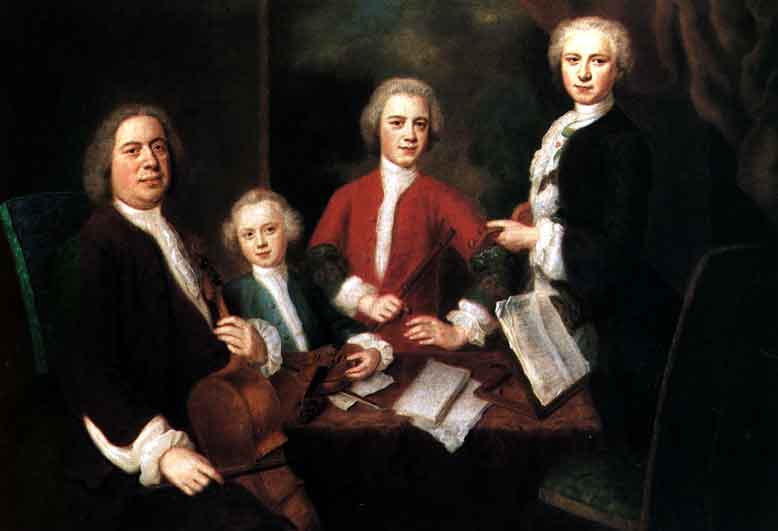
He hailed from a musical family, and is the patriarch of Europe’s largest musical dynasty. He fathered twenty children, seven with first wife and second cousin, Maria Barbara Bach, (only four survived into adulthood) and a further thirteen with his second wife, Anna Magdalena Wilcke, of which six made it past infancy and childhood.

All of his offspring were musicians, and two of his sons became notable composers in their own right: Carl Philipp Emanuel and Johann Christian Bach. J.S. Bach left the world an artistically and spiritually enriched place. No ordinary life…

His music spans time and space; three of his compositions were on NASA’s Voyager record, Music From Earth. Bach’s devotion to God shines through in his music, which speak to the soul on a primal level, regardless of one’s religious orientation. He was a rare genius indeed.

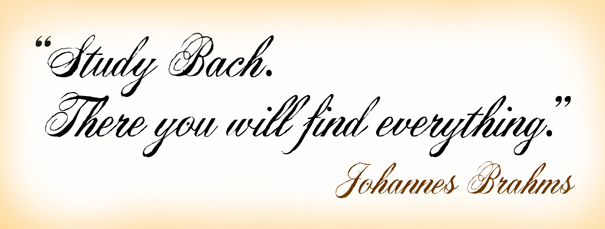
Brahms-Quote1

“I think that if I were required to spend the rest of my life on a desert island, and to listen to or play the music of any one composer during all that time, that composer would almost certainly be Bach. I really can’t think of any other music which is so all-encompassing, which moves me so deeply and so consistently, and which, to use a rather imprecise word, is valuable beyond all of its skill and brilliance for something more meaningful than that — its humanity.” ~ Glenn Gould

As a violinist, (other than Beethoven), he is my favourite composer to play and listen to, and I always play Bach at every practice session. He gives me a workout for my spirit, as well as my fingers and my brain. His sonatas and partitas for solo violin are essential repertoire for any violinist, not to mention his violin concertos.

But the ‘Chaconne’ in particular, (along with the adagio of the double violin concerto) touches me very deeply. It is a dance, and the minor key gives it a slightly melancholy feel; which is understandable, as it was written after his wife had died. If you are not already familiar with the work you are in for a treat. Immerse yourself in the music…

From Wikipedia:

The ciaccona (commonly called by the French form of the word, chaconne), the concluding movement of Partita No. 2 in D minor, BWV 1004, surpasses the duration of the previous four movements combined. Along with its disproportional relationship to the rest of the suite, it merits the emphasis given it by musicians and composers alike. The theme, presented in the first four measures in typical chaconne rhythm with a chord progression based on the repeated bass note pattern D D C♯ D B♭ G A D, begets the rest of the movement in a series of variations. The overall form is tripartite, the middle section of which is in major mode. It represents the pinnacle of the solo violin repertoire in that it covers every aspect of violin playing known during Bach’s time. It is still one of the most technically and musically demanding pieces for the instrument.

Yehudi Menuhin called the Chaconne “the greatest structure for solo violin that exists”.

Violinist Joshua Bell has said the Chaconne is “not just one of the greatest pieces of music ever written, but one of the greatest achievements of any man in history. It’s a spiritually powerful piece, emotionally powerful, structurally perfect.” He played the piece busking in L’Enfant Plaza for the Washington Post.

Piano transcriptions:

Since Bach’s time, several different transcriptions of the piece have been made for other instruments, particularly for the piano (by Ferruccio Busoni and Joachim Raff), and for the piano left-hand (by Brahms).

Johannes Brahms, in a letter to Clara Schumann, said about the Ciaccona:

On one stave, for a small instrument, the man writes a whole world of the deepest thoughts and most powerful feelings. If I imagined that I could have created, even conceived the piece, I am quite certain that the excess of excitement and earth-shattering experience would have driven me out of my mind.

Felix Mendelssohn and Robert Schumann each wrote piano accompaniments for the work.

I hope one day to be able to fully play the Chaconne. Maybe there is a teacher out there who can help me! The multi-stopping and chords are challenging to say the least. I must study Heifetz’s masterclass, but even that goes right over my head.

Reinvention:

His works lend themselves to transcriptions for other instruments more than any other composer I can think of. The composer and conductor Leopold Stokowski did many orchestral transcriptions of Bach’s works, as did Franz Liszt for the piano.

For me, there are three definitive solo violin recordings, (the original form of composition), which are by Menuhin, Stern and Heifetz. These clips perfectly illustrate the impact that personal interpretation and tempo have on the music:

I have listed below ten varied transcriptions I have enjoyed of this fabulous piece. Each conjures up a different mood. I’ll let the musicians do the talking…

Transcription for violin and piano by Schumann:

Piano version by Brahms for the left hand:

The Busoni piano transcription in a live performance by Marc-André  Hamelin:

It has to be John Williams on the classical guitar:

Orchestrated version by Leopold Stokowski:

Nicanor Zabaleta on the Harp:

Marimba:

ESP Saxophone group:

Viola:

This heartfelt Cello performance by Rustam Komachkov has oodles of rich, warm colours and soul:

Jean Rondeau on the Harpsichord:

“Bach is the supreme genius of music… This man, who knows everything and feels everything, cannot write one note, however unimportant it may appear, which is anything but transcendent. He has reached the heart of every noble thought, and has done it in the most perfect way.” ~ Pablo Casals

Which one is your favourite?

That’s it from me; I must get Bach to doing some more practice!

Guarneri (del Gesù), Stradivari and Nagyvary – The Debate over Ancient Violins vs. Modern Masterpieces

“’Tis God gives skill, but not without men’s hand: He could not make Antonio Stradivarius’s violins without Antonio.” ~ George Eliot

When it comes to the value of violins, (and for that matter violas and cellos); provenance matters. The allure of such revered names is enough to send any stringed player into a frenzy…

Ultimately, the quality and rarity of Amati, Stradivarius and Guarnerius violins will render them more expensive than their modern counterparts, no matter how good and comparable the modern violins may be. With only around 600 Stradivarius instruments left in the world not everyone is fortunate enough to be able to play on one, (at least all of the time), let alone own one. And of course, the provenance greatly affects the asking price. Who has owned it, and when, who has played on it, what music has been written for it, the condition, these elements all add to the mystique and desirability of the instrument. Much like a work of art, a painting is worth what someone is willing to pay for it. And in many instances they pay millions.

OLYMPUS DIGITAL CAMERAPaganini’s violin, the priceless ‘Il Cannone’ was made by a contemporary of Stradivarius; Giuseppe Antonio Guarneri of Cremona, in 1743, and is famed for its power and resonance. Interestingly, when it needed maintenance and repairs, these were undertaken by luthier Jean Baptiste Vuillaume in Paris, who constructed a replica violin so precise in every detail that even Paganini could not distinguish one from the other! Eventually he came to recognise the slight differences in tone, and was able to tell the original by sound. The violin and its replica are kept on display in Italy at the Genoa Town Hall. Occasionally it’s lent to performers.

The Devils’s Violinist (trailer) – A film about Paganini, played by violinist David Garrett:

Jazz violinist Regina Carter recorded an album on his beloved ‘Il Cannone’ (Paganini: After a Dream). Here is the track After a Dream arranged from Faure’s classic:

The debate over the sound quality of ancient Italian violins compared with each other and mostly to their modern counterparts has endured for years. Virtuosos past and present, such as Fritz Kreisler, Jascha Heifetz, Isaac Stern, Itzhak Perlman, Nigel Kennedy, Midori and Sarah Chang have owned, or played, and in some cases preferred, Guarneri over Stradivari.

Amati violinWho can say exactly what that special ‘je ne sais quois’ is, that elevates the Cremonese creations from all other violins? There are so many aspects to making a stringed instrument, and to me it makes sense that skill in every area of construction affects the finished product.

I think it’s worth making the point that for most musicians it’s the relationship that they develop with their instrument that’s the most important thing. After so many hours of practice and performance the feel and touch and memory of every curve and angle is interwoven into your psyche, and it can feel like part of your body!

My own violin is Hungarian, (late 19th Century), and to me its tone is amazing, considering it’s probably a gypsy violin. That’s why I was so interested in the story of the Hungarian born Dr. Joseph Nagyvary.

As the violinist and heroine of my novel, Isabelle Bryant does get a little caught up in this debate. In my story, she plays the Nagyvary violin that was once played by Yehudi Menuhin.

Here’s a brief excerpt that touches on this subject from chapter 1 of The Virtuoso. The protagonist has just given a masterclass at the Royal Academy of Music:

She made her way south on the underground from Baker Street to London Victoria. The dreary grey sky hung like a heavy cloak over the platform. As the train jolted to halt she quickly found a seat by the window, and nestled her case vertically between her feet and knees. As more passengers entered the carriage she touched the edge of her violin case lightly, smiling with resigned humour as a passing stranger made a joke about her carrying a machine gun.

Her violin represented another limb to her, it was that precious. It felt so natural, like an extension of her body. She gently rubbed her neck which was feeling a little sore. The rough, red patch of skin on her neck just below her jaw was often mistaken for a love bite, when in fact it was what she affectionately referred to as a violinist’s hickey. Many hours of gruelling practise had left their marks.

Her mind drifted to her earlier private viewing of the Academy’s museum, where she had been shown round by the curator in person. She had spent a blissful afternoon paying particular awe and reverence to their recent acquisition of Italian virtuoso Giovanni Battista Viotti’s 1709 Stradivarius, renamed as the Viotti ex-Bruce to honour its British donor, which the Academy extolled as one of the most important and well preserved Stradivarius violins in the world.

She had studied the sheen of the dark, pinky brown maple, picturing the old master craftsman huddled in his workshop in northern Italy; surrounded by the distinctive wooden shapes that would become so valuable over three hundred years later. Sadly there were so few of them remaining.

Her own violin, a modern Nagyvary, was crafted by the eminent Hungarian professor Joseph Nagyvary, who had spent his life studying the craftsmanship of Cremonese violin makers; namely Stradivarius and Guarnerius.

Nagyvary violins were made as closely to those of the ancient genius as possible, and there had been many debates about whether or not they actually sounded as good as those of the master. Isabelle adored its sonorous tonal qualities and projection power. If a Nagyvary violin had been good enough for Yehudi Menuhin to play for fifteen years, then it was good enough for her. Gerry, in his nothing is too much of a challenge for me attitude, had managed to do a deal with Joseph Nagyvary to loan Isabelle the instrument indefinitely.  It was her most precious possession – except that she didn’t own it.

Here is an interesting article in Scientific American

Can you tell the difference?

Dr Nagyvary discovers what preserved the violins from Cremona and Venice:

The Stradivarius Mystique – By Joseph Nagyvary

New York Times Article: What Exalts Stradivarius? Not Varnish, Study Says

Smithsonian: Scanning a Stradivarius

List of Stradivarius Violins and their provenance

Wonderful video from the Library of Congress with Peter Sheppard Skaerved, an award winning British violinist, who has performed on ‘Il Cannone’ five times.

An Introduction to Stradivari:

The mystery and romance of centuries old Italian violins has filtered into film making, with the brilliant 1998 movie, The Red Violin. The actual violin that inspired the Red Violin is Stradivari’s 1721 ‘Red Mendelssohn’, currently owned by Elizabeth Pitcairn, heiress to the PPG fortune, whose grandfather purchased it for her 16th birthday at auction for $1.7 million at Christie’s in London.

And on that note, I will leave you with the hauntingly beautiful soundtrack to the film, composed by John Corigliano and performed by Joshua Bell on his Gibson ex-Huberman Stradivarius:

https://www.youtube.com/watch?v=slCBWnH8Nms

Gem of a Violinist Illuminates Church Concert

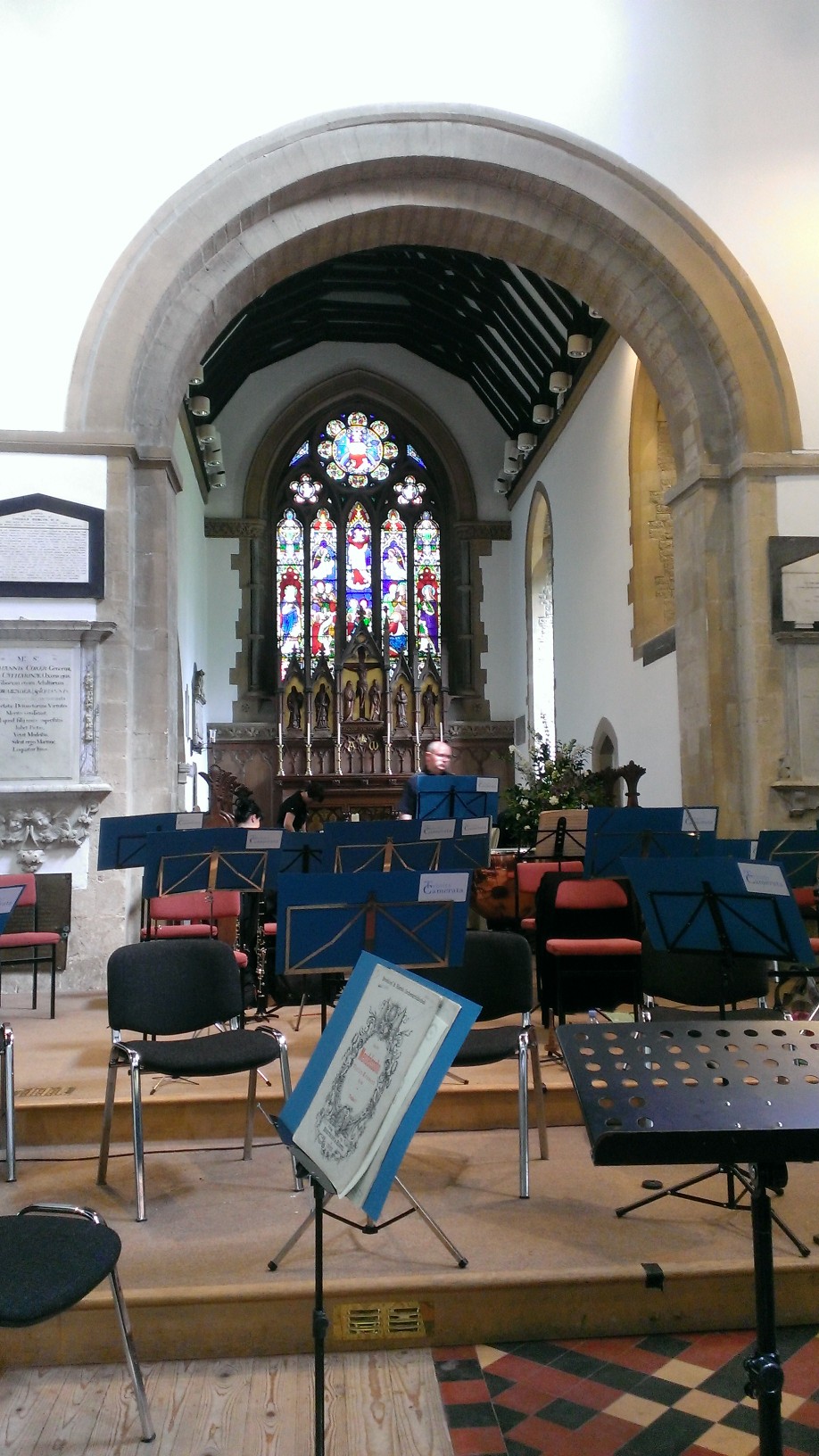
St Edburgs Church BicesterI went to a small scale church concert on Sunday at St. Edburg’s Church in Bicester with my aunt and my mother. It didn’t take long to persuade me as Mozart, Mendelssohn and Beethoven were on the programme.

The amateur music ensemble Trinity Camerata (conducted by Sam Laughton) gave a wonderful opening to the afternoon with the Overture to Don Giovanni. The conductor (who was very eloquent), gave us all a preamble about each piece, which was really interesting and added to our understanding and enjoyment of the music. It’s the sort of ensemble I’d like to join when I’ve taken my Grade 8 and have more time to practise.

The highlight of the afternoon was being just a few feet away from the guest soloist, Adelia Myslov, the young virtuoso who performed the popular Mendelssohn Violin Concerto in E minor.

Here is my favourite vintage recording of the work with Yehudi Menuhin, the Berlin Philharmonic and Wilhelm Furtwängler:

All I can say is wow, this diminutive Russian really packs a powerful punch with her violin. To say her performance blew me away is an understatement. As far as I could tell with my limited understanding of music her performance was pretty flawless. Not just technically, but stylistically, musically and emotionally. She had her eyes closed for most of it, and the feelings of the music were etched on her expressions, and then translated into the sound from her gifted Lorenzo Storioni violin.

She’s fabulously talented, and I sat in awe at her prowess on the violin. Her double-stopping was so clean, the rapid arpeggios seemed effortless, combined with incredible bow control, and impeccable intonation. She produced the sweetest top notes. The cadenza was truly virtuosic. The acoustics of the church were fantastic, and her pure tone sang out the lyrical melancholy tones of the opening movement with such poignancy that my eyes became leaky…

I have no doubt that she will make it onto the world stage. She deserves to be as well-known as the likes of Hilary Hahn, Julia Fischer, Nicola Benedetti, Janine Jansen, Anne-Sophie Mutter and Vanessa Mae. She will win many hearts and over time, a huge fan base.

Originally from St. Petersburg her family moved to the UK where she attended the Yehudi Menuhin School and Purcell School of Music. Her website charts her musical achievements: http://www.adeliamyslov.co.uk/

I found this clip from her acclaimed recital series ‘Mortal Man; Immortal Dreams’ with pianist Craig White.

When she is famous I’ll be able to look back and say I had the pleasure of seeing her perform in an old church in Oxfordshire.

The concert was rounded off with Beethoven’s jolly and exuberant 8th Symphony, that he affectionately nicknamed his “little one” in F Major.  Whilst not every note or nuance was perfect the Trinity Camerata certainly put in a competent performance and captured the Master’s impish and ebullient mood throughout his happiest symphony!

Trinity Camerata

Maxim’s Masterclass

On 11th April 2013 I was fortunate enough to attend my first masterclass run by world renowned violinist Maxim Vengerov, in conjunction with Oxford Philomusica. We gathered at the iconic (Grade 1 listed) Sheldonian Theatre, designed in 1664 by Sir Christpoher Wren.

I huddled excitedly into my wooden pew along with my fellow spectators, vying for a glimpse of one of my living musical heroes.  Vengerov did not disappoint.

Looking back now at my sketchy notes, the first thing that jumps out at me is his declaration that the violin should replicate the human voice; and he elicited much laughter from the audience by bursting into an impromptu song. He was warm, confident, knowledgeable (as you would expect), and he genuinely seemed to care about the students from Oxford University who were performing for his expert feedback. His insights into the music were unparalleled. He told the first student, who played Mozart’s Adagio in E Major, ‘Know where you are going in relation to the phrasing – have a goal.’

What impressed me was that he was able to impart a lot of relevant advice to the violinists in the short time he had to evaluate them. He was able to spot almost immediately where they needed improvement. To me they all seemed brilliant, and they were, but with Vengerov’s help they could become world class.

The second player tackled the Brahms Violin Sonata No. 1 in G Major.  He seemed to feel that she was too controlling, and he told her simply to, ‘Let go.’ He then proceeded to show her how to balance her bow, using the forefinger for control and the little finger to balance it. All the time his manner was relaxed yet utterly erudite and eloquent.

He compared violin technique to breathing:  ‘The left hand is the heartbeat and the right hand is the lung.’

There were other technical gems about increasing finger pressure, bow speed and vibrato to achieve a crescendo, and he coached on the art of smooth changes in bowing style and speed.

The third violinist was shown where she was missing out notes in the furious tempo of the Grieg sonata, and he told her to lift her fingers off the string completely to improve accuracy, and to accent the first note of a group. He compared her rendition to a train passing through a station without stopping.

He had us all captivated with his unique blend of joviality and humour, mixed with just the right amount of constructive and affable critique. His joy in coaching was evident. His own playing of each of their pieces to demonstrate his points transcended the music.  To add to the experience the acoustics were fantastic, and even though it was a grey day light was streaming in through the high windows. I only wish I had been able to sit closer to the action. In short: he is an amazing ambassador for the violin and classical music.

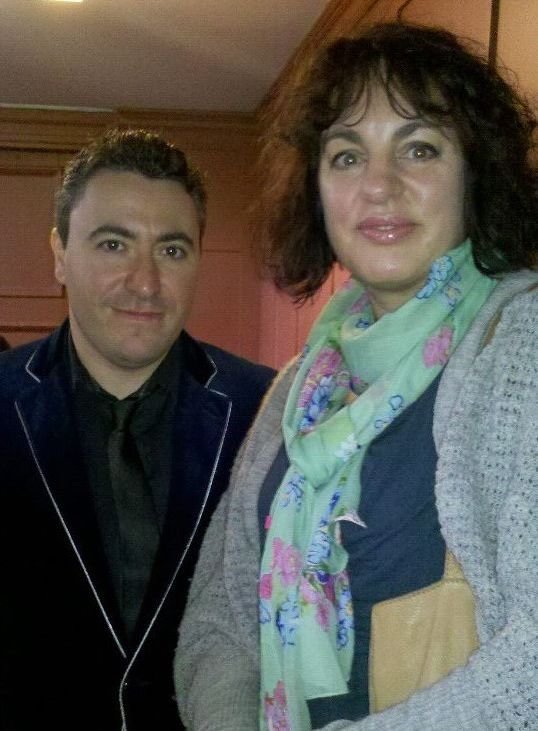
Meeting Virtuoso violinist Maxim Vengerov after his Oxford MasterclassHe was totally charming and stayed behind afterwards to sign autographs and meet his numerous fans (of which I was one). Hence the slightly deranged coat-hanger smile! I comfort myself thinking he must meet gushing and overawed amateur violinists quite often and forgive them their nervous blabbering.

The day was capped off with a visit to the Ashmolean Museum and sighting of my very first Stradivarius violin, the best preserved of them all – The Messiah.

List of Stradivarius Violins & their provenance

One of my favourite Vengerov performances, Waxman’s passionate Carmen Fantasy:

http://www.youtube.com/watch?v=TKHAgcOqJQA

To round off my point here he is in the documentary ‘Playing By Heart’