Halloween Special: A Terrifying Tour of the Hell Fire Caves at West Wycombe, Buckinghamshire…

“Abandon hope, all ye who enter here.” ~ Dante Alighieri (Divine Comedy)

‘Tis a grisly tale of death, debauchery and sinister, secret goings-on, some 300 feet underground. I hope you are not faint of heart!

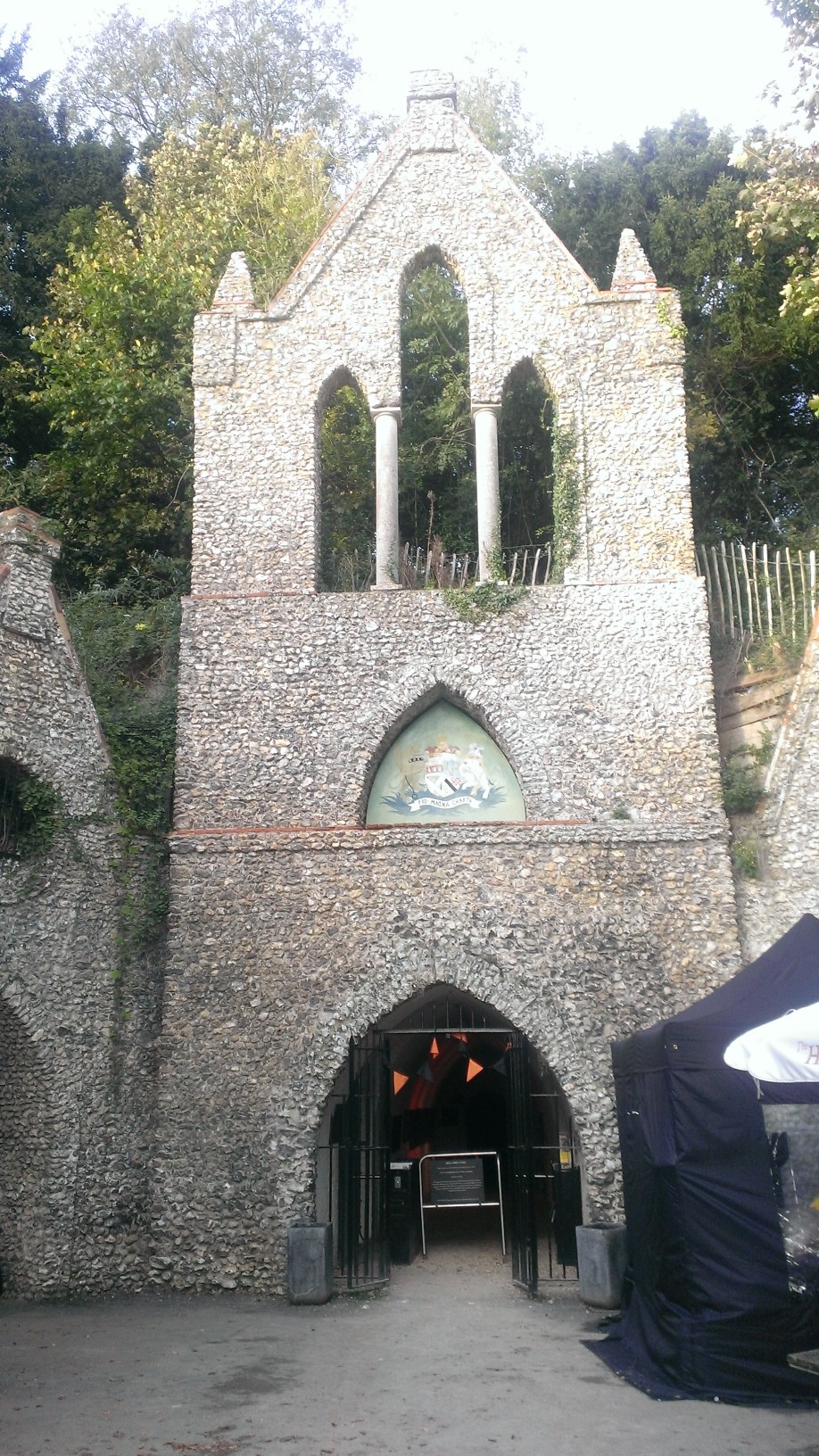
HFC facadeAs it’s Halloween this Friday I thought I would relay the hair-raising account of our family trip last Sunday into the depths of the Hell Fire Caves, not far from where I live.

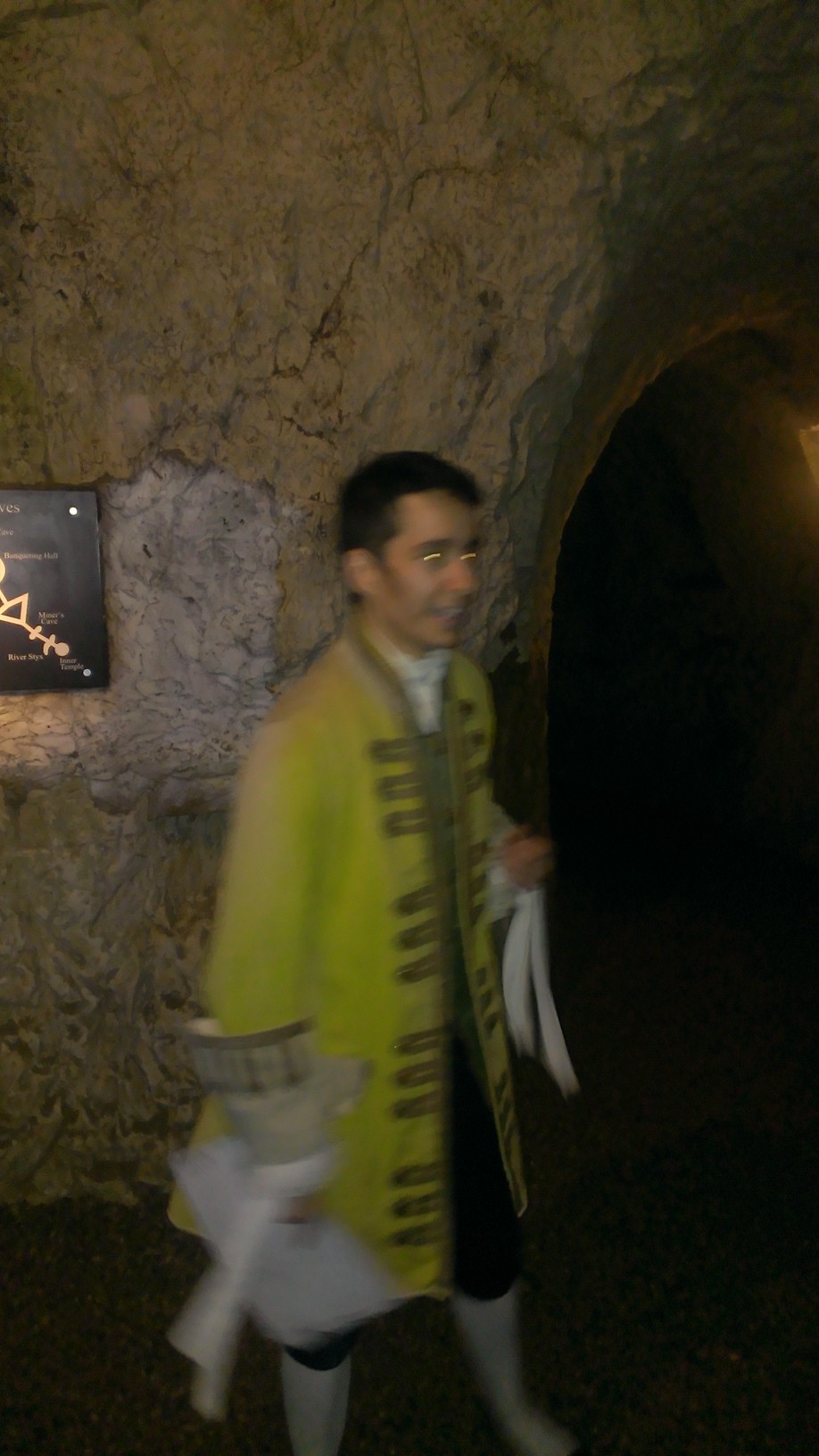
We were fortunate to grab the last tour of the day (they only run these guided tours once a month), and our tour guide, Jack, had a flair for the dramatic. We imbibed his enthusiasm and knowledge of the infamous and secretive ‘Hell Fire Club’ from the moment we stepped into the damp, dark corridor beneath the stone frontage of the caves.

He began by explaining in a rather comical fashion about the House of Hanover and the four Georges who were monarchs in Georgian England. When he mentioned that George 3rd apparently rode invisible horses, my daughter Emily, said to him most earnestly, ‘So does my sister!’ I was glowing with pride! That set the tone for a scary, fun and fascinating 45 minutes to follow.

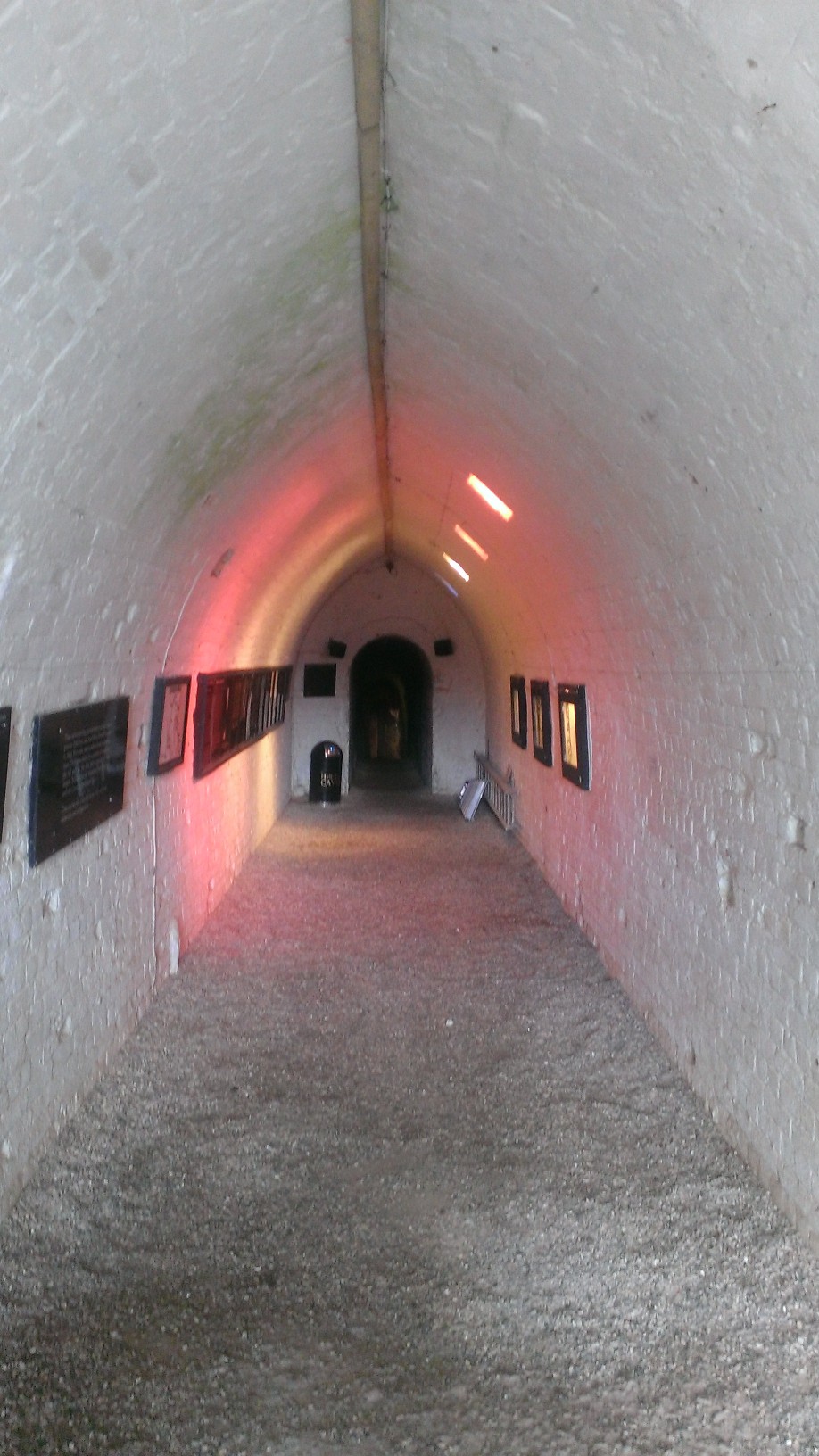
HFC entranceWe walked about fifty yards down the sloping tunnel, to learn that times were tough in 1747. The farmers of the village had suffered three consecutive failed harvests, and so the enterprising Francis Dashwood, 15th Baron le Despencer paid around a hundred men who would have been agricultural workers around a shilling a day, to dig out the caves. Little did they know the profligate purposes he intended to use it for!

They began work at 4 am, armed with a pick axe and candle, and if they were lucky they were allowed ten minutes for a break and to consume some ale and bread during their gruelling twelve hours beneath the ground.  I’m sure they would have been grateful for the EU labour laws in place today.

The caves were completed in 1752 and reached about a quarter of a mile into the hillside. The displaced chalk was used to build a new road from West Wycombe to High Wycombe, now a section of the A40 from London to Oxford.

1752 was a fairly momentous year… Great Britain and the American colonies lost eleven days to the annoyance and bewilderment of its citizens, as the switch was made from the Julian Calendar to the Gregorian Calendar, which was already in use in other European countries. Benjamin Franklin tested the lightning rod, Moscow was besieged by fires, the Liberty Bell arrived in Philadelphia, and the noted pianist and composer Muzio Clementi was born.

Sir Francis Dashwood and poet Paul Whitehead were best friends and the two founding members of the ‘Hell Fire Club’. They were later joined by lords, politicians and prominent men of the era, who wanted society to remain ignorant of their louche undertakings in sleepy West Wycombe.

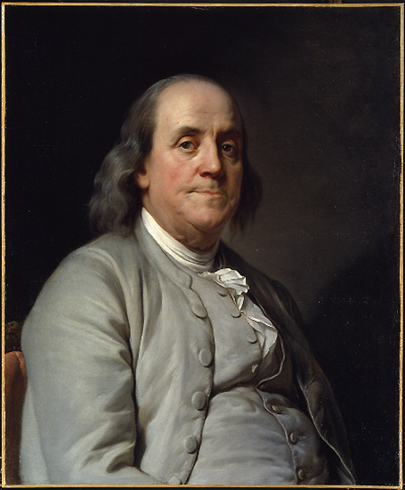
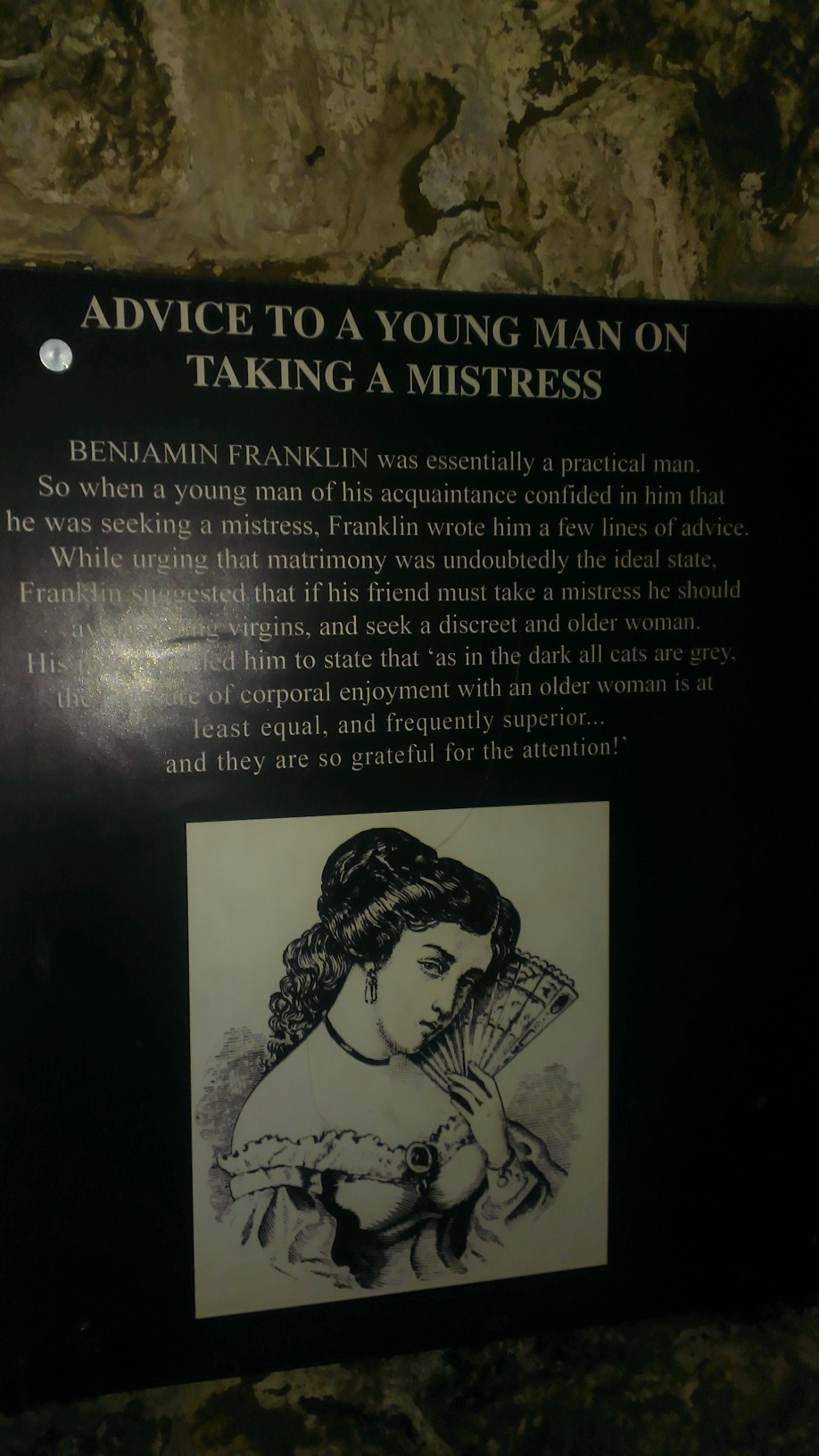
Benjamin Franklin

Benjamin Franklin

Among others, some of the most well-known members of the notorious ‘Hell Fire Club’ were: John Montague, the 4th Earl of Sandwich, (and inspiration of the favoured lunchtime food), who was First Lord of the Admiralty, Thomas Potter, son of the Archbishop of Canterbury, Dr Thomas Thompson, physician to the Prince of Wales, John Norris, MP and Don at Magdalen College, Oxford, John Wilkes, MP and Lord Mayor of London, painter William Hogarth, Sir John Russell, Sir John Aubrey, Sir William Stanhope, MP for Buckinghamshire, Francis Duffield, owner of Medmenham Abbey (where some of the same individuals first met in secret under the name of the Knights of St. Francis of Wycombe), and Benjamin Franklin, who was visiting from across the pond, espousing the benefits of the union of England and her American colonies. Little did they know that utopia wasn’t to last…but he nevertheless became very good friends with Sir Francis Dashwood and his powerful and wealthy cohorts.

These were the clandestine ‘rockers’ of their day, pushing the boundaries of decency behind their respectable public personas, privately discarding the religious morals of their time.

Not all the members of the ‘Hell Fire Club’ got on like a house on fire, there was known to be an intense hatred between John Montagu the Earl of Sandwich and MP John Wilkes. A prank that Wilkes was to play on Montagu would ultimately be the undoing of the sordid antics of the ‘Hell Fire Club’, but more on that later…

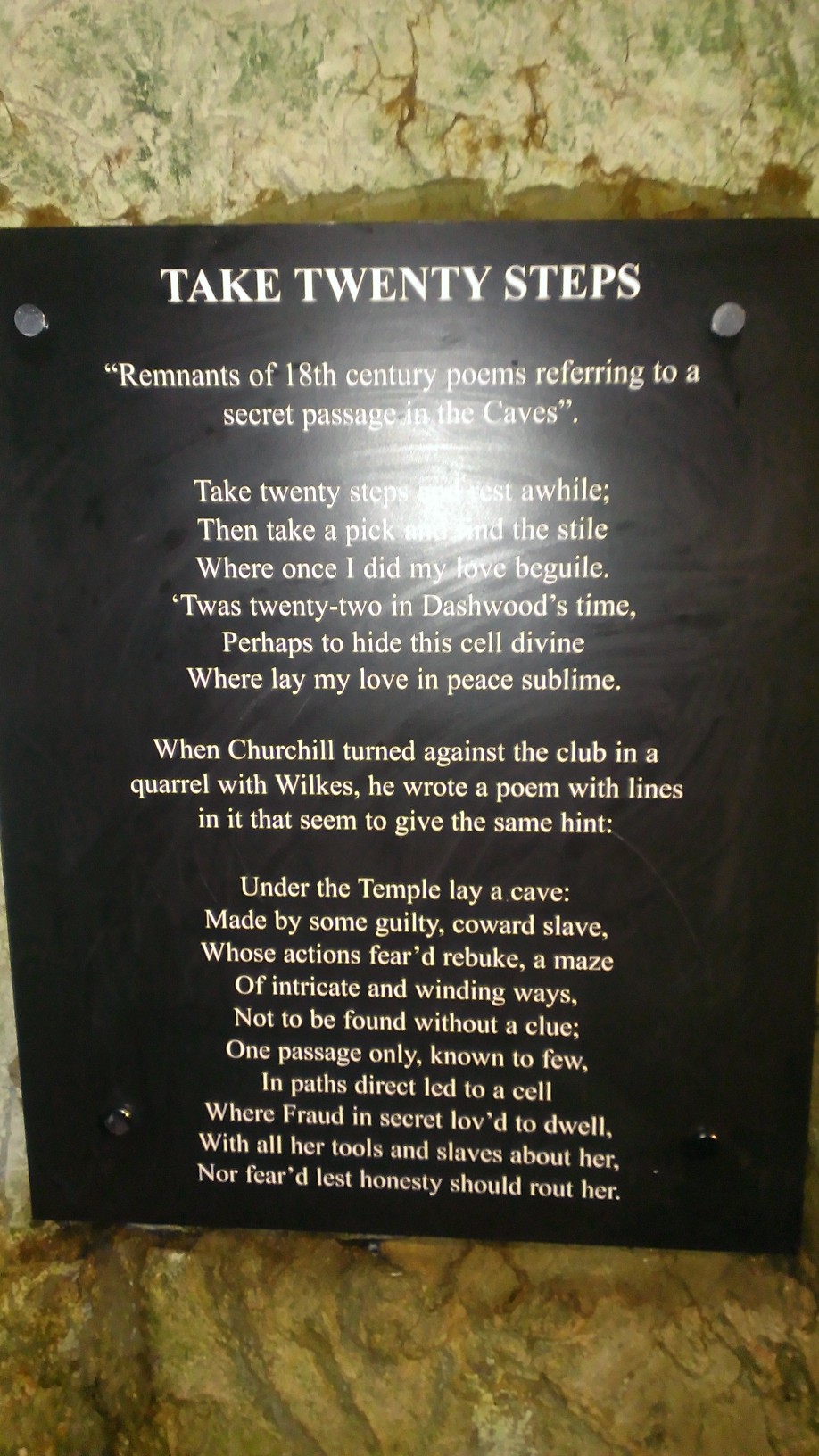
We stopped again a little further down to learn about the 22 steps, (not a follow-up novel by John Buchan), where it was recently discovered that another passageway had been sealed up when the caves were closed. A specialist team from Oxford had recently confirmed the existence of another tunnel, but due to the way it had been sealed was considered unsafe to reopen at the moment.

22 steps


They suspect it eventually opens out under the floor of St. Lawrence church, where the vicar had the floor pulled up due to warping, to find a bricked layer that concealed a long drop down…

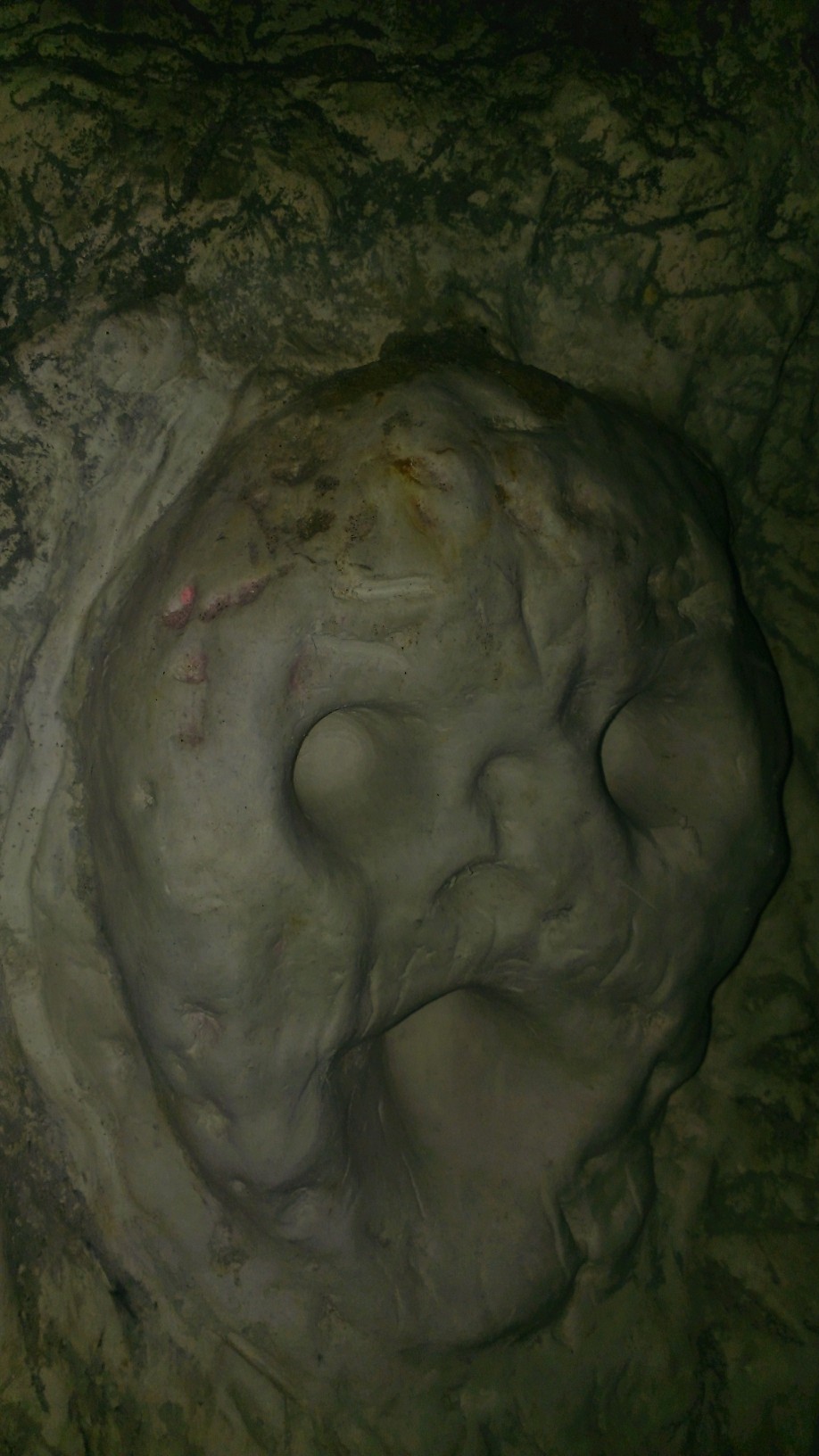
Ghoulish face carving HFCWe came upon numerous macabre faces carved at intervals into the chalk walls, representing the Pope, the Devil, a demon, and other ghoulish beings, the work of artist William Hogarth. They must have known their ‘blasphemy’ would earn them a one-way ticket into Hell itself, and so fashioned their secret club in mock religious terms. The arches down into the caves and throughout are shaped like those in churches. You can tell they were highly contemptuous of the Roman Catholic Church!

Anything but holy devotion was taking place out of the sight of prying eyes. Black magic, satanic rituals, orgies and mass consumption of wine in honour of Bacchus were the order of the day for this group of sexually voracious men and their female companions.

Francis Dashwood was heavily influenced by the monk and writer Francois Rabelais (1494 – 1553), adopting one of his phrases from Gargantua, ‘Do what thou wilt’ as his personal motto. Dashwood travelled extensively and was also interested in ancient Egyptian, Greek and Roman mythology.

Jack in the Banqueting HallFurther down we entered the massive ‘banqueting hall’ which is around forty feet across and fifty feet high, directly beneath the Mausoleum at the top of West Wycombe Hill. It even had the original 18th Century metal chandelier fitting still attached to the ceiling. According to our guide it once held in place the opulent rose quartz chandelier that Lord Dashwood had hung in the chamber. It is the largest man made chalk cave cavern in the world. Not bad for a cave hewn out of the hillside in 1748.  There are various devotional side ‘chapels’ that would have had beds in them, and there would have been a large dining table in the centre of the cavern.  Entertainment in the form of music and singing was also had in the massive chamber. They probably didn’t feel the cold if they were engaged in suspected hedonistic activities and worse; but we shall never know the true extent of what went on.

Paul Whitehead, who was the club’s steward, burnt all his papers and manuscripts in the three days before his death in 1774, knowing that his accounts of their nefarious deeds would have proved just too shameful for public consumption. Even more macabre, he bequeathed his heart and the sum of £50 for a marble urn to Lord Dashwood, which was duly cut from his corpse and placed in the urn, which was then placed in the mausoleum in an elaborate ceremony lead by Lord Dashwood. It remained there until it was stolen during the Victorian era.

HFC Susanna plaqueThere is a very sad tale relating to the banqueting hall that took place after the caves were no longer in use, again in the Victorian years. A pretty young chamber maid named Susanna who worked at the George and Dragon tavern in West Wycombe was rather popular with the local lads, but she rejected them to become the mistress of Lord Pitt. Sukie, (as she was known), received a love letter from her lord, telling her he wanted to elope with her and marry her, requesting her to meet him at midnight in the banqueting hall of the caves. Dressed in her mother’s bridal gown and holding a candle she followed the voice of the man she thought was her beau. When she reached the chamber it became obvious she had been lured there for other purposes, and several of the previously rebuffed local boys were mocking her. Angry and heartbroken, she hurled stones at her cruel tricksters, but when they threw a rock back it hit her in the head, and she collapsed. The cowardly boys ran, leaving her alone and injured in the dark. When it was discovered that she was missing the next day the boys owned up to their prank, and she was found dead in her blood stained white dress just fifty yards from the entrance.

This tragic story led onto talk of ghosts, hauntings and paranormal activity, and poor dear Sukie is said to be the Lady in White that many have reported seeing throughout the caves. I was not surprised to learn that the caves have been voted by BuzzFeed as the second scariest place in the UK.  Our guide quite openly admitted that the deepest reaches of the cave at 300 feet below ground scared even him. I have to admit, it was very cold and creepy, I’d hate to be alone down there.

An interesting interview about possible hauntings and paranormal activity with the founder’s descendent, Sir Edward Dashwood, about the Hell Fire Caves:

Deeper still, we came to the parting of two tunnels, known as Judgement’s Pass. Our guide put on his deepest, most serious, judgmental voice, wanting to know if we were either sinners or pious people, and to think carefully about our answers, as it would determine whether we took the left or right tunnel. So when he stared at each of us and asked, “Are you good, or are you or bad?” Emily, who had once again been paying close attention to his brilliant commentary, chirped up that she wasn’t sure, “Because I haven’t tidied up my bedroom.” I’m sure they must have heard our shrieks all the way up in the café. As it happens, both tunnels lead to the same chamber, the wine cellar.

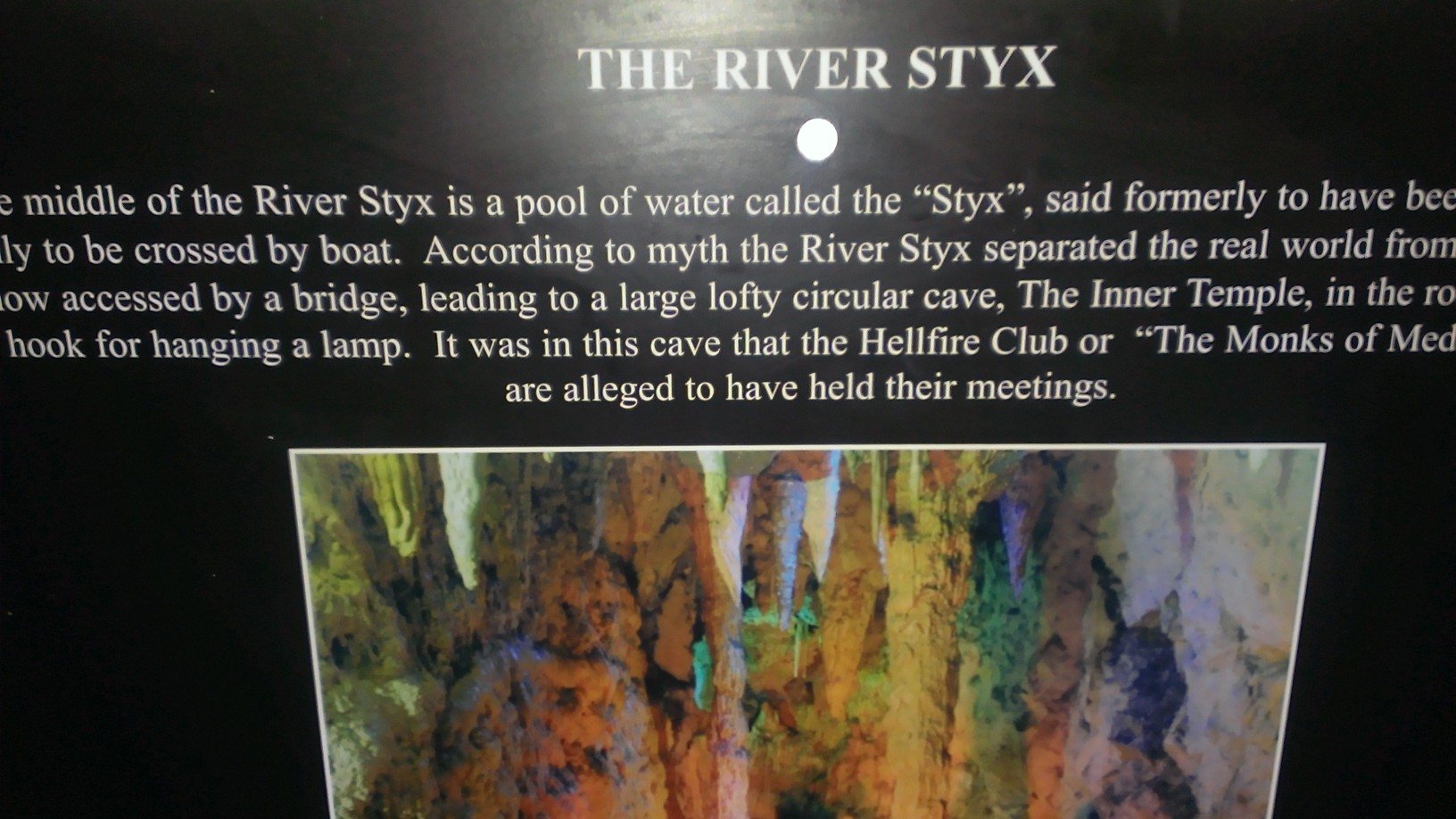
River Styx HFCOnly the ‘Twelve Apostles’ were permitted to go beyond this point, across the artificial River Styx and into the ‘Inner Temple’. This is where the tale gets even more bizarre…

It is said that John Wilkes played his prank on the 4th Earl of Sandwich at a gathering of the twelve Apostles. Wilkes pulled out a large mahogany chest, which was accompanied by quite an authentic creaking noise from our guide to demonstrate its opening, whereby out leapt a large baboon dressed as Satan, which promptly took a liking to John Montague. Hysterical, and then angry, as he saw the laughing faces of the other members, he stormed off threatening to spill the beans on their unsavoury subterranean secrets.

The ‘Hell Fire Club’ was duly exposed in humiliating fashion in the House of Lords, as the Earl of Sandwich read out the salacious poem by Thomas Potter and John Wilkes titled ‘Essay on Woman’ to satisfy the prurient curiosity of his fellow Lords in 1764. Potter was imprisoned and Wilkes fled to France.

The American Revolutionary War broke out in 1775 and Benjamin Franklin had returned home, having changed his mind about the colonies, becoming one of the key Founding Fathers of the United States of America.

Eventually the ‘Hell Fire Club’ disbanded, having been publicly routed.  So it seems rather fitting that their beastly activities were ended by a baboon!

Obviously Hell hath no fury like a Lord scorned…

An interesting blog: Secrets of the Hell Fire Club

The Hell Fire Caves were opened to the public as a tourist attraction in 1951.

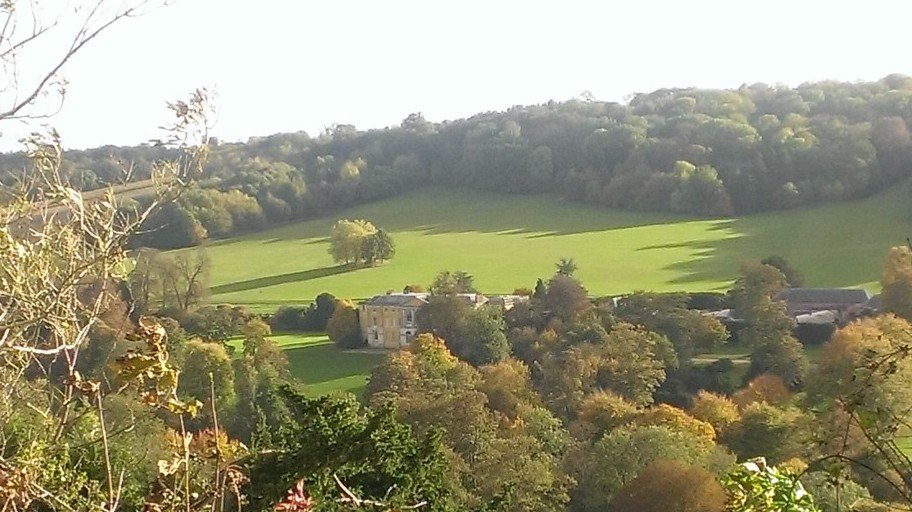
rsz_west_wycombe_park_from_west_wycombe_hill (2)I can thoroughly recommend them (and indeed the surrounding West Wycombe Park and Mausoleum) if you are ever in the Chiltern Hills and bonny Buckinghamshire, but maybe not on Halloween night!

How Purpose and Passion can Transform Life from the Mediocre to the Meaningful

“What is the meaning of life? To be happy and useful. ~ Dalai Lama

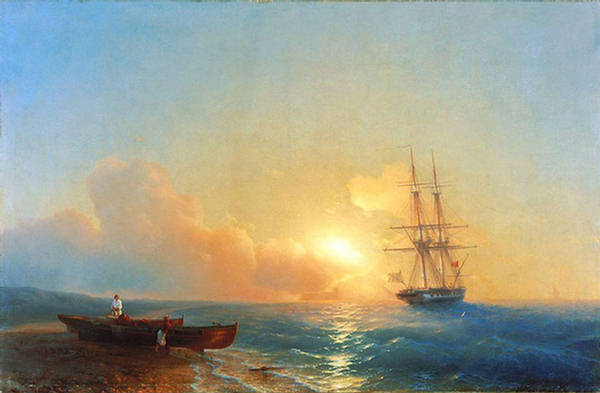
Ivan Aivazovsky -maritime artDo you truly know what floats your boat? John F. Kennedy wisely stated that a rising tide lifts all boats. Forget that he was talking about the economy. I’m talking about the sea of life, the ocean of experience. Is your mast set to wind? Is your course charted? Or is your vessel rudderless? It won’t all be plain sailing, but you’ll have many adventures navigating from port to port. Before you know it you will have circumnavigated the globe. Okay, okay, enough of the nautical lingo…

Are you aligned with your purpose in life? We can look at many examples of extraordinary people who changed the world by simply following their dream. Individuals who stayed the course, no matter the obstacles they faced.

What will keep you going regardless of success or failure? Inner peace and happiness comes from being true to your vision and values. To inspire your fellow human beings and be the tide that raises other ships, your purpose has to be something other than the quest for money, endless consumerism or a new pair of shoes. I might regret saying that last part!

It has to be a deeply felt cause that is bigger than us as individuals. Without that inner resolve there is no motivation to get out of bed in the morning.

VF quote on happinessDuring my life I’ve done jobs I absolutely hated. Luckily, they were only for relatively brief spells. I found myself wishing away my life, desperate to get to the weekend. I could really relate to philosopher Henry David Thoreau’s words, “The mass of men lead lives of quiet desperation.” How soul destroying it is to feel that your existence counts for nothing, that you do not matter. Do you know what you were put on this earth to do? Fortunate are those who have shaken free from the clutches of apathy, and are expressing their talents and passion in the world.

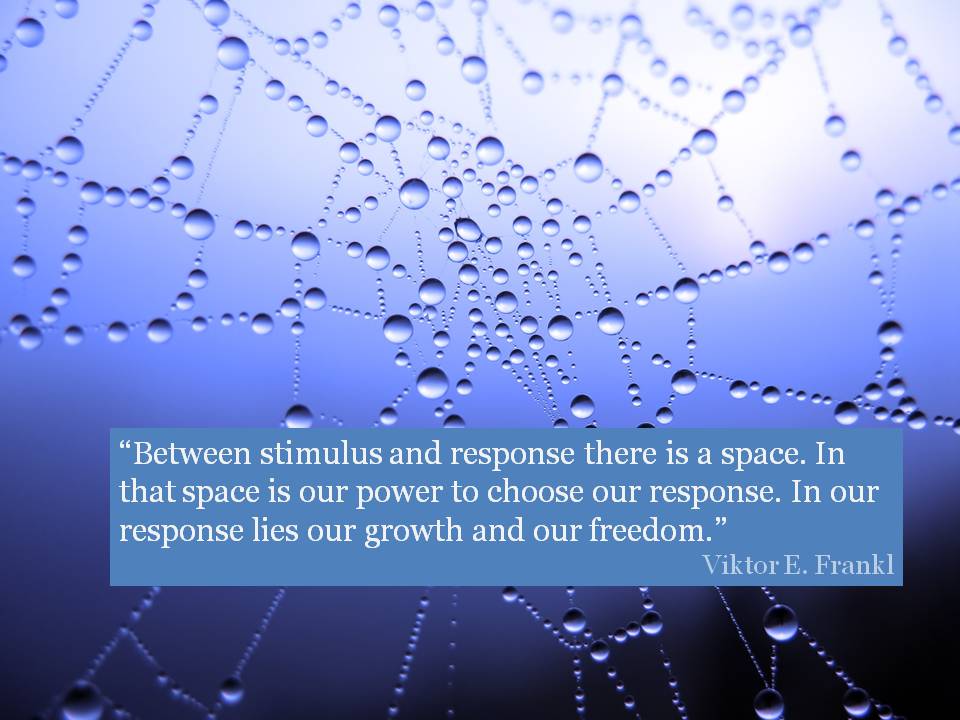
Viktor Frankl experienced more trauma in his life than most of us could ever imagine, or would ever face, and yet he went on to write a moving and inspiring lesson for us all, in his ground breaking 1946 book: Man’s Search for Meaning.

For me, when I look at the achievements of people past and present, such as Viktor Frankl, Mahatma Gandhi, Abraham Lincoln, Nelson Mandela, Winston Churchill, Steve Jobs, Bill Gates, Richard Branson, Beryl Markham, Emily Pankhurst, Florence Nightingale, Madam Curie, Helen Keller, Joan of Arc, Ludwig van Beethoven, Daniel Barenboim, William Shakespeare, Mother Theresa, Walt Disney and many more than I could possibly mention, whose lives were, and are challenging, but through being true to their purpose left their legacy in the annals of time. We ordinary mortals can achieve our success according to our own values and dreams.

You don’t have to be famous to make a difference. You don’t have to have a world changing vision. You just have to know who you are, where you’re going and have a plan to get there. Sounds simple right?

Five pointers to help you find your passion and purpose:

  1. Pay attention to how you spend your time. Chances are, if you do something a lot it means something to you. Awareness creates choice.
  2. What knowledge can you share? What activities are you good at and enjoy, that you could make a living from or help others master?
  3. Write a list of your values, brain storm, then make a short list of your top 10 values and see where they fit into your life. What causes are close to your heart? How can you get more involved?
  4. Delve into your beliefs. What beliefs do you hold around money, work, success, health, and relationships? Be honest with yourself, and label each one as being either resourceful to you or a hindrance to you. How many of them are long buried self-sabotaging beliefs creating negative self-talk? Beliefs are powerful, and we always find ways to prove them, whether they are ‘true’ or not. It makes sense to have well-adjusted healthy beliefs about ourselves and the world around us. It’s time to shake off years of indoctrination and remove the glass ceiling.
  5. What would you attempt if you knew you couldn’t fail? I know it’s a provocative question, but as Einstein stated, “Never give up on what you really want to do. The person with big dreams is more powerful than the one with all the facts.” He also said, “Imagination is more important than knowledge.”

Viktor-Frankl-quote1

There are really only four things that we have complete control over in our lives. How we feel, how we behave, the people and situations we attract to ourselves, and the meanings we assign to all of the above, our internal representations of our lives.

What Makes Life Meaningful: Michael Steger at TEDxCSU:

A recent Stanford research project explored the key differences between lives of happiness and meaningfulness. The meaningful life is a road worth traveling.

Feeling happy doesn’t mean our lives are easy, or perfect. We often feel sadness and joy along our journey, indeed, a whole range of emotions, that’s just the nature of life. But true purpose keeps us on course, gives us that inner peace that we are contributing to the world in our own unique way. Each of us has the ability to touch lives that no-one else can. Every day you are happy is a gift to the world. So in order to be altruistic you also need to be selfish. Indulge in what you love, and give it away…

PhotoFunia-time and tideWe all have the same time given to us. There are 86,400 seconds in a day, 31,536,000 in a year, and just over 2.2 billion seconds in a seventy year lifespan. None of us knows when our personal clock will stop ticking. Time is precious.

How will you spend yours?

Movie Review: Why I Love The English Patient

“We are the real countries, not the boundaries drawn on maps with the names of powerful men.”

There are many reasons why Michael Ondaatje’s literary novel, The English Patient, dramatised in 1996 by award winning screen writer and director Anthony Minghella, is my favourite film. It’s just breath-taking on so many levels.

TunisiaThe geography of the film’s narrative is every bit as epic as the geography of its location: North Africa. The cinematography is mesmerising, as we see the opening scenes of the brush strokes on paper, and look down from the Tiger Moth over endless Sahara sand dunes, and then we hear that exotic music, by Gabriel Yared with the haunting voice of Márta Sebestyén.

The sweeping shots of the desert and the contours of the dunes are reminiscent of the female form, which adds to the sensory aspects of the film. Also, I never knew what a suprasternal notch was beforehand!

The characters are making maps of the desert, but they are also mapping each other’s souls.

Although it’s brutal in many aspects, both visually and in the writing, with the patient’s horribly burnt body and its theme of war and betrayal, the film is also deeply sensual, portraying beauty as well as pain in the all-consuming love the characters feel as they are embroiled in the carnage.

The hauntingly beautiful soundtrack (Harry Rabinowitz, As Far As Florence):

Egypt during the Second World War is the backdrop for the intense fictional love story of cartographer and aviator, Count László de Almásy and the feisty married English woman, Katharine Clifton, which gives a unique context to their story in history. Then there’s the acting. Ralph Fiennes is at his finest! The chemistry between Ralph and Kristin Scott Thomas, who play the doomed lovers, is palpable. Everything about this film is perfect. The music, the setting, the script, the casting, the way it unfolds on screen…

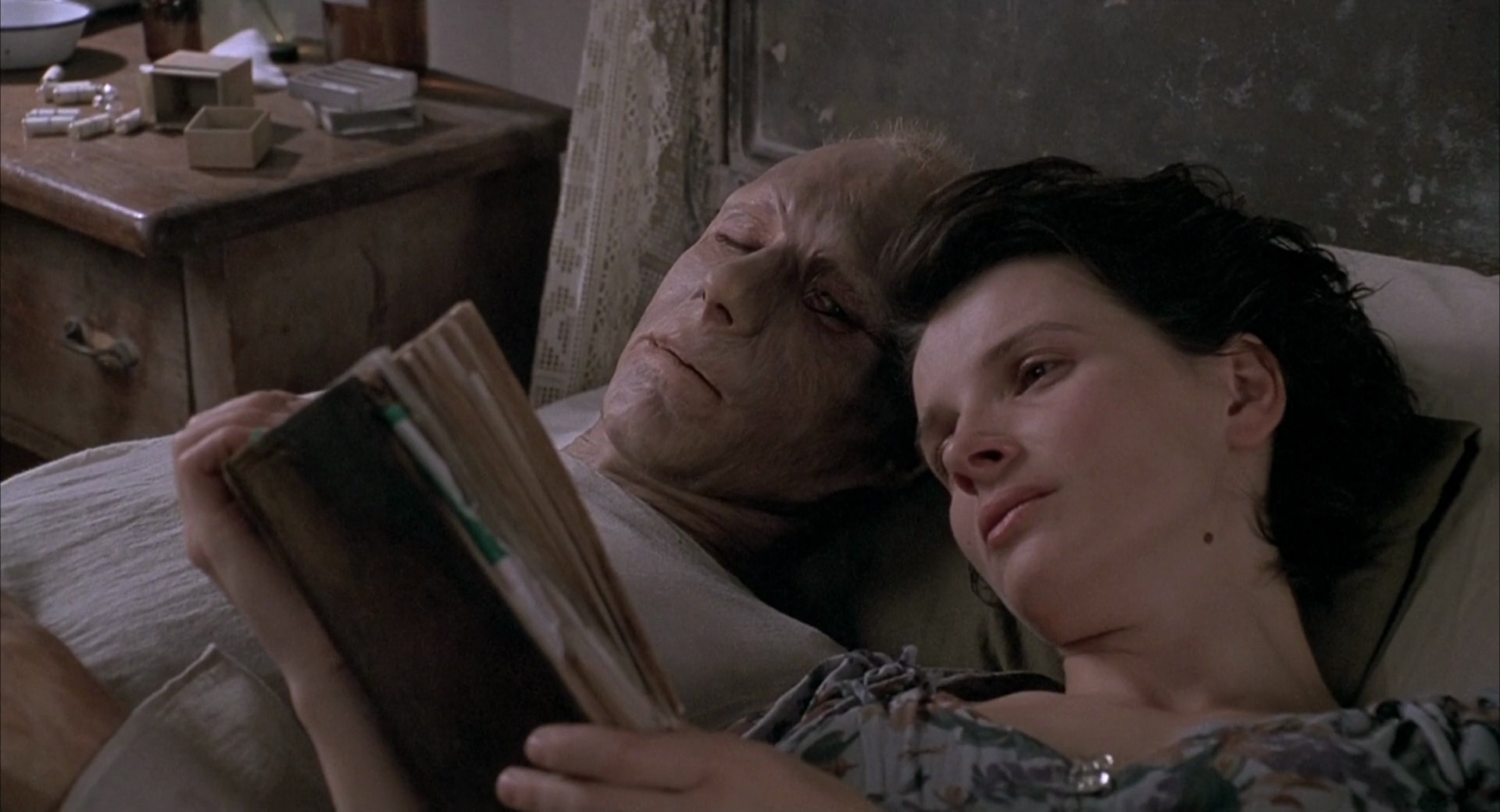
In fact, there’s more than one love story going on. There’s also the Canadian nurse (Hana), who cares for László in his last days, setting them up in the partly destroyed and deserted Italian villa San Girolamo. She gradually coaxes his poignant memories from him, which is how we learn of his love for Katharine. But Juliette Binoche, who plays Hana, has lost everyone she cared about earlier in the war and believes she is cursed. As she cares for the English patient whilst coming to terms with her own emotional scars, she falls in love with the courageous and dignified Indian bomb disposal expert, Kirpal Singh (Kip), played by Naveen Andrews. The scene where they meet for the first time is pure genius.

Then there’s David Caravaggio (Willem Dafoe), the bitter and traumatised allied thief turned spy, looking for vengeance against the man who handed aerial maps to the German’s, leading to his subsequent capture and torture. Their coming together at the villa changes them all, irrevocably.

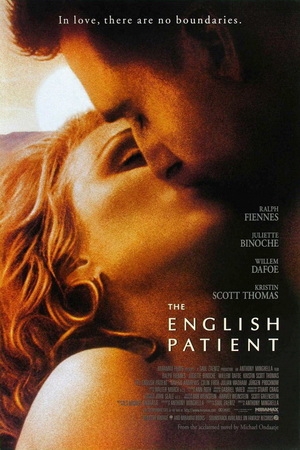
The_English_Patient_PosterThe film is beautifully shot, mostly through the patient’s flashbacks, starting at the tragic end and then taking you to the beginning of their story, when Katharine and her husband Geoffrey arrive in the desert to join the group for their map making expedition. You can see from László’s expression as he watches Katharine when she stands before them reading Herodotus, telling the party of the Royal Geographical Society explorers the story of Candaules and Gyges; that it’s love at first sight.

The tension and social differences between them leaps out from the screen. His following her in the market and the purchase of the thimble, the discovery of the cave of swimmers at Gilf Kebir, the first time they make love. Its intensity is visceral.

As well as the passionate love affair at the centre of the story it’s also about forgiveness and the power of the human spirit under almost unbearable circumstances.  All around them, as war is breaking out and lives are being destroyed, everyday human emotions are magnified and motivations heightened.

Laszlo and HanaIt’s an emotional experience to see how the lives of the four central characters are changed by their interactions with each other, and the redemption that Hana feels from her kindness towards the English patient. Perhaps the most moving of all, is the closure and passing for the central character himself (loosely based on the real László Almásy), as we understand his torment and the reason for his seemingly reprehensible actions.

I hope I have given you a flavour of the film, and if you haven’t seen it I don’t want to spoil every delicious nuance and lingering stare. Needless to say, I picked out some of my favourite scenes to whet your appetite!

Candaules tells Gyges…

Shall I play Bach?

Let me tell you about winds:

Happy Christmas:

The Thimble:

I’ll always go back to that church:

Katherine’s letter:

It’s a total triumph, and in my humble opinion Anthony Minghella’s best picture. It won 9 Academy Awards, including Best Picture, Best Director, Best Supporting Actress, and grossed over $200 million at the box office.

The English Patient is an emotional rollercoaster that hooks you from the start and spits you out at the end, broken and sobbing (well, it did me anyway)… It’s best to have a stash of chocolates, a comfy sofa, and a box of tissues at the ready.

I never get bored of watching The English Patient, and have seen it many times, now I really must read the actual book that it was based on!

“She had always wanted words, she loved them; grew up on them. Words gave her clarity, brought reason, shape.” ~ Michael Ondaatje, The English Patient

The Importance of a Musical Education

“Music…can name the unnameable and communicate the unknowable.” ~ Leonard Bernstein

As a child, opening up the music cupboard at school should be a magical moment, but for many primary school children it’s a case of no instruments and no budget; a stark reality that threatens our social and cultural heritage for years to come.

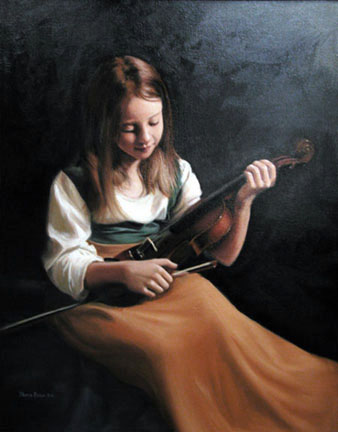
Hendrikus van den Sande Bakhuyzen - family_heirloomI became an amateur violinist thanks to the good fortune of being given free (yes, you read that correctly), free violin lessons at the age of eleven. I was only interested in playing the violin because my best friend at the time was learning it. After about three lessons she dropped out, but I stuck at it. When I left primary school, I continued to have private lessons (thanks to my parents) with Lillian Ing, (a virtuoso in her heyday) for the next five years until she sadly passed away.

In those hours of mostly forced practice, of scraping away at scales and etudes, studying for grades, and being told rather facetiously, “Can’t you play over the hills and far away?” I reached a point of competency.  I took pride in mastering each new piece.

I didn’t understand back then quite how much I would come to love and appreciate my moments on the violin; not just in terms of taking me outside of my ordinary life, but in the satisfaction of applying myself to an instrument that constantly stretches my mind and physical ability.

When I started college and later after I moved to London, I joined two amateur orchestras: the Aylesbury Orchestral Society and the Wandsworth Symphony Orchestra respectively. This was a wonderful experience for my development as a musician as well as a fun social interaction.

Quotation-Luciano-Pavarotti-age-music-children-Meetville-Quotes-4969Music runs in our family. My mother was a pianist and sang as a soprano in a choir, and she told me that she played Beethoven’s Moonlight sonata and Chopin nocturnes when she was pregnant with me.  I’m sure that’s why the Moonlight sonata in particular always evokes such peace in me, as well as my adoration of Beethoven’s and Chopin’s music full stop.

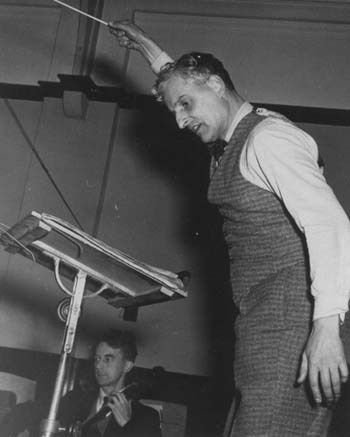
peter burges conductingMy daughters’ paternal great grandfather was a pianist, composer and conductor. He was conductor of the Ipswich Orchestral Society from 1948 until 1953, and his successor was none other than Colin Davis, who wasn’t yet a Sir, and who later became principle conductor of the London Symphony Orchestra from 1995 until 2006, when he was then made president. After leaving Ipswich Peter went on tour for a few years to countries like Malaysia, Singapore, Australia, Africa, New Zealand and Jamaica, (where he lived with his family from 1961-63, and founded the Jamaican School of Music). His life was so interesting and inspirational it’s worthy of a separate post.

I played my violin regularly when I was pregnant with three of my children.  I don’t know if it’s had an effect, but they all seem to like classical music.  Emily briefly had piano lessons but she appeared to lose interest (and I ran out of funds), while more recently Ruby has been observing me practising and asked if she can learn the violin.

I’m delighted by this, but also slightly concerned about the cost of buying an instrument and tuition.  I considered teaching her myself, but that would be doing her a disservice as I’ve almost certainly fallen into bad habits in the many years since I last had lessons.

It’s a national disgrace that my children’s generation do not have the same musical opportunities that I did, the result being, according to the Making Music report published by the Associated Board of the Royal Schools of Music, that there has been a 35 percent decrease over the last 15 years in the number of children aged 5-14 who know how to play a musical instrument.

Music-NoteMusic is not a priority in primary school education, despite conclusive research that indicates its positive impact on self-esteem, focus, literacy, numeracy and overall wellbeing. Even primary schools with good or outstanding OFSTED reports may not have funding for any type of musical education. Clearly the government pledge to tackle the ‘musical divide’ is showing no evidence of implementation at grassroots level.

The starting point should be for all primary schools to have a decent selection of musical instruments for children to try, and access to basic lessons where they can discover if they have an aptitude and love of music making.

At present, the study of music in a child’s formative years is an elitist undertaking. Parents want the best for their children, but those living in poverty are being discriminated against. Who knows what talent lies dormant in deprived areas of our inner cities? Perhaps music will prove to be the medium that keeps some youngsters out of gangs?

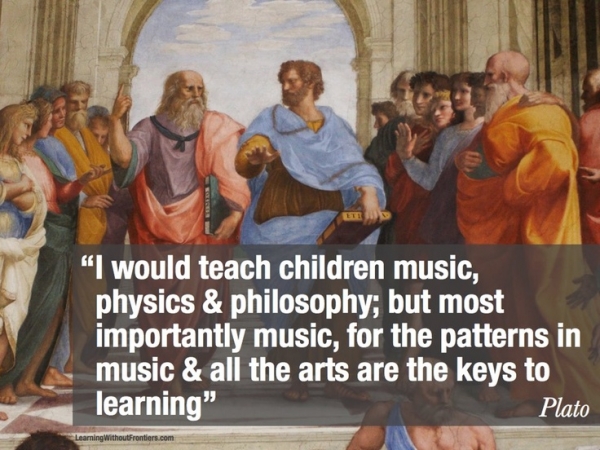
Plato music quote

We cannot afford to neglect this most beautiful, skilled and uplifting pursuit, which can improve the lives of the students as well as the numerous souls their vocation will affect; whether it be in composing, performing or teaching.

I’m not the only one who thinks this. Richard Gill in his TEDX Sydney presentation talks about the value of music education:

I admire musicians like violinist Nicola Benedetti who has spoken out about the state of music teaching in Britain, and also pianist James Rhodes for his Don’t Stop The Music campaign.

You can see how he got on with St. Teresa’s Primary School in the Channel 4 two-part documentary.

Why should the arts be the first thing to suffer in a climate of austerity? Why is it considered dispensable? Nourishment for the soul is what sustains us all.

Closer to home it looks like my daughters will be getting a half size guitar and three-quarter size violin for Christmas!

Treading the Bard’s Floorboards – An Afternoon at Shakespeare’s Birthplace in Stratford

“A quibble is to Shakespeare what luminous vapours are to the traveller: he follows it at all adventures; it is sure to lead him out of his way and sure to engulf him in the mire.”

“He was not of an age, but for all time!” ~ Ben Jonson (1573 – 1637)

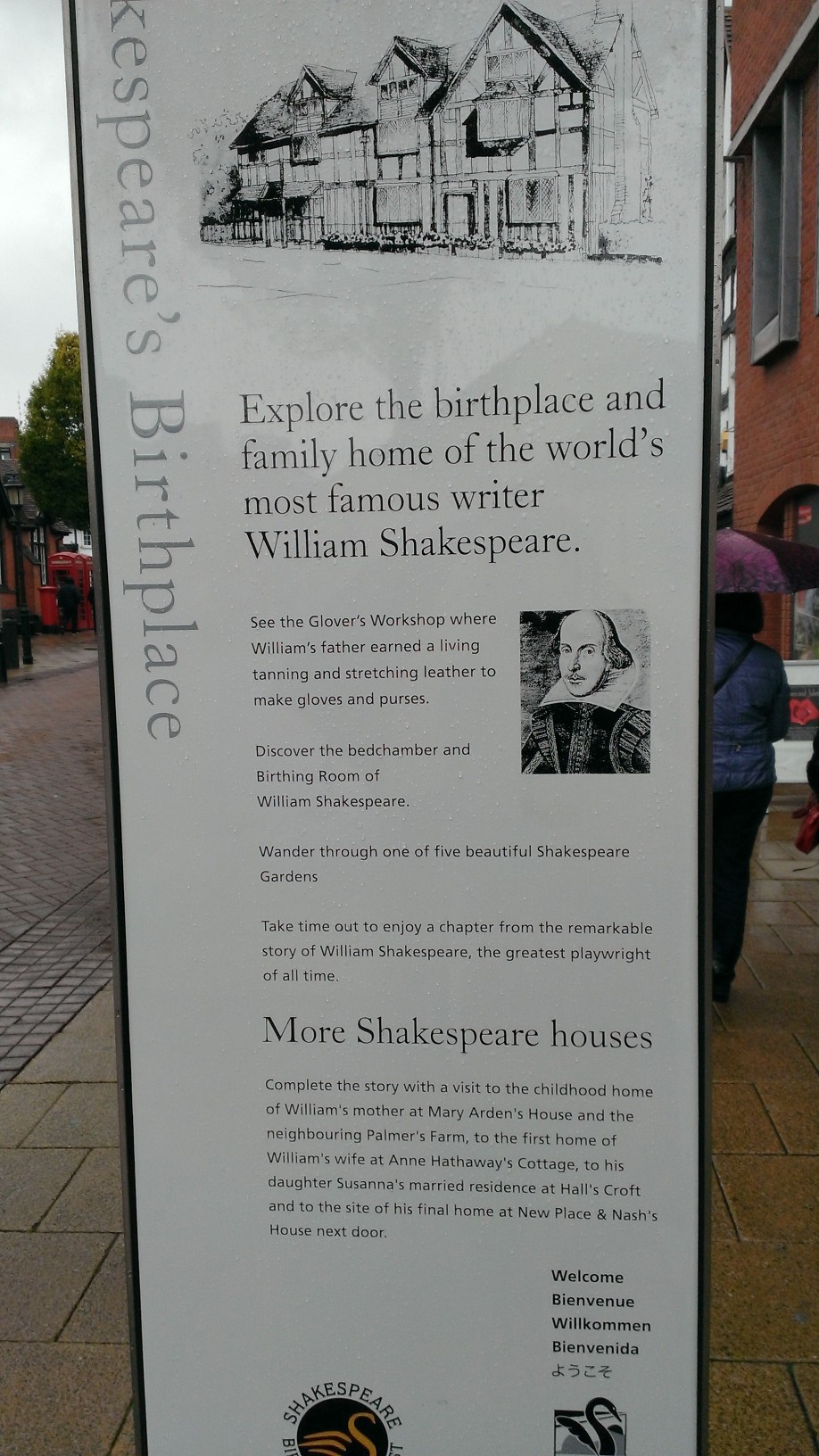
Birthplace signI say floorboards, but technically the ground floor of Shakespeare’s birthplace is stone. The original floor in fact, in the parlour, has remained in place for over 450 years. It’s something of a mystery to me why I’ve only just been able to visit the birthplace of one of the world’s greatest literary icons – but better late than never.

I had a few hours spare on my recent business trip to Stratford-upon-Avon, so I was determined to pay homage to ‘our William’, home grown poet, wordsmith and playwright. The weather was decidedly wet, and we had intermittent heavy rain showers, plus it was late in the afternoon; so luckily for me it wasn’t as busy as I suspect it usually is.  Without any of my beloved brood by my side to moan and whinge at me about how boring it was and when could we go, I was free to meander and absorb the environment of a time and place that has had a global impact and continues to define our cultural heritage to this day.

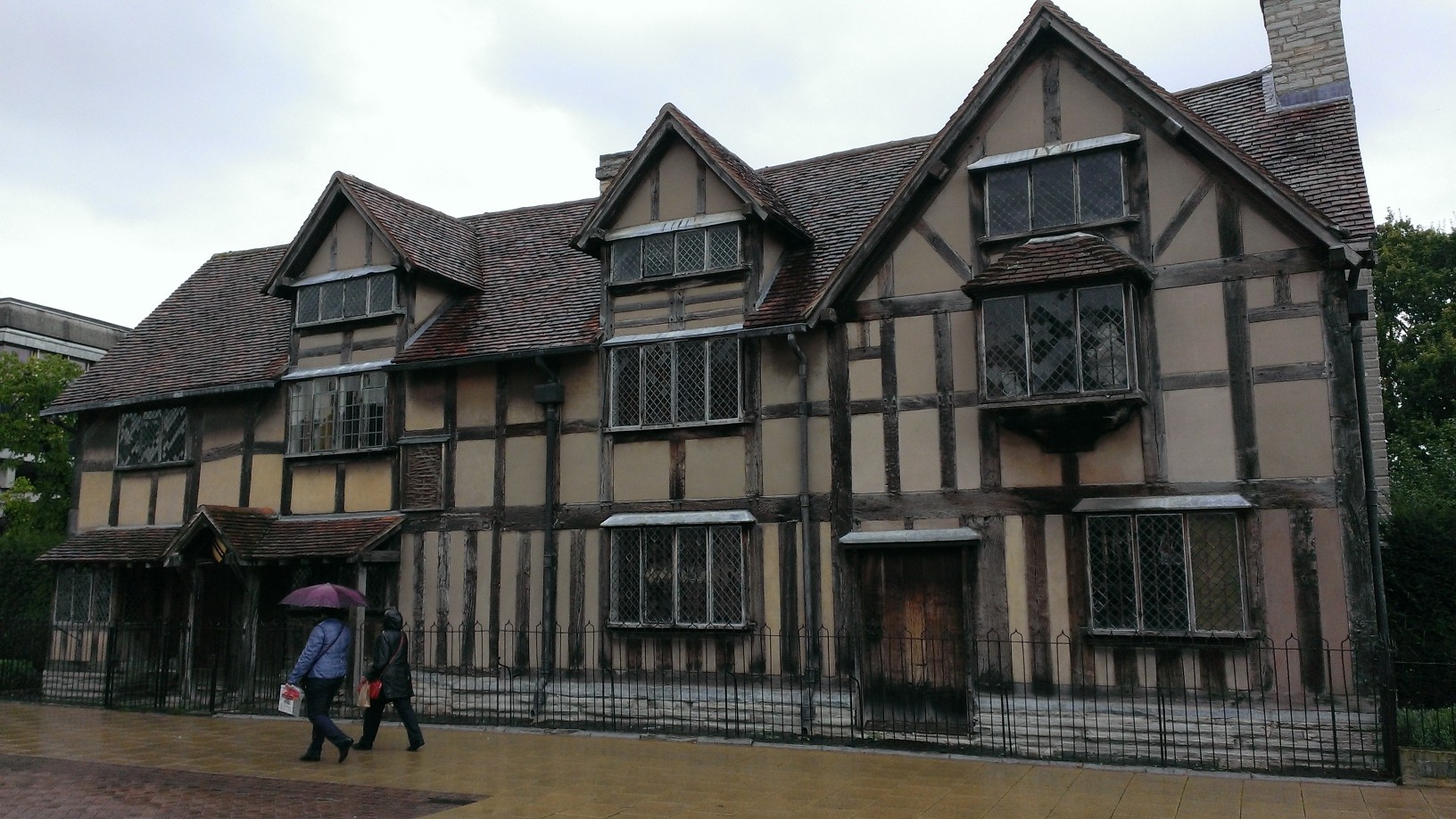
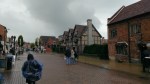
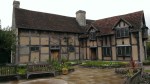
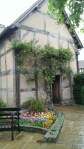
front of Shakespeares houseWalking up the old High Street, (now Henley Street), you see the Tudor house on your right. It’s wonderful, but you probably wouldn’t stop and stare for too long other than to admire a historic building if you weren’t aware of its illustrious son’s writings…

The main entrance is past the birthplace, through the modern building further up.  There’s a fascinating exhibition to take in before you pass out through the garden and into the rear of the birthplace.

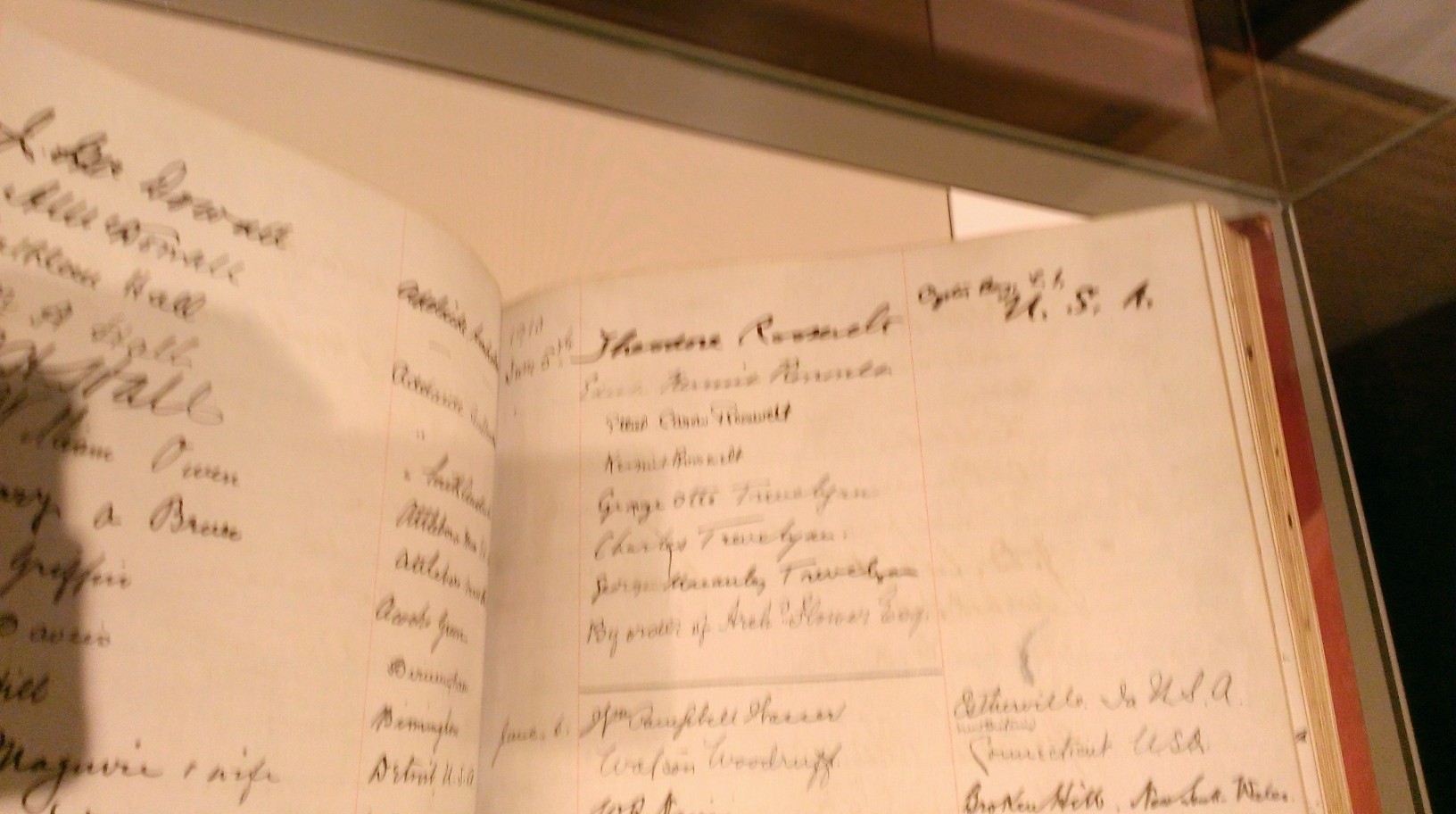
Rooselvelt signature visitors book 1910As part of the exhibition I was interested to see that American President Teddy Roosevelt visited the house in 1910 (and stayed at the same hotel as me, the Welcombe Spa), although in 1910 it was a private house owned by George Otto Trevelyan.

Also in the exhibition his family tree is laid out, clips of his plays and film adaptations run, some of his personal items, and a chronological list of his works are on display. The first folio was produced in 1623. There are no known surviving hand written papers of his individual plays, as penned by him with quill and ink, so we are very fortunate they were collated shortly after his death and have been in print ever since.

I have included a small photo album at the end of the post. The drag and drop option wasn’t working so I’m afraid they are a bit random!

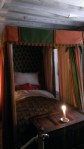
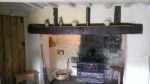
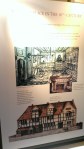
The entrance is through the dwelling next to Chez Shakespeare, a simple one up one down house which was also owned by William’s father, John Shakespeare, and rented out. From this small room you enter the parlour, which has a decent fireplace and a bed, which I was told was a sign of wealth. I suppose if you got bored of the conversation you could just snuggle down… Also what struck me is just how vertically challenged people were in medieval times, I had to stoop to pass under the low doorways.

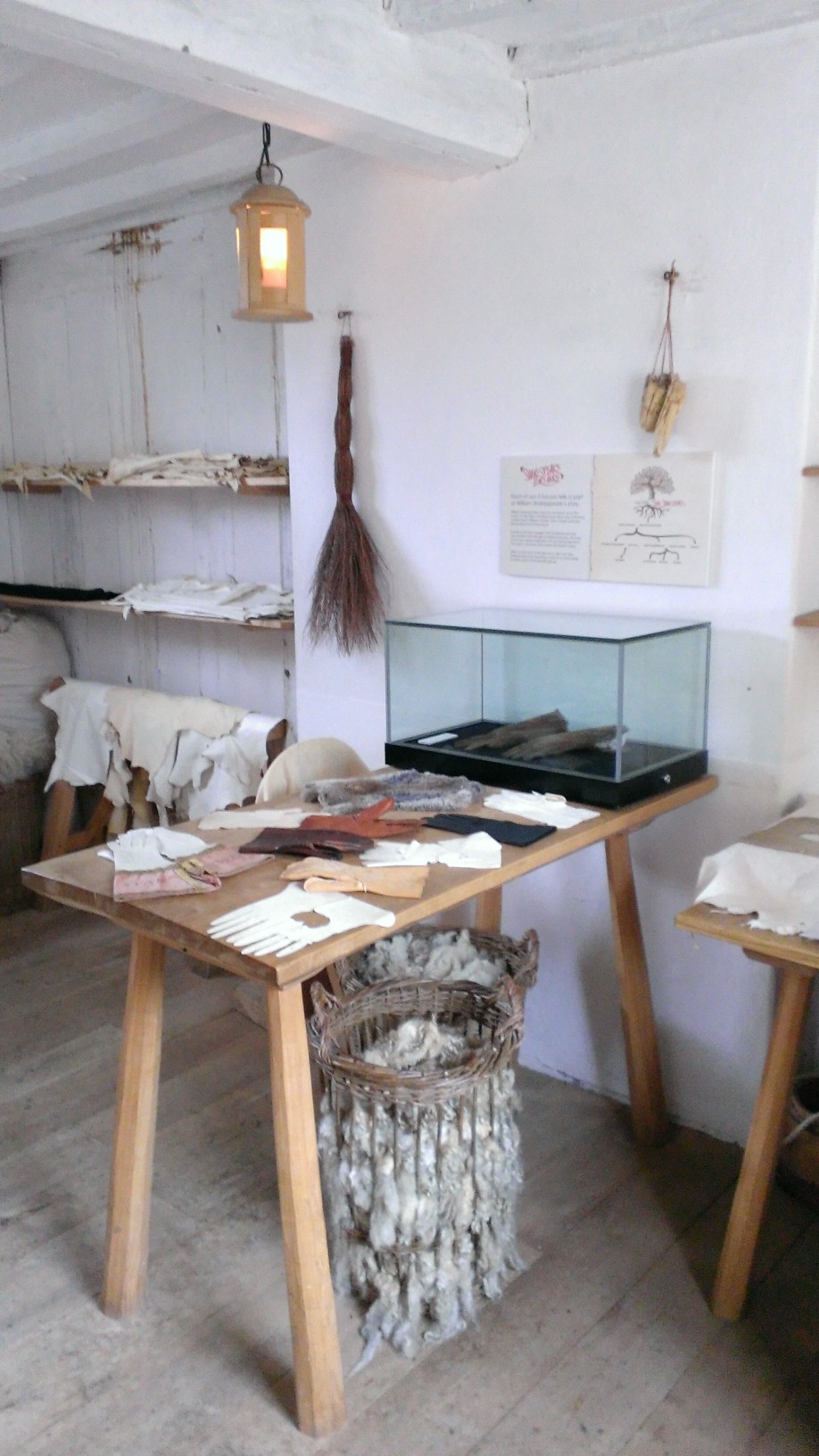
John Shakespeares work studioThere is more natural light in the adjoining dining hall. Again there is a large fireplace and a table and bench, and kitchen items.  Moving on from there you come to John Shakespeare’s workshop. This was easily the biggest room in the house, and the place where he made his leather and suede gloves and bags.  The window would have been absent 450 years ago, so that he could sell his wares directly to customers passing in the street. There would have been a market in the street in front of their house too. I couldn’t stop thinking how draughty and cold it must have been, especially in winter.

In the 1500’s Stratford had a population of around 1500 inhabitants, and at that time Birmingham didn’t exist, so it was a stop off point for travellers and traders journeying from Liverpool to London. It was roughly two to three days ride from Liverpool to Stratford, and four to five days from Stratford to London. John’s gloves sold well, and the family was wealthy. Although, his stint as a ‘brogger’ (illegal wool dealer) was probably more lucrative than glove making!

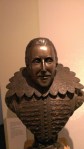
From there you follow the stairs up to the bedrooms. There is a bust, letters from famous visitors, the birth window that was signed by many literary figures, and of course, the birth room itself. A section of the wall has been left open so that visitors can see the original wattle and daub materials used in its construction.

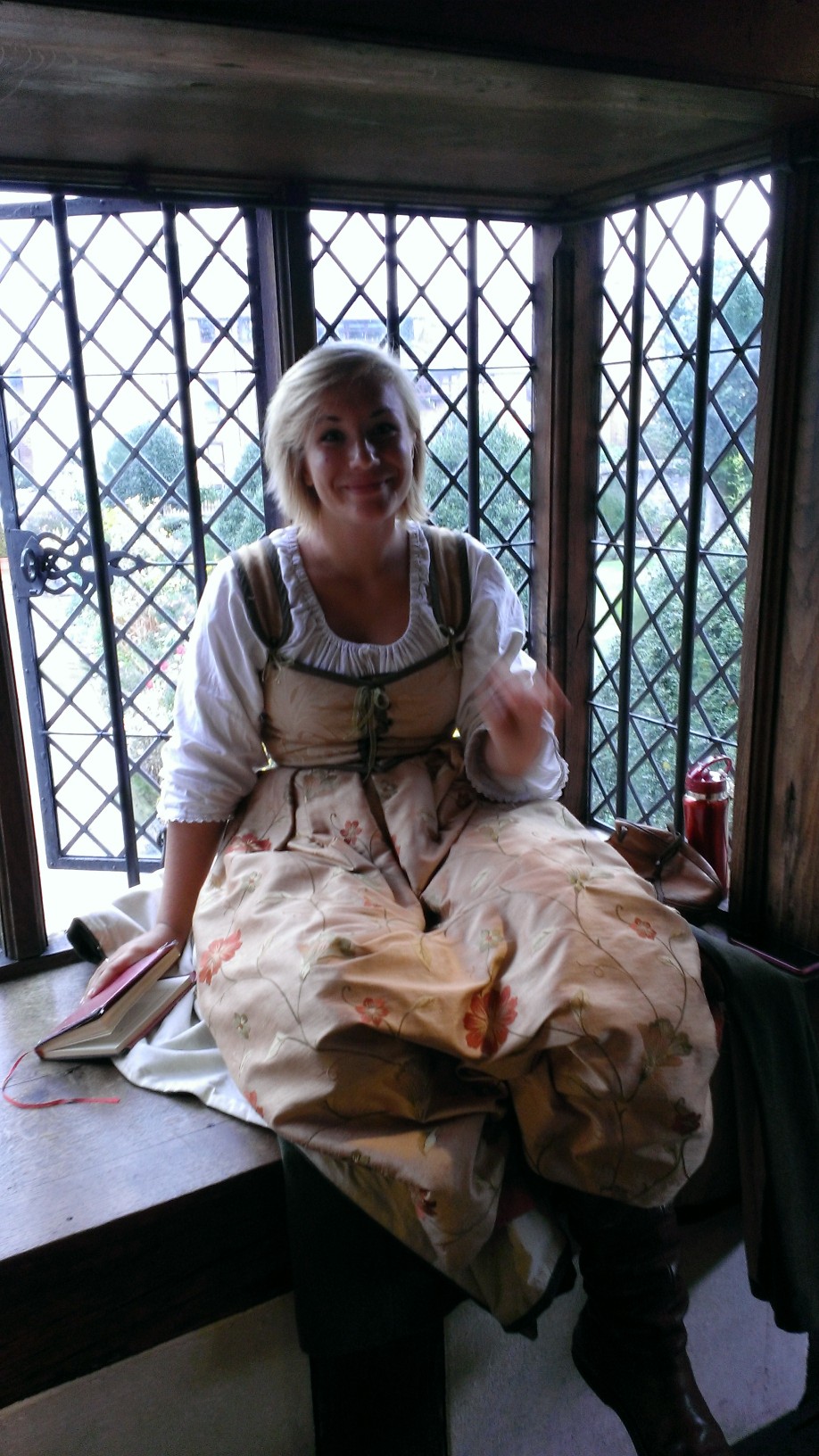
lady in period costume at Swan Inn SHFrom the birth room you then go to the extension made to the house by John Shakespeare, which served as an Inn. In the upper floor of the Swan Inn a lady in costume sat on the window sill and we shared some witty repartee. She told me she was wearing the traditional middle class costume of the era, a white chemise, long wool pinafore dress and silk overskirt, all held in by a corset.  I learned that the way a woman’s corset was stitched up said a lot about her status and moral standing. There were three ways to do up a corset. If it was cross-stitched (whereby a finger could unhook it all in a single lift and let it all hang out in one fell swoop) then she was considered a strumpet. The girl assured me that she wasn’t but that the costume had been easier to do up that way! Then you could strait-lace it (hence the saying about someone being puritanical), and the wealthiest women were done up at the back.

It was amazing to place myself into 16th century life, and imagine the place as William was growing up. He later inherited the house from his father and lived there with his own family. After his death the property passed to his sister, Joan Hart, and later his daughter, Susanna.  There is a timeline of ownership from his day to modern day, which also shows how the house was modified over the years.

What is the Shakespeare Birthplace Trust? Great video that features two of the guides I spoke to.

After purchasing a few tomes in the shop I went for a stroll past the Encore pub and along the canal and river, by the modern RSC theatre. In conclusion, Stratford and Shakespeare’s birthplace are well worth a visit if you ever find yourself in the heart of ye old England.

In Search of Shakespeare – a documentary for further education if you are a Bardolater!

A Time of Revolution:

The Lost Years:

The Duty of Poets:

For All Time:

“Till that I’ll view the manners of the town, Peruse the traders, gaze upon the buildings. ~ Comedy of Errors

The Eureka Effect – Where Does Creativity and Inspiration Come From?

“Creativity doesn’t wait for that perfect moment. It fashions its own perfect moments out of ordinary ones.” ~ Bruce Garrabrandt

Can you remember being at the receiving end of an enlightening or illuminating idea that flashed into your mind like an incandescent light bulb? Perhaps you’ve had quite a few moments of erudition? I’ve had a few too; and who wouldn’t want to have more of those those elusive but cherished aha! moments?

creativity lightbulbsUnfortunately the moment doesn’t tend to hang around long, you have to use it or risk losing it. I have taken to keeping a pen and pad by my bed, in my office and buried in the murky depths of my handbag, ready and waiting for rapid note taking… You never know when such blessings will infiltrate your consciousness, so it’s wise to be prepared! There have been times after stirring from slumber, when I am still in that twilight zone between lucid dreaming and being fully awake, when my subconscious mind has been streaming ideas into my conscious mind. Sometimes it’s so fast I just jot down whatever is in my head so as not to forget anything later on. I can always ditch the stuff that I may not use in the future.
In a minor aha! moment I thought it would be interesting to investigate such ephemeral phenomena, and try to understand how we can better manifest these fleeting gifts from the universe.

Etymology and language is constantly evolving, but essentially the definition of the word inspiration hasn’t changed much from its Latin roots: inspirare, meaning divine guidance, or in a more literal sense, breathing in spirit.

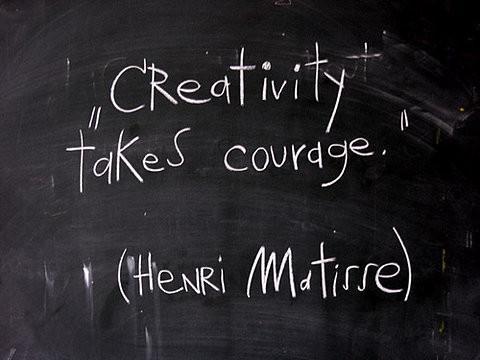
Creativity-takes-courage-Henri-Matisse-inspirational-quoteIdeas are everything. Ideas fuel man’s progress and make life better for humanity, especially in the areas of the arts, literature, health, science and technology. However, our ideas don’t all have to be on the same level as E=mc2, we can achieve smaller-scale wins by solving our everyday challenges, or, in my case, figuring out how to multi-task having a career alongside motherhood and running a home… I’m still figuring that one out!

Ideas are the intangible, ethereal side of our being. We cannot force them, but perhaps we can increase their frequency by learning a bit more about how they come about. Of course, they are nothing but useless data if they are not followed up by meaningful action.

Thomas Edison famously said, “Genius is one percent inspiration and ninety-nine percent perspiration.”

And here’s the rub: although that moment of glorious enlightenment may appear to be a bolt from the blue, it’s most likely the result of many smaller steps over time, and at times, a seeming impasse as to how to proceed. We do what we think we should, we hit obstacles, we try again, hit the repeat button a few times, and then, if we have the right mindset, the answer we have been seeking miraculously presents itself to us. We could be standing at the bus stop or be out on a hike, we could be in the middle of reading a book, we could be cooking, we could be drifting off to sleep…and ding! A passing, but profoundly brilliant thought pops into our heads.

Giovanna Mingarelli from the World Economic Forum highlights her take on the Eureka Effect:

The word ‘Eureka’ was coined by Greek polymath, Archimedes, after he had an epiphany about how to measure the volume of an irregular object.

Barry Evans gives an enlightened TED talk about Archimedes and his all important principle:

There are various theories about how creative insight works, this is my perception garnered from my personal experiences: I concentrate on a problem, mull it over, write down my ideas, follow the ones I think will work best, tweak if necessary, and then later try to empty my mind of it completely. Sometimes I forget about it for a long time, and then an answer or solution usually comes to me. I know that may sound simplistic, but it’s worked for me in the past.  I just have to get out of my own way. And of course, some Eureka moments are more recondite than others, but the fact that any kind of inspiration is flowing is a positive result. I have also found that meditation has greatly helped me to relax and clear my mind, to have that space when I have no thoughts and no content in my mind. In the right conditions I can easily go into the alpha brainwave pattern, and this seems to support my intuition and the mental settings needed for insight to take place. I find other than my meditation, nature and music are wonderfully conducive.
Transcendence seems to be key, as stated in this talk by author and entrepreneur Bernardo Kastrup (if you can put up with the audience coughing):

Here’s my previous post about meditation.

An absolutely brilliant presentation about the process of creative insight and why you need grit:

Again, they both draw the conclusion that eventually one should stop looking and focussing. Jonah talks about those all-important alpha waves again…and about the obsessive revisions that Beethoven made to his music to attain the level of genius that he is loved and admired for. Perseverance is half the battle, which reminds me of a famous Calvin Coolidge quote…

When worthwhile ideas come, it’s up to us to stick with them, hone them and improve them, and ultimately, to have faith in them.

Fabulous article by Eckhart Tolle on creativity.

CreativityI’m really getting into this mnemonic lark! Cognitive Random Ephemeral Attributes Transformed Into Valuable Expression

Wherever they come from, (perhaps it’s the infinite field of consciousness that all humans have access to), ideas will flow to you if the conditions are favourable. The Eureka Effect isn’t a domain just for the chosen few… Pay attention to the answers you seek, and then let it go. That song from Frozen sums it up perfectly! Take a walk, empty your mind and get ready for the influx…

“The desire to create is one of the deepest yearnings of the human soul.” ~ Dieter F. Uchtdorf

P.S. Any takers for the problems facing the Middle East at the moment??

An Evening with the British Association for Music Therapy (BAMT), in London

“The brain that engages in music is changed by engaging in music.” ~ Michael Thaut, Professor of Music and Professor of Neuroscience at Colorado State University

music solutionWe all know, on some level, how essential music is to human existence. We can recite instances when music has evoked powerful memories and emotional responses in us. Even if our involvement with music is only to the extent of listening to the radio now and then, to the more obsessive playing of our CDs, iPods and MP3’s on a constant loop, it has a major impact on the quality of our lives. Further up the scale, (sorry!) amateur musicians find joy and fulfilment from the pressures of everyday life by playing an instrument, and the more gifted of us make their living from bringing this lofty form of entertainment to the masses. Then there are those who specifically use the medium of music to reach out to segments of society that are suffering, either mentally, emotionally or physically. In the UK, there are over 700 of these caring and talented individuals who make up the membership of BAMT, which supports this network of highly trained and committed therapists.

I jumped at the opportunity to find out more about their valuable and pioneering work in this field when I was invited by Beth Britton to attend their exhibition: Music Therapy – The Art and Science, hosted by the Barbican Music Library in London on 10th September.

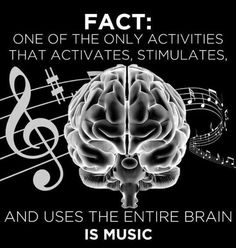
music factThe exhibition itself was full of amazing scientific facts about how music therapy has been successfully employed in the fields of neurology, child development, adolescent’s issues, autism, adult mental health, dementia, cancer and the challenges of old age. There were wonderful anecdotes and case studies from both therapists and recipients, as well as the history behind music therapy, not just in the UK but around the world, dating back to ancient times. Hippocrates, known as the father of medicine played music to some of his patients.

With a glass of wine in hand and a tasty selection of hors d’oeuvres on offer, I had had a lovely chat with a lady called Catherine; who is based in the north of England, working with seriously disturbed and mentally ill individuals. She told me her first instrument was the cello, but that she mainly used the piano and guitar in her sessions due to the sometimes unpredictable nature of the participants, as well as plenty of singing. She explained how singing was great to establish a rhythm and get patients moving, and she actively encouraged them to sing and dance.  I think she found her career very rewarding, but due to the intensity of the work and the time input she felt her own musical creativity was not being broadened.

The presentations were extremely interesting. Donald Wetherick,Chair of the BAMT Trustees, music therapist at Nordoff Robbins London Centre and music therapy tutor at Guildhall School of Music and Drama, highlighted the role of the charity in the UK, and explained about their work in the areas of research and collaboration in Europe and beyond. They are a point of contact for the public, for therapists and other professional bodies. You can find out more about them on their website. Or connect via Twitter: @musictherapyuk

“Currently provision of music therapy is uneven across the UK. We want to work with all those who champion music therapy to help change this, so that everyone who needs a music therapist can get access to one. Funding for large-scale research, such as the field of music therapy and dementia, is also vital if we are to harness the full potential of music therapy.” ~ Donald Wetherick

He introduced Richard Jones, the librarian of the Barbican Music Library, who gave us an overview of their set-up, They are only one of two music libraries in London (along with Westminster Music Library), and they have hosted various musical events from classical to jazz to rock. It seems appropriate that they are based on the second floor of the Barbican, which is also home to the London Symphony Orchestra and the Guildhall School of Music & Drama.

For more information click here. You can also follow them on Twitter: @BarbicanMusic

Donald then introduced my cousin, Beth, who is a Dementia Campaigner, writer and consultant, to talk about her experiences of how music helped her father, who lived with vascular dementia for the last nineteen years of his life. Discover more about her brilliant work here and on her blog: http://d4dementia.blogspot.co.uk/ and on Twitter: @bethyb1886

“Even as other abilities decline, music engages the brain through an extensive set of processes that are preserved and remain functional.” ~ Dr katrina McFerran, University of Melbourne

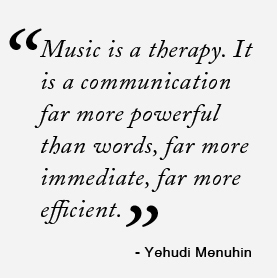
Yehudi Menuhin quoteThis explains why people who can no longer find the words to speak, may still be able to sing and play instruments. Beth related the story of her father humming and singing the last few words of his favourite songs as she sang to him, long after his ability to speak had gone. By encouraging and supporting active involvement in musical interaction and socialisation, music therapists can help clients living with dementia reduce feelings of apathy, anxiety, restlessness and depression, potentially lessening the need for medication.

These two videos express the essence and benefits of music therapy better than I ever could in words:

How does music therapy benefit children with special needs?

Music therapy, the empowering tool:

The final speaker was Professor Helen Odell-Miller, Head of Therapies at Anglia Ruskin University and Director of Music for Health Research Centre, who gave us a fascinating history of the origins of Music Therapy in the UK, and how the early pioneers established the framework of common practices and professional and personal qualifications that Music Therapists need, (a Master’s Degree in Music Therapy as well as having an advanced level of musicianship and skill, and also being registered with the Health and Care Professionals Council). Music therapists work in hospitals, schools, pupil referral units, day centres, hospices, care homes, therapy centres, prisons and in private practice across the UK.

BAMT is conducting cutting edge research into the role of music therapy on human health and wellbeing, in addition to providing support and training to music therapists. Notably, they are sharing the results of their discoveries with other health professionals as part of a multi-disciplinary team of speech & language therapists, physiotherapists, occupational therapists, doctors, paediatricians, teachers, social workers, consultants, psychologists and psychiatrists who are working to deliver the same aims in society.

Promotional video by Nordoff Robbins for those interested in training as a music therapist:

I hope the work of music therapy resonates with you! The BAMT exhibition is on display until 31st October at the Barbican Music Library in London.

A Study of J.S. Bach’s Baroque Violin Masterpiece: The ‘Chaconne’ in D Minor

“I was raised on Bach.” ~ Daniel Barenboim

Johann Sebastian Bach was one of the most dedicated, gifted and prolific composers that ever lived. Born in Thuringia in 1685, just a few days after fellow composer Handel; he was an accomplished organist, and his faith in the divine inspired him to write a substantial oeuvre of immortal music.

“Bach” is the German word for “brook”, hence Beethoven’s famous quote, ‘Not Brook but Ocean should be his name.’ Beethoven also referred to him as, ‘the immortal God of harmony.’

He wasn’t universally recognised as a great composer until the beginning of the 19th Century when Felix Mendelssohn championed his works, and later, by Pablo Casals, who was the first cellist to record his cello suites. What great artist is truly appreciated during their lifetime?

He hailed from a musical family, and is the patriarch of Europe’s largest musical dynasty. He fathered twenty children, seven with first wife and second cousin, Maria Barbara Bach, (only four survived into adulthood) and a further thirteen with his second wife, Anna Magdalena Wilcke, of which six made it past infancy and childhood.

All of his offspring were musicians, and two of his sons became notable composers in their own right: Carl Philipp Emanuel and Johann Christian Bach. J.S. Bach left the world an artistically and spiritually enriched place. No ordinary life…

His music spans time and space; three of his compositions were on NASA’s Voyager record, Music From Earth. Bach’s devotion to God shines through in his music, which speak to the soul on a primal level, regardless of one’s religious orientation. He was a rare genius indeed.

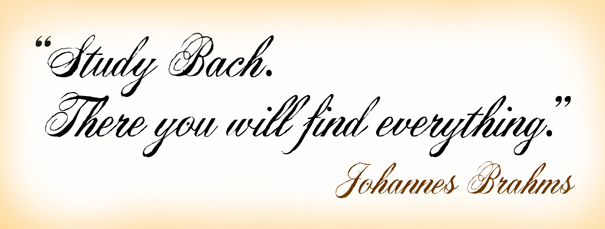
Brahms-Quote1

“I think that if I were required to spend the rest of my life on a desert island, and to listen to or play the music of any one composer during all that time, that composer would almost certainly be Bach. I really can’t think of any other music which is so all-encompassing, which moves me so deeply and so consistently, and which, to use a rather imprecise word, is valuable beyond all of its skill and brilliance for something more meaningful than that — its humanity.” ~ Glenn Gould

As a violinist, (other than Beethoven), he is my favourite composer to play and listen to, and I always play Bach at every practice session. He gives me a workout for my spirit, as well as my fingers and my brain. His sonatas and partitas for solo violin are essential repertoire for any violinist, not to mention his violin concertos.

But the ‘Chaconne’ in particular, (along with the adagio of the double violin concerto) touches me very deeply. It is a dance, and the minor key gives it a slightly melancholy feel; which is understandable, as it was written after his wife had died. If you are not already familiar with the work you are in for a treat. Immerse yourself in the music…

From Wikipedia:

The ciaccona (commonly called by the French form of the word, chaconne), the concluding movement of Partita No. 2 in D minor, BWV 1004, surpasses the duration of the previous four movements combined. Along with its disproportional relationship to the rest of the suite, it merits the emphasis given it by musicians and composers alike. The theme, presented in the first four measures in typical chaconne rhythm with a chord progression based on the repeated bass note pattern D D C♯ D B♭ G A D, begets the rest of the movement in a series of variations. The overall form is tripartite, the middle section of which is in major mode. It represents the pinnacle of the solo violin repertoire in that it covers every aspect of violin playing known during Bach’s time. It is still one of the most technically and musically demanding pieces for the instrument.

Yehudi Menuhin called the Chaconne “the greatest structure for solo violin that exists”.

Violinist Joshua Bell has said the Chaconne is “not just one of the greatest pieces of music ever written, but one of the greatest achievements of any man in history. It’s a spiritually powerful piece, emotionally powerful, structurally perfect.” He played the piece busking in L’Enfant Plaza for the Washington Post.

Piano transcriptions:

Since Bach’s time, several different transcriptions of the piece have been made for other instruments, particularly for the piano (by Ferruccio Busoni and Joachim Raff), and for the piano left-hand (by Brahms).

Johannes Brahms, in a letter to Clara Schumann, said about the Ciaccona:

On one stave, for a small instrument, the man writes a whole world of the deepest thoughts and most powerful feelings. If I imagined that I could have created, even conceived the piece, I am quite certain that the excess of excitement and earth-shattering experience would have driven me out of my mind.
Felix Mendelssohn and Robert Schumann each wrote piano accompaniments for the work.

I hope one day to be able to fully play the Chaconne. Maybe there is a teacher out there who can help me! The multi-stopping and chords are challenging to say the least. I must study Heifetz’s masterclass, but even that goes right over my head.

Reinvention:

His works lend themselves to transcriptions for other instruments more than any other composer I can think of. The composer and conductor Leopold Stokowski did many orchestral transcriptions of Bach’s works, as did Franz Liszt for the piano.

For me, there are three definitive solo violin recordings, (the original form of composition), which are by Menuhin, Stern and Heifetz. These clips perfectly illustrate the impact that personal interpretation and tempo have on the music:

I have listed below ten varied transcriptions I have enjoyed of this fabulous piece. Each conjures up a different mood. I’ll let the musicians do the talking…

Transcription for violin and piano by Schumann:

Piano version by Brahms for the left hand:

The Busoni piano transcription in a live performance by Marc-André  Hamelin:

It has to be John Williams on the classical guitar:

Orchestrated version by Leopold Stokowski:

Nicanor Zabaleta on the Harp:

Marimba:

ESP Saxophone group:

Viola:

This heartfelt Cello performance by Rustam Komachkov has oodles of rich, warm colours and soul:

Jean Rondeau on the Harpsichord:

“Bach is the supreme genius of music… This man, who knows everything and feels everything, cannot write one note, however unimportant it may appear, which is anything but transcendent. He has reached the heart of every noble thought, and has done it in the most perfect way.” ~ Pablo Casals

Which one is your favourite?

That’s it from me; I must get Bach to doing some more practice!

The Rewards of Letting Your Inner Child out to Play…

“One of the virtues of being very young is that you don’t let the facts get in the way of your imagination.”  ~ Sam Levenson

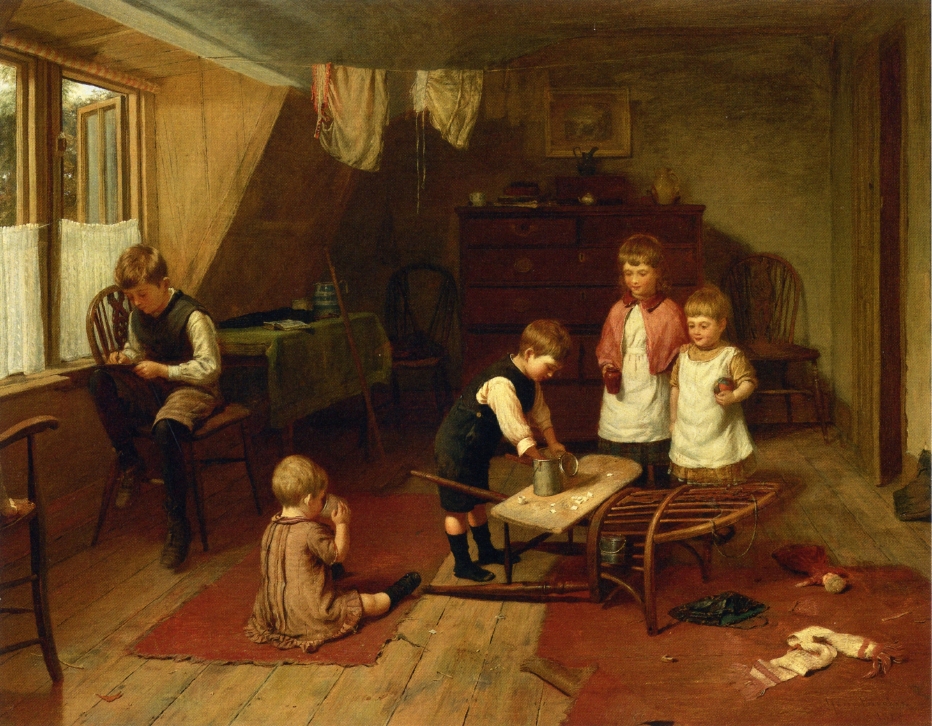
Children-at-Play by Harry Brooker‘You may say I’m a dreamer, but I’m not the only one…’ I can hear John Lennon’s immortal crooning in my mind. Isn’t that what children are so good at? They dream. They dream frequently, and they dream about anything they want, and they dream big. Left unfettered from cruelty, their minds are not naturally wired for questioning their self worth. They don’t think of excuses, they just follow their innate sense of curiosity and joy, they let their minds wander, and upon finding something of interest they become completely absorbed in whatever they are doing.

I love to watch Ruby play; she has such a vivid imagination. When she gets into her own little world she dresses up and tears around the house using whatever toys and props (usually kitchen utensils) are needed to fashion her make believe scenarios. If I call her name while she is ensconced in her imaginings she is completely deaf to me. Her excitement at what I would consider a mundane activity never fails to brighten my heart.

I think being a parent probably makes it easier to connect with our bounteous childlike energy, as our children help us to see the world through their amazed eyes.

Ignite Your Childlike State of Wonder:

How many of us can say at some point while we were growing up we were told by a parent, a teacher, or a well-meaning adult, ‘Stop daydreaming!’ It is misguided to think that so called ‘daydreaming’ is a negative trait. Far from it. This is the tool of creation. Creativity is inherently abundant in youngsters, and the school system with its rigid curriculum is not conducive to nurturing this very important aspect of a child’s development.

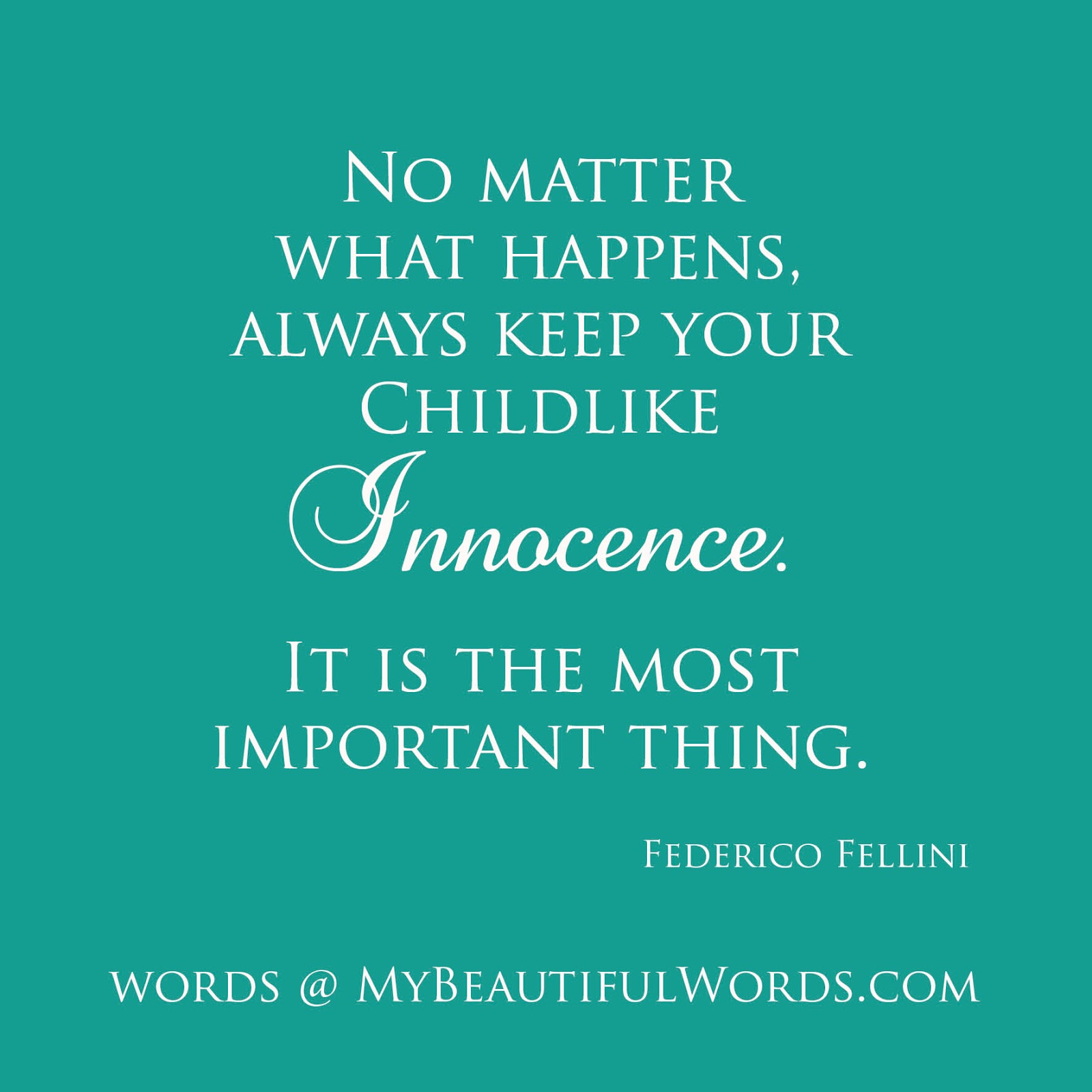
Federico Fellini - ChildlikeBy the time we reach adulthood most of us, (to some degree), have usually had the light of our dreams diluted or even drained out of us completely. A constant barrage of negative messages from the world around us can eventually drown out our intuitive childlike selves, fostering self-doubt within us instead. The mental baggage is accrued over time, and then it becomes so much harder to follow our dreams, for fear of failure. To be truly ourselves means letting go of other people’s expectations for how we conduct our lives. It means sticking our heads above the parapet. It takes courage to hold our dreams out in front of us like a lantern, glowing with the perseverance and faith that we experienced in our childhood.
“Creativity represents a miraculous coming together of the uninhibited energy of the child with its apparent opposite and enemy, the sense of order imposed on the disciplined adult intelligence.”   ~ Norman Podhoretz

looking for adventure at Waddesdon ManorUnlike Peter Pan, we all grow up, (well, most of us!) but that doesn’t mean life has to be all serious. Although we have responsibilities, bills to pay and all the trimmings that go with adulthood to deal with; the inner child that dwells within each of us can make being an adult so much more fun. We have a responsibility to love, nurture and parent our own inner child. And when properly cared for, children are happy and they flourish. The benefits to us as individuals (and the people around us), of embracing our inner child are manifold: increased joy, laughter, spontaneity, love, emotional honesty, and chiefly, living in the present moment. We do not brood on the past or worry about the future when we are fully engaged in the now…

“Man is most nearly himself when he achieves the seriousness of a child at play.”  ~ Heraclitus

Deepak Chopra quoteI’m not promoting the kind of ‘throw your toys out the pram’ mentality of narcissistic demands or temper tantrums, dependency, neediness, petulance and general egocentric behaviour.  Neither am I suggesting that we live in a world of fantasy. But if we can access that playful and innocent side of ourselves, we can harness this enthusiasm in multifarious ways. We can use that sense of wonder and awe and intense focus (without judgement) in whatever endeavour we like, or indeed, even just to elevate our everyday lives. It is all about achieving that balance between our heads and our hearts. Not living life solely in our conceptual minds, or always wearing our hearts on our sleeves with complete naïveté.

The original Jungian Child Archetype was the basis for many theories and development of the modern term ‘inner child’ including the work of Dr Eric Byrne in Transactional Analysis, and study of the ego states: Parent Child, Adult.

Getting in touch with our feelings can sometimes bring up unresolved trauma or an emotional blockage. However, we can begin to heal when we become conscious of the past wounds our inner child has suffered. Suppressed pain can hinder our functioning at full capacity as an Adult and Parent.

I love this talk by Eckhart Tolle on being yourself:

To coin Ruby’s favourite word, existence is ‘awesome’.  Now I’ve got John Lennon in my head again! ‘I hope some day you’ll join us, and the world will live as one.’

Here’s my own mnemonic: Doing Really Exciting Activities Mindfully

Dream big!

Guarneri (del Gesù), Stradivari and Nagyvary – The Debate over Ancient Violins vs. Modern Masterpieces

“’Tis God gives skill, but not without men’s hand: He could not make Antonio Stradivarius’s violins without Antonio.” ~ George Eliot

When it comes to the value of violins, (and for that matter violas and cellos); provenance matters. The allure of such revered names is enough to send any stringed player into a frenzy…

Ultimately, the quality and rarity of Amati, Stradivarius and Guarnerius violins will render them more expensive than their modern counterparts, no matter how good and comparable the modern violins may be. With only around 600 Stradivarius instruments left in the world not everyone is fortunate enough to be able to play on one, (at least all of the time), let alone own one. And of course, the provenance greatly affects the asking price. Who has owned it, and when, who has played on it, what music has been written for it, the condition, these elements all add to the mystique and desirability of the instrument. Much like a work of art, a painting is worth what someone is willing to pay for it. And in many instances they pay millions.

OLYMPUS DIGITAL CAMERAPaganini’s violin, the priceless ‘Il Cannone’ was made by a contemporary of Stradivarius; Giuseppe Antonio Guarneri of Cremona, in 1743, and is famed for its power and resonance. Interestingly, when it needed maintenance and repairs, these were undertaken by luthier Jean Baptiste Vuillaume in Paris, who constructed a replica violin so precise in every detail that even Paganini could not distinguish one from the other! Eventually he came to recognise the slight differences in tone, and was able to tell the original by sound. The violin and its replica are kept on display in Italy at the Genoa Town Hall. Occasionally it’s lent to performers.

The Devils’s Violinist (trailer) – A film about Paganini, played by violinist David Garrett:

Jazz violinist Regina Carter recorded an album on his beloved ‘Il Cannone’ (Paganini: After a Dream). Here is the track After a Dream arranged from Faure’s classic:

The debate over the sound quality of ancient Italian violins compared with each other and mostly to their modern counterparts has endured for years. Virtuosos past and present, such as Fritz Kreisler, Jascha Heifetz, Isaac Stern, Itzhak Perlman, Nigel Kennedy, Midori and Sarah Chang have owned, or played, and in some cases preferred, Guarneri over Stradivari.

Amati violinWho can say exactly what that special ‘je ne sais quois’ is, that elevates the Cremonese creations from all other violins? There are so many aspects to making a stringed instrument, and to me it makes sense that skill in every area of construction affects the finished product.

I think it’s worth making the point that for most musicians it’s the relationship that they develop with their instrument that’s the most important thing. After so many hours of practice and performance the feel and touch and memory of every curve and angle is interwoven into your psyche, and it can feel like part of your body!

My own violin is Hungarian, (late 19th Century), and to me its tone is amazing, considering it’s probably a gypsy violin. That’s why I was so interested in the story of the Hungarian born Dr. Joseph Nagyvary.

As the violinist and heroine of my novel, Isabelle Bryant does get a little caught up in this debate. In my story, she plays the Nagyvary violin that was once played by Yehudi Menuhin.

Here’s a brief excerpt that touches on this subject from chapter 1 of The Virtuoso. The protagonist has just given a masterclass at the Royal Academy of Music:

She made her way south on the underground from Baker Street to London Victoria. The dreary grey sky hung like a heavy cloak over the platform. As the train jolted to halt she quickly found a seat by the window, and nestled her case vertically between her feet and knees. As more passengers entered the carriage she touched the edge of her violin case lightly, smiling with resigned humour as a passing stranger made a joke about her carrying a machine gun.

Her violin represented another limb to her, it was that precious. It felt so natural, like an extension of her body. She gently rubbed her neck which was feeling a little sore. The rough, red patch of skin on her neck just below her jaw was often mistaken for a love bite, when in fact it was what she affectionately referred to as a violinist’s hickey. Many hours of gruelling practise had left their marks.

Her mind drifted to her earlier private viewing of the Academy’s museum, where she had been shown round by the curator in person. She had spent a blissful afternoon paying particular awe and reverence to their recent acquisition of Italian virtuoso Giovanni Battista Viotti’s 1709 Stradivarius, renamed as the Viotti ex-Bruce to honour its British donor, which the Academy extolled as one of the most important and well preserved Stradivarius violins in the world.

She had studied the sheen of the dark, pinky brown maple, picturing the old master craftsman huddled in his workshop in northern Italy; surrounded by the distinctive wooden shapes that would become so valuable over three hundred years later. Sadly there were so few of them remaining.

Her own violin, a modern Nagyvary, was crafted by the eminent Hungarian professor Joseph Nagyvary, who had spent his life studying the craftsmanship of Cremonese violin makers; namely Stradivarius and Guarnerius.

Nagyvary violins were made as closely to those of the ancient genius as possible, and there had been many debates about whether or not they actually sounded as good as those of the master. Isabelle adored its sonorous tonal qualities and projection power. If a Nagyvary violin had been good enough for Yehudi Menuhin to play for fifteen years, then it was good enough for her. Gerry, in his nothing is too much of a challenge for me attitude, had managed to do a deal with Joseph Nagyvary to loan Isabelle the instrument indefinitely.  It was her most precious possession – except that she didn’t own it.

Here is an interesting article in Scientific American

Can you tell the difference?

Dr Nagyvary discovers what preserved the violins from Cremona and Venice:

The Stradivarius Mystique – By Joseph Nagyvary

New York Times Article: What Exalts Stradivarius? Not Varnish, Study Says

Smithsonian: Scanning a Stradivarius

List of Stradivarius Violins and their provenance

Wonderful video from the Library of Congress with Peter Sheppard Skaerved, an award winning British violinist, who has performed on ‘Il Cannone’ five times.

An Introduction to Stradivari:

The mystery and romance of centuries old Italian violins has filtered into film making, with the brilliant 1998 movie, The Red Violin. The actual violin that inspired the Red Violin is Stradivari’s 1721 ‘Red Mendelssohn’, currently owned by Elizabeth Pitcairn, heiress to the PPG fortune, whose grandfather purchased it for her 16th birthday at auction for $1.7 million at Christie’s in London.

And on that note, I will leave you with the hauntingly beautiful soundtrack to the film, composed by John Corigliano and performed by Joshua Bell on his Gibson ex-Huberman Stradivarius: